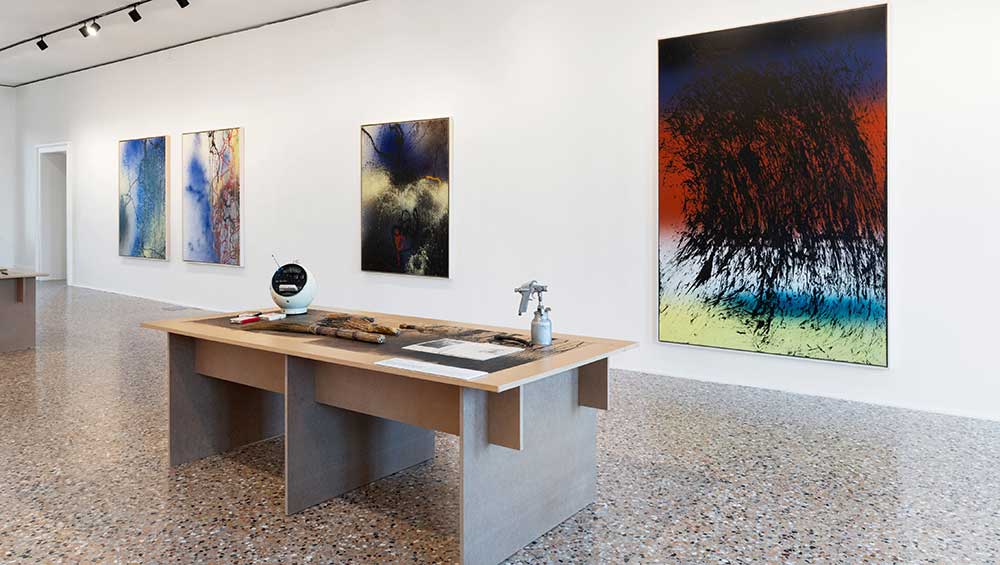
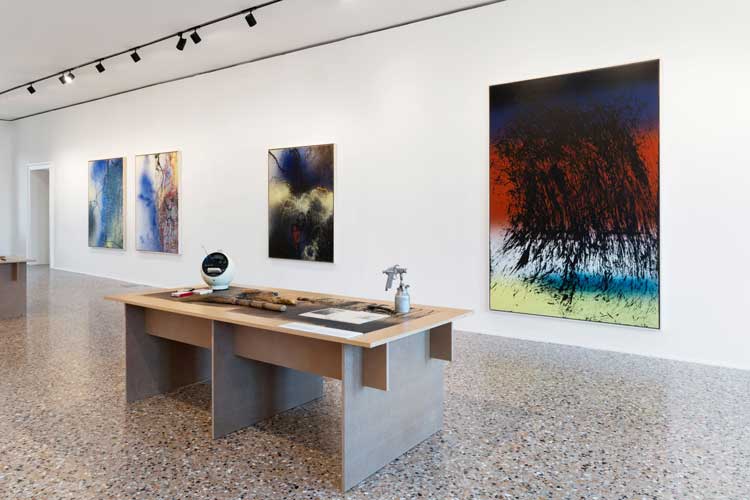
The Invisible Chord: Hans Hartung and Music, installation view, Querini Stampalia Foundation, Venice. Photo: © Tanguy Beurdeley. Courtesy of the Hartung Bergman Foundation, Querini Stampalia Foundation and Perrotin.
Fondazione Querini Stampalia, Venice
5 May – 13 September 2026
by LILLY WEI
If you weren’t aware that Hans Hartung had a lifelong obsession with music and that it was critical to his artmaking, you surely will be after a visit to the Fondazione Querini Stampalia in Venice. On view there is The Invisible Chord: Hans Hartung and Music, a fascinating, finely tuned overview of the eminent artist’s work through the lens of music. While exhibiting the artist’s output across five decades, it focuses on the 1970s and 80s and is not meant to be a retrospective. Emphasising that point, the curator, Thomas Schlesser, a scholar, author and the director of the Hartung-Bergman Foundation, presented the works thematically rather than chronologically. Each gallery is its own chapter, recounting an aspect of Hartung’s long and brilliant career, and the approximately 80 paintings and archival documents – including some notebooks shown for the first time – occupy the entirety of the venerable palazzo’s spacious third floor. The site and the installation are ideally matched, the presentation elegant, whether offering quietly contemplative compositions or those with the crackled snap of whiplashed lines, or small, but startling detonations of colour. In some galleries, selected music that the artist listened to while working is available to the viewer via headphones – a bonus – as well as a curious array of tools he adapted to achieve the painterly effects he sought. Schlesser stressed that all the materials on display – spray guns, rollers, the branches Hartung used as brushes, the paint still clinging to them – are “genuine”, unrestored, and evidence of his ongoing, even compulsive experimentations.
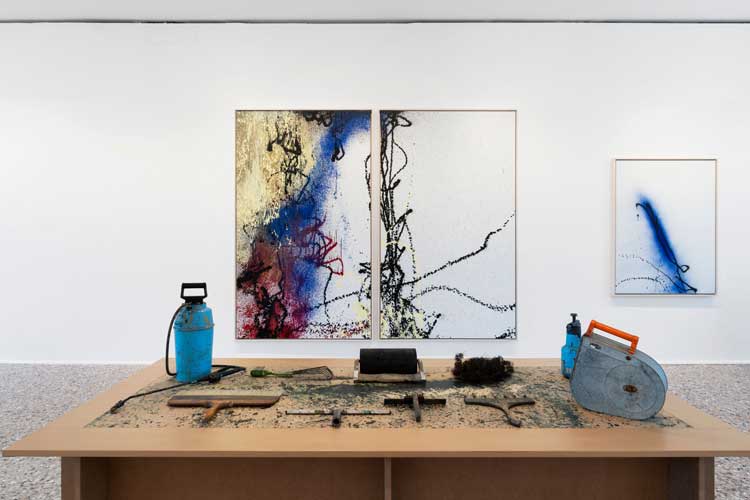
The Invisible Chord: Hans Hartung and Music, installation view, Querini Stampalia Foundation, Venice. Photo: © Tanguy Beurdeley. Courtesy of the Hartung Bergman Foundation, Querini Stampalia Foundation and Perrotin.
One of the major artists of postwar abstraction, Hartung was inevitably shaped by the turmoil in Europe between, during and after the wars. He was part of the generation that transformed abstraction from a radical proposition into modernism’s mother tongue. Born in Leipzig in 1904 (and died in Antibes in 1989), the city of his birth is closely associated with Johann Sebastian Bach and central to the composer’s restoration to the canon in the 19th century. Hartung came from a musical family – his mother adored Wagner and his sister was a violinist – and he once thought he would be a pianist, or perhaps a dancer. Immersed in music from his earliest days, he responded to all kinds, from Gregorian chants, Monteverdi, Bach – for most of his life, he listened to Bach every day – Handel and Vivaldi to Alban Berg, Schoenberg, Boulez, Stockhausen, to Philip Glass, and maybe, Schlesser conjectures, even David Bowie and Pink Floyd. On display in a room dedicated to memorabilia is a portrait of Franz Liszt from an early woodcut Hartung made and, in a nearby room, is a recording by Lili Boulanger (the sister of Nadia Boulanger, who taught many of the leading composers and musicians of the 20th century) who died when she was 24, but was already proclaimed one of the most gifted composers of her time, now largely forgotten, as examples of the adventuresomeness of his musical taste.
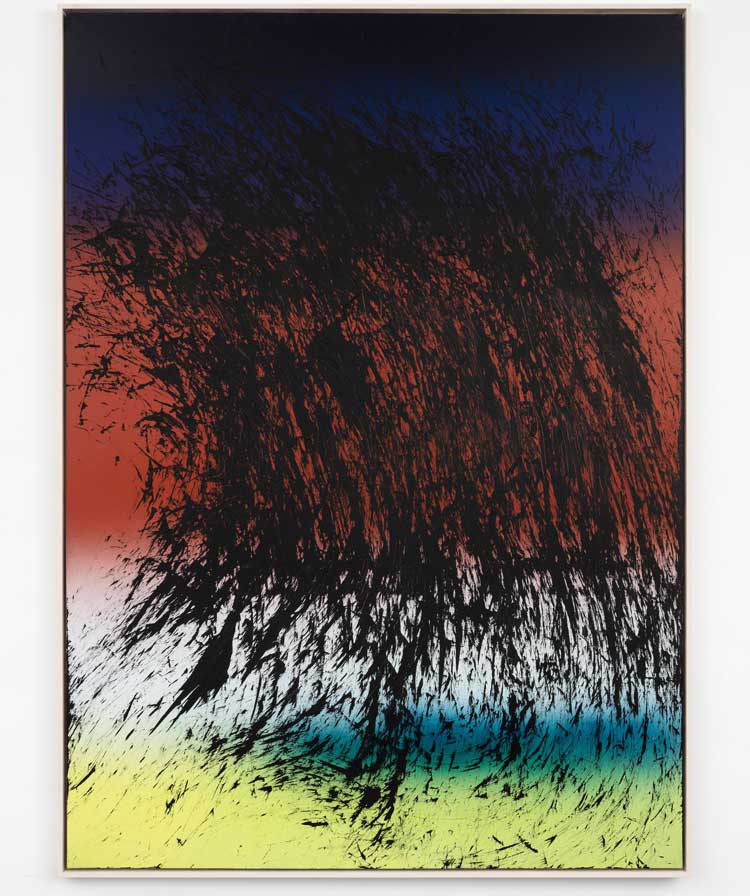
Hans Hartung, T1982-E21, 1982. Acrylic on canvas, 250 × 180 cm. © Hans Hartung / ADAGP, Paris 2026. Photo: Tanguy Beurdeley. Courtesy of Fondation Hartung Bergman and Perrotin.
In a 1948 letter, Pierre Soulages, a close friend, wrote this about him: “His radio is always on … “Even moments of rest, and especially of work, were almost unbearable for him without music.” Hartung’s paintings, however, do not try to visualise sounds or compositions, they are not about synaesthesia. Instead, they apply the process of composing music to his paintings as an analogous method of creating, based on rhythm, meter, tempo, pitch, intensity, interval, repetition, variation and so on. If you look at the paintings with that in mind, you can see the rhythm and momentum of the marks, lines and brushwork, you can sense the melody, like reading a kind of pictorial score. Walter Pater, the English critic and aesthete famously said that all art constantly aspires to the condition of music. Hartung seemed to concur, as did early modernists such as Kandinsky and Klee.
One of the largest galleries is installed with works from the 80s, his last decade. Highlighting the unconventional tools he deployed, it evoked a semblance of his studio. There is also a loop of Pablo Casals (his favourite cellist) playing Bach on a recording device. Two sides of his style confront each other from opposite walls. One consists of dense spraypainted fields activated by quick marks that seem to leap off the surface with explosive force. The other is hung with more minimalist canvases characterised by large, empty areas, or mostly so, the voids as significant as the gestures, creating a quieter, more meditative painting.
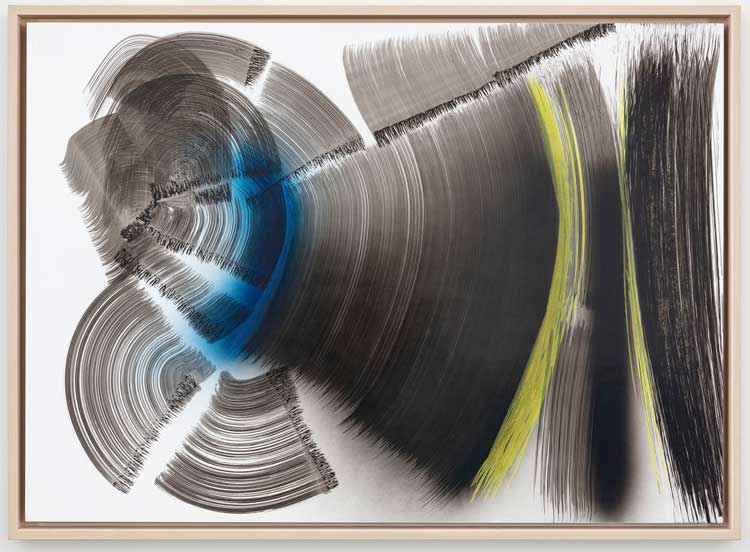
Hans Hartung, P1971-A72, 1971. Ink and acrylic on cardboard, 74.5 x 104.5 cm. © Hans Hartung / ADAGP, Paris 2026. Photo: Claire Dorn. Courtesy of Fondation Hartung Bergman and Perrotin.
The exhibition’s most colourful, even flamboyant installation is the floor-to-ceiling grid of works on paper that acts as an archive of Hartung’s explorations (like a mini-retrospective), revealing his impressive visual vocabulary. The installation is especially compelling for its array of materials: ink, charcoal, pastel, graphite, watercolour, gouache and a variety of industrial paints and pigments (he stopped using oils around 1960) that have been scratched, scraped, incised, sprayed, brushed and dragged across the surface, often using his improvised implements, the resulting textural variations adding to their appeal. Hartung cared deeply about materiality, tangibility and novel results, pushing his mediums, as always, beyond their traditional usage.
Another gallery pairs small, spontaneously executed drawings or works on paper with much larger paintings exactly like them, precisely reproduced from the original image as he scales them up for the canvas using a grid-transfer process, such as the almost brutally slashed bundles of straight black lines shown here. This contradicts the general assumption that Hartung’s paintings were always extemporaneous, clearly revealing that formal rigor is the heart of his process, his roots in European modernism, not American abstract expressionism.
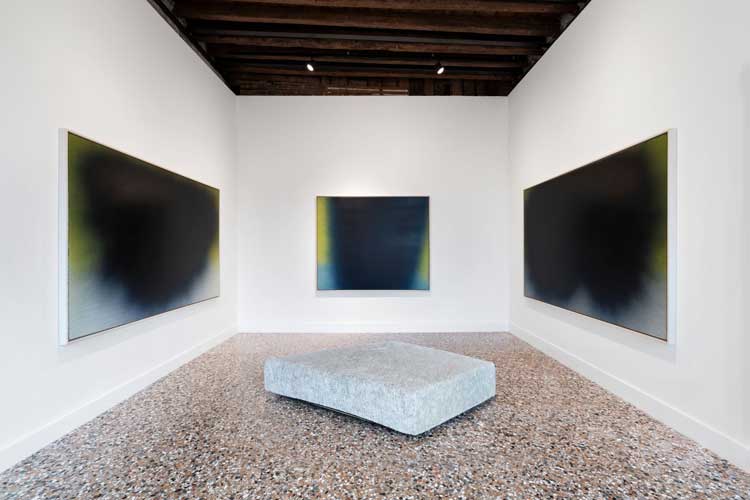
The Invisible Chord: Hans Hartung and Music, installation view, Querini Stampalia Foundation, Venice. Photo: © Tanguy Beurdeley. Courtesy of the Hartung Bergman Foundation, Querini Stampalia Foundation and Perrotin.
One of the most beautiful rooms is also somewhat of an anomaly. It contains three large paintings from the 60s that are enveloping, atmospheric, unlike the nervous calligraphic or fiercely scratched gestures that he is best known for. The fields are dark green/blue/black, the tones merging into each other and hard to pin down – the light subtle, the space measureless; with a quiet sense of movement that seems like breathing. Inevitably, they summon up Mark Rothko and his brooding, transcendent abstractions. Hartung is more introspective in this grouping, and while they might be perceptual investigations (he was not interested in the spiritual, the sublime), they also belie that, verging on an alchemised formality that slips into poetry, into poignancy.
At a moment when contemporary art has often pursued other directions and means, Hartung’s work, like the music that drives it, demonstrates to us that abstraction remains a powerful means of capturing experience. Juxtaposing the visible and invisible, this lucid, celebratory tribute to the artist reminds us, once again, why painting – and abstraction – has endured.
Click on the pictures below to enlarge

Copyright © 1893–2026 Studio International Foundation.
The title Studio International is the property of the Studio International Foundation and, together with the content, are bound by copyright. All rights reserved.
 |
 |
 |
|---|
-1000-300.jpg)