




A.rtificial I.ntrospection O. Installation view, Halle für Kunst Steiermark, Graz, 20 May – 6 September 2026. Photo: Bronac Ferran.
Halle für Kunst Steiermark, Graz, Austria
20 May – 6 September 2026
by BRONAĊ FERRAN
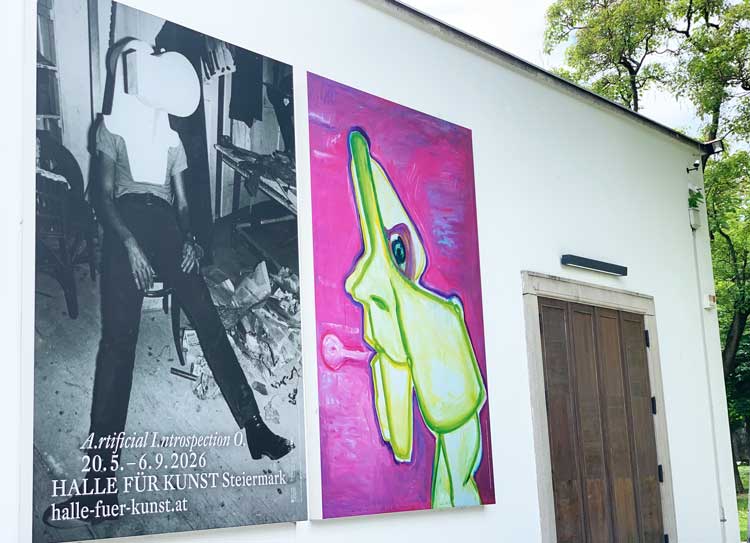
I am in Graz, at the Halle für Kunst, Steiermark, formerly the Kunstlerhaus, situated in the greenery of the City Park. Opening in 1952, it was the first cultural venue to be built in Graz after the end of the second world war. The architects reused rubble from destroyed buildings to construct a solid reinforced concrete edifice.
With its part-glass-fronted structure, it feels the perfect place contextually for the exhibition I am here to visit, one that confounds expectations in substituting the already difficult to define notion of “intelligence” with the impossible for neuroscientists to measure term “introspection” in its rather intriguing title. The exhibition blurb is illuminating, telling us that an “indistinguishability of human and machine language production, paradigmatically embedded in the Turing Test, shifts the question away from intelligence toward issues of observability, control and self-description”. Valuably, it also reminds us that art is not “a counter-model to technology”, but “a field in which similar processes of translation are at work as in cybernetics: visual, linguistic and affective information is encoded, decoded and transferred into circulating systems”.
The “O” which forms part of the title refers to the Austrian-born artist, teacher and writer Oswald Wiener (1935-2021), who emerges from the exhibition an exemplary agent of cybernetic transference between language systems and people. Wiener was part of Die Wiener Gruppe (the Vienna Group ) in the 1950s, which played a role in the postwar emergence of concrete, sound and visual poetry in which a dialectical tension between spareness and excess, a post-lyrical objectivisation of language elements and a non-linear looping were prevalent. In 1959, having read Cybernetics – Or Control and Communication in the Animal and the Machineby Norbert Wiener (no relation), Wiener took a job as a data entry specialist at Olivetti, spending nine years there and gaining ground-level experience of a technological revolution buzzing on the horizon.
A.rtificial I.ntrospection O. Installation view, Halle für Kunst Steiermark, Graz, 20 May – 6 September 2026. Photo: Bronac Ferran.
Wiener wrote a seminal novel, published in the German language in 1969, which has been described as going further than any other Austrian work of literature at that time towards “destroying the novel form completely”. The book was entitled Die Verbesserung von Mitteleuropa (The Improvement of Central Europe). In its introduction, Wiener stated: “Simply have an effect on others, have an effect on yourself, take sentences the way you do pills, let yourself be guided somewhere, put yourself in a state of being, allowing, wanting to communicate, probably even putting together a hypothesis for oneself.” He saw language, meanwhile, as a vibratory field situated in between people and observed: “The fact is that there is always just this bridge of language between my idea and what I am trying to induce in another person’s head.” 1
Within the range of works shown within the exhibition, we see how his preoccupations overlapped in various ways with a lineup of artistic luminaries; materials generated in these fertile interstices, directly and indirectly by Günter Brus, Valie Export, Michael Krebber, Maria Lassnig, Walter Pichler, Rudolf Polanszky, Dieter Roth, Franz West and Ingrid Wiener form the mainstay of the artworks shown in this diverse exhibition.
Ingrid Wiener, Dr Mülers Kabelfrühling (Dr Müller’s Cable Spring) 2008. Courtesy MAK – Museum für angewandte Kunst, Vienna.
Photo: kunst-documentation.com
A significant curatorial focus is also the notion of the “bio-adapter”, which forms one section of Wiener’s 1969 book; it would be worn on the human head and be dynamically responsive to the flow of language like vibrations through its systems and circuits. It had much in common with the TV-Helm – to be worn like a helmet, complete with embedded screen – conceived by Pichler, in a compelling series of Prototypes (1966/2006) some of which can be viewed in the upper gallery of the exhibition.
Wiener’s original text-written manuscript on the bio-adapter, from 1967, is one of the rare documents on display on the walls in the main downstairs gallery with its long vitrines full of facsimiles of handwritten and closely typed texts, along with magazine articles, letters, small-press publications, academic interpretations, photographs of performative actions and various print-based ephemera. These provide a privileged insight into the underbelly, the interior knitting, the knots, the loops, the letters, the dialogues, the interpoetics, the correspondences, crossovers and mutual infusions that were at play, particularly from the 50s to the 70s, when Wiener, or “Ossi” as he became familiarly known to friends and co-conspirators, was embedded in a close network of other leading-edge artists and thinkers.
Maria Lassnig, Letter to Oswald Wiener, 1976. Installation view, A.rtificial I.ntrospection O, Halle für Kunst Steiermark, Graz, 20 May – 6 September 2026. Photo: Bronac Ferran.
Among the material borrowed from the Literary Archive of the Austrian National Library in Vienna are: notebooks by Wiener, shown alongside manuscripts by, and correspondence from, Roth; a handwritten note by Roth on cardboard entitled “Mr Ossi”; characteristic postcards from Dorothy Iannone; and what look like outsider art drawings by Dominik Steiger. Sketches in Wiener’s notebooks also provide insights into how his mind was functioning, doing drawing after drawing of knots, like reflexive cybernetic loops feeding back on themselves.
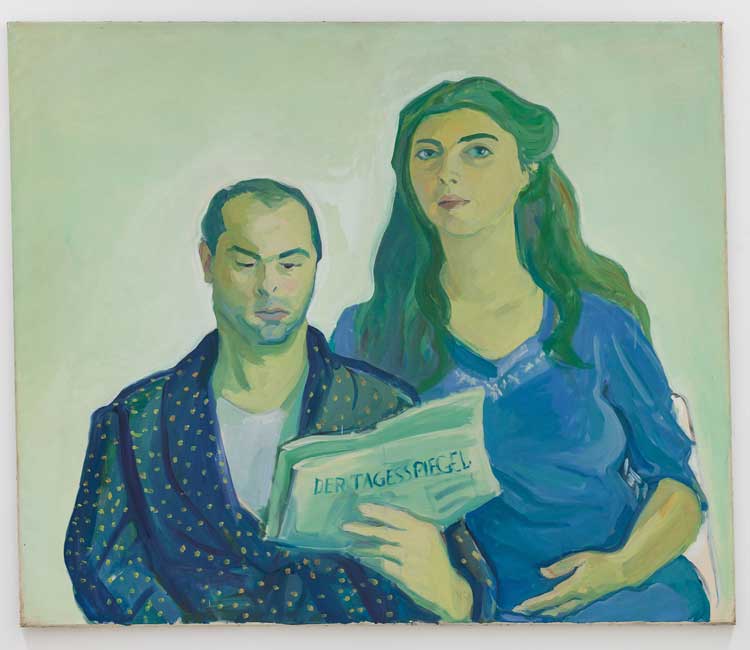
Maria Lassnig, Portrait von Ingrid und Oswald Wiener (Portrait of Ingrid and Oswald Wiener), 1967. Courtesy Ingrid Wiener, Kapfenstein. Photo: kunst-dokumentation.com
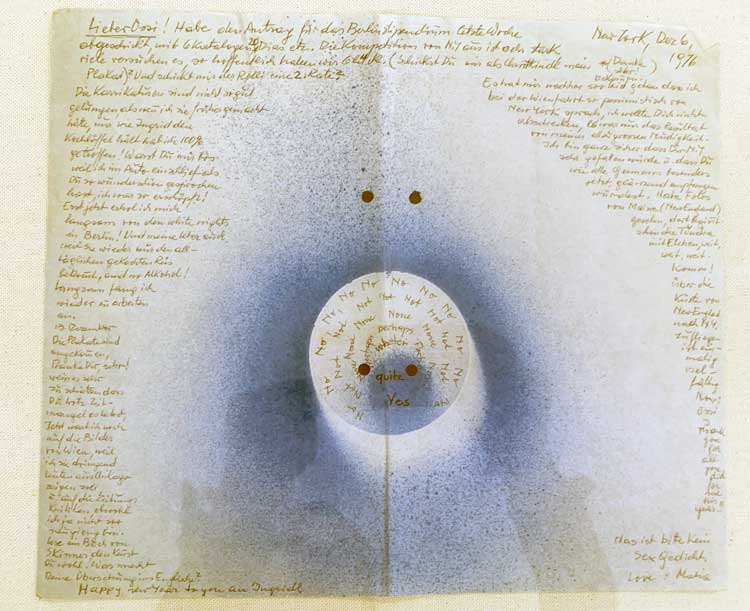
Downstairs we also find a rather evocative “double portrait” painted in oil in 1976 by Lassnig. Born in southern Austria in 1919, she has become widely acclaimed for how she consistently presented a sense of “body awareness” and of self-presence within her works from the 50s to her death in 2014. Lassnig moved to live in New York in 1968, as illustrated cards and letters on display that she sent to Wiener vividly reveal. They shared a fascination with the psychological state at play in the creative process. The portrait is of Wiener and his wife, the artist Ingrid Wiener. It has none of the expressively physical distortions that frequently populate Lassnig’s works (as a selection of these in the upstairs gallery reveal) but, instead, it has a rather classical form of a well-dressed man and a woman together. Ingrid is looking directly ahead while Wiener is closely examining a newspaper, his eyes like his mind, it is implied, seem to be turning inwards.
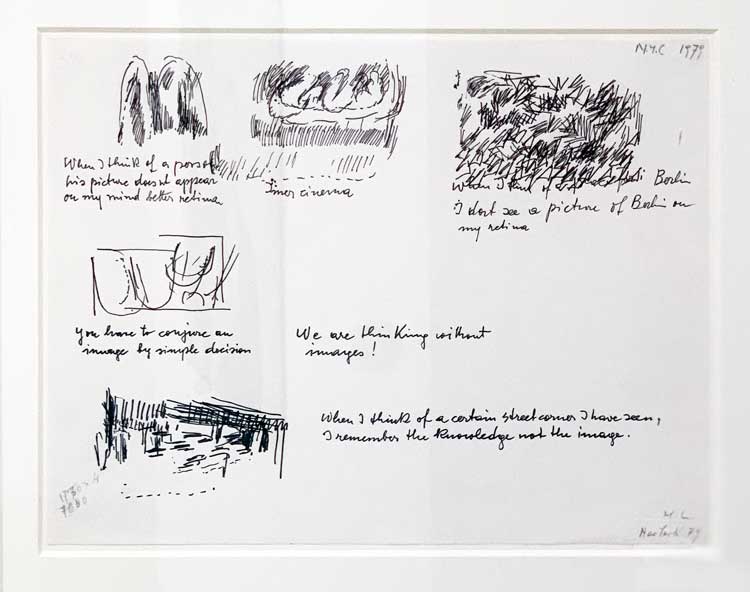
Maria Lassnig, from the series: Investigations into the Emergence of a Conscious Image, from verbal instructions by Oswald Wiener. Installation view, Halle für Kunst Steiermark, Graz, 20 May – 6 September 2026. Photo: Bronac Ferran.
It makes for a perfect entrée to the exhibition’s thematic narrative, as do a series of other works by Lassnig and by Wiener and Ingrid, in various intersections. One of these is entitled Drawing after instructions from Ossi Wiener (1976-79). We learn from the title cards that the “instructions” to Lassnig were made verbally and she would then annotate her own responses, with comments such as: “What comes to mind when I hear the word ‘dog’?” Another of the prompts given forms part of the display, stating: “sombody [sic] pushes himself off from one perception and arrives at the perception of this push-off.” Written in English in Lassnig’s handwriting, this gives some sense of the presence of ambiguity within the so-called instructions.
Nearby, we see material generated by Ingrid on Wiener’s suggestion that she could try to write and draw her dreams in a state of automatism without conscious filtering. Another piece is by Wiener, showing how he subdivided two cube-shaped objects into eight pieces, each opening out in various directions as if he were attempting to systematically model his own unfolding cognitive processes.
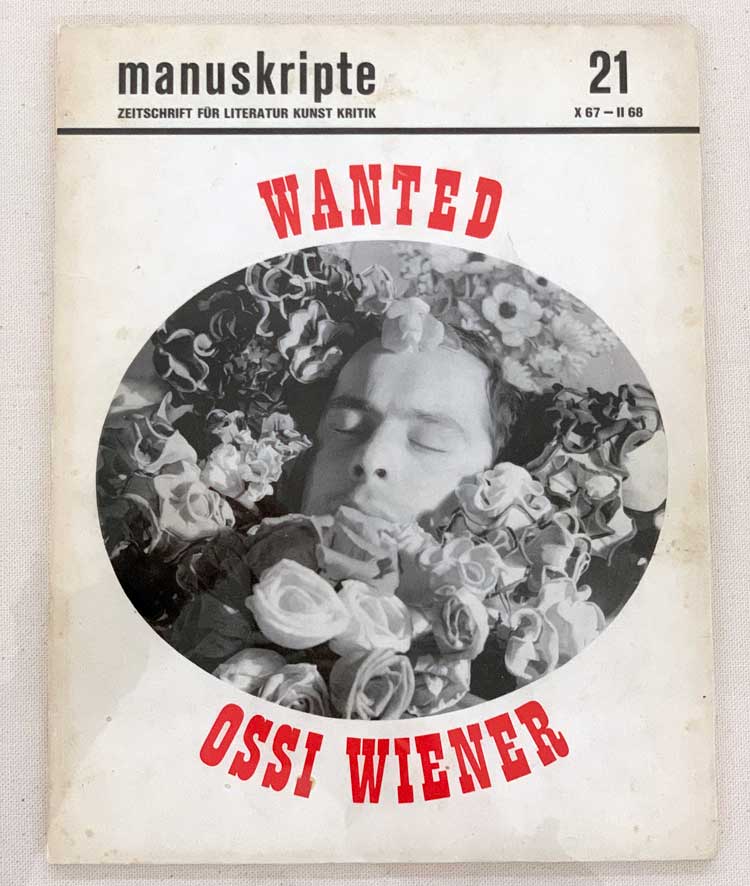
The literary and art magazine Manuskripte. Installation view, A.rtificial I.ntrospection O, Halle für Kunst Steiermark, Graz, 20 May – 6 September 2026. Photo: Bronac Ferran.
In 1968, the year he left Olivetti, Wiener took part in a Viennese Actionism performance entitled Kunst und Revolution (Art and Revolution) in Vienna, alongside Brus, Peter Weibel and Otto Mühl. This involved masturbation, nakedness and other bodily acts of desecration of the Austrian flag. Wiener’s contribution was a lecture on divergences between speech and thought. Brus and Mühl were sent to jail as a result and Wiener was held in custody for three months. Subsequently, Brus and Wiener left Vienna for Berlin. There, with Ingrid and the collector and restaurateur Michel Würthle, Wiener co-founded the Exil bar and restaurant in Kreuzberg. It became very successful, having good food and being popular among various cultural renegades. In an interview Würthle, who died in 2023, described his first meeting with Wiener earlier in the 60s: “Oswald was known as being a big outsider and dangerous. As a 17-year-old I felt very honoured. I felt like I had been included into some sort [of] anarchist secret society.” The Graz-based literary and art magazine Manuskripte, with which Wiener had long-term associations, published a cover in the year Wiener left Austria with a picture of his head surrounded by blossoms, topped and tailed by the words: “WANTED OSSI”.
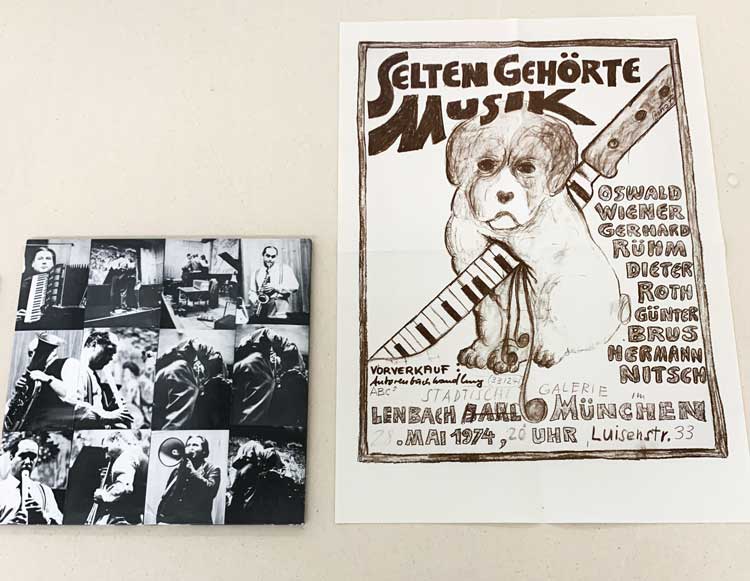
The vitrines also have flyers and covers of vinyl records published by Edition Hansjörg Mayer, relating to the Rarely Heard Music concerts featuring Brus, Roth, Wiener, Hermann Nitsch, Gerhard Rühm (who was in Die Wiener Gruppe with Wiener) and others, held in Berlin and elsewhere during the 70s. These were part improvisatory camaraderie and part chaotic and nihilistic energy, which somehow resulted in rather astonishing music. Alongside is Roth’s 1975 book Frühe Schriften und Typische Scheiße (Early Writings and Typical Shit), also published by Mayer; on its cover we read (in the German language) that these writings have been “selected and interspersed with a heap of partially digested material” by Wiener. We see, too, (a rather poor copy of) Wiener’s poem Du Dich, published by Mayer in 1964, within which there is an exemplary concretion of language combined with intensive graphic constraints. Mayer’s use of the line and circle of the Futura typeface and its spatialised layout fits exactly well with the tensile motif that Wiener established over seven compressed lines that speak eloquently to the narrative that this exhibition is also progressing: du dich ich / du dich ich / dudichich / dich / ichdichdu /ich dich du /ich dich du (you you I / you you I / you-you-I / you / I-you-you / I you you / I you you).
A.rtificial I.ntrospection O. Installation view, Halle für Kunst Steiermark, Graz, 20 May – 6 September 2026. Photo: Bronac Ferran.
In the 70s, Brus was designing and editing a remarkable periodical, Die Schastrommel, Organ of the Austrian Government in Exile. This featured extraordinary covers hand-drawn and coloured by Brus, which are now highly collectible. In the exhibition we see also two of his pencil drawings (1972) that make reference to Wiener and to Exil, revealing the close graphic correlation between the style of the magazine, the cafe and the concert flyers.
Among my favourite works in the exhibition are wall-based works by Brus, bearing the titles Aus Mir Entsteht Nichts, Aber Ich Kann Alles Machen (Nothing Comes from Me, But I Can Make Anything; Radikaler Versuch Selbst ein Glockenklang ohne Schwingung Sein Zu Koennen (Radical Attempt to Be a Bell-Like Sound Without Vibration); Vom Ende Der Selbstversuche im Halbschattengewächshaus (On the End of Self-Experiments in the Semi-Shaded Greenhouse); and Das Klassische Erbe oder Allegorie auf die Schlussfolgerung (The Classical Heritage or Allegory of the Conclusion). They are rather fine examples of what Brus in the 70s starting calling picture-poems, using language in a way that does not fully explain the meaning of the images but adds to their symbolic depths and shadows.
Brus was, meantime, also the subject of a series of pencil drawings by Wiener in 1970 entitled Approximate Layout of Günter Brus As a Bird. That they had both taken flight from Vienna to Berlin two years earlier adds to the poetic resonance of this title.
The mood of the exhibition shifts in the upper gallery from paper and print-based materials to time-based media, sculptures and weaving. Alongside drawings of the TV-Helm Prototyp by Pichler, we see a floor-based aluminium sculpture entitled Apparat (Prototyp 1), also by Pichler, from 1966, that appears vintage and yet is resonant of a moment of space-age and new communications media emergence that still had utopian dimensions at the high point of the 60s. It is spatially well positioned, at an angle gesturing towards the far end of the gallery where there are several works by contemporary artists with no direct connection to Wiener. For me, the most impressive of these is 25 Jan 2025, by Ken Okiishi, which seems to carry something of the spirit of Brus’s distortions of the performative body image as well as his compelling lightness of brushstrokes. Okiishi is also intervening in the public sphere, drawing on AI-based optimised recommendations on an Instagram platform, which function, as the artist has put it, as “an abject unconscious”.
On top of a video cache of images including shots of the bodies of real and AI-generated people, Okiishi superimposes digital brushstrokes that sit lightly over the underlying material, running like mutable lines of coloured light down screens, performing an act of equal seduction and concealing. In the exhibition description, we learn that Felix Bernstein, a New York-based writer, has described these works as “a wafer-thin membrane that lies over the image like a second skin”.
They also carry significant dimensions of resistance, subtlety and subterfuge, causing us to question the layers of seeming meaning that constantly cross our eyes as we gaze at social media streams, that quasi-holographically change and cybernetically evolve without ever resolving into clarity. One senses the acuity of relation here with a statement made by Wiener (that forms part of a remarkable interview, carried out by Axel Stockburger, in 2021) in which he observed: “We are all already sitting inside the bio-adapter.”
Included in the upper gallery and adding significantly to its offer are various versions of Rudolf Polanszky’s Der Musikalische Affe (The Musical Apes) project, which he began in 1978-79 using super-8 film and then continued to evolve in video forms until the turn of this century. It is also in many ways a seminal work in a lineage of introspective practices, that has multiple resonances also with various works by Roth, with whom Polanszky shares a preoccupation with things hanging on the edge of chaos, trying to relinquish as far as possible the interference of conscious human agency and, indeed, a deep interest in letting works be open to entropic forces of decay and alteration by more than human forces. In Polanszky’s series there are various animal presences, combined with medial multiplicities and distortions of humancentric control systems. The “dog” theme mentioned in relation to Lassnig and Wiener earlier comes back into focus here.
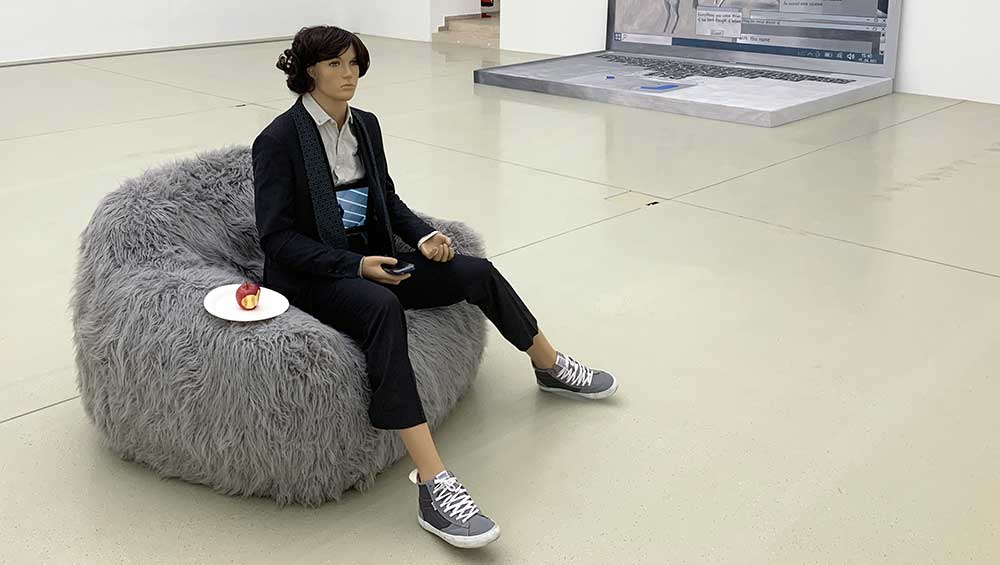
Also, in his later years, in a lecture given in 2017, Wiener said : “Dandyism is a very specific form of resistance to the idea that I am explainable.” One senses he would have found Morag Keil’s highly magnetic, depersonalised mannequin, named Mr Magic, who is sitting in total stillness, dominating the room without moving an inch, rather appealing. Walking closer to him, we recognise that on his chest is a small screen, like a dual monitor of internal and external observations. On the pouffe on which he sits is a half-eaten apple on a plate. In his hand is a mobile phone pointing upwards at himself: the screen on his chest carries his own image. He is looking in the direction of a microwave. It is all highly artificial and should feel like a zone of alienation, yet these behaviours we are observing feel highly recognisable and real. The work speaks brilliantly to Wiener’s sense, as the exhibition materials reflect, that in “the post-Turing era” the dandy “would have to up the ante and try to outdo the machine”.
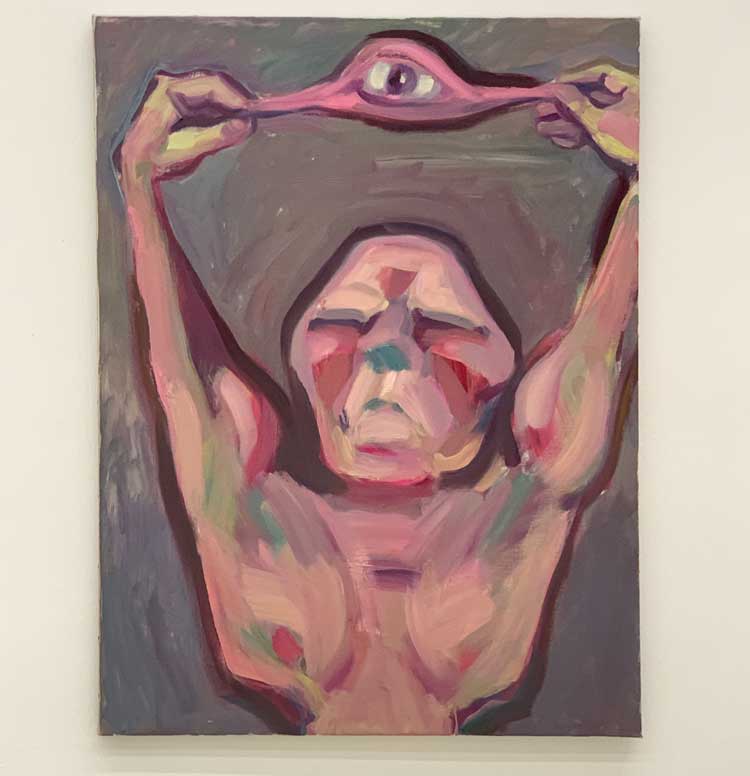
Maria Lassnig, Das optische Zeitalter (The Optical Age), 1985 –86. Courtesy Maria Lassnig Foundation, Vienna. Photo: kunst-dokumentation.com
Within a nearby separate room we see three rather haunting paintings by Lassnig that, once again, appear to blend human and animal narratives. Lassnig is now rightly acclaimed as a great artist who strips away all ornament with respect to portraiture, including of self, with what is left exposed in all its negations: in so doing, she arrives at a specific set of forms that appear indubitably authentic, generic and primitive and yet also convey something of her own inner sense of being, sans illusion and supremely enduring. It is like looking at a rock that has been shaped over millennia: Lassnig gets us down into the ground of inner being, and in so doing, casts off the self as self-conscious – or the veil of illusion – and leaves us conscious of her own firm ground of resistance that she arrived at in the 50s and that now speaks ever more loudly in an age of self-enhancement and self-production. One of the works depicted, Self-Portrait with a Speech Bubble is from 2006; another, The Purple Monster, dates from 1964; the third, The Optical Age, from the mid-80s, is radically visionary in its implications. Lassnig’s self-depictions as a mode of fragile yet fearsome otherness act as a salve with respect to what might be perceived as a technocentric dryness in various other contemporary works presented.
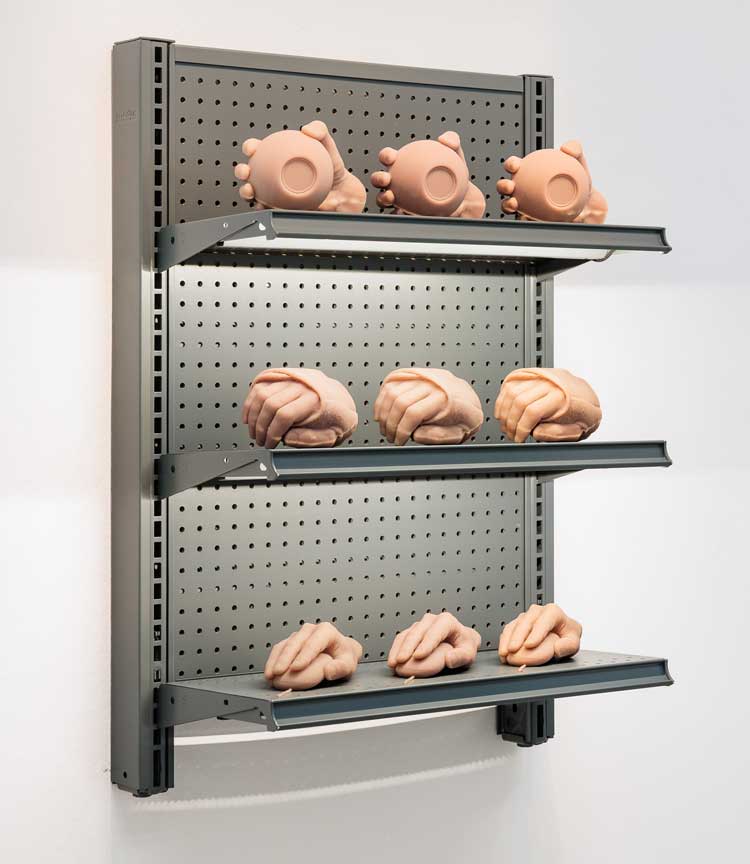
Josh Kline, Whatever It Takes 2024, 2024. Courtesy Josh Kline and Lisson Gallery, London / New York. Photo: kunst-dokumentation.com
What this corner of the exhibition spatially presents us with is an enactment of a tension between different kinds of alienation effects, a term spawned in the early 60s by Germanist scholar John Willett, who was a specialist on the works of Brecht; both would, I believe, have felt this at work in Whatever it Takes (2024), a display of 3D printed objects by Josh Kline. Over three shelves we see models of items Kline uses in his daily life online, including most disturbingly a set of his hands cut off at their wrists. The hand and its configuring being a critical indicator of the Happy Valley effect at play in all attempts by technological systems to mirror and replicate human functions, this work strikes a chord with all who now spend most of their time online We are being asked here to consider the hand lopped off and peeled away from any distinctive human characteristics, acting as a typology of automation’s psychic distancing, where fingers tightly grip 3D printed “mice”, as if trapped in their own modelling of machinic efficiency, situated behind a trip wire deterring anyone from getting too near. I find resonances here also of Pichler’s prototyping 60 years earlier.
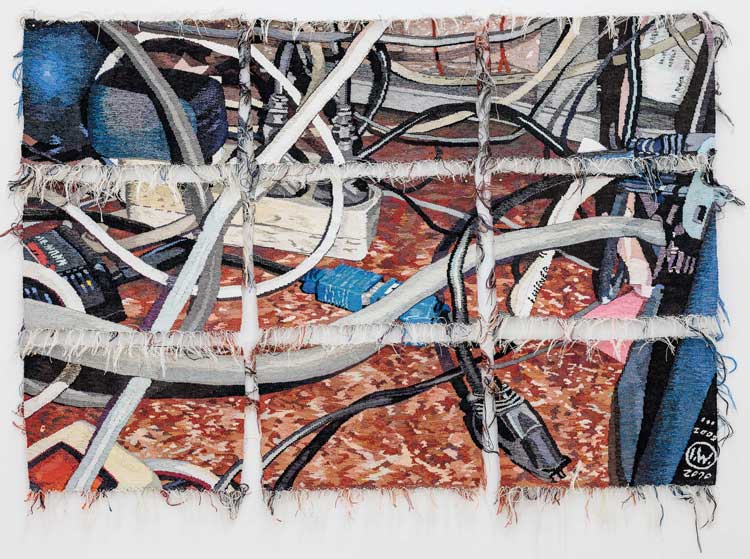
The dexterity of the human hand is, meantime, at the heart of four tapestries by Ingrid Wiener, including Dr Müller’s Cable Spring (2008) and Buchstabe E (Letter E) (2012), which counter somewhat the feeling of senselessness that cerebral art and technology projects can have on one’s senses. Wiener, by contrast, pulls us into the gears and switches of what she is doing, using traditional modes of weaving so as to depict, as these works do, a sense of an organistic network process, that grows out of the crossing of lines, that emerges in the interstices, at the deliberately fraying edges and in the stray threads.
It is not difficult to imagine why Roth, with his organic material inclinations and as the master of shifting and iterative processes, in whichever form of media he turned his mind to, would be drawn to the organic nature of the tapestries that Wiener was making, working together with her on a collaborative project over years. In another corner of this upper gallery, graceful drawings made by Roth using a rubber stamp on tracing paper have been sideways hung, like textiles, allowing us to appreciate surface and underside at once.
Wiener also worked with Valie Export on some hand-weaving projects, as well with her (and Oswald Wiener) on two documentaries, Yukon Quest (1986) and Das Unsagbare Sagen (Saying the Unsayable) (1992), which are also being shown, as is a solo work by Export, Oswald Wiener, Tischbemerkungen November 1985 (Table Remarks, 1985), where the primary subject is Wiener. The entanglements and network connections that the exhibition is highlighting in many ways come to a head with regard to these intersections.
The sadness of Export’s death just six days before the opening of the exhibition, which she had hoped to attend, is somewhat mitigated by the intensively live nature of what we see in all these works, using the technique of expanded cinema that she helped to pioneer and drawing on the time-based performance with which she is indelibly associated. The three works show us how Wiener’s preoccupations endured and evolved into the 80s and 90s. In the first, we see him shaving, working at his desk at home, his living-room etc. In Das Unsagbare Sagen, she worked with Ingrid and Oswald Wiener to channel into video format the phenomenon of glossolalia, meaning an incomprehensible language, which they track down in various locations, including at an ecstatic religious gathering and in experimental literary texts.
Most potently, at least for this reviewer, Yukon Quest is a documentary film that takes us to another extreme entirely: to the snowy wastes of northern Canada close to the Alaskan border, where the Wieners and Export decided to follow a regional sled dog-race from its start to its finish. The camera speeds along, as if held on the head of a dog, bringing us with it and then, to yet another frontier of witnessing what might happen at the edges, if you venture there, and fast. In the gallery, we watch as the race reaches its conclusion, with a due feeling of celebration.
Reference
1. This is a citation from Zoran Rosko’s site, where further helpful information about Wiener’s 1969 book is available.
Click on the pictures below to enlarge

Copyright © 1893–2026 Studio International Foundation.
The title Studio International is the property of the Studio International Foundation and, together with the content, are bound by copyright. All rights reserved.
 |
 |
 |
|---|
-300.jpg)
-300.jpg)

 Suspended Animation
 Architecture as Metaphor
 Maria Lassnig
 Reflections on the Self: From Dürer to Struth
 2015 Triennial: Surround Audience