




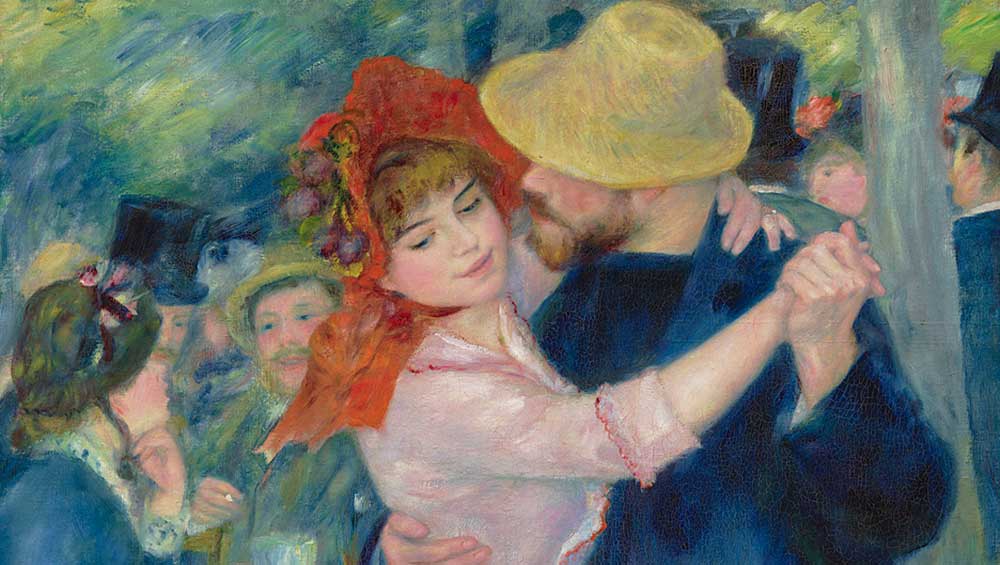
Pierre-Auguste Renoir, Dance at Bougival, 1883 (detail). Oil on canvas, 181.9 x 98.1 cm. © Museum of Fine Arts, Boston.
National Gallery, London
3 October 2026 – 31 January 2027
by JOE LLOYD
Pierre-Auguste Renoir (1841-1919) has an image problem – or does he? The French artist was contentious in his lifetime. Édouard Manet pleaded with anyone who saw him to “tell him please to give up painting”; contemporary critic Albert Wolff described one nude as “a mass of decomposing flesh with green and purple spots that indicate the state of total putrefaction in a corpse”. In more recent times his antisemitic views have come under fire, while the pictures of nude bathers that dominated his last decades have led to accusations of misogyny. But the biggest charge is that he was a painter of chintzy, saccharine, sloppy baubles. It has become a cliche to call his work “chocolate box”. In 2015, a group of protesters went viral after picketing New York’s Met and Boston’s Museum of Fine Arts with placards declaring: “Renoir sucks at painting.” They wanted nothing less than to strip Renoir’s work from the walls.
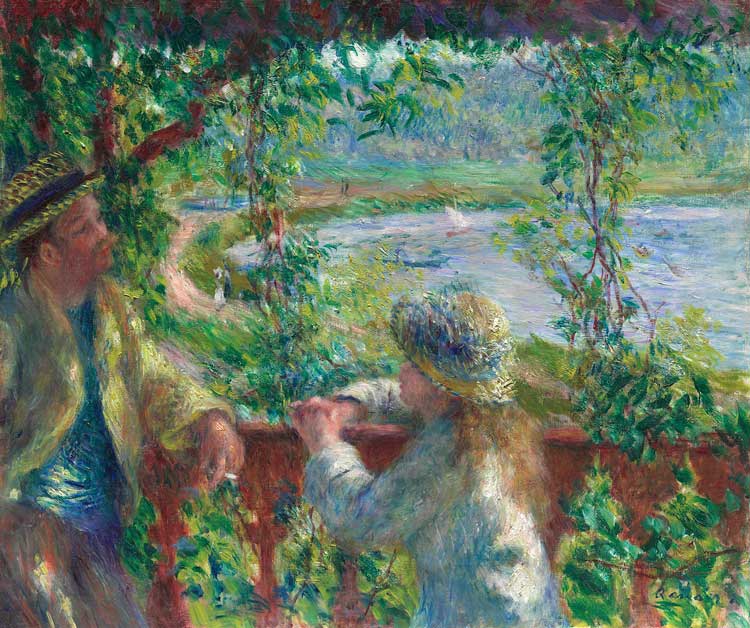
Pierre-Auguste Renoir, Near the Lake, 1879-80. Oil on canvas, 47.5 x 56.4cm. © The Art Institute of Chicago, Potter Palmer Collection.
The reason Renoir was on those walls in the first place, of course, is because so many curators and collectors did value his work. Renoir remains popular with the public: the National Gallery’s new exhibition broke advanced ticket booking records, selling more than 2024’s Van Gogh: Poets and Lovers. It achieved similar success this spring at the Musée d’Orsay. As well as a blockbuster draw, Renoir and Love offers a chance to reset the critical reputation of Renoir the painter, if not Renoir the man. To do so, the curators have narrowed the field to 1865-85, the artist’s most creatively fecund years, when he was one of the leading lights of impressionism. They have pulled in an impressive range of loans. And they have chosen to focus on Renoir’s least disputed talent: his propensity for capturing intimacy, whether romantic, friendly or familial.
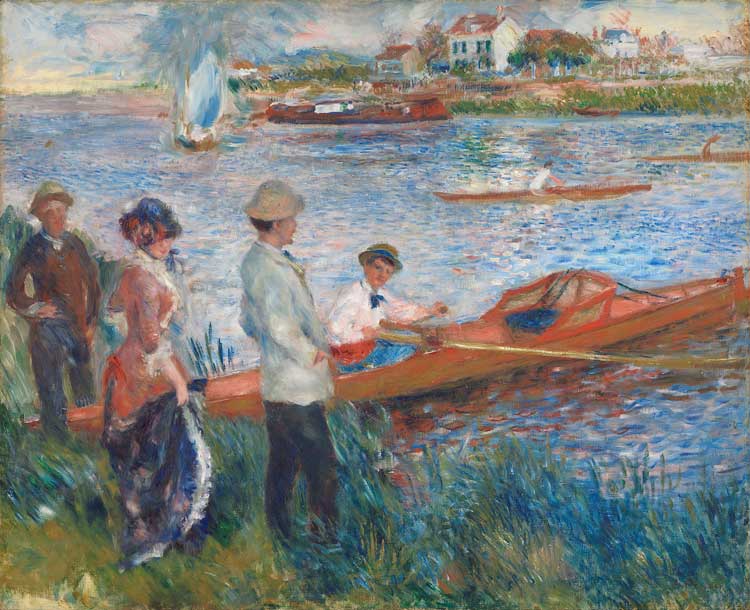
Pierre-Auguste Renoir, Oarsmen at Chatou, 1879. Oil on canvas, 81.2 x 100.2cm. © National Gallery of Art, Washington, Gift of Sam A. Lewisohn.
Renoir and Love is an exhibition that abounds in small moments of connection. Couples converse in sun-kissed gardens or pore over a newspaper. A young man awkwardly approaches a young woman outside a music school. Bathers fraternise on a camembert-shaped pontoon. Sailors enjoy post-prandial cigarettes. Two women relax in each other’s company in a rowing boat. Claude Monet’s wife, Camille, lies on the grass with her seven-year-old son. Brothers and sisters sit together with gentle regard. Perhaps no artist devoted so much time to capturing these most mundane pleasures. Renoir admired the rococo paintings of Jean-Honoré Fragonard and Antoine Watteau; in 1876, he followed the former in a painting of a woman on a swing, clad in a white dress, that recalls the latter’s Pierrot. But here we are not in some enchanted pastoral grove but in a suburban garden. The whimsical movement and eroticism of Fragonard’s masterpiece is replaced by a bashful awkwardness, complicated by the presence of a young girl.
It can often seem as if modernity has failed us. And so we are often drawn to those artists that suggest that the maladies of the modern city – alienation, isolation, divide, precariousness – have been there from the start. Renoir almost never reveals these issues. While Manet’s The Cafe-Concert (1879) sees three characters from different social backgrounds exist in their own spheres, Renoir’s At the Cafe (1877) has a well-heeled couple and a lower-class woman happily co-existing at the same crowded table. Yet I am not convinced that Renoir’s focus on happiness makes him any less serious a painter of reality. Summer weekend walks down city streets, drinking outside a bar on a sunny afternoon, trips to the theatre, gatherings of friends at each other’s apartments: Renoir captures the small joys of modern urban living.
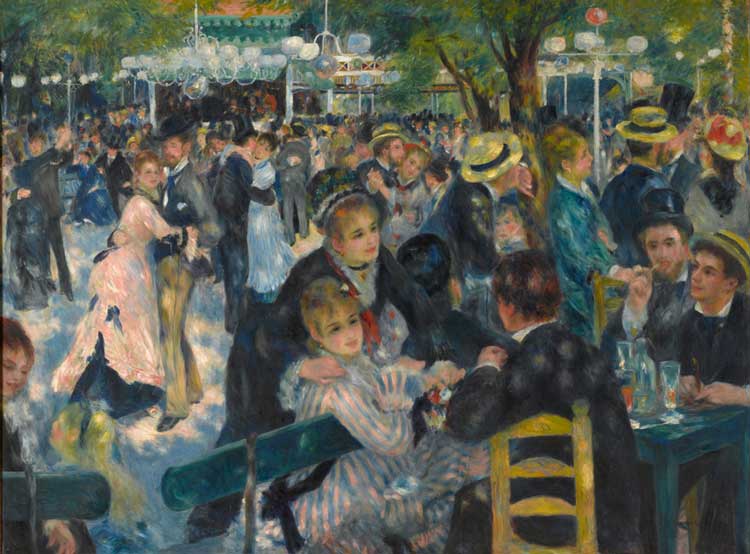
Pierre-Auguste Renoir, Dance at the Moulin de la Galette, 1876. Oil on canvas, 131.5 cm x 176.5 cm. Gustave Caillebotte Bequest, 1896, Musée d'Orsay. © Musée d'Orsay, Dist. RMN-Grand Palais / Patrice Schmidt.
They are the sort of incidents that today might be captured on a phone camera. Some of the most interesting paintings here themselves have the feeling of an accidental snapshot. La Place Clichy (1880) sees a woman viewed in profile about to cross the road – the sort of quotidian instance that happens innumerable times each day, here immortalised. Other works have a blurriness created by wet-on-wet painting, as if they have been captured on a low-spec video camera. This sense of the extempore, of catching fleeting time, might be Renoir’s great talent. His masterpiece the Dance at Le Moulin de la Galette (1876), loaned to the UK from the Musée d’Orsay for the first time, expands this to grand scale. Few paintings capture momentary jollity so well, whether that of dancers, spectators or those sitting down for a drink. Renoir was the only major impressionist from a working-class background, and there is a generosity in the way he accords these everyday Parisians the same respect as his later bourgeois subjects.
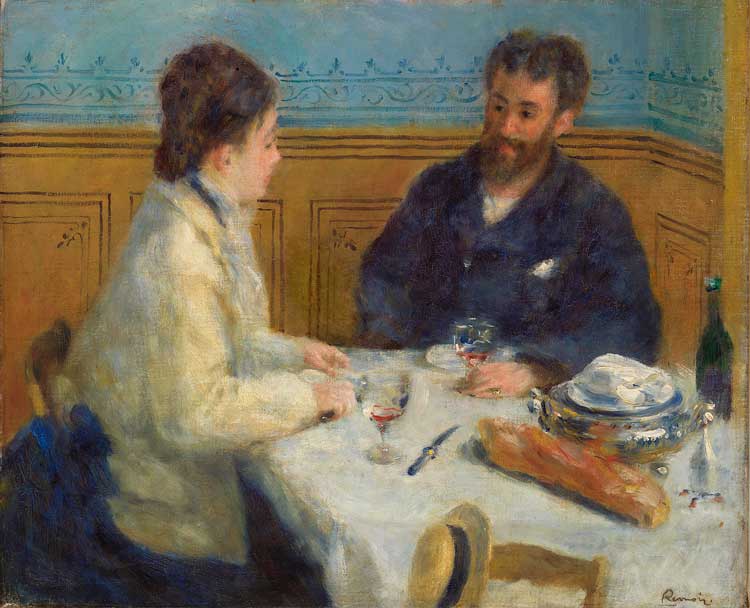
Pierre-Auguste Renoir, Luncheon, 1875. Oil on canvas, 49.2 x 60 cm. © The Barnes Foundation, Philadelphia.
Renoir’s best work has a true literary sensibility, one closer to Guy de Maupassant’s stories of lusty days out than Émile Zola’s social critique. Many of his paintings lead you to wonder what has happened before and what will transpire next. Will the man in the brown coat in The Umbrellas (c1881-86) offer his shelter to the woman in front of him, identified by the curators as a milliner’s assistant? What will the boating couple in Luncheon (1875) discuss as they finish their wine? Two beguiling 1883 paintings show Renoir’s future wife, Aline, dancing with a man. Her face is a picture of contentment, his of devotion. In one of them, the pair waltz across a floor littered with matches and cigarettes, the litter of a long night out.
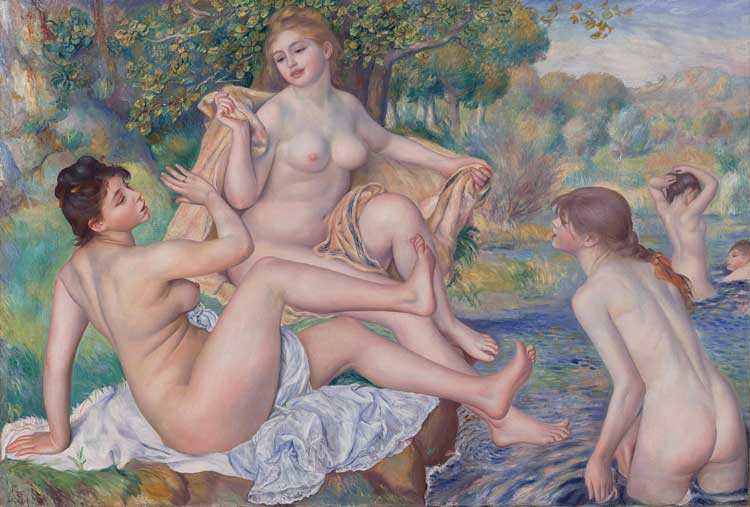
Pierre-Auguste Renoir, The Great Bathers, Oil on canvas, 117.5 × 171 cm. © Philadelphia Museum of Art: The Mr. and Mrs. Carroll S. Tyson, Jr., Collection.
Renoir and Love often makes it hard to see why the artist’s canvases, rather than his views, have aroused such scorn. The final work in the exhibition offers some clues. Feeling that impressionism had run its course, Renoir decided to move to a smoother style, inspired by classical French painting, in particular Jean-Auguste-Dominique Ingres. In 1887, he unveiled The Great Bathers, an enormous depiction of idealised female nudes frolicking in the water. It lacks his previous psychological intimacy and Ingres’ order and force, though it impressed Monet and inspired Paul Cézanne. Later, he would retreat to softness and sensuality, and it is this second act that has divided so many. But the genius of his first two decades is hard to argue against.
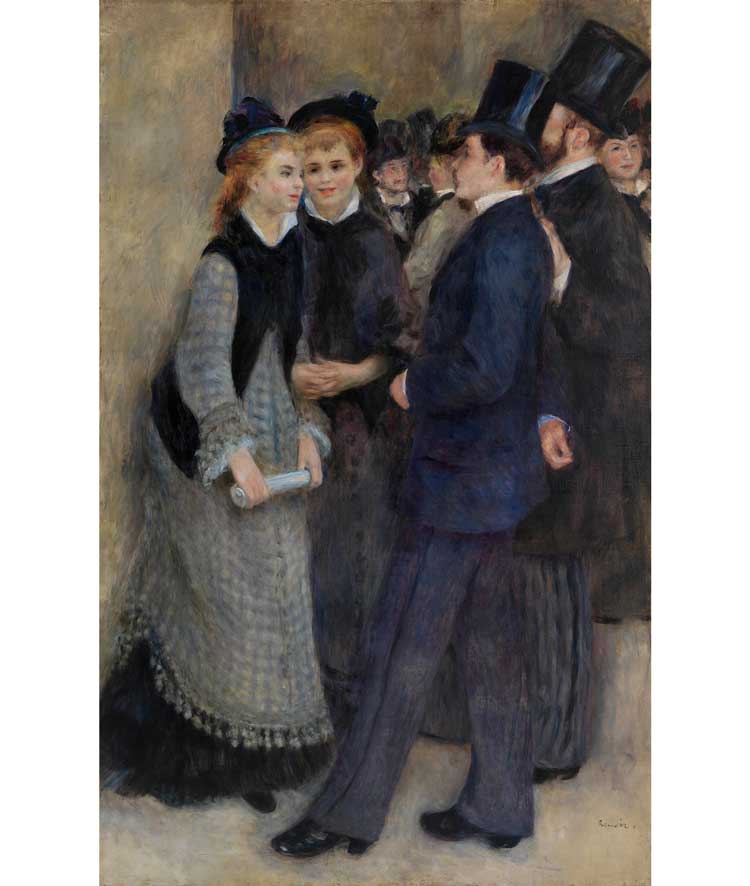
Pierre-Auguste Renoir, Leaving the Conservatory. Oil on canvas, 187.5 × 117.5 cm. © The Barnes Foundation, Philadelphia.
Click on the pictures below to enlarge

Copyright © 1893–2026 Studio International Foundation.
The title Studio International is the property of the Studio International Foundation and, together with the content, are bound by copyright. All rights reserved.

 |
 |
 |
|---|





-300.jpg)

-300.jpg)
 Julián Zugazagoitia: ‘Museums should generate interest and open a door that leads to further learning’
 Masterpiece Fair 2017
 Delacroix and the Rise of Modern Art
 Inventing Impressionism: Paul Durand-Ruel and the Modern Art Market
 A Painter of Sorrows