



.jpg)
Mary Kelly’s Extase, a six-panel installation, What Remains, The Women’s Art Collection, Murray Edwards College, Cambridge. Photo: Jo Underhill.
The Women’s Art Collection, Murray Edwards College, Cambridge
23 September 2026 – 28 February 2027
by ANNA McNAY
For the academic year 1985-86, the artist-in-residence post, offered as part of a Cambridge-wide residency scheme, organised in collaboration with Kettle’s Yard, was offered to the American feminist conceptual artist Mary Kelly (b1941, Iowa). Despite the scheme having run since 1977, Kelly was the first woman to hold the post, which offered a studio space, room and board in a college, a stipend of £9,500, free access to the university’s academic resources, such as lectures and libraries, and an exhibition at Kettle’s Yard. Initially, Kelly was told by an Arts Council officer that she should not see her husband and child even at weekends as this would prove too great a distraction from her work. Thankfully, however, Hilary Gresty, the then curator at Kettle’s Yard, intervened, and New Hall (now Murray Edwards College), upholding its status as a site of feminist academe, different from the other colleges and academic environments in Cambridge at the time, provided Kelly with a three-bedroom flat.1
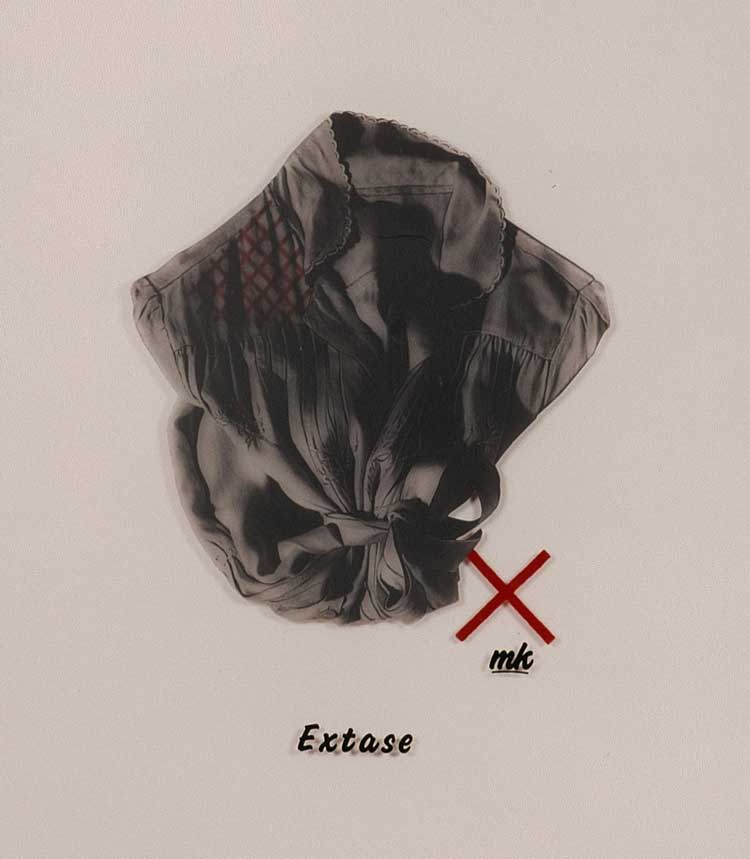
Mary Kelly, Extase, 1986, Laminated photo positive screenprints and acrylic on Perspex, six panels at 122 x 92 cm each. © Mary Kelly. The Women's Art Collection.
One of the outcomes of Kelly’s residency was the work Extase, a six-panel installation, which forms part of a larger work, Corpus (Body), exploring women’s bodies and aging in relation to the five so-called “passionate attributes” that late-19th-century neurologist Jean-Martin Charcot used to describe hysterical women. In Extase, three panels of text are interspersed by three images of folded clothing, both annotated in red. The texts deliberately imitate the confessional language of women’s magazines. The annotations and highlighting evoke the feeling of doing something wrong somewhere where it matters (eg, school or college) or of editorial copy. The clothing operates as a trace of Kelly’s lived experience, providing a self-portrait of sorts that emerges as a process, rather than a fixed likeness. It should be noted that Corpus, in turn, comprises one of four thematic sections of the larger work Interim (1984-89), the very title of which suggests some kind of undefined liminal period of change or development. At the end of Kelly’s residency, Extase was acquired by New Hall, and it went on to become the first work of the Women’s Art Collection, which now, four decades later, tallies more than 600 works of art.
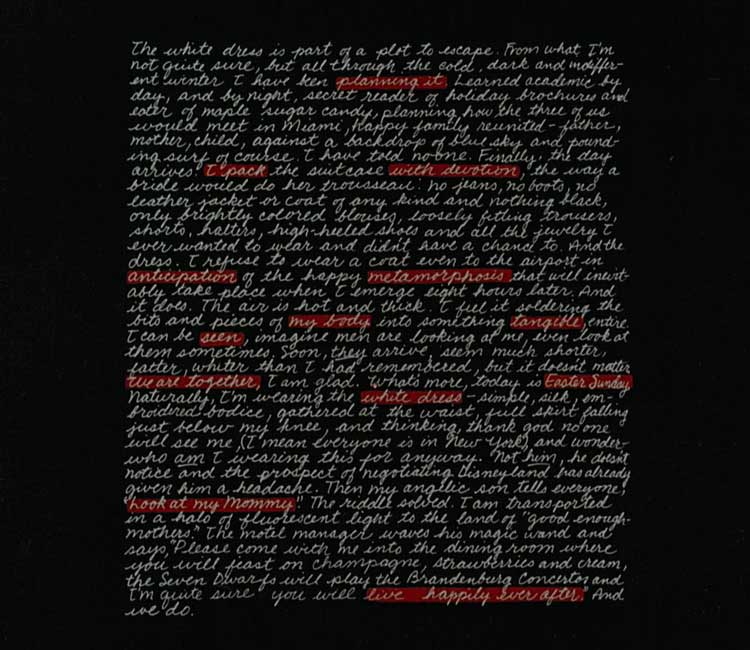
Mary Kelly, Extase, 1986, Laminated photo positive screenprints and acrylic on Perspex, six panels at 122 x 92 cm each. © Mary Kelly. The Women's Art Collection.
The Women’s Art Collection is an amazing thing – a free museum, on display all around the Chamberlin, Powell and Bon-designed college (the same architects as designed the Barbican, and which, still acting differently from other Cambridge colleges, is open to the public), in the dining room, in the common rooms, in the hallways, in the garden. There is also, if you’re lucky enough to find it, a small corridor gallery used for temporary exhibitions. The current exhibition is of Extase, accompanied by loan works by nine contemporary artists and archival material, celebrating the 40th anniversary of the collection and asking the question: “How do artists experience, activate and rework memory and history while imagining possible futures?” In other words: What is still relevant from the earlier days of feminist and queer theory? What has changed and what has not? What needs now to change? As the curator Laura Moseley writes in her introduction to the booklet printed to accompany the exhibition: “The work [Extase] emerged from a moment in which feminist art and theory became newly self-aware as political, intellectual and aesthetic projects.”2
In an interview with the art historian Amy Tobin in the exhibition booklet, Kelly notes of Extase: “Today younger audiences often say it reminds them of blogs, which is amusing because blogs didn’t exist at the time. But that shift in language allows the work to keep speaking across generations.”3 Something about the work is still relevant and vital today. Tobin notes that her students are often surprised when she instructs them to stop reading the text panels and to focus, instead, on the work as a whole, making connections – and ultimately meaning – between images, text and history. (Accordingly, the exhibition text panel is placed after the Kelly work, bridging with the contemporary loans.) Harriet Loffler, the director of the Women’s Art Collection, adds that Kelly intended the panels to be like those found at bus stops – even to the extent that you see your outline reflected and thus feel yourself implicated.
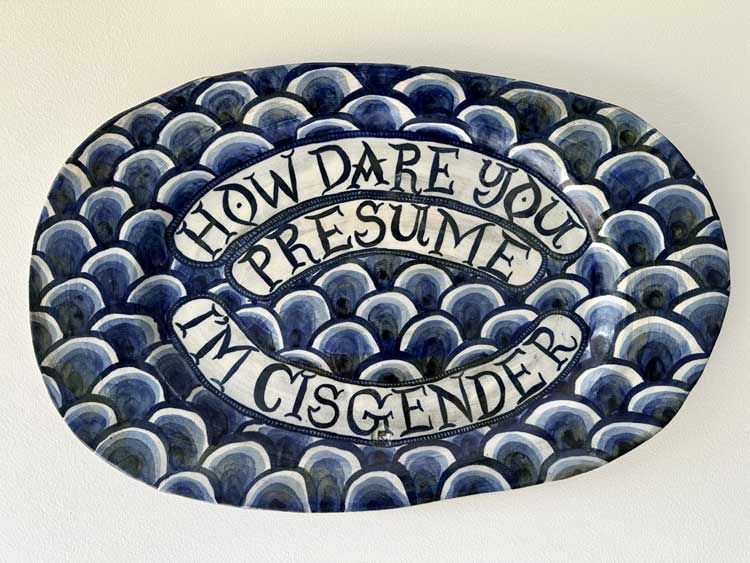
Rachael House, Assume Nothing, 2025. Courtesy the artist.
We are implicated, too, in the contemporary works that speak directly to us, most notably Rachael House’s Assume Nothing (2025), a glazed, oval-shaped platter, decorated with the words: “How dare you presume I’m cisgender.” For House, the ceramic form evokes traditional commemorative platters like those made for royal weddings and coronations, but this association is subverted through reference to activist culture. The historical, the subversive and the everyday are compressed in a simple yet highly impactful manner.
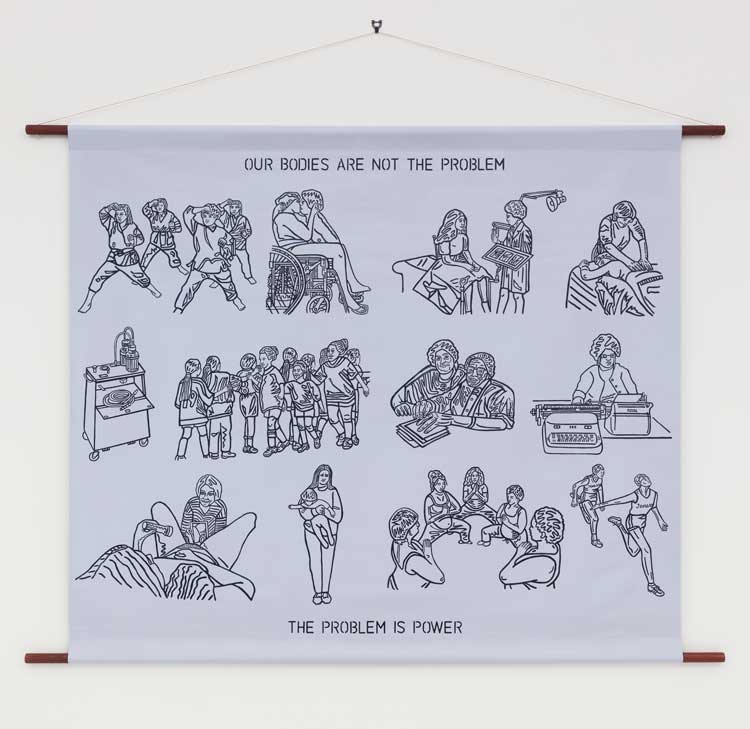
Olivia Plender, Our Bodies are Not the Problem, 2022. Courtesy the artist.
Olivia Plender’s Our Bodies are Not the Problem, the Problem is Power (2022), part of a project with the Glasgow Women’s Library, likewise shouts out to its audience, through the reimagining of an educational healthcare poster with imagery from Our Bodies, Ourselves: A Book by and for Women (1973) (a copy of which is in the vitrine opposite – sadly not where we can delve into its contents), which was groundbreaking at the time – it was self-published in 1970 by the Boston Women’s Health Book Collective – for its discussion of abortion, sexuality, gender identity, birth control, menopause and more.
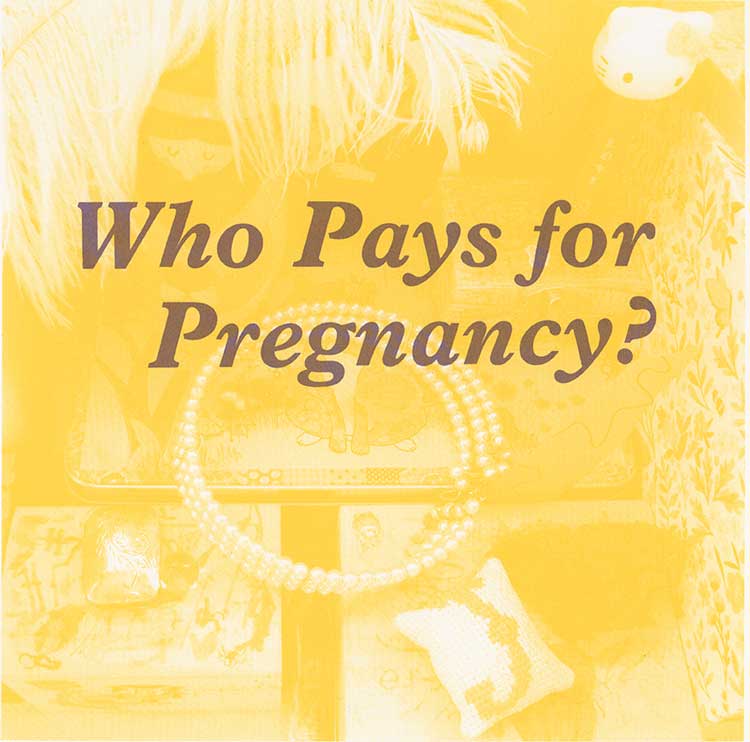
Helen de Main, Childcare Now!, 2023. Screenprint, 40 x 40 cm. © Helen de Main. Courtesy of the artist.
We hardly need reminding that many of the inequalities and struggles identified in the booklet remain unsolved, and that healthcare continues to be shaped by wider systems of power. Also still salient are the rallying cries in Helen de Main’s Childcare Now! (2023), which comprises a number of screenprints as part of a larger series responding to the artist’s research into childcare campaigns led by feminist groups in the 1970s and 80s.
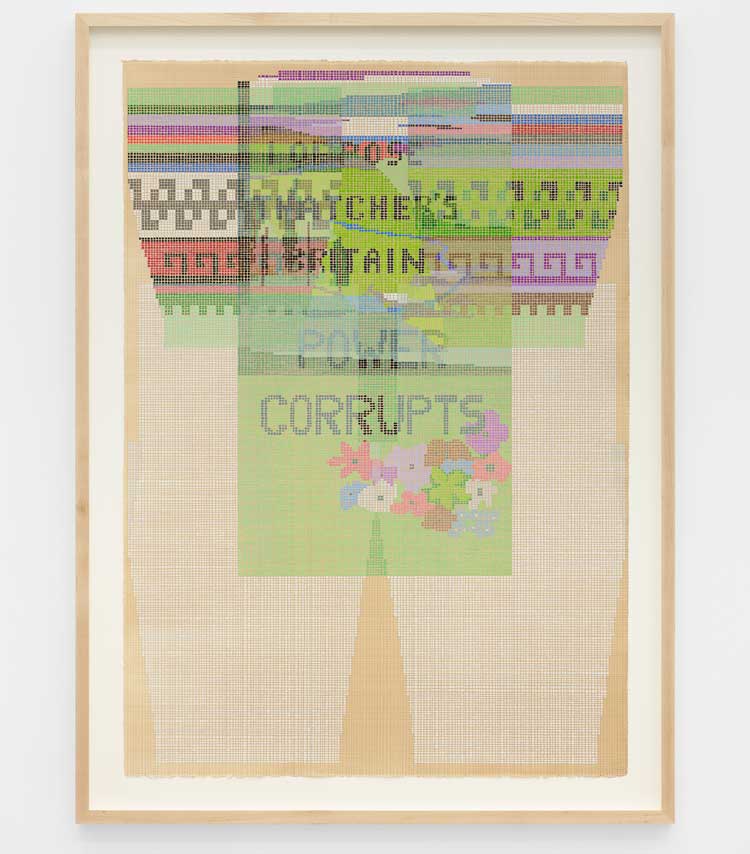
Ellen Lesperance, I Oppose Thatcher's Britain / Power Corrupts (for Juley Howard), 2024. Gouache and graphite on tea-stained paper, 106.7 x 74.9 cm. © Ellen Lesperance. Courtesy the artist and Hollybush Gardens, London. Photo: Eva Herzog.
Further reference to the media comes in the form of Lorna Hamilton-Brown’s WE MEK Knitted Magazine Cover – Issue One (2021), which transforms the familiar format of a magazine cover into a space for being seen and historical reflection. (WE MEK is patois for “we make”.) Ellen Lesperance’s I Oppose Thatcher’s Britain / Power Corrupts (for Juley Howard) (2024) comprises archival fragments relating to the Greenham Common Women’s Peace Camp mixed with her own knitting patterns, and Sarah-Joy Ford’s Archives and Amazons (2021) is stitched in lavender, a colour term used since the early-20th century as a code word, symbol and descriptive label for homosexual people and culture. Speaking especially to Kelly’s work is Sadé Mica’s Getting There (2026), a chest binder decorated with cross-stitched text, including the Biblical parody:
“I am not what I make of me, I never have been.
I am not how you maketh me, I never have been.”
All four of these works also invoke traditionally feminine crafts, subverting their use to question the heteronormative white patriarchy.
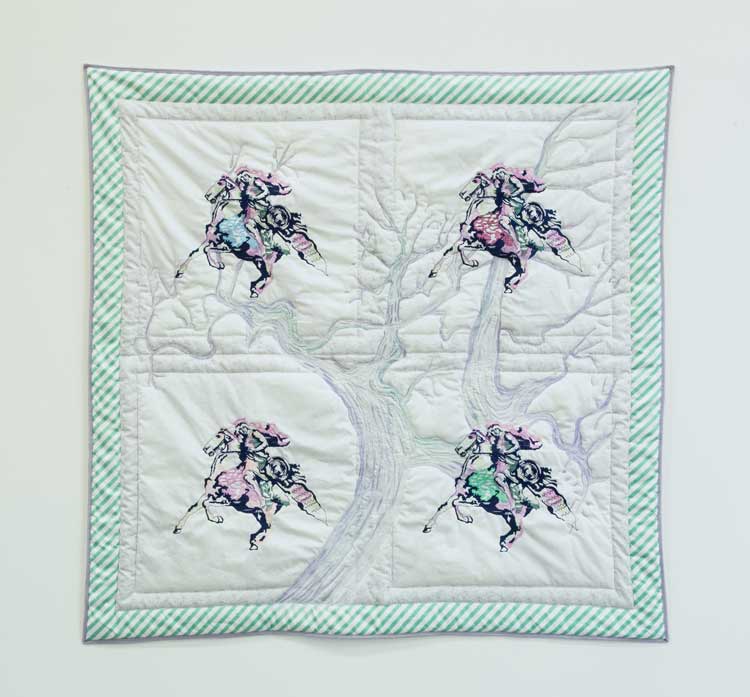
Sarah-Joy Ford, Archives and Amazons, 2021. Quilt, 150 x 150 cm. © Sarah-Joy Ford. Courtesy of the artist. Photo: Elle Brotherhood.
In the vitrines opposite, there are numerous magazines and fanzines, newsletters and artists’ publications spanning the past five decades and tracing the vital role that independent publishing has played in creating spaces for political debate, artistic experimentation and collective knowledge beyond – or, in the case of New Hall, within (but also without) – mainstream institutions. These include Spare Rib, Sappho and THING, a magazine documenting Black queer art, music and culture during the HIV/Aids crisis. Issues of Radical Deviance: A Journal of Transgendered Politics – each one about 40 pages long, A4, saddle-stitched and bearing the intent of promoting and securing the nascent project of trans theory in the UK – are also on display for the first time.
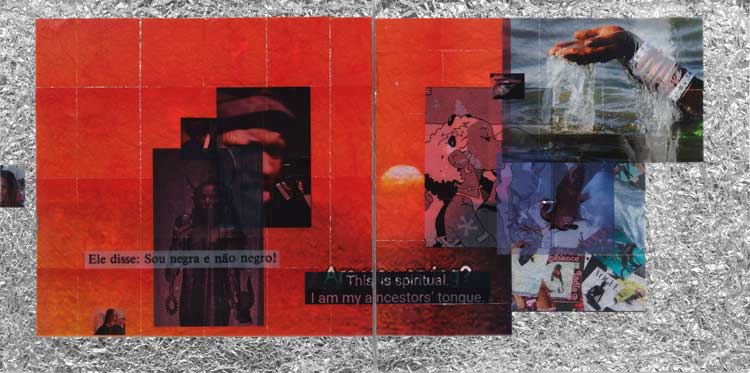
Ebun Sodipo, Self Portrait / I am my ancestors' tongue, 2026. Mylar, digital prints, resin, 240 × 120 cm. Courtesy the artist and Soft Opening, London. Photo: Eva Herzog.
The final two contemporary pieces are Kelly O’Brien’s “Magic” Memories (2024), which explores the relationship between labour, family and class, and Ebun Sodipo’s Self Portrait / I Am My Ancestors’ Tongue (2025), which brings together fragments of imagery, creating a self-portrait that follows “the pathway that I took to womanhood”. This, really, summarises the exhibition as a whole.
One final section worth a mention is a vitrine of letters between Kelly and the university, offering her the post and summing up her activities at its close. While it is important to heed the lesson inherent in all the works and archival materials on display, namely that much has not changed over the past four or five decades, it is, I think, also important to acknowledge what has. The fact that we can smile at these letters as evidently dated is a relief. Thanks to colleges such as New Hall, women have been offered a level pegging to men at one of the best universities in the world. And these advances are celebrated also by the Women’s Art Collection. To close with another quote from Kelly’s conversation with Tobin: “The future is always shaped by what we choose to carry forward.”4 This exhibition provides us with a good starting point to select from.
References
1. In fact, her family stayed living in London, but the point is that this was their consensual choice.
2. Introduction by Laura Moseley in What Remains. 40th Anniversary of the Women’s Art Collection, exhibition booklet, pages 3-6, page 5.
3. What Remains. A Conversation with Mary Kelly and Amy Tobin, exh booklet, pages 13-22, page 19.
4. Ibid, page 22.
Click on the pictures below to enlarge

Copyright © 1893–2026 Studio International Foundation.
The title Studio International is the property of the Studio International Foundation and, together with the content, are bound by copyright. All rights reserved.
 |
 |
 |
|---|
-300.jpg)
 Threesome and 3X3
 Marie Yates: ‘In my view, everything is textual, and a text is visual’
 Asya Dodina and Slava Polishchuk: ‘Material dictates the way you relate to the fact you describe’
 Comix Creatrix: 100 women making comics
 Margaret Harrison: ‘You have to have a strategy to draw people into the work’