



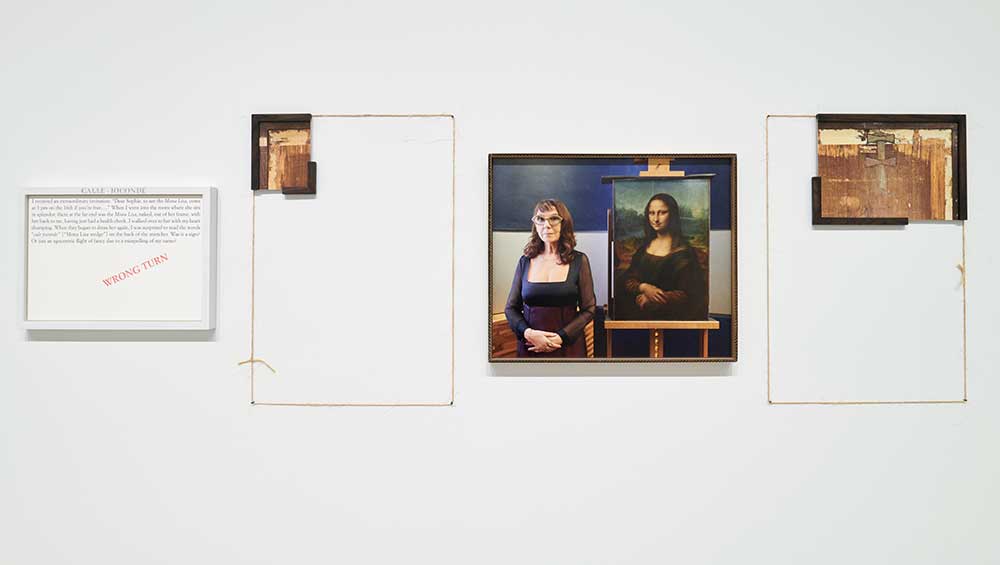
Sophie Calle, Calle-Joconde – Wrong Turn, 2023 from Catalogue raisonné of the unfinished, 2023. Installation view of Sophie Calle: Something Missing?, 2026. Courtesy Turner Contemporary. Photo: Jo Underhill © Turner Contemporary.
Turner Contemporary, Margate
3 October 2026 – 24 January 2027
by ANNA McNAY
Words, words, words. Words are my tool. But what happens when an artist’s use of words is so prolific, yet so efficient and precise, that mine suddenly seem superfluous? This is exactly how I feel in relation to the work of Sophie Calle (b1953, Paris). Each piece consists of a bipartite sign, which, unlike the linguistic and semiotic model of Ferdinand de Saussure, with its signifier (arbitrary words or image) and signified (mental concept), comprises two signifiers: word (typically a first-person account) and image (photograph or moving image). In an interview with the author Édouard Louis in the catalogue to accompany her exhibition, Something Missing?, which began at the Louisiana Museum of Modern Art in March 2026, Calle suggests it is due to her parents that she is who she is, and that her mother influenced her to want to write, and her father to want to photograph. However, since she felt inadequate at each of these professions in and of themselves, she brought them together and became an artist, something at which she has excelled over the past half a century.
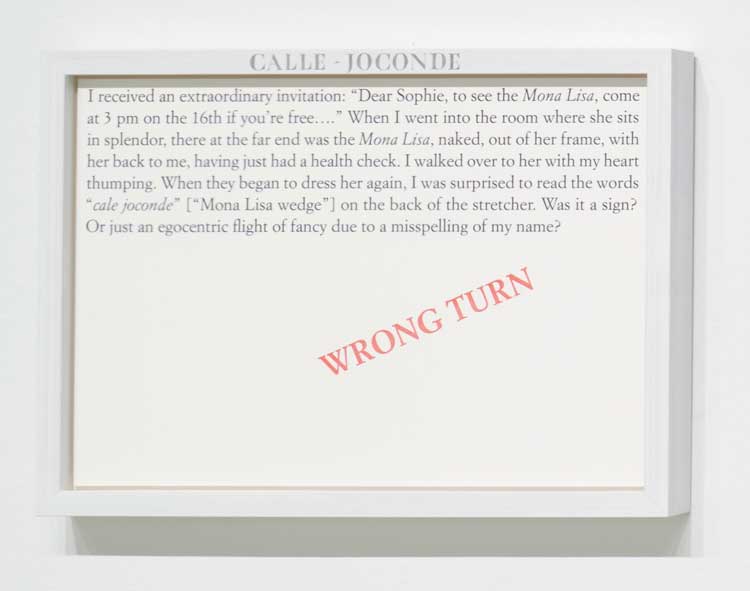
Sophie Calle, Calle-Joconde – Wrong Turn, 2023 from Catalogue raisonné of the unfinished, 2023 (detail). Installation view of Sophie Calle: Something Missing?, 2026. Courtesy Turner Contemporary. Photo: Jo Underhill © Turner Contemporary.
Calle’s projects range from the banal to the profound, yet each is presented with warmth, humour and conceptual rigour. The theme of absence runs through pretty much all her work, so much so that the gallery’s introduction goes as far as to call absence “more than just a theme, [it] is Calle’s method”. Indeed, the all-important question mark in the exhibition title, Something Missing?, asks the question as to whether anything actually is missing, or whether Calle’s method conversely draws out a presence inherent in each absence.
For example, when she was invited to do an exhibition at the Musée Picasso in Paris, in dialogue with the artist, to mark 50 years since his death (already an absence of sorts), Calle initially turned down the opportunity because she was afraid to have her works shown alongside his. Then, during the pandemic, Picasso’s works were all covered over with protective sheets, and Calle decided to make a work about his “ghost-like” (and therefore far less intimidating) works, called Picassos in Lockdown (2022). In it, the covered work is shown hanging alongside its label. It is a bit like the conundrum of whether or not a tree falling in a forest makes a sound if no one hears it: does something remain present when it is labelled as such and simply concealed, or must it be visible?
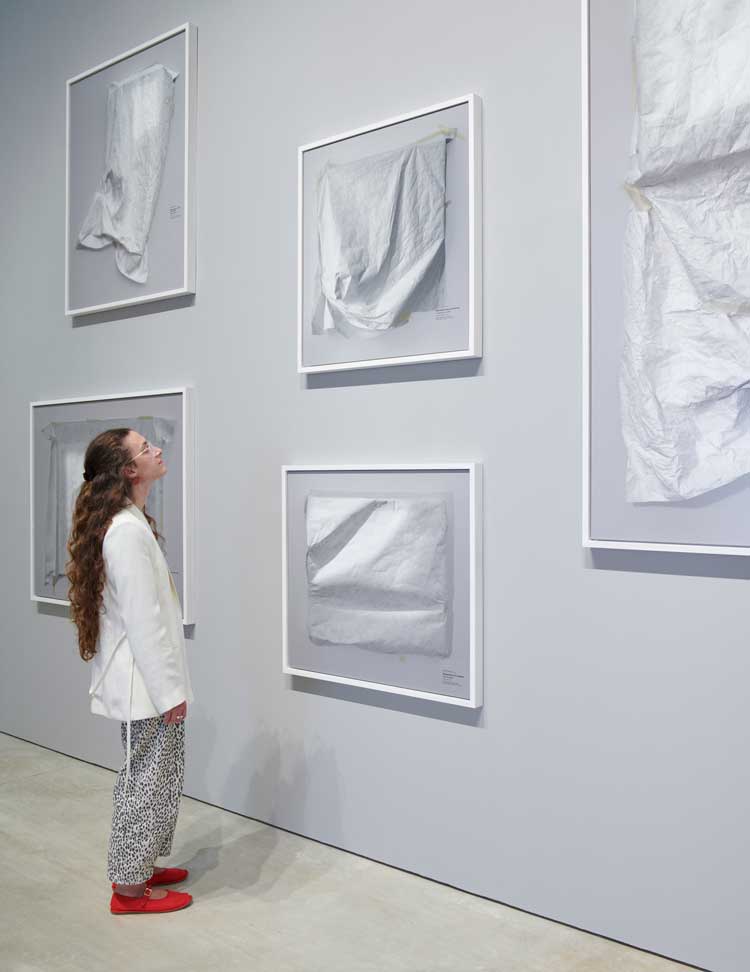
Sophie Calle, Picassos in Lockdown (detail), 2022. Installation view of Sophie Calle: Something Missing?, 2026. Courtesy Turner Contemporary. Photo: Jo Underhill © Turner Contemporary.
Similarly, What Do You See? (2013) responds to the thefts of a number of works from the Isabella Stewart Gardner Museum in Boston in 1990. The frames were left behind during the thefts, and they were restored by the museum and rehung, empty. “All the missing paintings were visible in their absence,” says Calle (perhaps also answering the Picasso conundrum). For this work, she asked curators, guards and other staff members to describe what they saw within the (empty) frames. Similarly, Turners (1998-2013), an especially suitable project for Turner Contemporary, looks at the theft of two JMW Turner works from the Schirn Kunsthalle in Frankfurt while on loan from Tate in 1994.
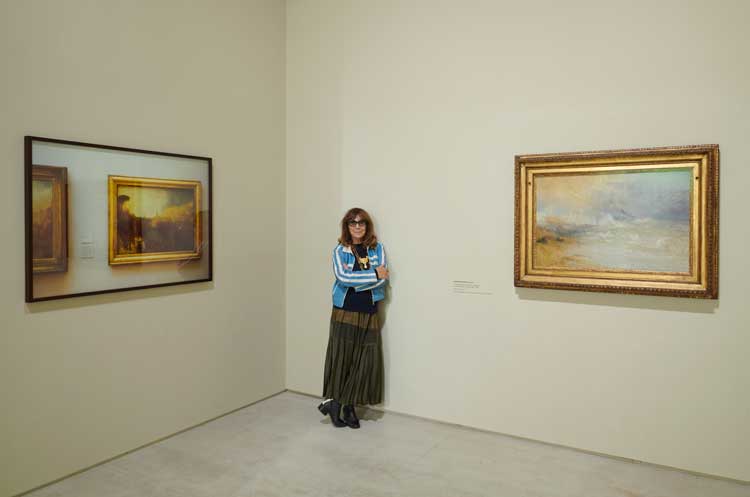
Sophie Calle in front of Turners, 1998–2013 and JMW Turner, Waves Breaking on a Lee Shore at Margate (Study for ‘Rockets and Blue Lights’), c1840. Installation view of Sophie Calle: Something Missing?, 2026. Courtesy Turner Contemporary. Photo: Jo Underhill © Turner Contemporary.
Standing in front of the replacement Turners, Calle this time asked curators, guards and other staff members to describe the missing works. This is shown alongside Waves Breaking on a Lee Shore at Margate (c1840), proving that Calle is not too intimidated to show alongside the British master: “I wasn’t afraid of Turner like I was of Picasso,” she says. “There’s more distance.”
-2018-26.jpg "Sophie Calle, Because (detail), 2018–2026. Installation view of Sophie Calle: Something Missing?, 2026. Courtesy Turner Contemporary. Photo: Jo Underhill © Turner Contemporary.")
Sophie Calle, Because (detail), 2018–2026. Installation view of Sophie Calle: Something Missing?, 2026. Courtesy Turner Contemporary. Photo: Jo Underhill © Turner Contemporary.
Extending the idea of covered or absent works, Because (2018-26) displays images concealed behind curtains, on which are embroidered texts revealing the motivation behind each photograph. Since, for Calle, an image alone typically feels unfinished, she interrogated her reasons for taking that shot. Was it of something beautiful? Did it capture a particular memory? The idea was to slow down the viewer’s access to the seemingly banal images and make them stop and think more about them.
.jpg "Sophie Calle, The Blind, 1986 (detail). Louisiana Museum of Modern Art, Humlebaek, Denmark. Acquired with support from The New Carlsberg Foundation and The Augustinus Foundation. Installation view of Sophie Calle: Something Missing?, 2026. Courtesy Turner Contemporary. Photo: Jo Underhill © Turner Contemporary.")
Sophie Calle, The Blind, 1986 (detail). Louisiana Museum of Modern Art, Humlebaek, Denmark. Acquired with support from The New Carlsberg Foundation and The Augustinus Foundation. Installation view of Sophie Calle: Something Missing?, 2026. Courtesy Turner Contemporary. Photo: Jo Underhill © Turner Contemporary.
Absence is also lingering in the oldest work on display, The Blind (1986). For this poignant project, Calle met people who were born blind and had never seen and asked them what their image of beauty was. The result is a real tear-jerker, and itself a thing of beauty. The answer here would definitively seem to be that even where we might see or expect an absence, there is nevertheless a presence.
Voir la Mer (2011) also made me suppress a sob or two. This time, Calle took people living in the mountains near Istanbul to see the sea for the first time. They were blindfolded and filmed from behind as they were allowed to look and, minutes later, they turned round and looked into the camera, their eyes filled with emotion. Calle was too scared to miss that “decisive moment” – “I could not ask them to look at the sea for the first time 10 times!” she jokes – and so she asked a friend to do the filming for her. For once, Calle says, the images spoke for themselves, without words: “It’s my only silent work.”
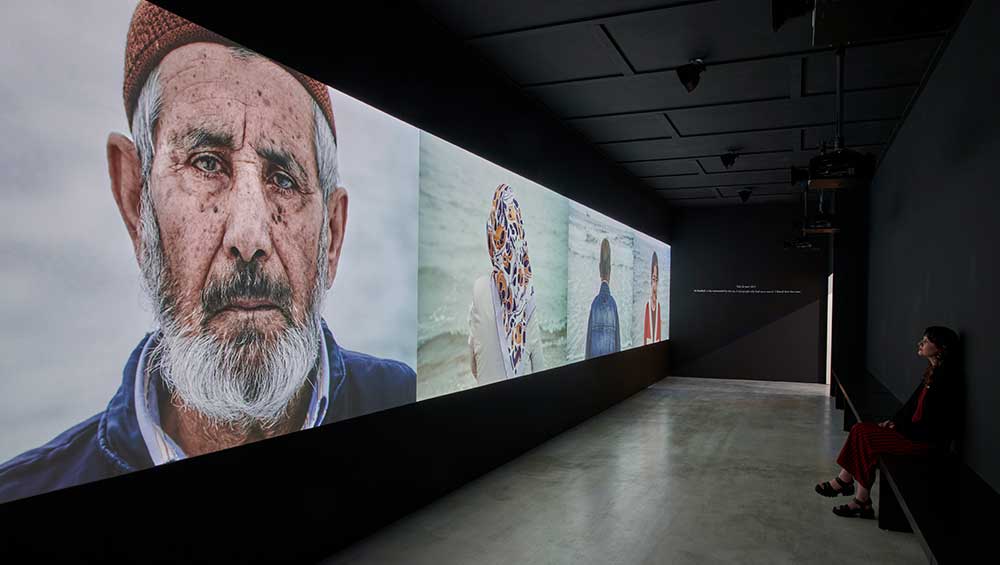
Sophie Calle, Voir la Mer, 2011. Installation view of Sophie Calle: Something Missing?, 2026. Courtesy Turner Contemporary. Photo: Jo Underhill © Turner Contemporary.
A truly monumental work in the exhibition is Calle’s Catalogue Raisonée of the Unfinished (2023). It comprises an inventory of every project she had ever wanted to do, but for some reason didn’t finish. For each one, there is a description of the idea, rubber-stamped with her reason for not completing it (think anything and everything from “what’s the point?” to “too late” to “self-censorship”), and an image (or, in a couple of cases, film) relating to the idea. Calle describes this work as “a way of giving life to my projects that I didn’t finish … a way of unburdening the weight”
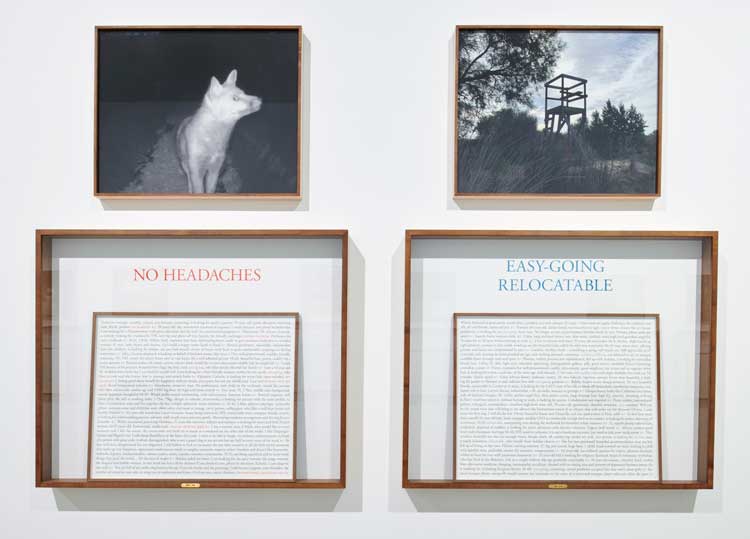
Sophie Calle, On the Hunt, 2017–2024. Installation view of Sophie Calle: Something Missing?, 2026. Courtesy Turner Contemporary. Photo: Jo Underhill © Turner Contemporary.
The pièce de résistance, however, has to be On the Hunt (2017-24). Once again, Calle was commissioned to make an exhibition for a museum that initially confounded her. The Musée de la Chasse et de la Nature (Museum of Hunting and Nature) in Paris invited her, but she felt she had no connection to hunting – until, of course, she did. Calle’s unique take on the problem was to interrogate the idea of hunting for a partner. She looked at personal ads from the journal Le Chasseur Français (The French Hunter), between 1895 and 2010, and then also on Tinder up to 2019. Assuming the role of a sociologist or historian, Calle sorted the ads by gender and divided them into 12 pairs of male-seeking-female and female-seeking-male, accompanied by images of wildlife captured by a night camera. For each pair, across each time period (mostly a decade, marked by a gold label at the bottom of each wooden frame), she wrote a headline and highlighted the prevalent search criteria. Here, the absence is the target of each search, who is very much implied by each concise description. Sometimes shocking, sometimes poignant, I didn’t see anybody looking at this project who did not break into a smile – if not a giggle – at some point.
Above all, Calle is a storyteller. Her works range from tearjerking to laugh-out-loud and everything in between. Their banality captures something that speaks to us all about the everydayness of the everyday. The absences create openings into which we, as viewers, can step, becoming implicated and a part of the work. Is it perhaps we who are signified?
Click on the pictures below to enlarge

Copyright © 1893–2026 Studio International Foundation.
The title Studio International is the property of the Studio International Foundation and, together with the content, are bound by copyright. All rights reserved.
 |
 |
 |
|---|
-300.jpg)
-300.jpg)

 Found Cities, Lost Objects: Women in the City
 Sophie Calle and her guest Jean-Paul Demoule: The Ghosts of Orsay
 Anna Ray: Fibre and Form
 GSK Contemporary, Earth: Art of a changing world
 Sophie Calle: Talking to Strangers