



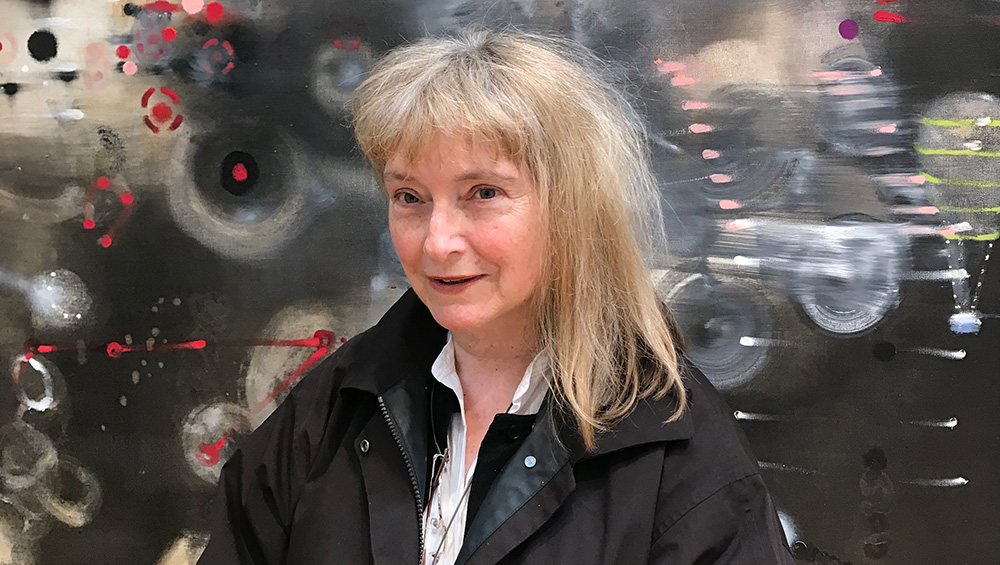
Virginia Verran, 2024. Image copyright and courtesy the Artist.
by SAM CORNISH
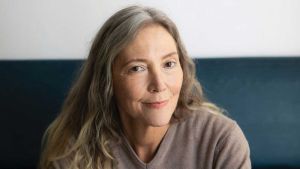
Virginia Verran visualises life, from the bodily to the social, as something unstable, joyful, tragic, unknowable, yet shot through with the strangely familiar. The same generation as the YBAs, she has made her own way, committed to painting, developing a highly personal, undogmatic language. Large atmospheric spaces are contrasted with graphic incidents, sometimes cryptic, occasionally disarmingly direct. Serious enough to include humour, these paintings are focused enough to be full of tangents, digressions and sideways glances. Her first solo exhibition took place in 1986, her most recent at Art Space Gallery, London, in 2024. She won the 2010 Jerwood Drawing Prize. The Henie Onstad Kunstsenter, Oslo, held a retrospective of her paintings in 1999, and a follow-up is long overdue. As well as a respected teacher, currently with Turps Banana, Verran runs the estate of photographer Bruce Bernard.
Sam Cornish: Your paintings include disparate approaches to making space. Amorphous, light-dark expanses are combined with diagrammatic indications of perspectival depth. Figurative imagery also ranges widely. A shadowy suggestion of a body or torso may take up much of a large painting that also contains inch-high toy-town depictions of people. Is your aim to resolve these spatial tensions or keep them alive? You seem to want to keep the viewer on their toes …
Virginia Verran: I am as interested in the atmospheric, romantic allusion to deep space in the paintings as I am in the tiny graphic details which sometimes sit on the surface of them—indicating approximate 3D perspectival chairs, ladders, roads and fences. Washes of pigment are rubbed back to reveal light, alluding to what I often consider to be an abstracted body or skin, and this often occupies the height of the painting. This could potentially be the essence of me, or of anyone: a membrane, slightly larger than life-scale, slowed down in an almost holographic space. The sometimes frenetic, staccato marks, the ticker-tape stripings, and the occasional tiny, graphic, cartoonish figures are there on the surface layer to disrupt and sharpen up the almost ectoplasmic heads and veils, and to provide a vital difference in scale. In my mind's eye, this could be confronting a sense of the precarious self and, in terms of the figures, introducing a symbol of “everyman”.
-2004.jpg "Virginia Verran, Black Painting (Speed 101), 2004. Oil on canvas, 183 x 167.5 cm Image copyright and courtesy the Artist.")
Virginia Verran, Black Painting (Speed 101), 2004. Oil on canvas, 183 x 167.5 cm Image copyright and courtesy the Artist.
So, no, I am not interested in the resolution of the paintings’ complexities and, yes, I want to keep the viewer on their toes—or even on metaphorical barbed wire occasionally – where the anxious issues of endless time and space and the thin membrane we inhabit are palpable referents, but euphoria and playfulness exist, too, in the diagrammatic, doodled, graphic component parts.
SC: Could we say that the painterly expanses stand in for the unescapable constants we face as humans, in a single body, among other bodies, against the light and space and stuff of the world; while the drawing optimistically suggests the idiosyncrasies of individual experience, the importance of personality, the possibility of caprice and unexpected connections? The drawing also seems to me to be conversational, talkative, while a lot of abstract art asks for a silent viewer.
VV: That is certainly a possible view, because there is a very conscious separation between the deeper, denser atmospheric space – which represents, in some way, the larger territory, the endless questions, what can’t be known – and the introduction of small graphic details which attempt to define and confine what I do feel that I know. I like to flirt with those.
I am now questioning myself with regard to what happens with those drawn elements on and in the paintings, and with what happens in the very large sketchbooks. In the sketchbooks, I am quite aware that I use them as a visual diary. There are frequent pages and sequences of pages where the drawings clearly represent, to me, experiences I am going through which I then might feel the need to undo and hide in some way, usually with repetitive lines or chequered patterning. At the same time, there is a greater lightness of touch – an immediacy in the connection between the mind, eye, and heart – something I refer to as “a hot line to the nervous system”, which allows the conversational quality you suggest, with signs and signals which invite interpretation. I might introduce a hand, a ring, a road, a telegraph pole, a fire, spectacles, a small crowd, or a heart among repetitive patterned areas. In the drawings, these are the main focal point, but in the paintings, they are mostly small additions to the whole which usually sit on the surface.
,-2026.jpg "Virginia Verran, Orange-Pink (Fallen), 2026, oil and mixed media on canvas, 30 x 30 cm Image copyright and courtesy the Artist.")
Virginia Verran, Orange-Pink (Fallen), 2026, oil and mixed media on canvas, 30 x 30 cm Image copyright and courtesy the Artist.
You mention that “a lot of abstract art asks for a silent viewer”, and it is interesting that I do not readily place myself in that category as an “abstract” artist. It is not a word I claim for myself in relation to what I do and how I think, and I am not sure that silence is what I am looking for in relation to the viewer because, as I see it, that is something we face for all eternity. I want to provoke, unsettle, and open up questioning thought patterns as much as I want to lose myself or anyone else in the immersive act of painting. I suppose this suggests that I am not ultimately looking for a kind of silent reverie, although it is something I greatly appreciate in painting.
SC: I think that I – as someone who looks at a lot of abstract painting – am partly drawn to your paintings because they break that silence.
Switching tack, can you say something about the use of the circle as a motif in your painting? Sometimes they are in the form of a dot, like the pinpricks in needlework or tattooing. Sometimes they become three-dimensional, orbs or spheres, sometimes like a kind of spotlight. You have also made tondos, although you did say to me you hated that word!
VV: “Circle” is the word I prefer (it is true that I cringe at “tondo”). Working for the very first time in the studio with circular boards came about purely through chance, because somebody discarded six of them, painted a fluorescent orange. I primed them white, keeping the orange edges. Then this form became simply another possibility in the work rather than having a very specific significance. Edges in the paintings are always very important, and in this case, it’s a continuous one. Over time, I have made that edge a more conscious element, with some of the paintings having a suggested ticker-tape edge all the way around, emphasising a border beyond which you cannot go.
,-2025.jpg "Virginia Verran, Outside the Golden Age (After Cranach), 1530, 2020, mixed media on canvas and paper, 25 x 20 cm Image copyright and courtesy the Artist.")
Virginia Verran, Outside the Golden Age (After Cranach), 1530, 2020, mixed media on canvas and paper, 25 x 20 cm Image copyright and courtesy the Artist.
You are right that circles, holes, dots (another form of delineation line), pinpricks, spotlights, and planets appear across all aspects of the work – and they have done since I began making work aged 16 – and they have very different roles to play. I like the precision of placing perfect dots that have a sharp, raised edge like braille across an area of paint, sitting on the surface of it like a screen. This helps to create a layered space, with an accent on rhythm and repetition (I played drums in my teens and often there are analogies to be made with the skin of the canvas and the skin of the snare drum), which I then work with further to disrupt and complicate any readily identifiable vantage point.
I draw circles fast to see how close to perfect I can make them, and I get a particular pleasure out of winging this, making very rapid single, precise dots of paint on very large paintings. Sometimes these are the last, consciously controlled details I add, such as in Blue/Black (Interior) (2023). It is a daredevil act because it could go very wrong, but it has something to do with finalising the painting with a precise consciousness.
,-2025-6.jpg "Virginia Verran, Blue-Black (Interior), 2023. Oil on canvas, 183 x 167.5 cm Image copyright and courtesy the Artist.")
Virginia Verran, Blue-Black (Interior), 2023. Oil on canvas, 183 x 167.5 cm Image copyright and courtesy the Artist.
In the paintings, I think of satellites, stars, searchlights, surveillance, radars, spotlights and clocks, so there is an element of being watched, of checks and balances, and of sparkling, unreachable mystery. But at one and the same time, these allusions and details could work simply as circles and dots, having precision and delicacy set against the large, amorphous painted space. It is important that perceived images can also read as abstract signs and devices, but I want them to be dependent on each other across all my work, keeping the thought process open.
SC: I’m interested in your use of photography. From what I can tell, the photographs in your paintings are ones you have discovered in newspapers, books, X-rays. Why found imagery, rather than your own photographs? Especially given how easy photography now is.
VV: Photography and allusion to photographic qualities are certainly important factors. In terms of painting itself, I often drag and blur the paint, creating movement, and draw attention to the skid of the brushmark.
I have incorporated cut-out images from books because I want the actual image as a fact rather than a painted version. Although I usually add a protective glaze, I then add paint to partly make it my own and transition it into the painted realm.
,-1997.jpg "Virginia Verran, Black Painting (One Million Miles), 1997. Oil and mixed media on canvas, 228 x 198 cm Image copyright and courtesy the Artist.")
Virginia Verran, Black Painting (One Million Miles), 1997. Oil and mixed media on canvas, 228 x 198 cm Image copyright and courtesy the Artist.
One example of this approach is Black Painting (One Million Miles) (2007). In the bottom left-hand corner is a man in white overalls (or perhaps a spacesuit) walking out of the painting and the enormity of all that is above him. That is pretty much how I think of life from my basement studio. Near to him, but completely isolated, is another cut-out figure, dressed in black, standing in his own pool of light. These images were taken from photographs I no longer remember. Further up is a path through a field of green grass, and beyond that, a cut-out image of a car on fire and a man who has presumably escaped. On the right-hand edge, near a painted hot air balloon, is a cut-out image of a woman from one of the Roman Fayum portraits – paintings which I think are some of the greatest portraits ever made, having a warm, generous gaze which cuts across the centuries.
,-2018.jpg "Virginia Verran, Facture / Fracture (After Cranach), 2018. Mixed media on watercolour paper. Image copyright and courtesy the Artist.")
Virginia Verran, Facture / Fracture (After Cranach), 2018. Mixed media on watercolour paper. Image copyright and courtesy the Artist.
In a separate, more graphic series of work, I have taken cut-out figures from Lucas Cranach’s The Golden Age (Cranach is a favourite of mine) and placed them in a more dystopian age – using regular images, signs and symbols; metaphorical “toy” bombs, flags and rooftops/ladders incorporated into a fractured and fragmented space.
Very occasionally I have included details from my own photographs, for example a detailed piece I made partly during a residency in Ireland, where the circle became a predominant form. I had been thinking of my father (“MDV”) while staring out at sea (he died when I was 11) and, initially, I included a small photograph of his head but then drew heavy black ink all over it and, eventually, in very private language, incorporated a small circular photograph of a tiny area of sea at Meudon, Cornwall, where he taught me to swim. On this are drawn tiny crosses.
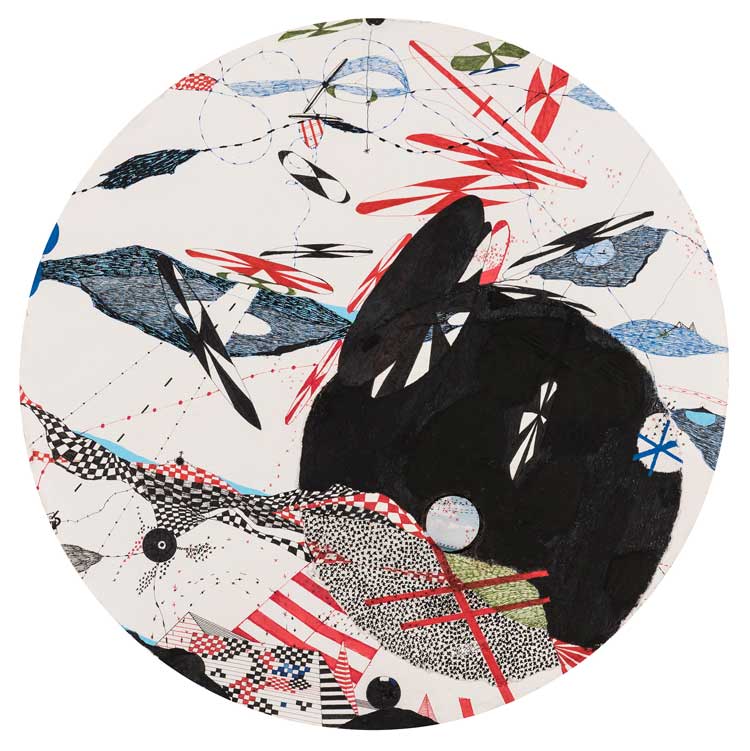
Virginia Verran, MDV-Space, 2014. Mixed media on watercolour paper, 60 cm diameter. Image copyright and courtesy the Artist.
Nobody would know that the colliding forms – the propellor-like shapes spinning and cutting through space towards the chequered fields below – are a coded language for sudden and dramatic change in circumstance (in this case the sudden death of my father). But beyond the personal, there are the risks we all live with every day: hidden threats – physical; geological; astral.
Alongside this sense of gravity lies chance, serendipity, mischief and a strong desire to avoid narrative. I am equally emphasising formal considerations of composition, repetition and colour, while focusing on light, materiality, touch, grace, beauty, and elevation – elements that are vital to me (from Rembrandt to Richard Tuttle) in painting.
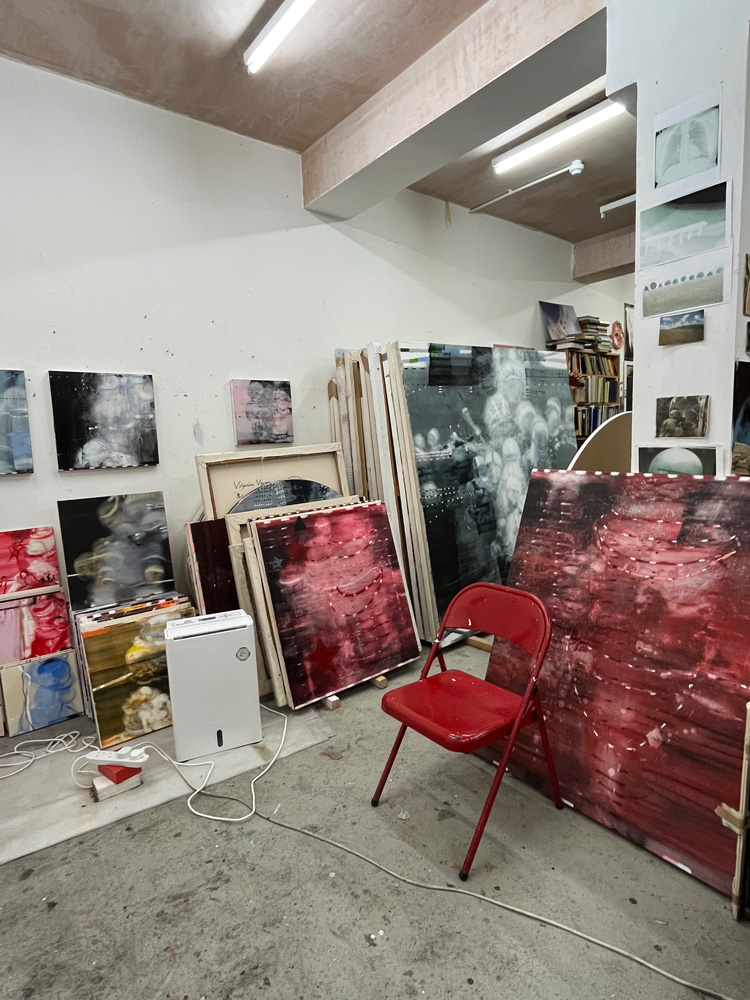
Virginia Verran's studio Image copyright and courtesy the Artist.
Click on the pictures below to enlarge

Copyright © 1893–2026 Studio International Foundation.
The title Studio International is the property of the Studio International Foundation and, together with the content, are bound by copyright. All rights reserved.
 |
 |
 |
|---|
-300.jpg)
-300.jpg)
 Trinity Buoy Wharf Drawing Prize 2020
 Tania Kovats and Kimathi Donkor discuss drawing practice and education
 Axel Antas: Nature of Things/Marijke van Warmerdam: First Drop