




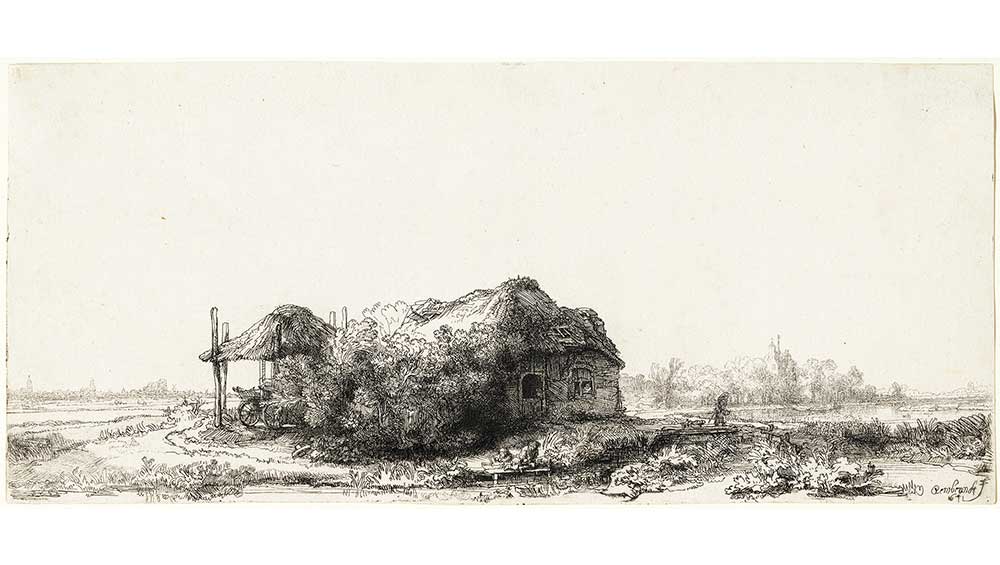
Rembrandt van Rijn (1606–1669). Landscape with Cottages and a Hay Barn: Oblong, 1641. Etching with touches of drypoint on paper, 14.5 x 32.4 cm. National Gallery of Ireland Collection. Photo: National Gallery of Ireland.
National Gallery of Ireland, Dublin
18 July – 6 December 2026
by JULIET RIX
To celebrate Ireland’s presidency of the Council of the European Union (July – December 2026) and showcase the range of its 15,000-strong collection of works on paper, the National Gallery of Ireland (NGI) is displaying 57 selected drawings, prints, watercolours and pastels normally viewable only by appointment. The range is indeed broad covering not only Rembrandt to Matisse (as the title guarantees), but 15th-century Italian old master drawings to 21st-century Irish and Finnish photography via German expressionist prints and watercolour.
The show has no unifying narrative – only the above stated aims and a desire to demonstrate the different ways paper is used by artists, from technical study and preparatory sketches to the intimate or experimental and, of course, to enable wider dissemination of their art. The show is a hotch-potch, but one containing some beautiful and intriguing images. As the curator, Niamh MacNally, points out, work on paper, and drawings in particular, can bring us closer to the creative process and intent: “They are a direct and tangible link to the artist.”
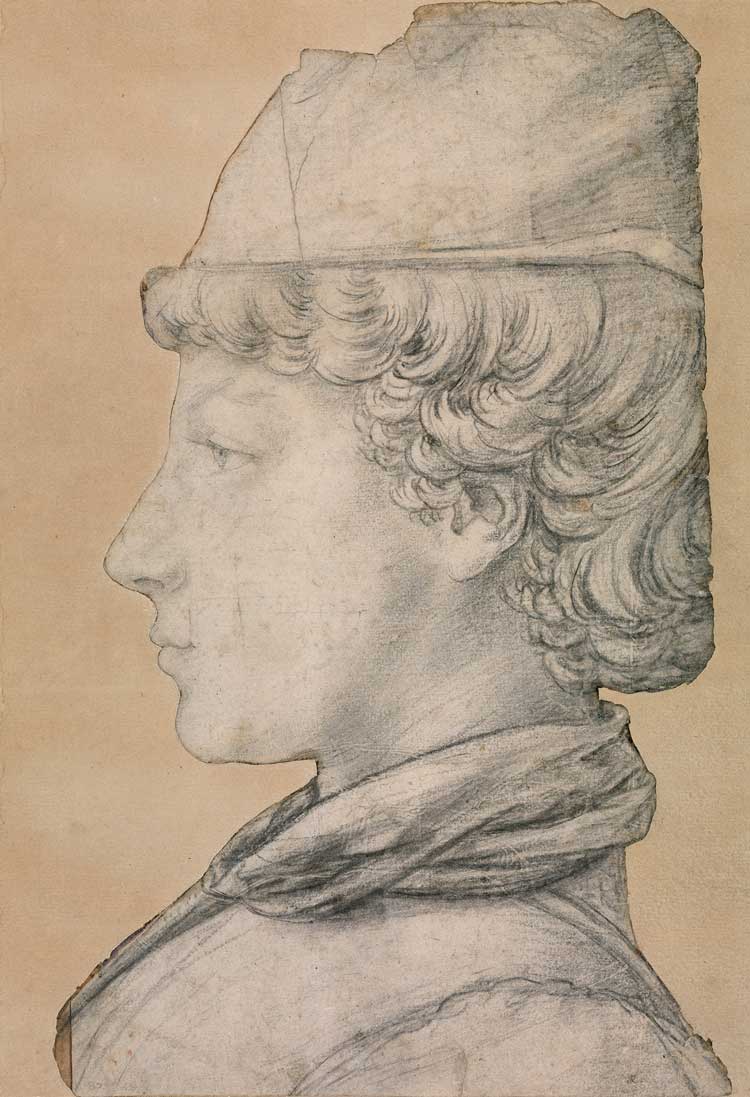
Antonio del Pollaiuolo (c1432-1498). Profile Portrait of a Young Man, c1470-1475. Black chalk, traces of stylus and brown watercolour on paper. Photo: National Gallery of Ireland.
The exhibition kicks off with a recognisably Pollaiuolo chalk drawing, Profile Portrait of a Young Man (c1470-75). It is still debated which Pollaiuolo brother, Antonio or Piero, made it (or whether both did). Not directly connected to any known painting, the picture was bought for the gallery just two years after it opened in 1864, at Sotheby’s 1866 London sale of treasures from the collection of Rev Dr Henry Wellesley (collector and curator of the Bodleian Library and Ashmolean Museum Oxford). Several other drawings were purchased here, too, including the equally fine and “finished” c1490s portrait head (with neck and shoulders adorned in highly decorated brocade) that is now presumed to be Francesco Il Gonzaga, Duke of Mantua, by his court painter, Andrea Mantegna (c1431-1506) – though at the time of its purchase it was labelled less convincingly as The Duke of Milan by Leonardo da Vinci.
The Mantegna drawing carries an ink stamp showing its ownership by leading English Regency miniaturist Richard Cosway, whose miniature self-portrait is displayed nearby. The Pollaiuolo is stamped “JR” – the mark of the London portrait painter, writer on art and collector Jonathan Richardson the Elder (1667-1745), who is said to have inspired Joshua Reynolds. Remarkably (to us) it was normal for 18th-century collectors, including leading artists, not only to mark their drawings as if branding their herd, but to do so on the front of the work. Though a habit we would not now condone, it does provide insight into provenance, artistic connections and possible influence.
Richardson also owned a red chalk drawing by Parmigianino, A Putto with an Eagle (with Saint Matthias on verso) (c1522), that hangs nearby and this picture has an additional stamp showing it had been previously owned by the American artist Benjamin West. A “School of Raphael” drawing (formerly attributed to the master), Standing ?Philospher [sic] and Hand Study (c1508-10, perhaps related to Raphael’s School of Athens fresco), carries the initials of English portraitist Sir Thomas Lawrence (1769-1830) as do the exhibition’s two drawings by Ludovico Carracci (1555-1619). One of these, St Francis of Assisi (c1588-89) has been stamped by three owners: an Austrian Count; the British politician and poet Sir Francis Egerton, 1st Earl of Ellesmere (1800-1857); and Lawrence. Collecting old master drawings could be about social status or artistic pursuit. In Lawrence’s case, drawing was central to his practice and the art historian Michael Levey wrote of him: “For delicacy and precision as a draughtsman he was rivalled in his period only by Ingres.”
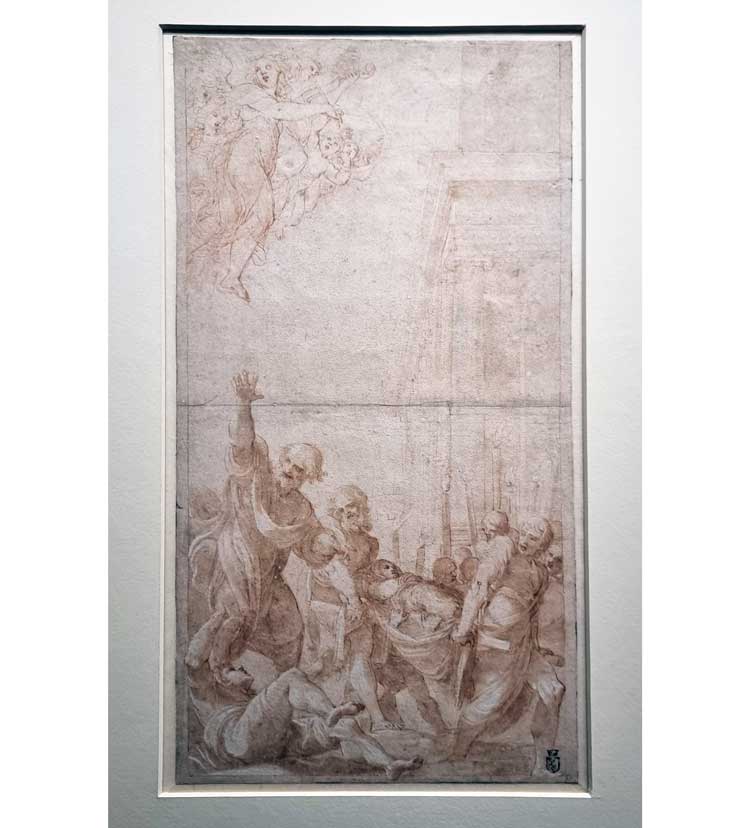
Ludovico Carracci. The Apostles Carrying the Body of The Virgin to the Tomb, 1605-09. Photo: Juliet Rix.
The other Carracci, The Apostles Carrying the Body of The Virgin to the Tomb (1605-09), is described on the exhibition label as a preparatory drawing for his painting Funeral of the Virgin Mary (c1605-09) for Piacenza Cathedral – though the painting is not very similar. One of the most interesting differences is the exclusion from the bottom left of the drawing of the disturbing prone figure writhing in agony, his hands having been severed and left attached to the Virgin’s stretcher. This non-biblical narrative of the punishment (and then conversion) of a Jewish opponent of Mary is generally found on Orthodox icons of the Dormition of Theotokos (falling asleep of the Mother of God), so it is perhaps not surprising if the Roman Catholic Bishop of Piacenza chose not to include it in his church.
It would have been good to have a photo of the Carracci painting alongside the drawing – a trick missed more than once in this exhibition when paintings are referenced. Fortunately, we have Google and Wikimedia to help.
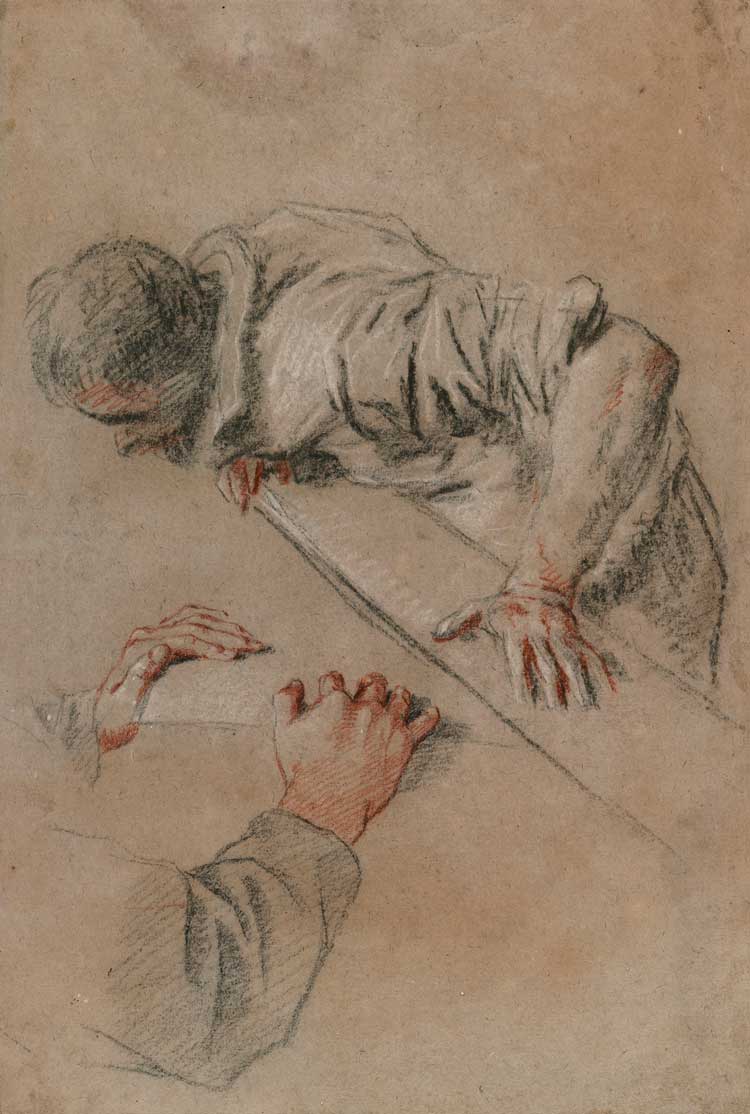
Jacopo Bassano il vecchio, (c1510-1592). A Man Leaning over a Parapet and a Pair of Hands. Black, white and red chalk on paper. Photo: National Gallery of Ireland.
A rather different drawing, though from a similar era, is A Man Leaning over a Parapet and a Pair of Hands in red, white and black chalk by Jacopo Bassano (c1510-92). Bassano is known for the naturalistic elements he inserted into his biblical paintings, and this study is thought to have been done from life. It certainly has a lively immediacy, and you can feel the weight of the man’s leaning body on the hand pushing down on the wall.
The show’s second room starts with landscapes, including the recently acquired Rembrandt of the title. Landscape with Cottages and a Hay Barn (1641) at first seems a simple hatched etching neatly matching its title. Look closer though and there are enjoyable details: cartwheels sticking out of the barn, two figures fishing, someone looking out of a window and another walking the riverside with a dog. In the distance on the left is Amsterdam (where Rembrandt worked from 1631), on the right, a grand house believed to be of the Kostverloren estate, placing the scene on the Amstel River south of Amsterdam. Dutch artists at this time were beginning to work from nature, but not slavishly. Rembrandt takes realistic elements and combines them in his own way, here using a vast expanse of empty paper – about two-thirds of the image – for the sky, something quite revolutionary in Dutch art at the time.
Rembrandt is an example of an artist who relied on art on paper. Never travelling outside his native Netherlands, his experience of non-Dutch artists came almost entirely through prints, and in turn it was prints that allowed the dissemination of his art abroad.
Like Rembrandt, the other two household name artists with landscapes displayed in this room made effective use of unpainted paper in their sketches. We see this in a sparse en plein air watercolour by Paul Cezanne (1839-1906) of one of his late-in-life favourite subjects, Mont Sainte-Victoire (1901-06), and in JMW Turner’s (1775-1851) luminous watercolour sketch, Bregenz, Lake Constance, Austria (c1840), where Turner’s choice of blue paper is used to great effect.
Lesser known is the artist Maxime Maufra (1861-1918). His Bilfot Cove (1893) is a gentle etching and aquatint of a bay in Brittany where the artist spent time with Paul Gaugin and his circle. Maufra valued feeling over accuracy and it shows. Although apparently a simple scenic view, this remarkably composed and engaging work has unexpected emotional strength (it is better in the flesh than in reproduction). One of the curator’s favourite works in the show, it is one of mine too.
Also influenced by Gaugin was the Breton artist Armand Séguin (1869-1903). His Trees Above the Estuary (1892) is a graphic black-and-white print of watery meanders through patterns of foliage that clearly owes much to Japanese prints (popular in France at this time). Séguin became friends with the Irish artist Roderic O’Conor who produced a series of experimental etchings under Séguin’s tutelage. One of these was The Cliff (1893) displayed here – a moody, abstracted, thoroughly modern piece.
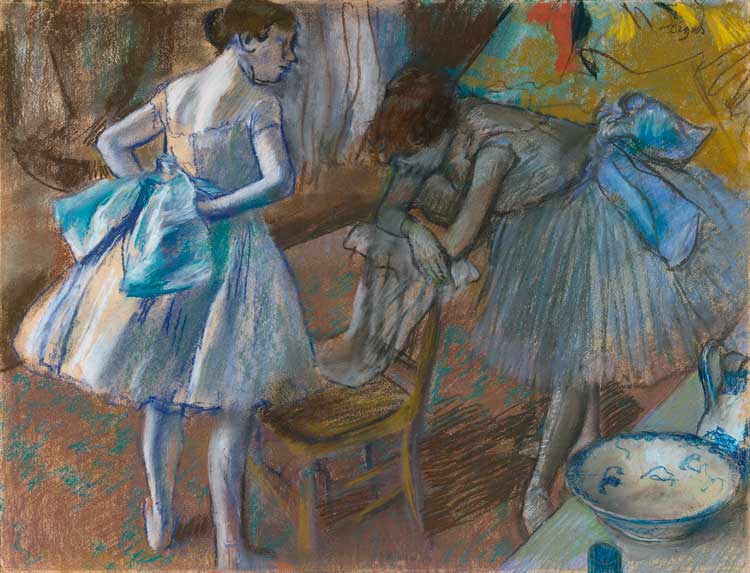
Edgar Degas (1834-1917). Two Ballet Dancers in a Dressing Room, c1880. Pastel on paper, 48.5 x 64 cm. National Gallery of Ireland Collection. Photo: National Gallery of Ireland.
These prints are, of course, not studies or preparation but finished works of art. So, too, are many of the human figures that fill the other half of this room. Most are dancers and along with the inevitable Edgar Degas (1834-1917) ballerinas is his wonderfully colourful and vibrant drawing Two Harlequins (c1885), a Pablo Picasso (1881-1973) and an Henri Matisse (1869-1954). Picasso’s Two Seated Dancers of Les Ballets Russes, Monte Carlo (1925) is a study drawn at the end of a period when Picasso designed sets and costumes for Diaghilev’s company and was married to one of its dancers, Olga Khokhlova, an early muse. The ballerinas are seen here at rest. One – with a dual viewpoint face that nods to cubism – has her right arm around the shoulder of her companion while her left hand rubs her foot as if recovering after dancing.
I particularly like Matisse’s lithograph Dancer Reflected in the Mirror (1927), originally one of a set of 10 lithographs of Henriette Darricarrère (Matisse’s favourite model from 1920-27) in various dance poses. There is something intimate, private even, about the angle of her body and her face in the mirror; you feel she thinks she is alone. Matisse valued drawing as an end in itself, writing: “Personally I think painting and drawing say the same thing. Drawing is painting with reduced means.”
A frankly sexual chalk and graphite sketch, A Female Nude Reclining on a Chaise-longue (c1752) by François Boucher (1703-70) is almost certainly a study for his erotic painting The Blonde Odalisque (two versions 1751/52) which it closely matches. The nude model here is thought to be a 14- or 15-year-old Marie-Louise O’Murphy – yes, of Irish origin, hence her inclusion here – who became mistress to King Louis XV, possibly as a result of the King seeing the painting.
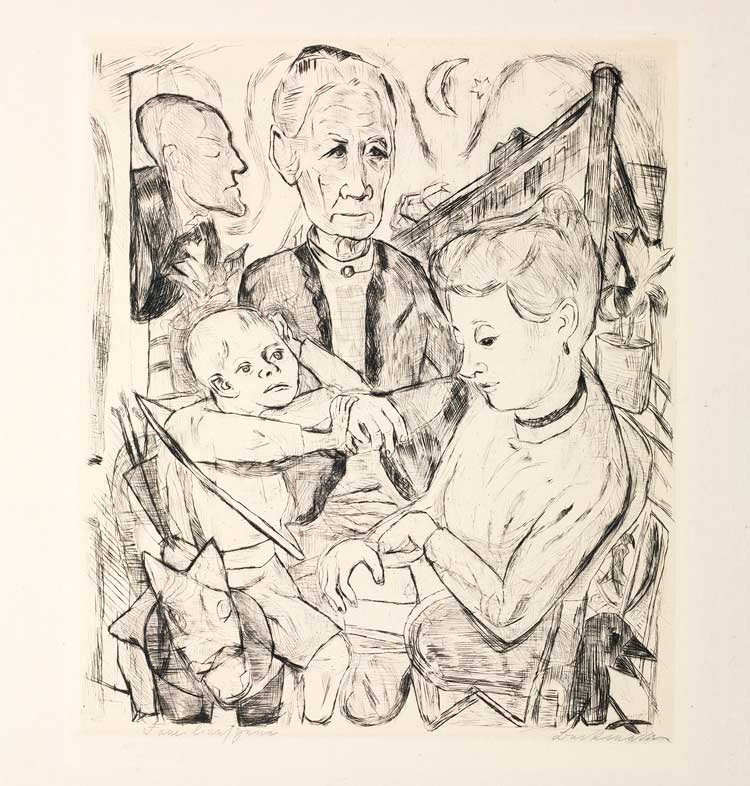
Max Beckmann, (1884-1950). Family Scene (The Beckmann Family), 1918. Drypoint etching on Simili Japon paper. Photo: National Gallery of Ireland.
The NGI has a significant holding of German expressionist art on paper, represented here by five works including an unusually affectionate wartime etching by Max Beckmann (1884-1950). Family Scene (Beckmann Family) (1918), depicts his wife, mother-in-law and young son strikingly interconnected, with Beckmann placed separately in profile in the background with his eyes closed. Beckmann lived apart from his family during and in the aftermath of the first world war. Initially, he didn’t (couldn’t?) paint and apparently found his way to his new style through prints and drawings. An early victim of the Nazification of art, Beckmann was sacked from his teaching job in 1933 and later labelled “degenerate”, as were Käthe Kollwitz (1867-1945) and Emil Nolde (1867-1956) also exhibited here.
Kollwitz’s Working Woman with Blue Shawl (1903) is an evocative colour lithograph of the face of a careworn woman. Expressing strength as well as resignation, it is a moving image, probably inspired by one of the local poor treated by the artist’s doctor husband. Certainly, it reflects Kollwitz’s concern – in life and art – for those, especially women, struggling to survive in early 20th-century Germany.
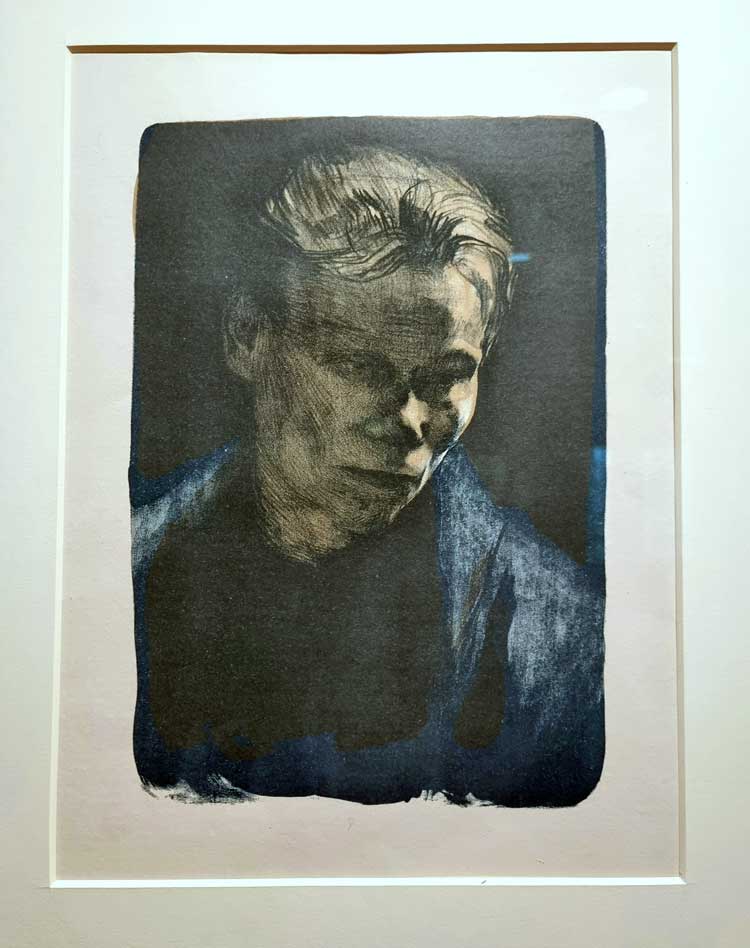
Käthe Kollwitz (1867-1945). Working Woman with Blue Shawl, 1903. Colour lithograph. Photo: Juliet Rix.
At about the time of this picture, Kollwitz consciously shifted from painting to print-making to ensure her work was accessible to a wider audience. As a champion of the downtrodden, she was never popular with the establishment and under National Socialism, this socialist artist lost her career and died just before she could witness the defeat of the Nazis.
Nolde fared better in terms of survival but spent years unable to work openly. As a result, he secretly created what he could: small scale watercolours on paper. He made 1,300 such colourful images which he called his “unpainted paintings”. Rain over a Marsh (c1938), displayed here, is one of these, a vibrant, atmospheric image of the flat Schleswig-Holstein land that surrounded his home with a couple of tiny brightly coloured buildings and a huge dramatic sky of thick black clouds – and a hopeful swathe of blue.
The exhibition ends with a few works – mostly photographs – inspired by the landscape and culture of Ireland. A black-and-white photo by the Irish artist Sean Scully (b1945, Dublin) of Aran’s lines of dry-stone walls (2006) echoes the stripe paintings for which he is best known (and which can be seen in the NGI’s permanent collection). Employing a similar combination of documentary truth and geometric abstraction is a silvery monochrome photograph by another Irish artist. Hand Cut Bog (2011) by Amelia Stein (b1958, Dublin) was part of a series of images she produced of the traditional cutting and stacking of peat turf in North Mayo. It is possible (for those in the know), MacNally tells me, “to identify from the cutting pattern the hand that made it – like the mark-making of an artist”.
Just as Irish artists have taken inspiration from continental Europe, so some continental Europeans have been inspired by Ireland. The German artist and activist Joseph Beuys (1921-1986) visited Ireland from the 1940s onwards – particularly intrigued by its boglands and geology. He became the first “contemporary” artist to exhibit on both sides of the Irish border and his trip across the island in 1974 was documented by his friend and collaborator, the then Guardian art critic Caroline Tisdall (b1945).
Her photograph of him amid the striking and varied basalt columns of the Giant’s Causeway is shown here. The famous formation on the Northern Irish coast was an inspiration for one of his best-known works, his “social sculpture” 7000 Oaks (1982). The 7,000 basalt columns of this outdoor installation were “sold” to sponsors to pay for the planting of the same number of oaks – a process that outlasted the artist. The trees, paired with their basalt columns, still stand outside the German town of Kassel. In the Giant’s Causeway, Beuys saw “unity in diversity” – perhaps a suitable place to end a potpourri show of work from across the European Union.
Click on the pictures below to enlarge

Copyright © 1893–2026 Studio International Foundation.
The title Studio International is the property of the Studio International Foundation and, together with the content, are bound by copyright. All rights reserved.
 |
 |
 |
|---|
-300.jpg)

-300.jpg)
 How the Master Became the Master
 Interview: Kim Thomas Reflects On Art, Music, Poetry and Life
 Sharon Booma's Odes and Intimations of Immortality
 Matisse, His Art and His Textiles. The Fabric of Dreams
 Matisse Picasso