




-1000.jpg)
Tomás Saraceno in collaboration, Ancestral Futures, exhibition view, Haus der Kunst München, 2026. Photo: Agostino Osio. © Haus der Kunst München, 2026.
Haus der Kunst, Munich
17 July 2026 – 7 February 2027
by VERONICA SIMPSON
I felt a little disappointed on my initial tour of Ancestral Futures, the Argentinian-born, Berlin-based artist Tomás Saraceno’s show at Munich’s Haus der Kunst. Saraceno’s interdisciplinary ambition, his passion for celebrating the ingenuity and splendour of spidery universes and his desire to enrich our human sensibilities with greater awareness of how other species think, collaborate and navigate is impressive. So, too, is the fact that he is so attuned to the elements that are negatively impacted by our species’ toxic practices. Assisted by his large, multidisciplinary studio in Berlin, each of his investigative projects results in something spectacular, always underpinned by rigorous thinking. The projects are, understandably, enormously time-consuming, so it’s not surprising that, as his shows tour the world, many of the same projects and works are revisited.
I first witnessed his spider sculptures, Webs of At-tent(s)ion in 2020 in Florence’s Palazzo Strozzi. Created in 2018 for his Palais de Tokyo show, these genuine marvels of engineering and architecture are created by spider “collaborators” in his Berlin studio, transported in secure glass frames and shown in darkened rooms, artfully spotlit. They also played a starring role at his survey show at the Serpentine South Gallery in London in 2023. While still a thing of wonder, they are undeniably less thrilling when I encounter them for the third time, despite being expertly choreographed and displayed in this monumental Munich museum.
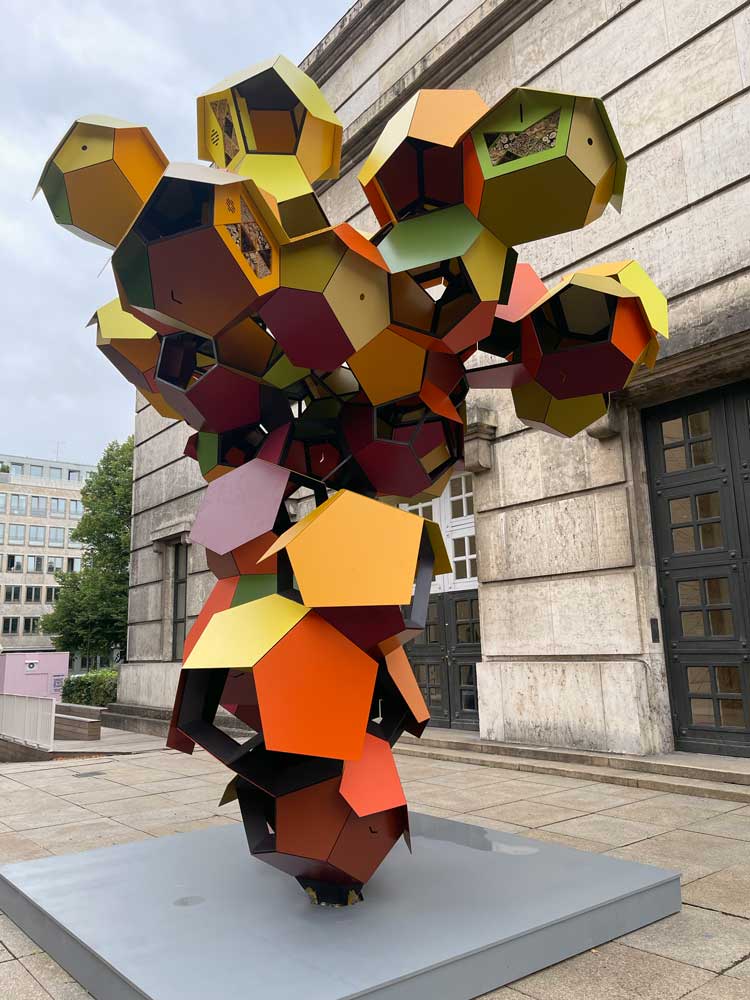
Tomás Saraceno, Species of Spaces and Other Pieces, 2023. installation view, Haus der Kunst München, 2026. Photo: Veronica Simpson.
The colourful outdoor sculpture Species of Spaces and Other Pieces (2023) debuted at the Serpentine. Then it was positioned on the Hyde Park lawns outside the gallery. This time, it sits on the Haus der Kunst’s terrace, looking like a cross between a complex molecule and a Meccano kit. Each geometric segment is apparently tailored for an assortment of birds and flying or crawling insects. The hope is that many of them will make themselves at home during the show’s duration, but this leads me to a less comfortable thought. Will those birds, bees and insects be rendered homeless when the sculpture is moved to the next institution?
The welcome of “other species” here includes canine companions. A handful of doggy paintings are displayed in the gallery adjacent to the terrace: seemingly blank, white canvases are presented at canine nose level (high and low) and infused with fascinating scents that only a dog could detect. This foyer, strung with strikingly web-like, human-made sculptures, will be accessed free of charge by terrace-visitors.
i(y)thms-(2019)-HDK_Ausstellungsansicht_Tomas-Saraceno_Foto-Agostino-Osio_3230.jpg "Tomás Saraceno in collaboration, Algo-r(h)i(y)thms, 2019. Installation view, Ancestral Futures, Haus der Kunst München, 2026. Photo: Agostino Osio. © Haus der Kunst München, 2026.")
Tomás Saraceno in collaboration, Algo-r(h)i(y)thms, 2019. Installation view, Ancestral Futures, Haus der Kunst München, 2026. Photo: Agostino Osio. © Haus der Kunst München, 2026.
I hope that entry to the room that opens off this foyer, which is occupied by Saraceno’s Algo-r(h)i(y)thms (2019) will also be free. Created together with researchers in bioacoustics and animal behaviour, each strand or cluster of strands in a dense, web-like rope formation inside the room gives off notes that vibrate as you move through them. It’s a pleasantly harmonious kind of music, veering between solo, chordal and polyphonic depending on the movement within it, mimicking the way spiders detect the vibrations of things making contact with their webs. I kicked off my shoes and crept around the work, experiencing its quirky resonances with delight. This one was new to me.
I had previously encountered Thermodynamic Constellations (2020) – semi-transparent and partially metallised, reflective globes described by Saraceno as “prototypes for aerosolar sculptures” – in Florence, where they adorned an outdoor courtyard, suspended on wires. Here, they are shown in a darkened room, floating above our heads. They are accompanied by a suitably spooky, Brian Eno-esque ambient soundtrack, along with projections displaying a mixture of interplanetary movements, including solar eclipses, along with closeups of spider gymnastics. The macro juxtaposed with the micro is very much part of Saraceno’s aesthetic and intellectual alchemy.
-HDK_Ausstellungsansicht_Towards-the-Sanctuary-of-Water_Tomas-Saraceno_Foto-Agostino-Osio_4145.jpg "Tomás Saraceno in collaboration, Ancestral Futures, installation view, Haus der Kunst München, 2026. Photo: Agostino Osio. © Haus der Kunst München, 2026.")
Tomás Saraceno in collaboration, Ancestral Futures, installation view, Haus der Kunst München, 2026. Photo: Agostino Osio. © Haus der Kunst München, 2026.
This particular presentation will make a powerful introduction to the more cosmic, aesthetically immersive aspects of Saraceno’s work, as it occupies one huge hall almost immediately after the opening encounter: Museo Aero Solar (2007 – ongoing), a solar-powered hot-air balloon that Saraceno devised and conjured out of waste plastic bags and gaffer tape. It can be inflated by bicycles (as here) attached to small fans with the air then funnelled into the balloon, but can also, when outside, be powered by hot air. A version of this appeared at The Shed in New York in 2022. Nearly two decades after Saraceno first conceived this hot-air balloon, it still makes a fabulous statement at the front of the show; filling a monumental hall, it is a call out for inventiveness, using unlovely resources to make a kind of magic happen.
-HDK_Ausstellungsansicht_Tomas-Saraceno_Foto-Agostino-Osio_11009.jpg "Tomás Saraceno in collaboration, Museo Aero Solar, 2007 – ongoing). installation view, Haus der Kunst München, 2026. Photo: Agostino Osio. © Haus der Kunst München, 2026.")
Tomás Saraceno in collaboration, Museo Aero Solar, 2007 – ongoing). installation view, Haus der Kunst München, 2026. Photo: Agostino Osio. © Haus der Kunst München, 2026.
You can walk all around it, leap on one of the bicycles that inflate it, and even walk around inside it (a somewhat claustrophobia-inducing experience). A wall caption informs us of pilot Leticia Noemi Marqués’ successful flight in 2020 of Saraceno’s prototype balloon, powered by the heat of the sun and the air and setting 32 world records in the process. She flew it across the surreal landscape of the Salinas Grandes salt flats in northern Argentina, where Indigenous communities are fighting large-scale lithium extraction. On that inaugural flight, it carried the message: “Water and life are worth more than lithium.”
You can watch the documentary Fly with Pacha, Into the Aerocene (2023), directed by Saraceno and Maximiliano Laina, which shows the flight and tells the story of Saraceno’s establishment in 2017 of the Aerocene network, which investigates “planetary mobility and ethics” in collaboration with the Indigenous communities of the Salinas Grandes and Laguna de Guayatayoc Basin in Argentina. This landscape pops up later in the exhibition documenting Saraceno’s project El Santuario del Agua (The Sanctuary of Water), which supports the Indigenous communities in their fight against the lithium mining that is depleting the ecosystem and causing droughts. The project, to which the Haus der Kunst is contributing financially, has become a central part of Saraceno’s practice – of which, more later.
In the meantime, back to that balloon, and a reflection I had while walking around inside this temple to Lidl, Aldi and the like: that this cathedral to consumption no longer lands the way it once did. The once ubiquitous, single-use plastic bag has been banished or is used minimally in most western countries – and Germany was one of the earliest and most evangelically anti-plastic nations in Europe. A bin is available for visitors to donate plastic bags, but I’d be surprised if many Munich residents could lay their hands on one. If enough are donated, the museum aims to run workshops where local people can build their own balloon, which, weather conditions permitting, could be flown in the enormous park in which the museum sits.
Between the Museo Aero Solar and the Thermodynamic Constellations room, there is a place for respite: a platform filled with colourful rugs and cushions, woven by Saraceno’s friends in the Red Atacama communities of Salinas Grandes, is an invitation to take off your shoes and rest for a while.
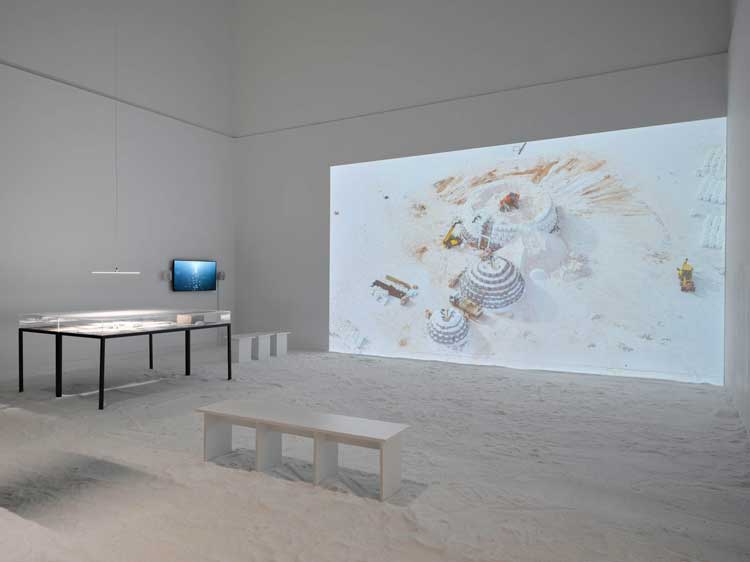
Tomás Saraceno in collaboration, Sanctuary of Water exhibition, installation view, Haus der Kunst München, 2026. Photo: Veronica Simpson.
Two rooms are allocated to the Sanctuary of Water exhibition. The first contains information: one wall is painted with a large map showing the lakes in that area, with details of the flora and fauna typical of the region, and the location of the Indigenous communities that form the Red Atacama collective with whom Saraceno is working.. Plenty of detail on the environmental impacts is provided in adjacent showcases. But what will impress visitors more, however, is a map of Bavaria that has been drawn on the wall next to the Salinas Grandes map. It shows how soon each of its many lakes would dry up if lithium were to be mined there – some would shrivel in as little as six months. Lithium-mining is incredibly water-intensive: according to Wetlands International Europe, every tonne of lithium requires about 2m litres of water to be evaporated.
In the second room, a film shows us the most recent artistic response to this blighted and beautiful land: the creation of surreal, glowing white, igloo-style structures made from salt bricks – a kind of land art but with purpose. It is the first work of land art that has been made with and for the Indigenous community on which it sits. The collective hopes that these eerily beautiful igloos will become a space of ritual and gathering for the Red Atacama communities, and a place of thoughtful and slow eco-tourism that might benefit the communities, rather than enrich the global hospitality industry. Lawyers are working with Saraceno’s team and the collective to find a way of advocating their rights to protect their territory (subverting a bizarre Argentinian rule of law that says Indigenous communities can own the surface of the land, while the government retains the rights to whatever lies under that surface).
After all that complexity, there is simplicity: a powerful light beam is projected across a darkened gallery, floating specks of dust visible in its rays. Most of these dust flecks, we are told, will have come from human skin. After this gallery comes the pleasantly musical web encounter, by the terrace, and its canine cultural enrichment. In a further room off that foyer is an informative space showing us how arachnophobia is a cultural construction, with a timeline of suggested myths and delusions that have been attached to spiders over the last century. Beyond that are stunning glass cases filled with webs, as mentioned at the start of this review.
It was a deliberate move, Andrea Lissoni, artistic director tells us, to intersperse rooms dedicated to knowledge enrichment between the artworks. “Knowledge is woven into the form of the exhibition itself,” he says. Thinking about this weaving of knowledge into the physical experience of the exhibition, I realise that the spiders are not the main event for Saraceno. Rather, it is all the connecting elements – the air they miraculously traverse on their slender filaments, the quality of the air that allows a balloon made of plastic bags taped together to transport humans, lifted only by the warming air currents of a sunny day. It’s the preservation of methods of attention, so crucial to a spider’s survival, as well as to the relationship of Indigenous Red Atacama communities to their landscape, and of the water to their very survival. An expanded awareness of all of this is what Saraceno hopes to activate.
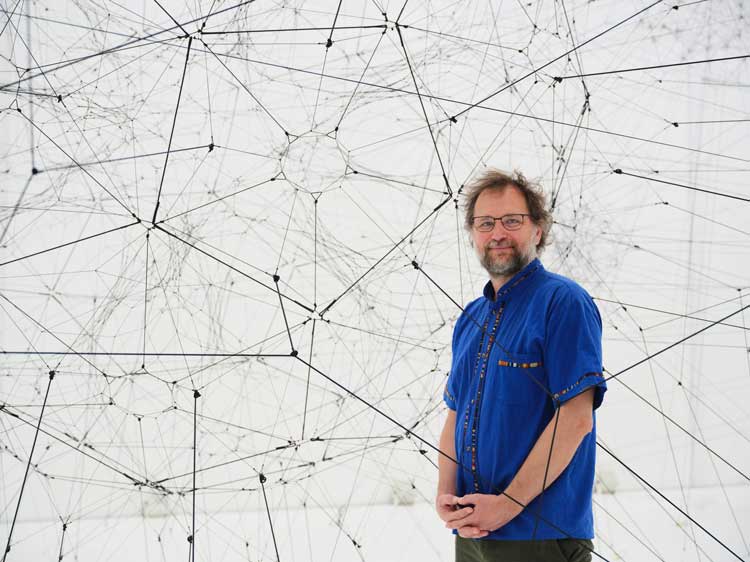
Tomás Saraceno. Photo: Agostino Osio.
The artist and three spokespeople for these communities join us shortly before we leave. Saraceno, despite a touch of grey in his beard, has a boyish, engaging look, his optimism seemingly undiminished in the face of a collapsing world order. He is a dreamer, he dreams big, and is good at persuading people to join him on his aesthetic, environmental and scientific adventures. Lissoni is clearly a happy fellow traveller on this journey. He says: “Ancestral Futures begins from a simple proposition: everything is connected. For more than two decades, Tomás Saraceno has explored webs (literal and figurative), atmospheric systems, aerosolar structures, and collective forms of organisation as ways of understanding how relations produce meaning … Tomás consistently returns to the same question: what can be sensed when we shift our attention from individual entities to the systems that sustain them? Much of his work suggests that the most significant forces often remain unseen.”
And this message – and Saraceno’s tireless and imaginative work in reiterating it – never gets old.
Click on the pictures below to enlarge

Copyright © 1893–2026 Studio International Foundation.
The title Studio International is the property of the Studio International Foundation and, together with the content, are bound by copyright. All rights reserved.

 |
 |
 |
|---|
-300.jpg)


-300.jpg)
 Portraits of Dogs: From Gainsborough to Hockney