




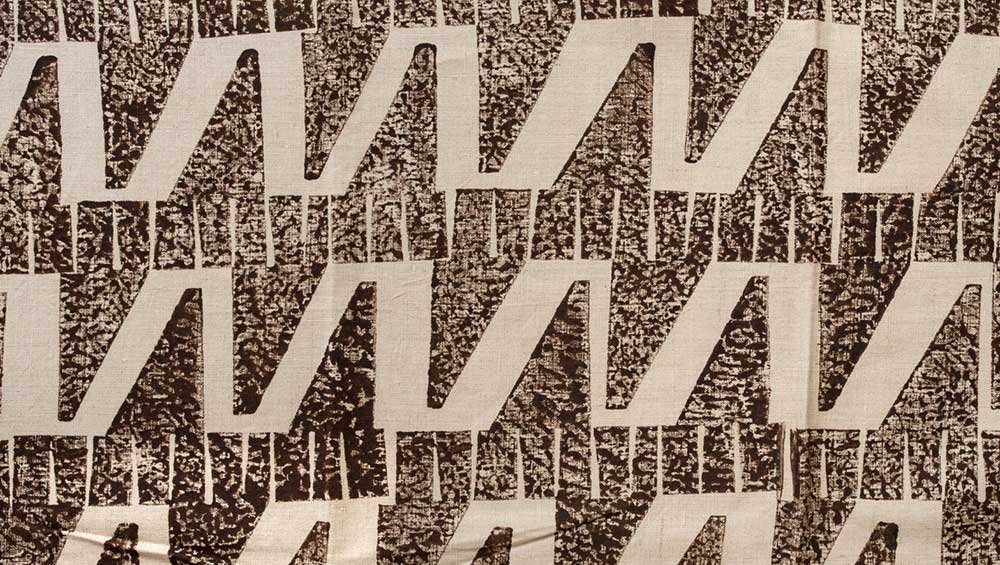
Enid Marx, Ziggurat, 1933. Handblocked textile, Victoria and Albert Museum, © The Estate of Enid Marx.
Compton Verney, Warwickshire
18 July 2026 – 3 January 2027
by ANNA McNAY
Born in London to an entrepreneurial, upper-middle-class, German-Jewish family, Enid Crystal Dorothy Marx (1902-98) grew up with the ambition, inspired by her father who had himself produced numerous patents, to make design available to the wider public by harnessing the machine age. Marx studied painting at the Central School of Arts and Crafts (1921-22) and the Royal College of Art (1922-25), where her cohort – comprising contemporaries such as Eric Ravilious, Bernard Leach, Roger Fry and Barnett Freedman – was heralded as “an outbreak of talent” by their tutor Paul Nash. Her diploma at the RCA was nevertheless failed by the examiners for a painting they judged to be “too radical” and “too abstract”. Marx was further refused entry to wood-engraving classes, ostensibly owing to her “poor drawing”, but more likely to her gender. It was from her friend Ravilious that she learned the rudiments, and this practice went on to be her primary medium. From 1925-27, she trained in wood-block printing and natural dyeing techniques with the textile designers Phyllis Barron and Dorothy Larcher, becoming quite the convert and noting: “Every material has its own particular limitations and its own individual qualities. Wood, whether end grain or plank, when cut with engraver or chisel gives a crisp line which cannot be obtained by pencil, pen or brush.” She, like Nash, believed wood engraving allowed artists to express something personal and even autobiographical. Whereas William Morris expounded the belief that arts and crafts should be produced by hand in workshops, however, Marx looked to modernity and the possibilities of mass production.
-The-Estate-of-Enid-Marx--(2).jpg "Portrait of Enid Marx, Design Council Archive, University of Brighton Design Archives.")
Portrait of Enid Marx, Design Council Archive, University of Brighton Design Archives.
This exhibition begins by setting the stage on which Marx appeared, by including examples of Victorian textile patterns by the likes of Morris, which she described as “washed out William Morris stuff”. During her time as a student, the RCA was next door to the V&A, and part of the context of the time was the imperial influence of the ethnographic collections there and in the British Museum. Marx and Morris associated the abstract patternmaking often found in indigenous cultures (for better or worse) with emotional and instinctive creativity, and she proudly “borrowed” (her term for what might now be considered “cultural appropriation”) from the past. In fact, Marx said: “Textiles cannot be isolated from their background – ever … you will usually find the designer has borrowed extensively from the past.” Examples of this influence in the exhibition include Morris’s African Marigold (1878), which combines marigolds, lilies and acanthus leaves with details of his interpretation of Maori scrollwork, and Marx’s Ogee printed textile (1930s), based on a combination of Turkish, Persian, Nigerian and Ghanaian patterns. These are shown alongside source material from the museum collections and a contemporary piece, Iwa (2025) by Ranti Bam (b1982, Lagos), made in response to Marx’s patterns during a residency at the Crafts Study Centre. The stonework objectdemonstrates how patterns produced through British colonialism might be reimagined and given new meaning.
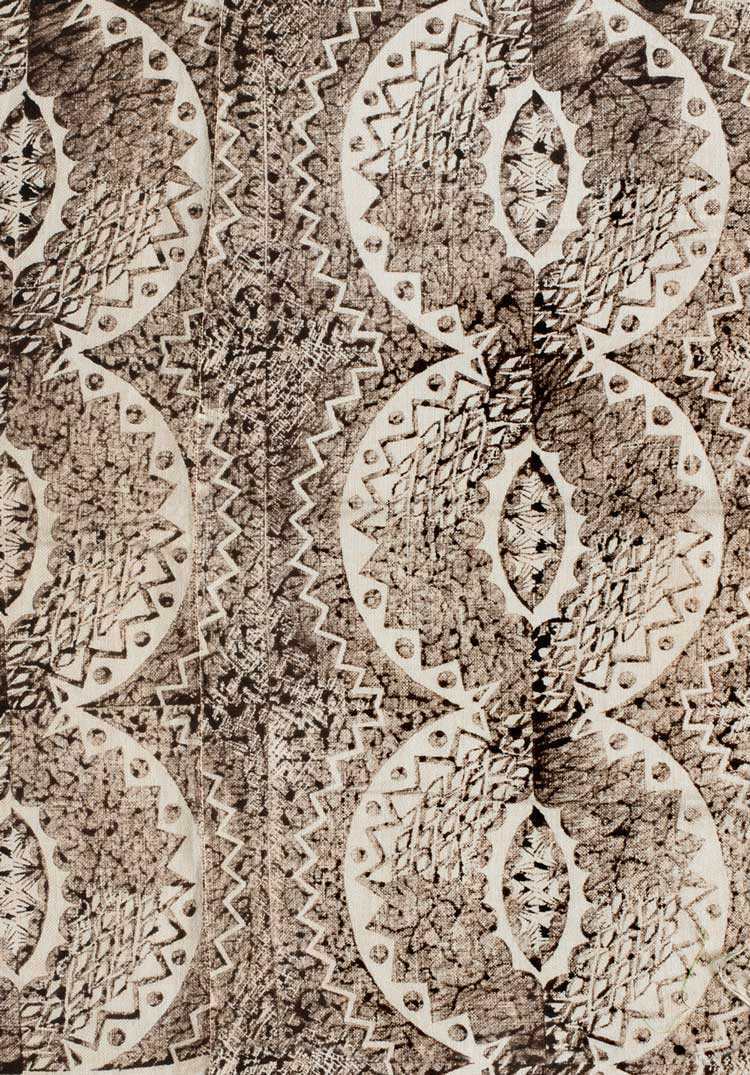
Enid Marx, Ogee, 1930s. Handblocked textile, Victoria and Albert Museum, © The Estate of Enid Marx.
Facing this is a delicate fragment of a painting of one of the cave murals from Ajanta, India, made by Christiana Herringham on an expedition there in the 1910s. The artist and suffragist – and latterly founder of the National Art Collections Fund (Art Fund) – was assisted on one of these trips by Larcher, and there is also a fabric print on display by Barron and Larcher, Square (Jasmine) (1920s-30s), which repeats some of the patterns found in the cave painting.
In 1927, Marx set up her own studio above a cowshed in Hampstead. Over the next decade, her relationship with Barron and Larcher became strained as she became more successful in her own right. An order book from the late 1930s shows some of Marx’s main clients. Examples of her work from this period include a selection of neckties and a radiant gold dress and jacket (in Spreyton Spot pattern), likely worn by her life partner, Margaret Lambert. There is also a fabulous chaise longue, furbished in the Fairy and Stipple pattern of ellipses and stars, which once furnished Marx and Lambert’s home in Islington. A favourite display of mine, however, is not by Marx, but rather by Claud Lovat Fraser, whom she much admired, comprising a range of exquisite Curwen Press pattern papers. The influence on Marx – doubtless two-way – is apparent.
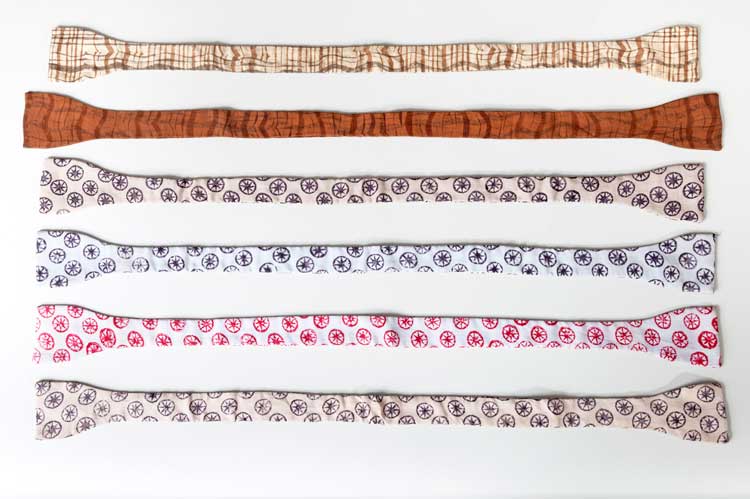
A selection of neckties in fabric designed by Enid Marx, mid-20th century, silk. © Compton Verney, Photo: Jamie Woodley
Marx’s first solo exhibition of textiles was held in June 1930 at the Little Gallery. Later her work was displayed alongside not only Barron, Larcher and other print contemporaries, but also the pottery of Leach and Shoji Hamada. Marx said: “I realise just how lucky we were to have been working in that halcyon period between the wars, when all the arts flowered in such profusion.”
Marx’s career reached its peak in the late 30s and 40s as the outbreak of the second world war afforded many women greater professional freedoms. It is when you cross the corridor into the second gallery space that the taste of success becomes undeniable.
TfL-from-London-Transport-Museum-collection.jpg "Enid Marx, Sample of moquette with Shield design, c1935. Wool. © TfL from the London Transport Museum collection / The Estate of Enid Marx.")
Enid Marx, Sample of moquette with Shield design, c1935. Wool. © TfL from the London Transport Museum collection / The Estate of Enid Marx.
Marx secured major commissions for London Transport, the wartime Utility scheme, Morton Sundour and Edinburgh Weavers. The former comprised not only posters, but patterns for London Underground moquette seat covers. In these, many of the facets of her earlier designs – and borrowings – are visible. No known records of the brief remain although the key principles were “dazzle, dirt, scale”, whereby it should be borne in mind that certain “dazzling” patterns might induce motion sickness, and also that green would have a calming effect. Four of Marx’s designs went into service: Belsize was used on the Metropolitan and District Lines from c1940, Shield was used on the Bakerloo and Northern Lines between 1938 and 1948, and Brent (also known as Grid) and Chevron were used to refurbish 1938 tube stock. All the patterns were woven in shades of brown, jade and buff, or in contrasting green and red.
It is interesting also to compare the three London Underground posters on display with the artwork for one by Edward Bawden, on display in the first gallery. His is a typical Hyde Park scene, filled with promenading couples, nannies with perambulators, children on scooters, dogwalkers, men feeding pigeons, and horse riders up the central muddy pathway; hers, made 32 years later, are much simpler and clearer, depicting Noah’s Ark (for London Zoo) and a series of hot air balloons (for the Science Museum).
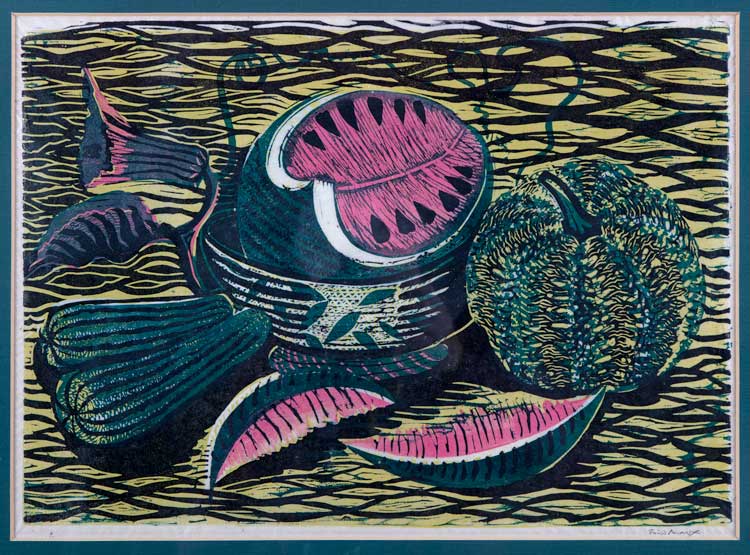
Enid Marx, Watermelon, pumpkin and cucumber, 1950s. Three-colour linocut on paper. © Compton Verney, photo by Jamie Woodley.
Marx’s role with the Utility panel meant that she was responsible for designing all furnishing fabrics for homes affected by bomb damage. In 1944, she became the first female engraver to be named a Royal Designer for Industry, in recognition of her success and service. From 1947, she taught textile design at Gravesend School of Art, London County Council City Literary Institute, Maidstone College of Art and Bromley College of Art. In 1952, Marx designed the first postage stamp to depict Queen Elizabeth II. She influenced generations of illustrators, pattern designers and artists.
Together with Lambert, Marx assembled a rich assortment of folk art, ephemera and craft, forming a collection that interweaves personal, artistic and political histories. Marx visited Compton Verney in 1998, when the mansion house was still undergoing its transformation into an art gallery and was inspired to donate this collection of “popular art” to the organisation. The final room showcases objects from this collection, now known as the Marx-Lambert Collection of English Popular Art. Highlights include linocuts from Marx’s alphabet series, made for Marco’s Animal Alphabet (1979, but only published posthumously in 2000), including a ferocious-looking rhinoceros, based on a 16th-century print by Albrecht Dürer, and a handmade Valentine’s card, made by Marx for Lambert in 1947, reading, in extravagant script, “EM hearts ML”. The display has been laid out much as it would have been in Marx and Lambert’s home. Oli McCall, the senior curator at Compton Verney, said: “You see these images of the house they lived in on Thornhill Road in Islington, this great big Georgian house, and it was absolutely packed full of all these wonderful things from the collection. So, we tried to take our cues from that.”
The exhibition text describes Marx as the linchpin whose life and works connect key ideas and influential figures of the arts and crafts movement, the Bloomsbury group, St Ives pottery, and industry. The exhibition succeeds not only in bringing this key British designer back into the deserved limelight, but also in evoking her character and her context.
Click on the pictures below to enlarge

Copyright © 1893–2026 Studio International Foundation.
The title Studio International is the property of the Studio International Foundation and, together with the content, are bound by copyright. All rights reserved.
 |
 |
 |
|---|

-1000-300.jpg)

 Uproar! The First 50 Years of the London Group 1913-1963
 Stay of life in Venice
 Pallant House Gallery, Chichester
 William Roberts: England at Play
 Eric Ravilious