Tate St Ives, Cornwall
24 October 2026 – 3 May 2027
by DAVID TRIGG
In 1949, Wilhelmina Barns-Graham (1912-2004) visited the majestic Grindelwald Glaciers in the Swiss Alps. It was a life-changing trip that famously prompted her to turn towards abstraction. A photograph of her scaling the ice opens this exhibition, which is the first to fully span the breadth of the Scottish-born artist’s eight-decade career. Although she was a principal member of the St Ives School, her reputation has remained overshadowed by her male contemporaries, including Terry Frost, Patrick Heron and Peter Lanyon. This long overdue retrospective provides a welcome opportunity to reconsider her practice more fully, from her student days in Edinburgh, to her contribution to traditional and avant-garde circles in St Ives, to her relationship with wider developments in postwar abstraction.
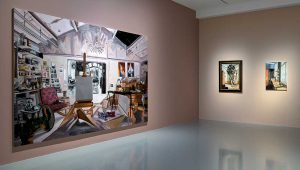
While Barns-Graham’s early works focused primarily on Scottish and Cornish landscapes, the exhibition begins with paintings of her workspaces. Studio Interior, Alva Street (c1938) captures the cluttered yet cosy interior of her first studio in Edinburgh, which she rented as a student. Crammed with painting equipment and works in progress, its haphazard appearance couldn’t be further from the neat and pared-back aesthetic of Studio Interior (c1945). Here, flat planes of colour describe No 3 Porthmeor Studios, St Ives, where Barns-Graham worked from 1940 to 1946, having moved to the Cornish town at the age of 28, soon after the start of the second world war.
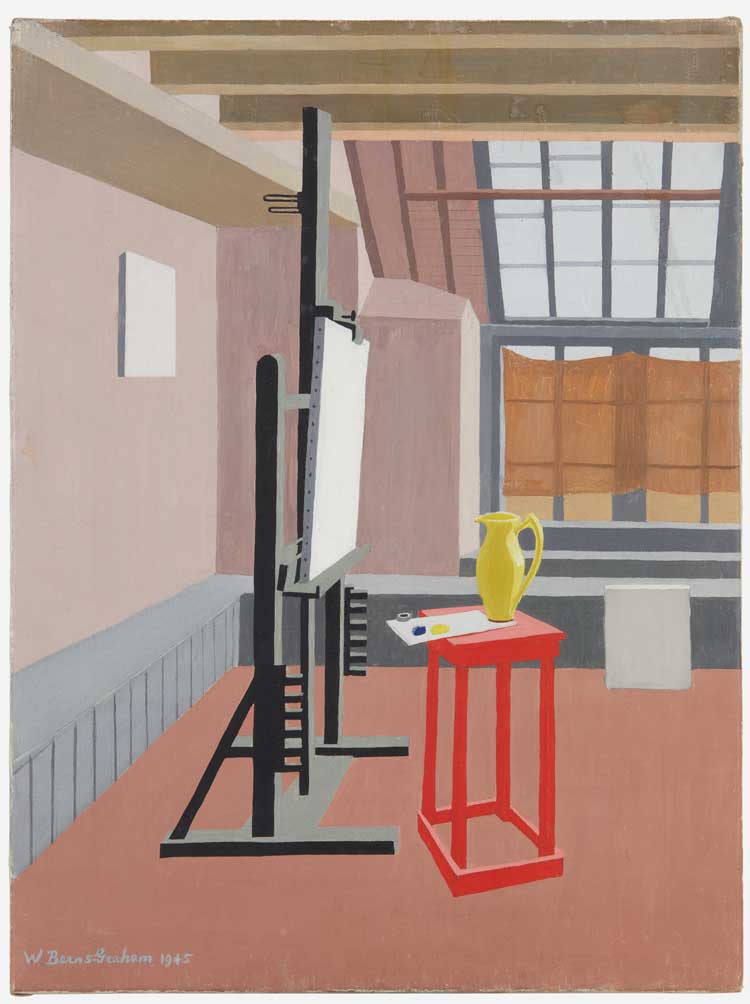
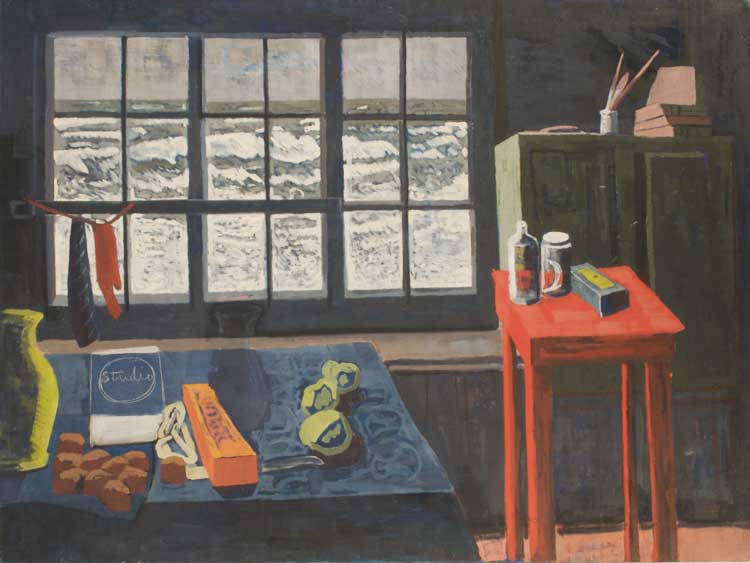
The rigid geometry of this and the related Studio Interior (Red Stool) (1945) gives way to looser paint handling in The Blue Studio (c1947-48), showing her space in No 1 Porthmeor Studios. Among her working materials is a copy of The Studio, alluding to her awareness of, and desire to be a part of, current debates in modern art. The darkened, claustrophobic interior is juxtaposed with ocean waves visible through a window. This dialogue between inside and outside hints at her growing interest in the relationship between inner perception and external reality. Indeed, as her work evolved from landscapes and interiors to abstract compositions, she increasingly sought to bridge what she saw with what she felt.
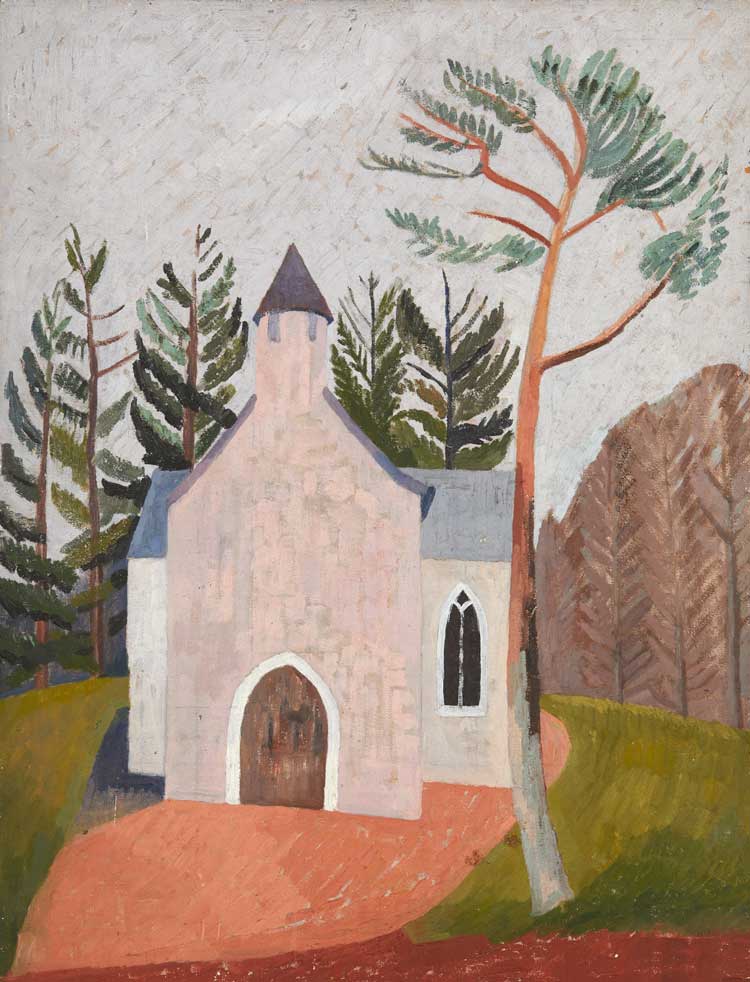
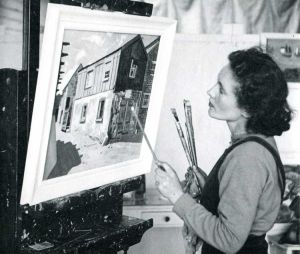
A room filled with early landscapes demonstrate how other artists initially shaped her vision. With its bold palette and simplified forms, The Episcopal Church, Aviemore (1938) shows the influence of the fauvists by way of the Scottish colourists. Nearby, Island Sheds, St Ives No 1 (1940), which depicts several sheds on the St Ives headland, adopts the muted colours, high horizon and skewed perspective of Alfred Wallis, the influential fisherman-turned-artist who lived and worked just a short distance from her studio.
In St Ives, Barns-Graham immersed herself in the artistic community. She joined the St Ives Society of Artists as well as the Newlyn Society of Artists and later became involved with progressive collectives such as the Penwith Society of Arts and the Crypt Group. Her broad-ranging alliances are reflected by the mix of styles on display and, as the 1940s progressed, it was the textures, structures and rhythms of the local landscape that became catalysts for experimentation. In works such as Gurnard’s Head (1947), Sleeping Town (1948) and Tregerthen II (1949), we see her playing with different painting techniques while mixing direct observation with memory and sensory experience.
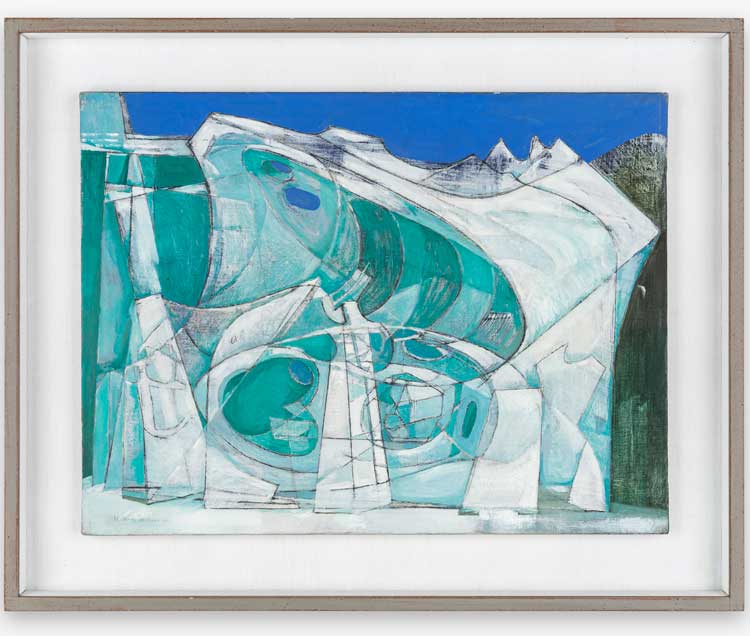
The real turning point came in 1949, following her trip to the Grindelwald Glaciers, which inspired a pivotal series of more than 60 paintings, drawings and prints. An expansive display of these works and related studies reveals how her experience of the immense crystalline structures marked a radical shift in her visual language. Although geological features are sometimes identifiable in these modestly sized pictures, her treatment is largely imaginative, distilling the glaciers’ grand scale, impressive surfaces and contrasts of solidity and transparency into jewel-like abstractions.
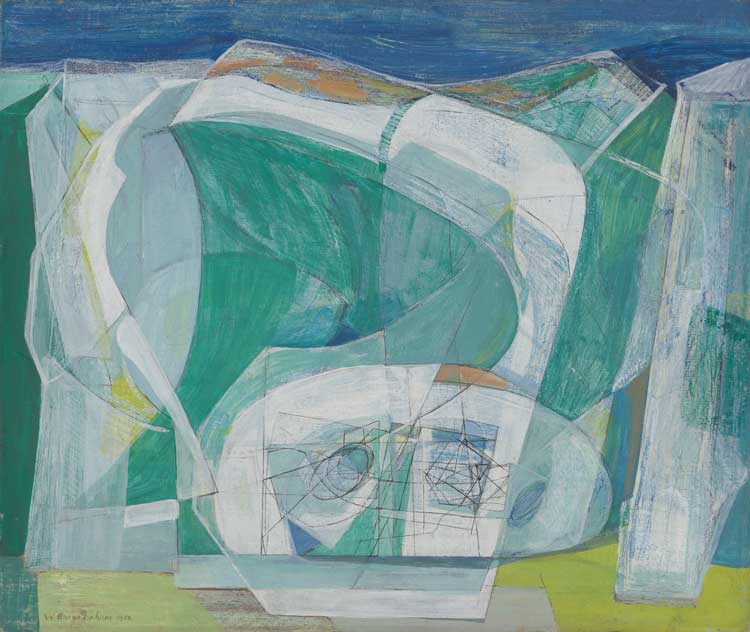
Barns-Graham was particularly taken with the glaciers’ shifting appearance under varying weather conditions, referring to their “many moods” that were at once “beautiful and frightening”. In works such as Glacier Crystal, Grindelwald (1950), we see the frozen structures transformed into splintered, post-cubist configurations of geometric forms and overlapping planes. In Ice Cavern (1951), interior and exterior become indistinguishable – a reflection of the artist’s stated desire to “combine in a work all angles at once, from above, through and all around … a total experience”. Other works, including Glacier Blue Cave (1950), suggest internal spaces behind the picture plane, while Glacier Morpheus (1951), whose title references the Greek god of dreams, implies elements of unreality and fantasy.
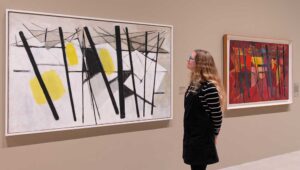
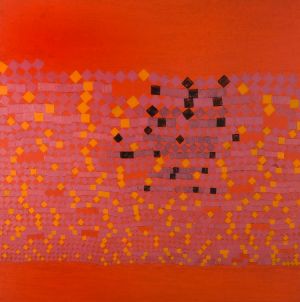
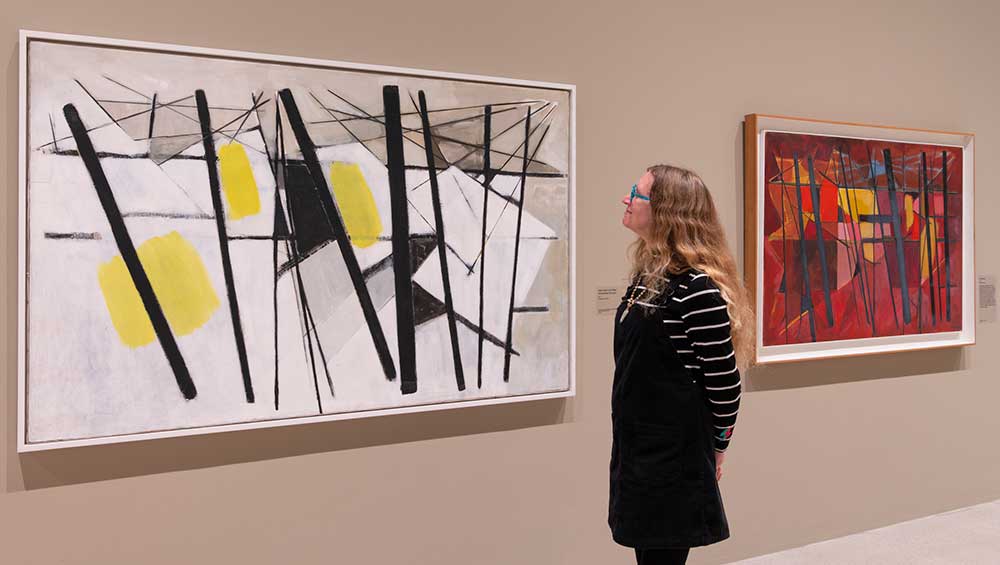
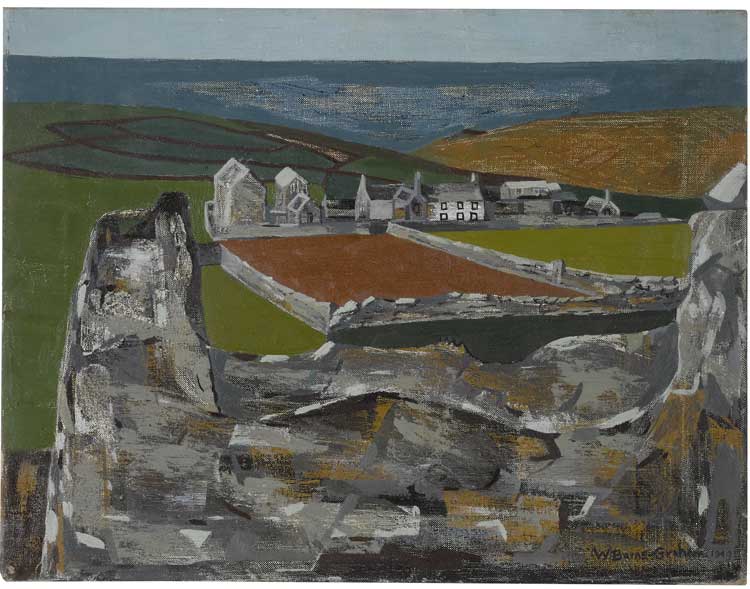
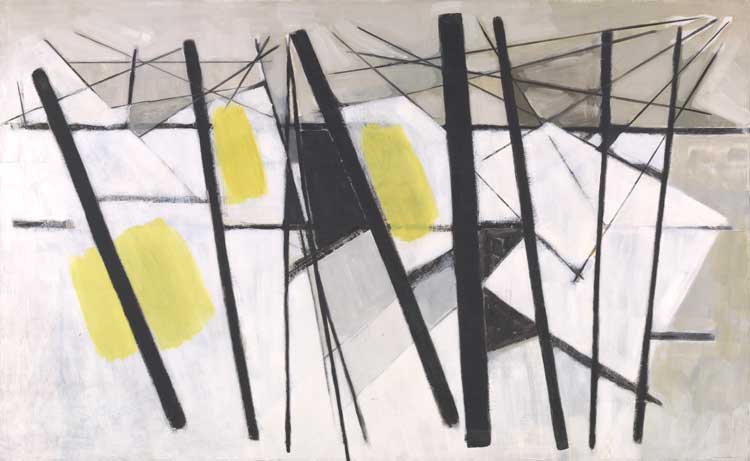
From Swiss glaciers, Barns-Graham turned her attention to the geology of Cornwall in semi-abstract works such as Rock Theme, St Just (1953), which depicts imposing rock formations overlooking the West Penwith coast. The balance of lines and shapes here anticipate the geometrical paintings of snow-covered fields in the Yorkshire Dales that she made while living in Leeds between 1956 and 1957. Her first fully abstract painting with no reference to the visible world was Red Painting (1957), in which a patchwork of reds and yellows is rhythmically divided by black, angled lines of varying thicknesses. This was followed by gestural paintings inspired by her travels in Spain and the Balearic Islands, works that were resolutely abstract yet still informed by the structures of the natural world.
In the early 1960s, she rented a studio in Putney, immersing herself in the London art world but never aligning with any group or movement. Direct references to nature gave way to non-representational works that foregrounded systems, rhythm, repetition and the tension between structure and instability. In a room dedicated to this period are large-scale works reflecting the influence of constructionism, hard-edge painting, op art, colour field and other developments in international postwar abstraction that she had encountered in London and the United States. Controlled arrangements of squares, circles and geometric shapes are repeatedly set against white grounds or vibrant colour fields. While some appear haphazard, others are carefully composed experiments in formal spatial relationships.
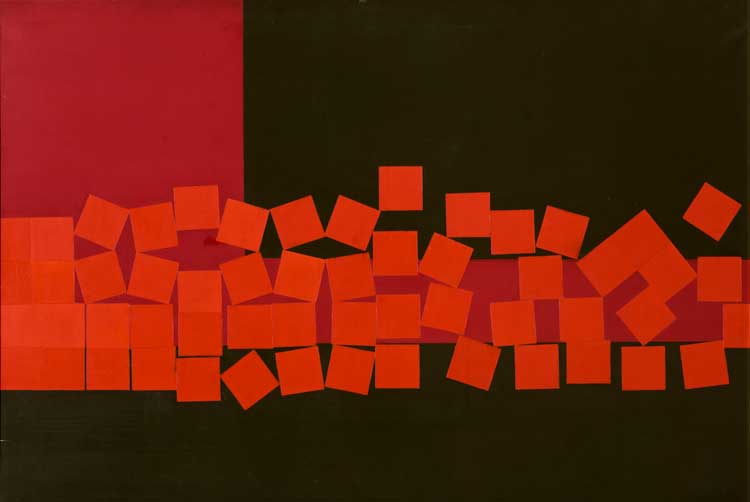
Visually striking works such as Olive Green Squares on Vermillion (1968) use highly saturated and contrasting hues to create an optical buzz. Here, the misaligned arrangement of green squares against a red background feels precarious, a compositional choice that Barns-Graham likened to “a broken marriage” and is perhaps analogous to the personal upset of her divorce from the writer and architect David Lewis in 1963. Later works, such as Protest (1966) and Glasgow Airport (1971), give the impression of swarming multitudes, their titles ostensibly referencing places and events in the real world (the former was created after Barns-Graham encountered a political demonstration in the streets of Amsterdam).
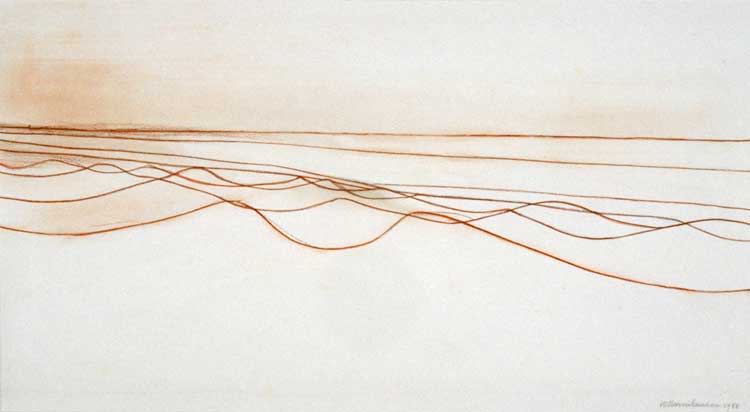
The exhibition’s final two rooms underscore just how industrious she was in her later years. Despite bouts of ill health, her creative energy never dimmed as she continued to experiment with different techniques and mediums, including collage, chalk drawing, gouache, etching and screenprinting. Moving away from geometric abstraction, she returned to making observational drawings directly from nature. In her Small Energy series, precise arrangements of undulating black lines over coloured grounds evoke swirling wave patterns, tidal movements and other natural rhythms. Rolling ocean waves are suggested by the elegant chalk drawing Eight Lines, Porthmeor (1986), which is drawn with an assured economy of sinuous lines. While Cornwall remained an enduring source of inspiration, so too did the Canary Islands. Four trips to Lanzarote between 1989 and 1993 provided substantial creative fuel, reinvigorating her work with semi-abstract pictures in which washes of gouache and dynamic chalk lines capture the awe-inspiring topography of a volcanic landscape scarred with crags, crevices and craters.
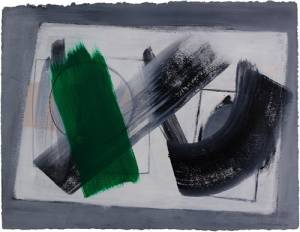
The restrained palettes of these works give way to a riot of colour in the final room, which is aptly titled Restless Energy. Included here are selections from her abstract Scorpio series, each of which consists of several large, energetic and gestural brushstrokes in bold hues. Made with acrylic paint on paper, these exuberant works recall her earlier abstracts, such as Red Painting or White, Black and Yellow (Composition February) (both 1957), but here there is a greater sense of freedom and expression, which is also true of her vibrant screenprints.
Barns-Graham continued working until a few days before her death. Although she had become increasingly appalled at the state of the world, bemoaning the way that humanity was “making the most awful disorder [and] breaking things down without thought”, there is something joyous and celebratory about her final works. “I want to stimulate and excite people, give them an enthusiasm for looking,” she said. On the evidence presented here, this was something she routinely achieved, not only in her final years but across the entirety of her career.