
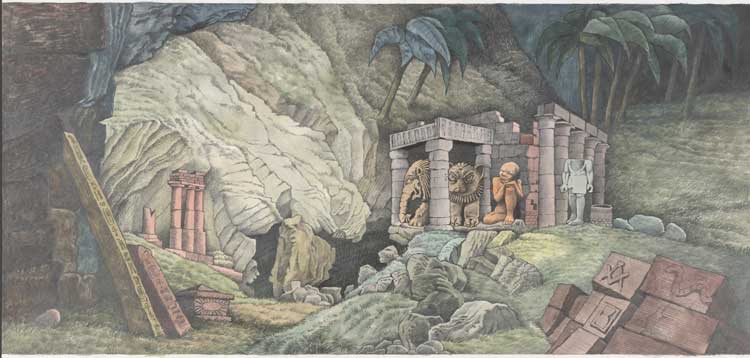
Maurice Sendak, Design for Scrim, Act 2 (The Magic Flute), 1979–80. Watercolour and graphite on paper, mounted to laminated paperboard. The Morgan Library & Museum, Bequest of Maurice Sendak, 2013, 2013.104:112. Photo: Janny Chiu; © Maurice Sendak Foundation.
Morgan Library & Museum, New York
17 March – 28 June 2026
by Michael Patrick Hearn
In 1978, Maurice Sendak, then the most celebrated children’s book artist of his generation and approaching 50, made a dramatic turn in his career. He was suffering a serious mid-life crisis. He had been labouring for years on the overwrought Outside Over There (which was eventually published in 1981), the final volume of his dubiously self-titled “trilogy” that also comprised the far more celebrated Where the Wild Things Are (1963) and In the Night Kitchen (1971). He always resented being known as just a “kiddie book illustrator”, and was eager for a major change in his life. Then, out of nowhere, he got a call from the esteemed “maverick” stage director Frank Corsaro. He knew Sendak through the books he read his own son and especially admired Sendak’s magisterial The Juniper Tree and Other Tales from Grimm (1973). Would Sendak be willing to design a new production of The Magic Flute for the Houston Grand Opera? Would he! Mozart was one of Sendak’s gods. Music had always been an important part of his drawing process. For years he had made spontaneous spirited sequential fantasy sketches while listening to Mozart and other classical composers. But Sendak had designed only one earlier opera, British composer Oliver Knussen’s one-act Where the Wild Things Are, with libretto by Sendak himself, for the Théâtre de la Monnaie in Brussels in 1980. He recounted his conversation with Corsaro in Tony Kushner’s coffee table book The Art of Maurice Sendak 1980 to the Present (2003). “I protested,” he said. “I couldn't imagine doing it, I had no idea how to do such a thing. But then I agreed.” Thus simply began a new and important phase in Sendak’s long, illustrious career.
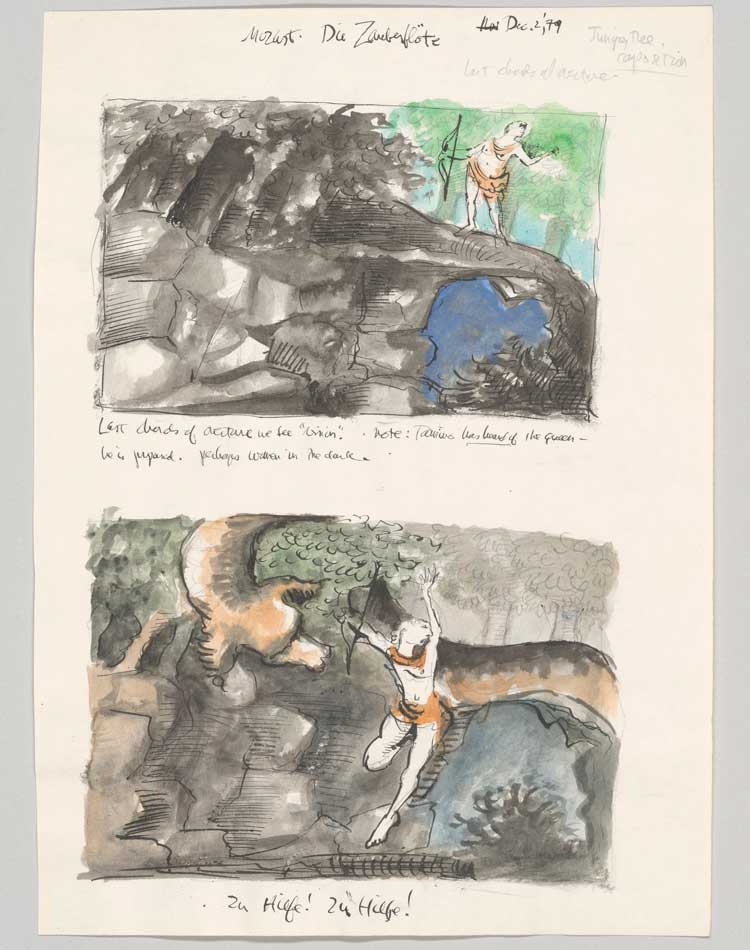
Maurice Sendak, Juniper Tree Composition (Act I, Scene I), 1979. Watercolour, pen and ink, and graphite. The Morgan Library & Museum, Bequest of Maurice Sendak, 2013, 2013.104:81. Photo: Janny Chiu; © Maurice Sendak Foundation.
His initial approach to the material was a conservative, almost reactionary response to Mozart. Book illustration and stage design were separate arts. “Have I, in fact, been able to bridge the two disciplines?” he wrote to Corsaro. “First I must illustrate the scene as though for a book and then re-order it for the stage.” The real challenge was in transforming two dimensions into three. He mapped out the entire action of the piece with all the characters and decor in the kind of storyboard that Walt Disney Studios might have prepared for any animated cartoon. It was the same method Sendak followed in creating the dummies for his picture books. These preliminary sketches unroll like elaborate wordless comic strips (unfettered by dialogue within speech balloons) that indicate the entire action of the libretto as well as the gestures of the players.
Where the Wild Things Are was his maiden effort; and it suffered a long gestation from a disastrous initial run in Brussels in 1980, followed by a production in 1984 at the Glyndebourne Festival in Sussex, and on to the triumphant production performed at the Minnesota Opera in September 1985 and the New York City Opera in November 1987. It was like the picture book come to life. After the fitful start, the sets and costumes eventually captured the Sendak vision of childhood, however neurotic and sometimes terrifying, on stage. The major problem with the piece was Knussen’s ponderous discordant music. It did not really capture the charm of the children’s book. (At least it was better than the jarring 2009 Spike Jonze movie!) The score was perhaps far too mature for the show’s intended audience. The island of Wild Things is no place for grownups. Max’s monster Mamma, who never appeared in the picture book, showed up in the opera, shmata and all. Sendak also revealed in his libretto that one of his Wild Things is female. Sendak was the first to admit that the initial effort was a disaster. Corsaro eventually took a crack at it, and Sendak was delighted with the results. He allowed Max to be exactly what Sendak envisioned, “a real pain in the backside as he is supposed to be”. But the one-act opera was a bit thin for an evening’s entertainment. When it was revived at Glyndebourne in 1984, Knussen’s companion piece, Higglety Pigglety Pop!, based on another Sendak book, filled out the bill. In 1986, Wild Things was paired with Sendak’s new interpretation of Mozart’s minor opera buffa The Goose of Cairo at the Lyric Opera of Kansas City and later the New York City Opera.
.jpg "Maurice Sendak, Design for Scrim, Act 2 (The Magic Flute), 1979–80 (detail). Watercolour and graphite on paper, mounted to laminated paperboard. The Morgan Library & Museum, Bequest of Maurice Sendak, 2013, 2013.104:112. Photo: Janny Chiu; © Maurice Sendak Foundation.")
Maurice Sendak, Design for Scrim, Act 2 (The Magic Flute), 1979–80 (detail). Watercolour and graphite on paper, mounted to laminated paperboard. The Morgan Library & Museum, Bequest of Maurice Sendak, 2013, 2013.104:112. Photo: Janny Chiu; © Maurice Sendak Foundation.
Sendak was obviously determined to make his Magic Flute surpass the Metropolitan Opera’s then flimsy outdated sets and threadbare costumes designed by another prominent children’s book illustrator, Sendak’s formidable Italian rival Beni Montresor. Yet Sendak’s series of two-dimensional flats looks like hand-coloured sheets from the British juvenile or toy theatre rather than fully realised stage settings. The composition and execution are at times faulty. Sendak just seemed to be filling up the space with distracting oversized flowers and flabby rocks among unexpected architectural ruins rather than significantly supporting the action of the libretto. His technique worked perfectly for the Wild Things opera, but it did not raise the staging of The Magic Flute to the supernal heights of its glorious score. He was learning on the job. “I mean it’s a very one-dimensional production,” Corsaro’s assistant, Christopher Mattaliano, recalled in 2019. “You can tell that it’s designed by someone who does illustrations for books. They just do not do opera productions like this any more. It’s a very old-fashioned opera production with many, many scenes and many, many drops … It’s as if you are turning the pages of a beautifully illustrated book.” It was an expensive way to work. These designs do have their charm but none of the breadth and depth of a seasoned set designer. They lack the chances taken by David Hockney and Julie Taymor in their edgier modernist productions. While others played with “turntables and multimedia and special effects”, Sendak was set in his ways. He had little patience for fads and fashions. He insisted on being true only to himself.
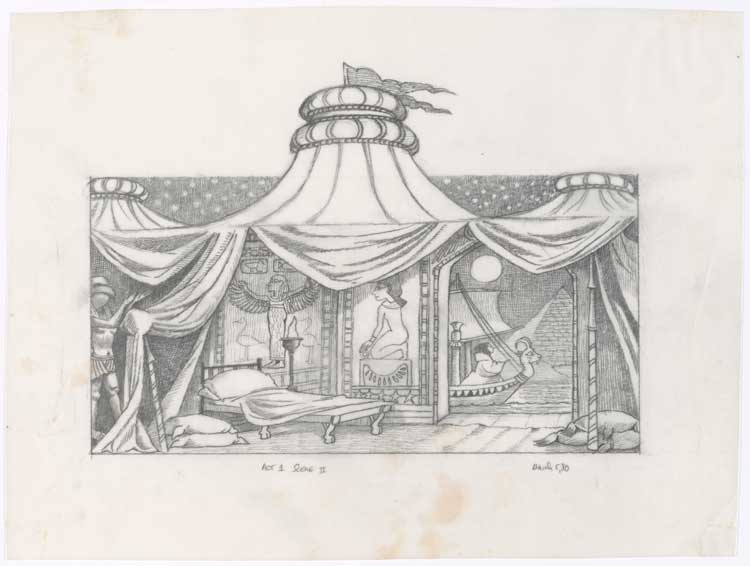
Maurice Sendak. Scene Design for a Room in Sarastro’s Palace (Act I, Scene II), 1980. Graphite on tracing paper. The Morgan Library & Museum, Bequest of Maurice Sendak, 2013, 2013.104:40. Photo: Janny Chiu; © Maurice Sendak Foundation.
His sets and costumes, like his book illustrations, always drew from a wildly eclectic and eccentric hotchpotch of sources. The profusion of detail in the staging of The Magic Flute tended towards clutter without reason. Like many of their predecessors and successors, Sendak and Corsaro took liberties with the original explicit stage directions of Die Zauberflöte. Sendak said in a taped interview that his collaborator’s nontraditional approach was like “climbing into the gut of the opera”. The then recent King Tut exhibit at The Met gave Sendak the idea to set the late-18th-century opera in a romanticised Egypt. He concluded that the high priest must have been a Mason like Mozart and his librettist, Emanuel Schikaneder, so he filled Sarastro’s temple with the secret society’s symbols. He mishmashed elements from Philipp Otto Runge, William Blake, even Star Wars. He must have been well aware of the Ballets Russes: his rendering of the figures in his costume designs looks remarkably similar to the way the artist and designer for the company, Alexandre Benois, worked; and the interior of Sarastro’s temple could have appeared on the same stage as Ivan Bilibin’s highly stylised sets for the original 1909 production of Rimsky-Korsakov’s The Golden Cockerel. One can also spot an obvious reference to Edward Hicks’ The Peaceable Kingdom. Artist and director were determined to avoid “the cutes” (as they put it); and yet Sendak created a deliciously silly Barneyesque dragon (from Blake’s watercolour of Leviathan in the Morgan Library) to open the production. Here lay one obvious problem and limitation of much of Sendak’s theatre work: an uncontrollable temptation to combine the ridiculous with the sublime.
Not everyone appreciated what Sendak and Corsaro were trying to do. Despite his indefatigable reputation as the world’s leading children’s book illustrator, Sendak was nearly unknown to theatre people. Opera snobs thought he was no more than a dilettante, dabbling in an area in which he had never been trained. Yet Sendak took this work seriously, as seriously as he did his picture books. At first, he was baffled by all the hands that were needed to stage a production. He was used to working alone rather than with a whole crew. He was quite miffed when he went into a meeting with Beverly Sills, then the director of the New York City Opera, and she did not really know who he was. She worked with him anyway. He was outraged when she refused to pay for one especially lavish stage effect. She said it was just too expensive. Sendak was not used to anyone saying no to him.
Corsaro proposed to Sills in 1981 that he and Sendak collaborate on the little known The Cunning Little Vixen by Czech composer Leoš Janáček. Sendak did not know the opera. Janáček was hardly Mozart! It was foolhardy for Sendak to take on something for which he felt no passion. He was exhausted and suffering from a “mini nervous breakdown”. He finally completed Outside Over There during the production of this opera so its influence is apparent in his sets and costumes, particularly in the oversized sunflowers lifted from his beloved Runge. At first glance the project seemed perfect for Sendak. It was the world of fable, aligned in spirit with the no-nonsense naturalism of Beatrix Potter, whom he adored. Still it proved to be particularly challenging, for Sendak did not really care for the score. However, Corsaro thought Janáček was the greatest of all composers of opera in the 20th century, and he greatly admired this story that explored the cycle of life.
Janáček based The Cunning Little Vixen (1923) on Rudolf Těsnohlídek’s novella Příhody lišky Bystroušky, which had been serialised in a newspaper. But Sendak rejected the Czech artist Stanislav Lolek’s original illustrations. Instead, his earthy, folksy designs complemented Janáček’s folk-infused exploration of the renewal of life after death. Sendak, like Janáček, was an atheist, so he cluttered the stage with the remnants of a neglected Christianity in ruins. The witty sets and costumes suggest Wilhelm Busch mixed with Walt Disney, particularly Pinocchio (1940) and Bambi (1942) that so mesmerised Sendak as a boy. He outdid himself in the costumes for the spiders, grasshoppers, fireflies, dung beetles, ladybugs and other assorted insects, badgers and frogs. Sendak’s dapper Fox Gold-Spur looked like a grownup Max in his Wild Thing suit. It was obvious that these were people dressed in animal clothing but free of the papier-mache heads so often used to bring John Tenniel’s characters to life in Lewis Carroll’s Wonderland.
But that was also their limitation. The flighty flock of hens was amusing and the clever barrage of bugs were cute in a Disney sort of way, but they fought with the seriousness of Janáček's score. It was shocking when the fox kills all the chickens. However furry, fluffy and feathery their costumes might be, these animals had to be true to their natures. Sendak and Corsaro did add one chilling scene not suggested by the original libretto: when a poacher shoots and kills Vixen Sharp-Ears, all the creatures of the wood feed on her corpse. Her cubs do survive as an echo of EB White’s beloved classic Charlotte’s Web (1952) in which the spider’s children live on after her. In the end, Sendak was startled by how terribly moved he was by the final production. “The opera is touching, sweet and sometimes I cry,” he finally admitted in his journal. “It’s a very important opera to me now.”
Perhaps the most fully realised of Sendak’s operas was Sergei Prokofiev’s The Love for Three Oranges that Corsaro directed for Glyndebourne in 1982. It certainly brought out the best in Sendak. The two were so flattered to be the first Americans to be invited to work with the famous company that they signed the contract without really knowing the piece. Once they looked into it, they were unimpressed and considered backing out. Sendak thought it “an awfully silly opera but delightful music”. Corsaro dismissed it as “Dada kitsch”. But the lack of immediate enthusiasm for the project proved to be liberating. They proceeded to refashion the narrative according to their own ideas. The work is a mixed-up international anomaly: the Russian composer based his French comic opera L’Amour des Trois Oranges on a Russian translation by Vsevolod Meyerhold of the Italian play L’Amore delle Tre Melarance by Carlo Gozzi, who derived his comedy from an early 17th-century Neapolitan fairytale from Giambattista Basile’s Il Pentamerone. The very first production of this artistic hybrid was American: it opened at the Auditorium Theatre in Chicago on 30 December 1921. (It was not until 1926 that it was performed in the USSR.) Because neither Sendak nor Corsaro revered the opera as they did The Magic Flute, they could be as irreverent as they wished in staging it. They initially relied on the original French libretto that Tom Stoppard later translated into English for the touring company.
Sendak had fallen head over heels for Venetian Giovanni Battista Tiepolo’s wash drawings of the commedia dell’arte at the Morgan and was determined to do something special with them. “It is an odd matter indeed, this almost magical union that occurs between stealer and stealee,” he confessed to the director in a letter. “It is as though I know what I want but can see it only inside (in this case) a Tiepolo drawing and then I can draw it out and quite properly make it my own.” The Italian’s loose lithe line freed Sendak from the dense crosshatching that permeated so many of his children’s books. He sought “to reproduce that delicate, undulating, sepia-line, and peach-grey look” of Tiepolo’s originals, while assuring Corsaro: “The costumes, in stronger, bolder tones, will act as contrasts.” The resulting designs are reminiscent of the Thomas Rowlandson-inspired pictures for Frank R Stockton’s The Bee-Man of Orn (1964). Sendak was never really a painter: his pictures are all coloured drawings, and his chosen palette was never a particularly strong component of his art. He had to seek it from sources other than his own invention. The scheme for The Magic Flute came from Blake’s paintings for Milton’s L’Allegro and Il Penseroso in the Morgan. That for Three Oranges was done in washes of elegant spare, pale, harmonious, transparent watercolour derived from the Morgan’s Tiepolos.
Sendak reset the opera anachronistically in the French Revolution of 1789 and introduced a play within a play performed by, appropriately, Théâtre Tiepolo. He gave a Marat/Sade spin to the proceedings by having the revolutionaries watch a royalist performance. Sendak and Corsaro shared a bawdy sense of humour that is evident everywhere in the production and not just in the phallic Punchinello masks. Sendak produced an erudite masterpiece of stage design. He depicted the evil witch Fata Morgana at one point as a large balloon that looked like a huge inflatable sex doll; and the Cook was an ingeniously constructed mechanical giant with rolling eyes and flailing arms that filled the stage and would have felt at home in the French silent trick films of Georges Méliès. The melancholy Prince looks like Mr Goodbody in his painted body suit. Sendak wickedly caricatured Sills as a lady swine and the Wild Thing was Luciano Pavarotti complete with his ever-handy handkerchief. They look like great floppy Muppets. Sendak was totally in charge and produced the sort of play from which the audience walks away whistling the scenery.
The notoriety of his work for the opera convinced the choreographer Kent Stowell, director of the Pacific Northwest Ballet in Seattle, to approach him in 1981 to redesign Tchaikovsky’s The Nutcracker. Sendak, famous children’s book illustrator, feared he was being typecast and only reluctantly agreed. He never liked Balanchine’s New York City Ballet production and swore that he would liberate Tchaikovsky from the chains of the original choreographer, Marius Petipa. So annoyed by the way the Waspy producers insisted on calling him “Maury”, he informed them that he wanted to drop all “the sugarplum shit” from the 1892 imperial ballet. He said he was going to replace the little Aryan children in the opening party scene with yarmulka-wearing Jewish kids. And instead of the cliched giant Christmas Tree, there would be an enormous menorah rising from the stage! He was, of course, kidding. He did retain the huge fir tree and added a gigantic clock invented by Drosselmeyer.
Sendak’s revisionist ballet was intended to be a darker reinterpretation of the famous Christmas confection, but it never went as far as Mark Morris’ audaciously campy The Hard Nut (1991). Besotted with German Romanticism, Sendak returned to ETA Hoffmann’s kunstmärchen and provided in the ballet a summary of the tale within the tale about the Hard Nut. (The traditional Russian ballet derived from the French retelling by Alexandre Dumas père rather than the German original.) Sendak dispensed with the highly caloric Land of Sweets and interpolated a serenade from Tchaikovsky’s opera Pique Dame. He saw the story as the sexual awakening of a girl on the verge of puberty who falls in love with the Nutcracker Prince. Like the previous Max, Mickey and Ida, courageous Clara sails to the sometimes menacing Land of Dreams. The Nutcracker himself was a self-caricature of the artist. Nowhere is that more apparent than in Sendak’s “meshuggah mug” (as Kushner put it in The Art of Maurice Sendak 1980 to the Present) on the show curtain. Sendak seemed to enjoy himself most in designing unconventional but elegant and often clever costumes for the sequence of specialty dances that takes up much of the dream. He produced additional pictures for a new English translation of Hoffmann’s fairytale in an elaborate bestselling coffee table book. The entire Pacific Northwest Ballet production was filmed by the renowned director Carroll Ballard and released in 1986. Sendak went in there an amateur and came back a star. In the end, he conquered set and costume design just as he had book illustration. While Sendak may never be considered among the foremost masters of modern stage craft, he remains one of the most curious and adventurous.
In 2019, the Morgan paid tribute to a remarkable bequest of more than 900 largely forgotten storyboards, preliminary sketches, finished drawings and watercolours, and dioramas for the stage that Sendak left to the library in his will with the full-scale exhibition Drawing the Curtain that drew on almost his entire output for the stage. It was only fitting that all that work ended up there, for the artist often dipped into the institution’s celebrated vast collections for inspiration. Even earlier, in September 1981, the library displayed his original art for Outside Over There and The Magic Flute along with works by the revered Blake and Mozart who so inspired him. No matter how beautiful or engaging are the individual designs for the theatre, an exhibition consists of no more than a series of delicious fragments. After all, the final work of art of any stage production is the performance in which all elements of music and design come together. But what made such a show as Drawing the Curtain so fascinating was its ability to trace through all of its various and varied pieces exactly how the artist worked out his ideas.
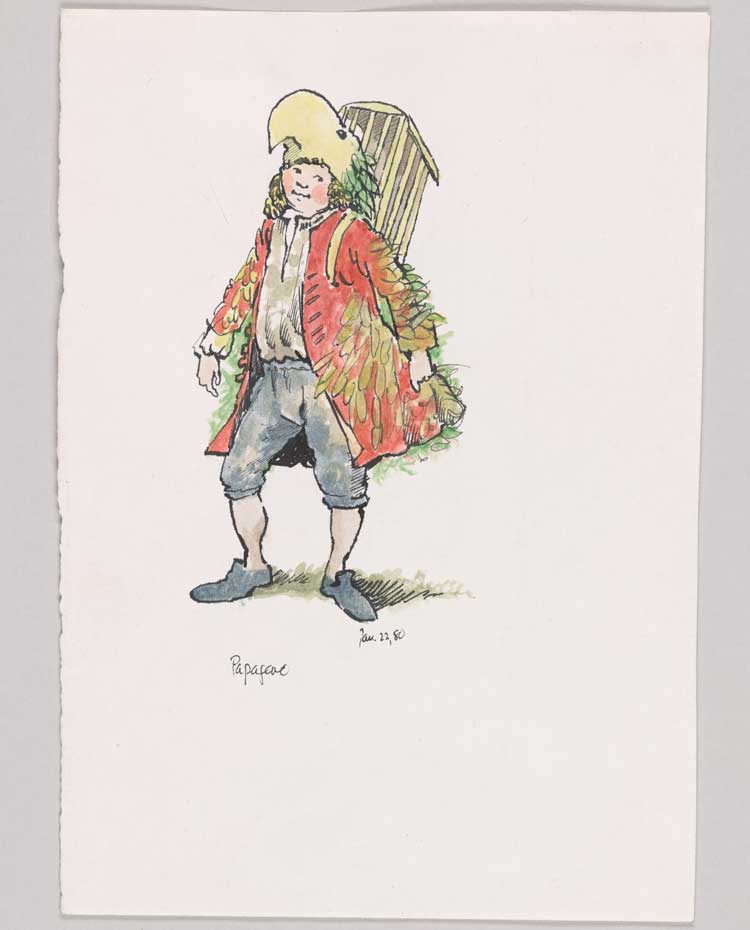
Maurice Sendak. Papageno, 1980. Watercolour and pen and ink. The Morgan Library & Museum, Bequest of Maurice Sendak, 2013., 2013.104:74. Photo: Graham S. Haber; © The Maurice Sendak Foundation.
The current show, Sendak, Mozart and The Magic Flute, provides only a sampling, just a single wall of sketches in the basement with two additional large stage designs down the hall on the way to the spectacular major exhibition Wolfgang Amadeus Mozart: Treasures from the Mozarteum Foundation of Salzburg. The Sendak display serves as little more than a tantalising footnote to this splendid survey of Mozart’s life and career. There are music manuscripts and portraits and letters and other important artefacts of the great composer such as his childhood violin and the last clavichord on which he composed in Vienna. Most of the items from Salzburg have never been on view in the United States before and beautifully complement other works by Mozart in the Morgan’s own collections. Josef Gail’s set design in ink and pencil for the first Magic Flute in Vienna in 1791 pales next to Sendak’s ornate vision from 1980. It is amusing to compare Johann Salomon Richter’s rather literal Papageno, the bird man, for the 1793 Leipzig production, one of the earliest surviving costume designs for the opera, to Sendak’s jolly watercolour of the identical character. There are also two charming attempts by Sendak to portray Mozart composing in his Vienna retreat. While the old sets and costumes gather dust from disuse, Sendak’s generous bequest of set and costume designs to the Morgan will continue to delight and inspire those acquainted and unacquainted with this relatively little known and under-appreciated aspect of his extraordinary artistic achievement.
Click on the pictures below to enlarge

Copyright © 1893–2026 Studio International Foundation.
The title Studio International is the property of the Studio International Foundation and, together with the content, are bound by copyright. All rights reserved.
 |
 |
 |
|---|

-1000-300.jpg)