




-18.jpg)
Towner Eastbourne
7 May – 18 October 2026
by JOE LLOYD
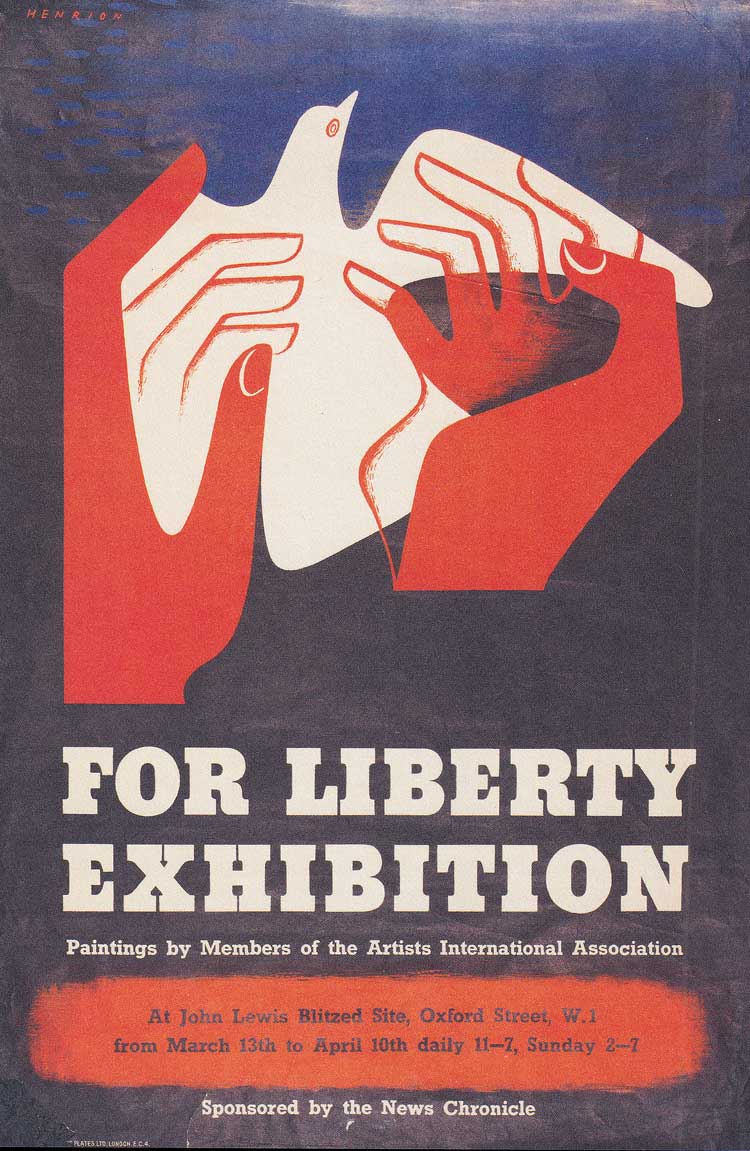
On 18 September 1940, a German incendiary oil bomb landed directly on John Lewis’s Oxford Street flagship department store. One wing of the store was reduced to rubble. George Orwell, who passed by soon after, described seeing “a pile of plaster dress models, very pink and realistic, looking so like a pile of corpses”; mercifully the staff survived in the store’s underground bunker. Two and half years later it became the site of a remarkable exhibition. For Liberty united dozens of artists, many from opposing aesthetic and political persuasions, to exhibit work on “war, peace and freedom”. It was organised by a group called the Artists International Association (AIA), which at its peak boasted about 1,000 members.
The Towner’s new exhibition, Comrades in Art, tells the story of this organisation and how it rose from a radical fringe organisation in the early 1930s to a central point in Britain’s wartime art scene. It is curated by Andy Friend, whose 2025 book of the same name is the definitive source on the group’s rise to prominence. It is a crowded story, with dozens of figures leaping in, then fading out of focus. As a result, the exhibition is dense with artwork – the Towner has gathered 320 loans from 62 collections – and explanatory text. Many still prominent practitioners took part in the AIA’s exhibitions. But the core group was formed by artists who are relatively obscure today. Comrades in Art has to introduce these figures and tell the story of their collective action.
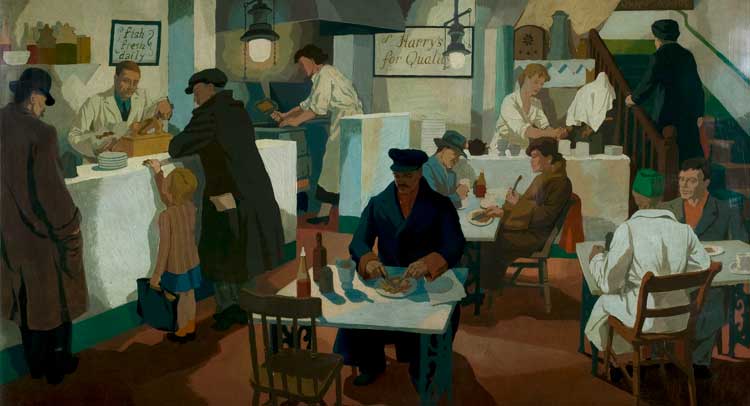
Cliff Rowe, The Fried Fish Shop, 1936. © Cliff Rowe Estate. Reproduced courtesy of Leicester Museums and Galleries.
An exception to this is Misha Black, who would later become co-founder of the trailblazing consultancy Design Research Unit and a prolific designer of signage and trains. But in 1933 times were lean; Black’s design business was on the verge of collapse. Times were also volatile, with fascism rising in Europe, and London wracked by violent confrontations between hunger protesters and the police. One autumn evening, a ragtag collection of leftwing artists, illustrators and designers assembled in London at Black’s Seven Dials studio to hear the painter Clifford Rowe speak. They included the Jewish émigrés Peter Laszlo Peri and Edith Simon, the New Zealand socialist James Boswell and the working-class Lancastrians Pearl Binder and James Fitton.
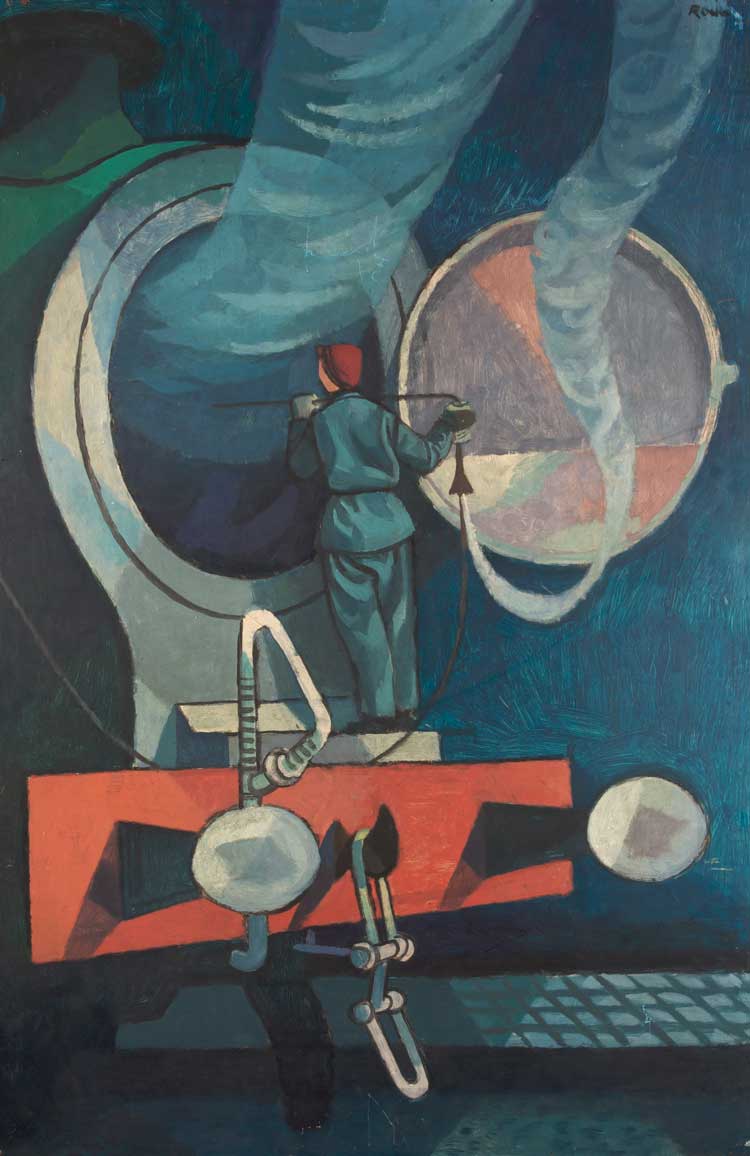
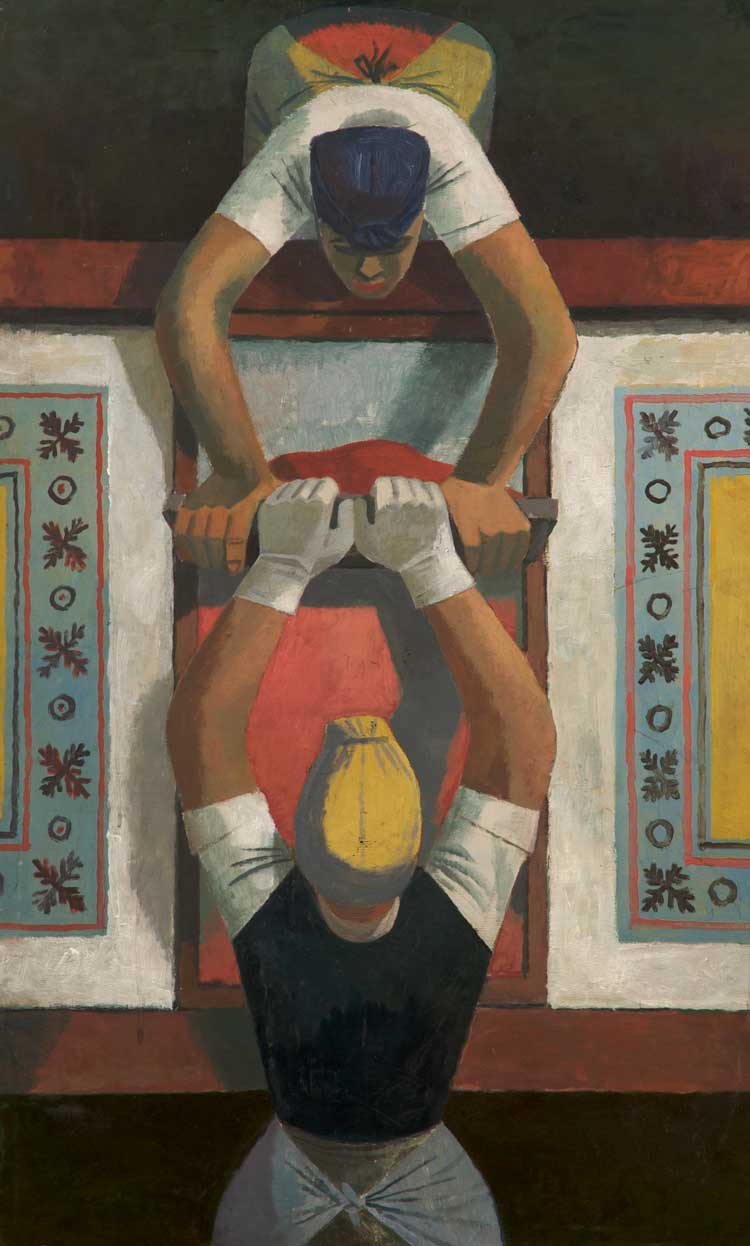
Cliff Rowe, Woman Cleaning Locomotive Boiler, c1942-45. © Cliff Rowe Estate. Courtesy of the People's History Museum.
Rowe had just returned from an 18-month sojourn in the Soviet Union, which may have begun as an elopement with his married lover. While there, he had painted a vast scene of police violence on Trafalgar Square (there is a smaller reproduction at the Towner), fusing futurist dynamism with socialist realism. During his visit, Japan had invaded Manchuria. Rowe was impressed by seeing émigré Chinese and Japanese artists collaborating despite the war and inspired by the idea that artists could put national identity aside for the common good. He and Binder – who had herself just returned from a short Moscow trip – were also enthusiastic about the state support for artists under Soviet communism.
The company decided to form a new group, a sort of revolutionary union for artists that would promote progressive politics while rallying against imperialism, fascism and warmongering. After a second meeting with doubled attendance, the Artists International – soon to be renamed the AIA – was born. It would achieve its ends through lectures, publications, posters and exhibitions, the latter of which quickly became its most vital engine. Boswell would describe the group as “a mixture of agitprop body, Marxist discussion group, exhibitions and anti-war, anti-fascist outfit”.
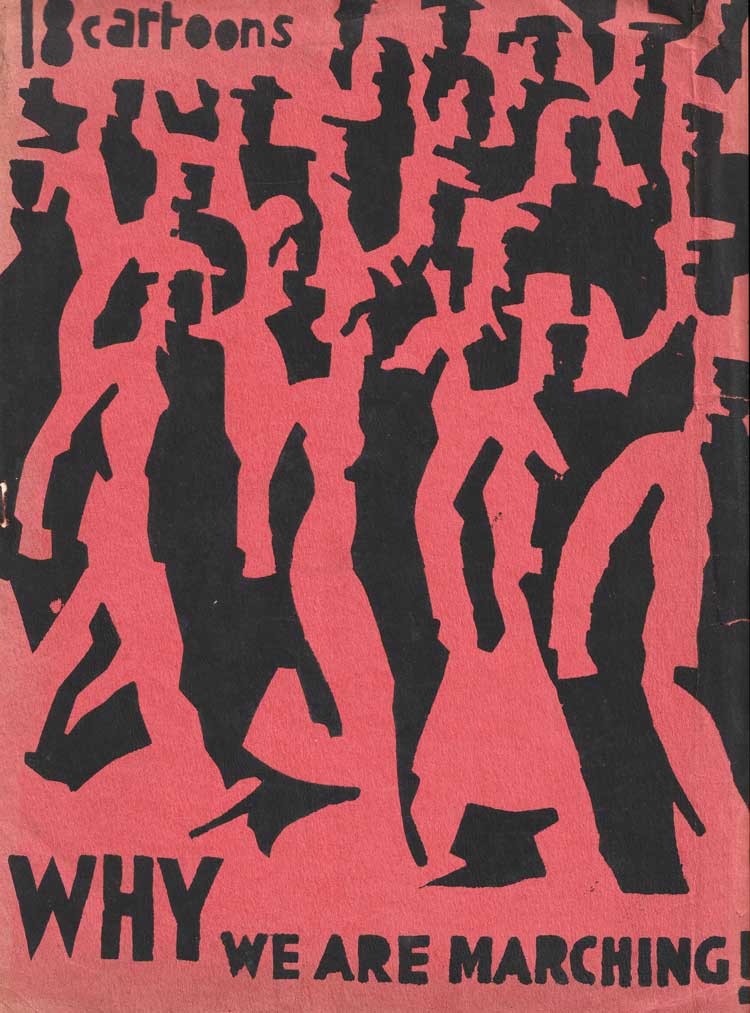
Cliff Rowe, Why We Are Marching! 1934. © Cliff Rowe Estate.
At the Towner, the first part of the exhibition introduces the work of these and other early members. Many of them excelled in print mediums, in particular lithographs. Binder created atmospheric scenes of East End life, taking us into Jewish bookshops, Kosher restaurants and streets choked with rush-hour buses. Fitton brought some Fernand Léger-esque cubism to a poster for the company Russian Oil Products, a commission that would lead to him being put under Special Branch surveillance.
Boswell’s lithograph The Fall of London (1933) is a tribute to Goya’s Disasters of War, with a hint of Hogarth and Piranesi; it shows an apocalyptic London after some unspoken disaster. Boswell also created sharp George Grosz-like sketches of politicians and wrote and illustrated an account of the Battle of Cable Street. A similar morbid grotesque animates Rowe’s Jubilee (1935) poster, which shows a skeleton king dripping blood from its mouth above the words “25 years of War Hunger Unemployment”. This poster was placed along the procession route for King George V’s silver jubilee. It foolishly carried the address of sculptor and AIA secretary Betty Rea, whose wealthy father cut her off in response.
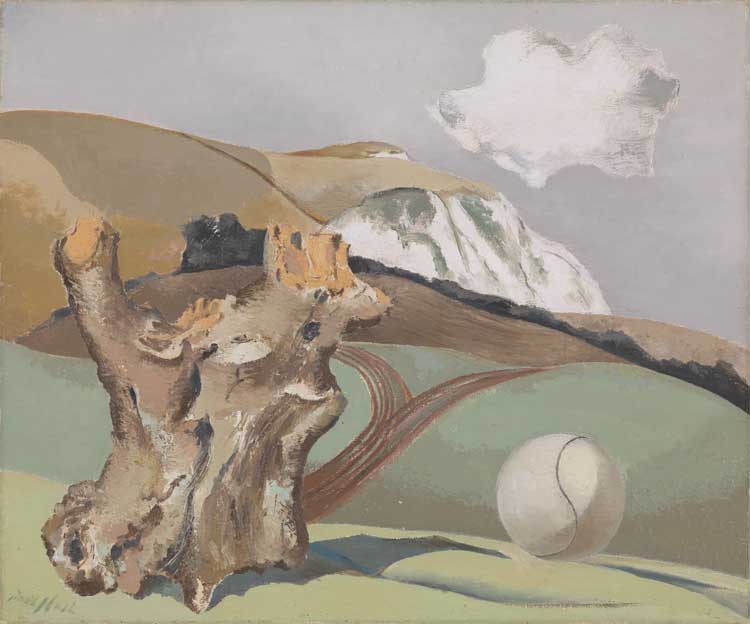
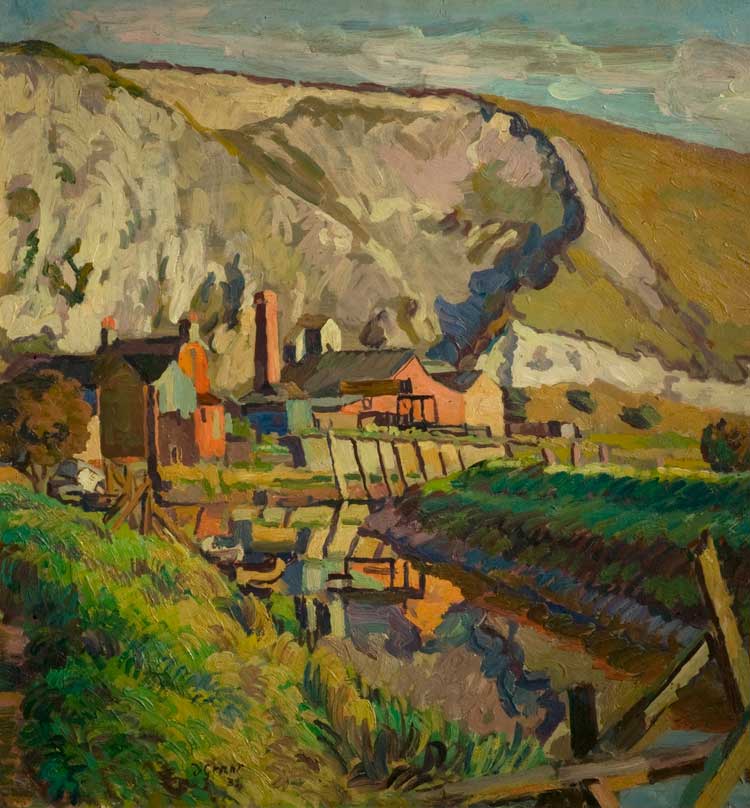
Paul Nash, Event on the Downs, 1934. UK Government Art Collection.
The AIA hosted its first exhibition, The Social Scene, in late 1934. Although it arrived at a time when many British artists still subscribed to an art-for-art’s-sake mentality, it quickly garnished submissions from outside the core group: Edward Burra, Henry Moore and Paul Nash all contributed. The reception was mixed. The Studio saluted its intentions but noted that “much of the work shown seemed to be crude and bad”, while The Left Review opined that, with some exceptions, the artists had more feeling for “the working-class movement than the working class itself”. The prominent critic and anarchist Herbert Read felt that the organisation should embrace radical modernism as the art with the potential to smash the old order.
Read soon joined the AIA. But it’s “everything and the kitchen sink” approach to genre nevertheless continued, as reflected in the Towner by a very disparate range of artworks. Artists Against Fascism and War, held in a Soho Square townhouse in 1935, numbered 179 artists, including an international contingent. The 1937 edition, in a rococo Grosvenor Square mansion, had separate spaces for abstract, surrealist, impressionist, post-impressionist, realist and academic art. Supporters included John Maynard Keynes and the publisher Victor Gollancz, who helped the group to lease the mansion. An organisation established by a band of penniless illustrators and desperate émigrés had given birth to one of the major interwar exhibition platforms in London.
It became more ambitious. In 1938, it supported a vast exhibition of expressionist art, branded as “degenerate” in Nazi Germany. In 1939. it decided to launch a series of 52 prints by 41 artists priced at 1/- (one shilling, or about £4.80 today), an attempt to make art affordable as Penguin paperbacks had done with books. One of the highlights of the exhibition is the only complete set of this project, both an inventory of artistic concerns of the period and testament to the ambition and endeavour of the artists involved. It was executed as the AIA faced a possible schism. The group was set up as an anti-war organisation. War with Germany was coming to seem inevitable. How should it respond? Members were divided between supporting action against fascism and retaining their anti-war principles.
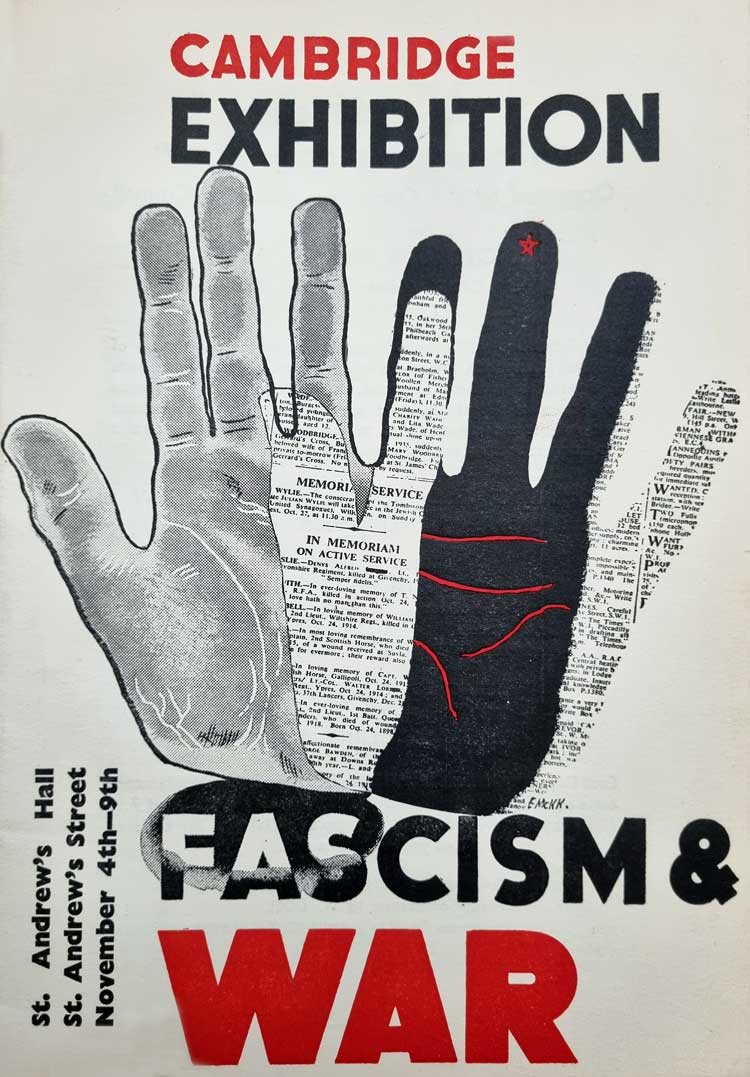
Edward McKnight Kauffer, design for Cambridge Exhibition Against War and Fascism, 1935.
In the end, the AIA chose the former path. Many of its male protagonists were conscripted, while others dispersed to the countryside. Some tried to become official war artists. Boswell, who failed to achieve this status due to his communism, went full Grosz with brilliant sketches depicting soldiers as anthropomorphic animals. Comrades in Art contains significant works on the horrors and absurdities of the conflict. Carel Weight painted a zebra escaping from London Zoo during an air raid (1941), while Humphrey Spender – brother of poet Stephen – captured the stage set strangeness of the training simulations at Salisbury Plain (1941). Some of the artists designed propaganda posters, which the AIA exhibited in the 1943 touring exhibition Poster Design in War-Time Britain, which in retrospect seems a surprising example of self-scrutiny.
There is a sense of gradual dissolution after the war. It expanded: artists once associated with the right, including Wyndham Lewis and Edward Wadsworth, contributed to its exhibitions. It became more influential. Some of its ideas for making art accessible to a wider public informed the newly formed Arts Council. Black became a prime mover in the Festival of Britain. But the organisation also lost its radical aims. In 1953, members voted to remove the leftwing political aims from its constitution. Other groups would emerge to take its place, such as Artists for Peace, which brought together such temporally distant figures as Augustus John and John Berger. In 1971, the AIA folded with little fanfare. Comrades in Art belatedly gives it the remembrance it deserves.

Click on the pictures below to enlarge
-18.jpg)
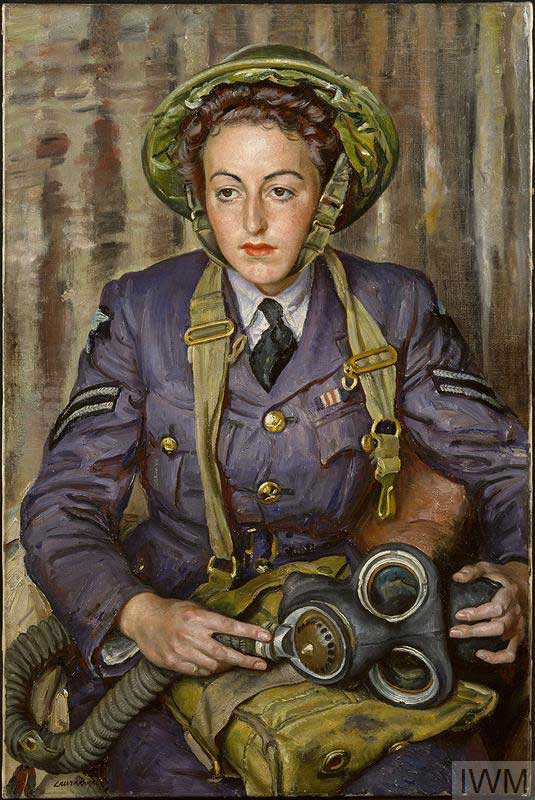
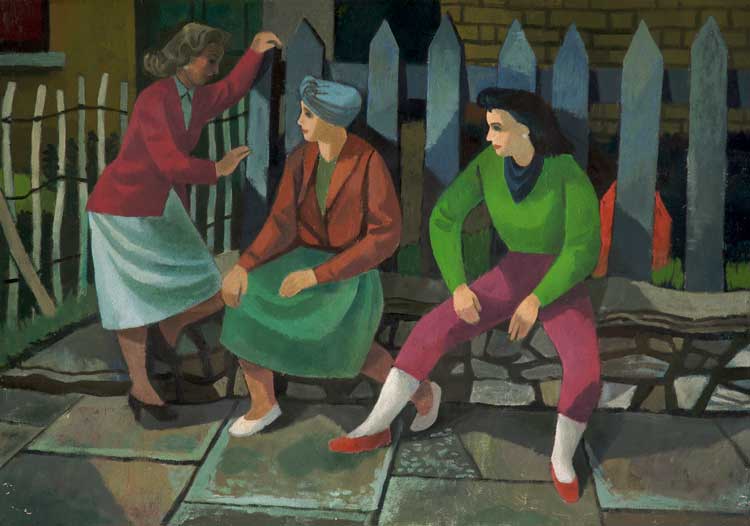
-37.jpg)
-65.jpg)
-71.jpg)
-82.jpg)
-18-300.jpg)
Comrades in Art: Artists Against Fascism
A teeming exhibition tells the story of the Artists International Association (AIA), from radical un...
Monster Chetwynd: A Friends Making Machine
In her first solo outdoor exhibition, Monster Chetwynd plunges us into her imaginative universe of s...
From Peter Struycken’s 1969 Computerstructuur, using computer programming to draft images, to Mais...
Genti Korini talks about A Place in the Sun, his twisty, challenging video installation at the Alban...
Aleksandra Kasuba: Shelters for the Senses
The Lithuanian-American Aleksandra Kasuba worked across art, design and architecture, creating publi...
-300.jpg)
From mummified cats to Tamagotchis and medieval assistance dogs to my own support dog barking at the...

The Columbian artist Delcy Morelos on how she made her enormous earthen outdoor sculpture now on sho...

Evelyn Taocheng Wang – interview
At her new exhibition in Bolzano, the Chinese-born, Netherlands-based artist Evelyn Taocheng Wang di...
RSA 200 Annual Exhibition, Edinburgh
Despite packing in 560 works, the show doesn’t feel crowded and a walk through the galleries felt ...
The 61st international art exhibition is a vast, volatile project that this year, more than most has...
25th Biennale of Sydney – Rememory
Central to this biennale are First Nations voices and the diverse diasporas that shape contemporary ...
This year is the 250th anniversary of the birth of John Constable and to celebrate, his native Suffo...

MoonSunStarEarthSkyWater, the first UK presentation of the late artist Nancy Holt’s work to includ...
The first UK retrospective of the great Spanish baroque painter Francisco de Zurbarán trades the mo...
Several Eternities in a Day: Form in the Age of Living Materials
Opened within weeks of each other, the Hammer Museum presents a mind-bending show of Brown Art and L...
André Leon Talley – interview with curator Rafael Brauer Gomes
Rafael Brauer Gomes, the director of fashion exhibitions at Savannah College of Art and Design (SCAD...
To coincide with his first UK exhibition, Agua Salada at Hauser & Wirth Somerset, Angel Otero talked...
Paula Rego: Dance Among Thorns
With more than 140 works on show, this exhibition encompasses the breadth of Rego’s art, from her ...
Handpicked: Painting Flowers from 1900 to Today
A smorgasbord of flower paintings from the last 125 years, exploring meaning, metaphor, accuracy and...
Klima Biennale Wien 2026: Unspeakable Worlds
Vienna’s climate biennale takes place across the city with institutional exhibitions and public pr...
Troublemakers and Prophets: Elizabeth Allen and Other Visionary Artists
The amazing story of an artist, who saw herself as a contemporary prophet, and made patchwork artwor...
Bellmer Nauman Pondick: Material Desire
Focusing on the work of Rona Pondick, Hans Bellmer and Bruce Nauman, this exhibition considers how b...
-300.jpg)
Spanish artist Angela de la Cruz’s twisted canvases and collapsed objects are a reflection of the ...
,-Red-Devil-(soul-2),-Drifting-Leaves,-1972-300.jpg)
Senga Nengudi: Performance Works 1972-1982
Featuring photographic works, archival materials and films of key performance pieces, this exhibitio...
-Cecily-Brown-Photo-(c)-Jo-Underhill-300.jpg)
A painter’s painter, whose dynamic landscapes take viewers on a walk, Cecily Brown returns to Lond...
Frank Bowling: Seeking the Sublime
Though containing just 10 works, this exhibition demonstrates the breadth of the British-Guyanese ar...
This exhibition explores ageing from the 1500s on, but it was the contemporary works here that reson...
This show focuses on honouring ancient relationships between people, land and water, with new work f...
Gainsborough: The Fashion of Portraiture
Despite once saying he was sick of portraits, Gainsborough was one of the most sought-after portrait...
Histories of erasure, displacement, annihilation and colonisation are told with power, subtlety, cla...

Copyright © 1893–2026 Studio International Foundation.
The title Studio International is the property of the Studio International Foundation and, together with the content, are bound by copyright. All rights reserved.
 |
 |
 |
|---|
 David Smith: Personage
 Rodin
Rodin Henry Moore
 A Delicate Game of Cat-and-Mouse
 Pallant House Gallery, Chichester