





Serpentine Galleries, London
11 October 2024 – 2 March 2025
by SABINE CASPARIE
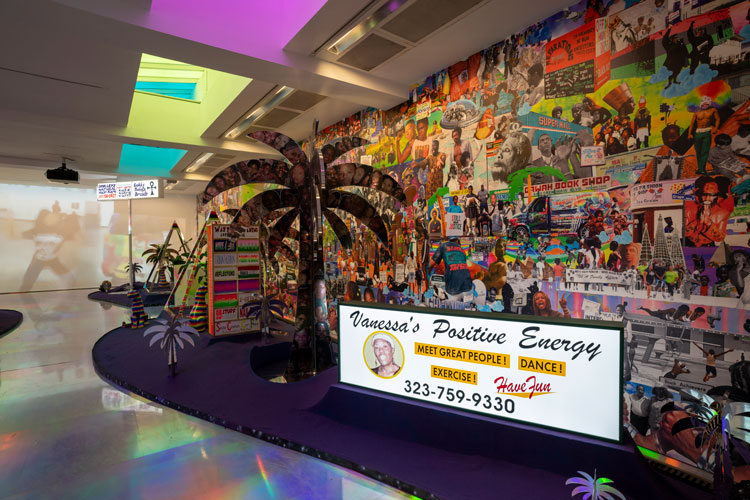
Imagine (or, should I say, emajen) being the person who has to write up the inventory for Lauren Halsey’s Emajendat. At a glance, I spot the following items: rugs, billboards, about 100 plants, about 1,000 small figurines, about 10,000 CDs for the wallpaper, mirror-plated palm trees with photographs, mirrored pyramids with text, disco balls, about 50 cutouts of heads of pharaohs.
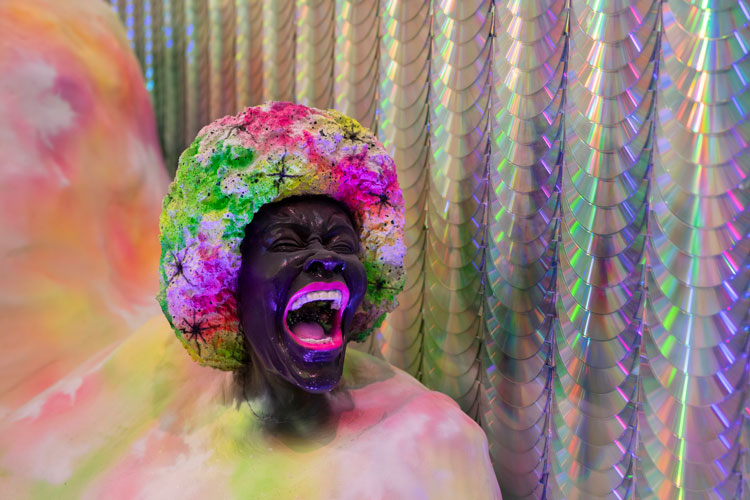
Lauren Halsey, Emajendat, 2024. Installation view, Serpentine South. © Lauren Halsey. Photo: © Hugo Glendinning. Courtesy Serpentine.
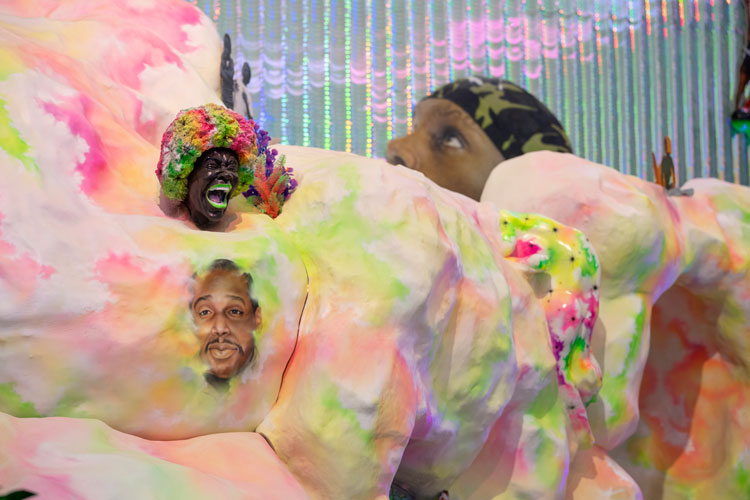
Probably because of this visual overload, there is an invigilator at the entrance telling visitors what direction to move in (clockwise). We slide over rugs in shades of brown, black and white – a pathway of sorts. The rug I am standing on depicts the busts of five dark-skinned children, praying. Along the “path” there are shiny palm trees containing photographs of the heads of more children. There are white Technicolor “rocks” with holes containing maquettes of houses and tiny people. Behind this plasticky landscape is wallpaper with a dark purple sky with thousands of little stars.
Lauren Halsey, Emajendat, 2024. Installation view, Serpentine South. © Lauren Halsey. Photo: © Hugo Glendinning. Courtesy Serpentine.
Halsey’s background is in architecture, and this exhibition feels like a three-dimensional version of her photo collages – remixes of signs, symbols and Afrofuturist visions inspired by her neighbourhood of South Central Los Angeles. In fact, all Halsey’s work is inspired by the aesthetics of her neighbourhood, as well as by Parliament Funkadelic or P-Funk, a musical collective that combines funk music with elements of psychedelic rock. Studying architecture at a local community college, Halsey travelled on the same bus route for many years: up and down Western Avenue, Broadway, across Crenshaw Boulevard. She started paying attention to the specifics of the city, and developing content for something she calls “fantastical spatial proposals”. “How could I use art to explore and honour the different ways these Black and Brown communities imagine and experience our neighbourhoods, lived histories and physical environments?” she writes in the exhibition guide.
Lauren Halsey, Emajendat, 2024. Installation view, Serpentine South. © Lauren Halsey. Photo: © Hugo Glendinning. Courtesy Serpentine.
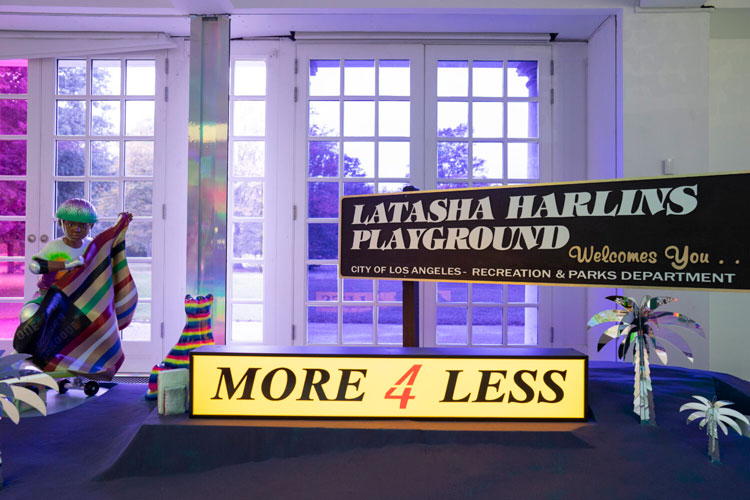
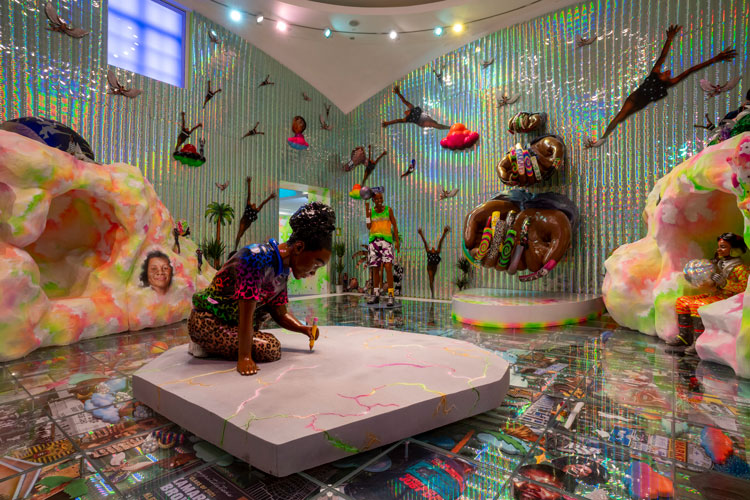
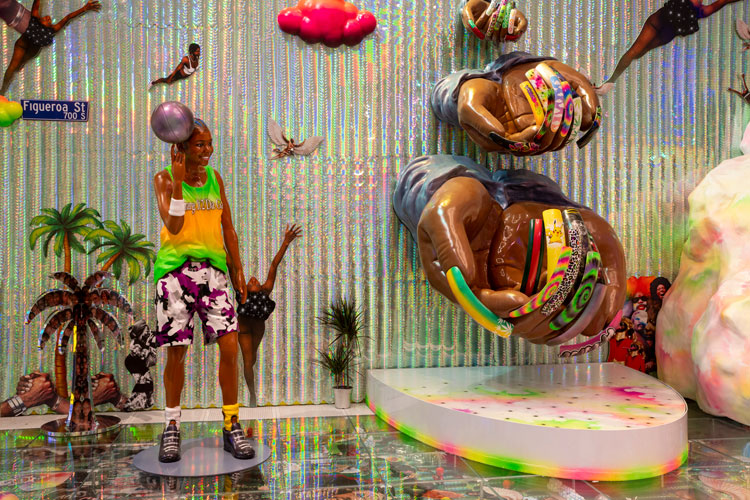
In Emajendat, Halsey takes this aesthetic of the street into the gallery. There are billboards with texts such as “My Hood Gucci” and “Pride in my Neighborhood”. There are larger-than life sculptures that look as if they have been transported from a theme park: a boy with a skateboard; a girl holding a basketball. There are literal basketballs hidden under the Perspex floorboards. A giant sculpture of a Black girl is drawing lines on a floor that seems to be breaking apart, just as Halsey is breaking open the canon of art, leaving cracks filled with fluorescent paint.
Amid the cacophony, a film in the second of three rooms provides an anchor point of sorts. Two young Black girls are dancing in a garage in front of a minibus graffitied with coloured paint and the word “Clown”. “In a place where car culture is pretty much everything, I, at an early age noticed nuances in architectural materiality,” Halsey writes. “For example, the material differences on the exteriors of neighbourhoods in South Central, versus the exterior of a city block in Westchester – neighborhoods, geographically speaking, that are right next door to one another – differences such as businesses with bars on windows or bulletproof Plexiglass versus neighborhoods where this isn’t the case.”
Lauren Halsey, Emajendat, 2024. Installation view, Serpentine South. © Lauren Halsey. Photo: © Hugo Glendinning. Courtesy Serpentine.
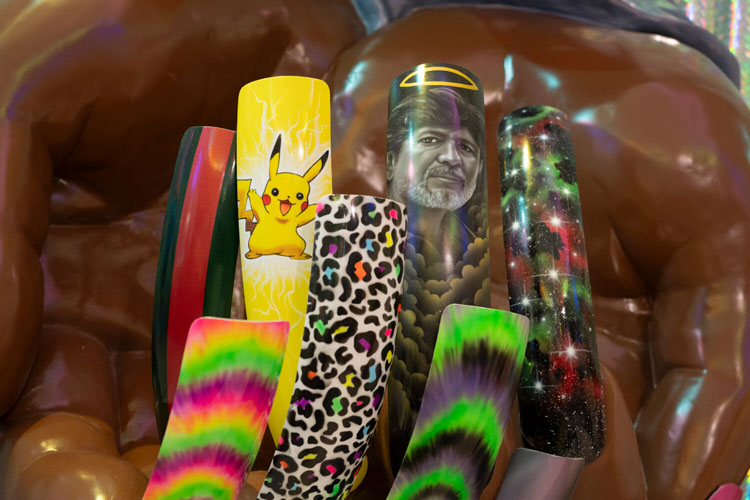
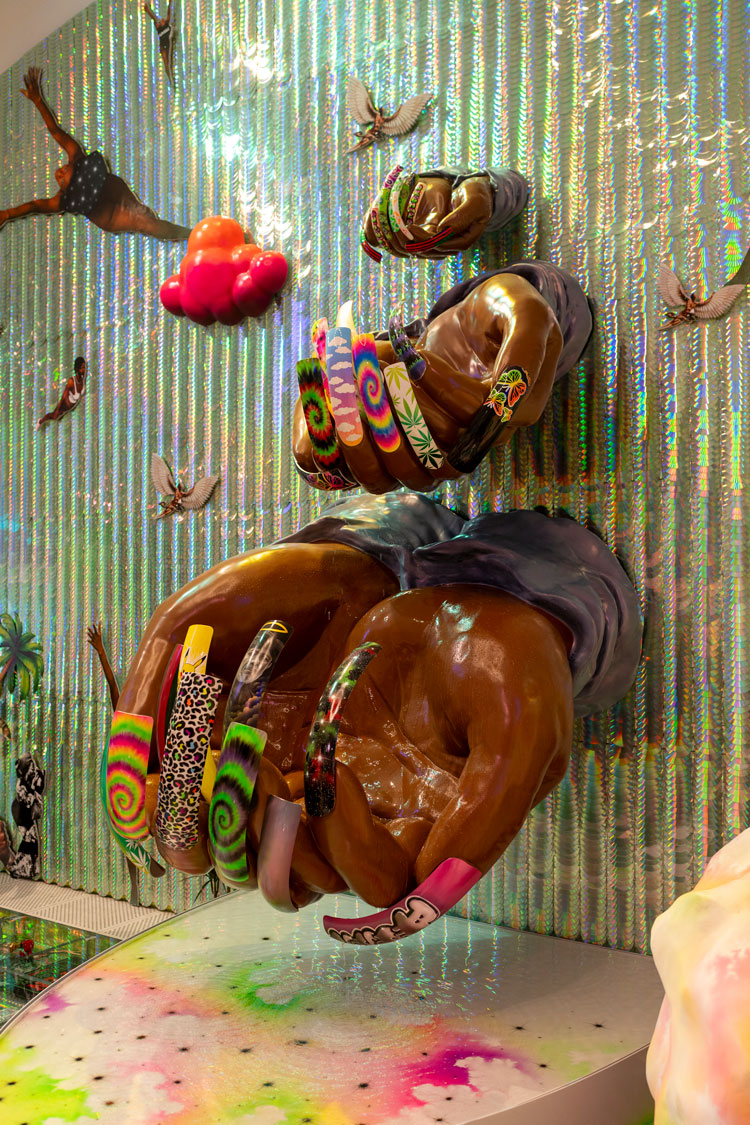
The most striking element is in the third and final room: a giant fountain in the form of a three-tier sculpture of shiny brown hands with long, fake nails in screaming colours, increasing in scale from top to bottom. The water flows through the hands, and my mind makes a connection with the praying hands of the children on the rug at the entrance – it is interesting how our minds always like to seek for something to latch on to. But latching on proves difficult here; an invigilator, having observed me standing still and making notes for several minutes, asks me if I want to take some photos and I don’t know where to start. Halsey’s art has no centre, and so everything is central. That seems to be the point.
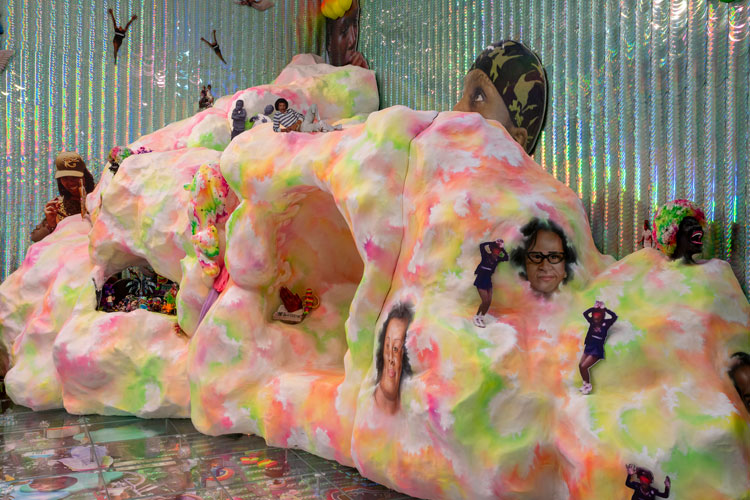
Lauren Halsey, Emajendat, 2024. Installation view, Serpentine South. © Lauren Halsey. Photo: © Hugo Glendinning. Courtesy Serpentine.
Halsey is often grouped together with artists who are inspired by hip-hop, and she describes her exhibition Emajendat as a “Funk Garden, countering the calm, green spaces of Hyde Park outside”. But for an explosion of visual noise, sound is strangely absent. The dancing girls in the video look elated and relaxed, but it is hard to tell; without audio, the film blends in with the rest of the imagery and becomes a decorative backdrop rather than an artwork per se. In the final room, the absence of sound becomes even more apparent – all I can hear is the trickling of water and the hum of a generator – not exactly the sounds of funk.
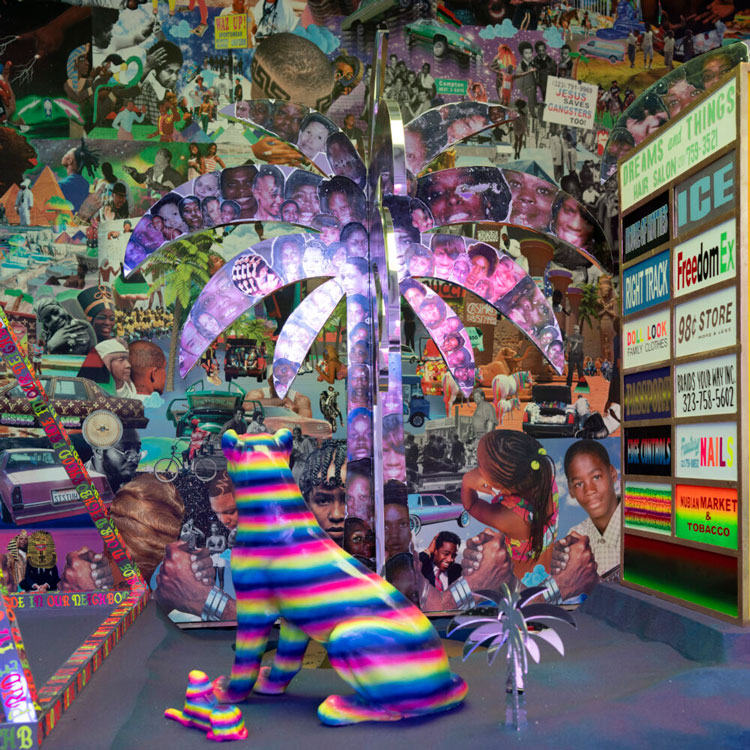
Lauren Halsey, Emajendat, 2024. Installation view, Serpentine South. © Lauren Halsey. Photo: © Hugo Glendinning. Courtesy Serpentine.
Maybe writing about this show is a little like writing about hip-hop, a cultural movement that prides itself on its nature of being indefinable. Or, as Greg Tate said in his 1996 spoken word performance, What is Hip-hop: “Hip-hop currently resides beneath the noise … You know hip-hop when you see it, you may not see hip-hop before it seizes you. Hip-hop is not what it is today but what it could be tomorrow … Arguing with hip-hop about the nature of hip-hop is like arguing with water about the nature of wetness … Hip-hop flows right through ya … Hip-hop is black Prozac.”
Halsey has created a multicolour, candyfloss, shout-out vision of a universe, a Gesamtkunstwerk that is maximalist yet hyper-specific, a meta-commentary on what it is to be part of something, to have a past and a future, to believe and to thrive, to make a mark. I leave the show upbeat and a little confused, in all the right ways.

Click on the pictures below to enlarge
To coincide with his first UK exhibition, Agua Salada at Hauser & Wirth Somerset, Angel Otero talked...
Paula Rego: Dance Among Thorns
With more than 140 works on show, this exhibition encompasses the breadth of Rego’s art, from her ...
Handpicked: Painting Flowers from 1900 to Today
A smorgasbord of flower paintings from the last 125 years, exploring meaning, metaphor, accuracy and...

Klima Biennale Wien 2026: Unspeakable Worlds
Vienna’s climate biennale takes place across the city with institutional exhibitions and public pr...

Troublemakers and Prophets: Elizabeth Allen and Other Visionary Artists
The amazing story of an artist, who saw herself as a contemporary prophet, and made patchwork artwor...
Bellmer Nauman Pondick: Material Desire
Focusing on the work of Rona Pondick, Hans Bellmer and Bruce Nauman, this exhibition considers how b...
-300.jpg)
Spanish artist Angela de la Cruz’s twisted canvases and collapsed objects are a reflection of the ...
,-Red-Devil-(soul-2),-Drifting-Leaves,-1972-300.jpg)
Senga Nengudi: Performance Works 1972-1982
Featuring photographic works, archival materials and films of key performance pieces, this exhibitio...
-Cecily-Brown-Photo-(c)-Jo-Underhill-300.jpg)
A painter’s painter, whose dynamic landscapes take viewers on a walk, Cecily Brown returns to Lond...
Frank Bowling: Seeking the Sublime
Though containing just 10 works, this exhibition demonstrates the breadth of the British-Guyanese ar...
This exhibition explores ageing from the 1500s on, but it was the contemporary works here that reson...
This show focuses on honouring ancient relationships between people, land and water, with new work f...

Gainsborough: The Fashion of Portraiture
Despite once saying he was sick of portraits, Gainsborough was one of the most sought-after portrait...

Histories of erasure, displacement, annihilation and colonisation are told with power, subtlety, cla...
-(8)-300.jpg)
Hurvin Anderson’s paintings, which here stretch across his career, blend his British and Caribbean...
-(c)-DACS,-London,-2026-and-Chiharu-Shiota.-300.jpg)
Chiharu Shiota: Threads of Life
Chiharu Shiota’s immersive web-like installations, fashioned from coloured thread and found object...
-(c)Rob-Battersby-6-1000-300.jpg)
Paul Eastwood, who is dyslexic, attempts to explore neurodiversity and the complexities of language,...
The artist and writer Morgan Quaintance, winner of the 2025 Film London Jarman Award among other acc...
Maggie’s: Architecture That Cares
Celebrating 30 years of the distinctive Maggie’s Centres for cancer care, this exhibition highligh...
Euan Uglow: An Arc from the Eye
His almost scientific methods of observation led Euan Uglow to take months, even years to finish a p...
A look behind the scenes of the travelling exhibition on Berthe Weill
The show celebrating the pioneering Parisian avant-garde gallerist opened in New York before travell...

Hammershøi: The Eye That Listens
A substantial retrospective reveals the mysteries and anomalies of magnetic Danish master Vilhelm Ha...

Barbados Museum & Historical Society challenges narrative around slavery
These two fascinating, interrelated exhibitions – one of a 19th-century Black Barbadian, the other...
Melania Toma explains her interest in collective and interspecies perspectives, her dynamic process,...

Ilana Halperin: What Is Us and What Is Earth
Collaborating with artists, scientists, geologists and nature itself, through her exquisite works, H...
Alberto Greco: Viva el Arte Vivo
The Reina Sofia recovers the art of a queer Argentinian maverick who believed he could turn anything...

The first major museum exhibition of Catherine Opie’s work in the UK charts her career from when s...
British-Nigerian artist Onyeka Igwe is having a busy year. She talks about Our Generous Mother, her ...

An absolute tour de force celebrates the life – and second life – of an artist who has progresse...
Rose Wylie: The Picture Comes First
Don’t be fooled by the cartoonish depictions, Rose Wylie is constantly finding new ways of thought...

Copyright © 1893–2026 Studio International Foundation.
The title Studio International is the property of the Studio International Foundation and, together with the content, are bound by copyright. All rights reserved.

 |
 |
 |
|---|
 Back To Earth
 Lucia Pietroiusti – interview: ‘Art can do a million things, from accelerating innovation to enriching public understanding’
 Formafantasma: Cambio
 Junya Ishigami’s Serpentine Pavilion