





The Koppel Project, London
11 March – 29 April 2022
by CHRISTIANA SPENS
Featuring eight emerging contemporary artists, Judith Burrows, Matthew Burrows, Clare Chapman, Alison Goodyear, Libby Heaney, Suzanne O’Haire, Carol Robertson and Perdita Sinclair (who also co-curates the exhibition with Anna McNay), Things Will Continue to Change … is a record of a tumultuous and life-altering time for these individuals as well as us all. Inspired by David Shrigley’s work Things will Continue to Change, this group exhibition is a communal reflection on how much has been transformed by the emergence of Covid-19 and the start of the global pandemic two years ago, in March 2020, and how much continues to shift and alter in the wake of it.
.jpg)
Perdita Sinclair. Die Eule und Die Miezekatze, 2021. Oil on canvas, 175 x 125 cm.
In particular, the exhibition explores the darker meaning of the government-backed advertising campaigns during this period, which suggested those working in the arts consider retraining – from a dancer to a police officer, or an artist to an electrician, for instance – and which appeared to come from the UK chancellor, Rishi Sunak. Working in the arts seemed to be seen as a luxury, rather than as a sustainable career or valuable asset to society that should be paid for. Yet, although there was so much turmoil and destabilisation, at every level of society, it was often art and culture that saved people during this time. This exhibition is evidence of the fact that art during the past two years especially, though it has been difficult to produce and extremely precarious as a career, has been a life raft for many.
.jpg)
Judith Burrows. Akashic library, 2021-22. Steel, organic matter, laquer, magnets, comprising free standing and leaning panels, dimensions variable.
The artists featured in Things Will Continue to Change … showcase painting, sculpture, and digital media installations, all engaging with this recent communal trauma and, in particular, the experience of precariousness.
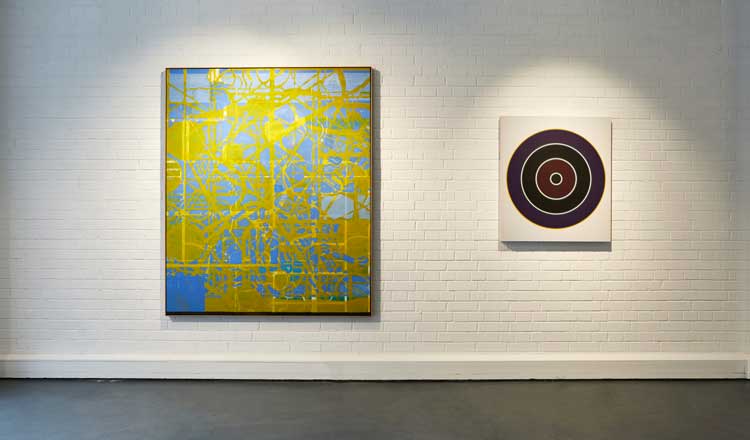
Left: Matthew Burrows. Gatescape, 2019; Right: Carol Robertson, Inner Space of Solitude, 2021. Installation view, Things Will Continue to Change, Photo: Rocio-Chacon.
Robertson shows five works, including Inner Space of Solitude (2021), a mesmerising abstract piece that resembles a dartboard, mostly black, with white circles and a yellow perimeter, capturing a feeling of vertigo or spiralling. In Solo in Pink (2021), she shows a similar circular work, though in red, black and pale pink, which reminded me of the plughole in a sink, or an eye – and which also captures a sense of sinking or spiralling into a singular, unknown space.
.jpg)
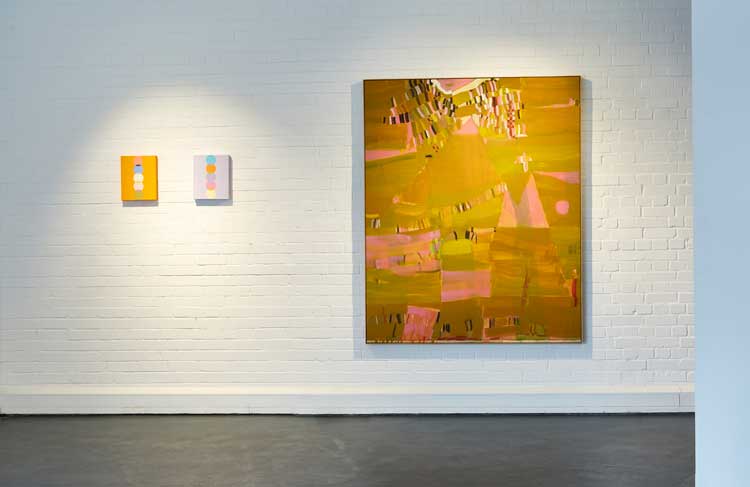
Carol Robertson. Eclipse #3, 2021. Oil on canvas, 30.5 x 25.5 cm.
In her three small Eclipses paintings (2022), overlapping neon or pastel shades form a column in each work, presenting a more upbeat vision, and showing these shapes as they eclipse one another and so create new tones where they overlap.
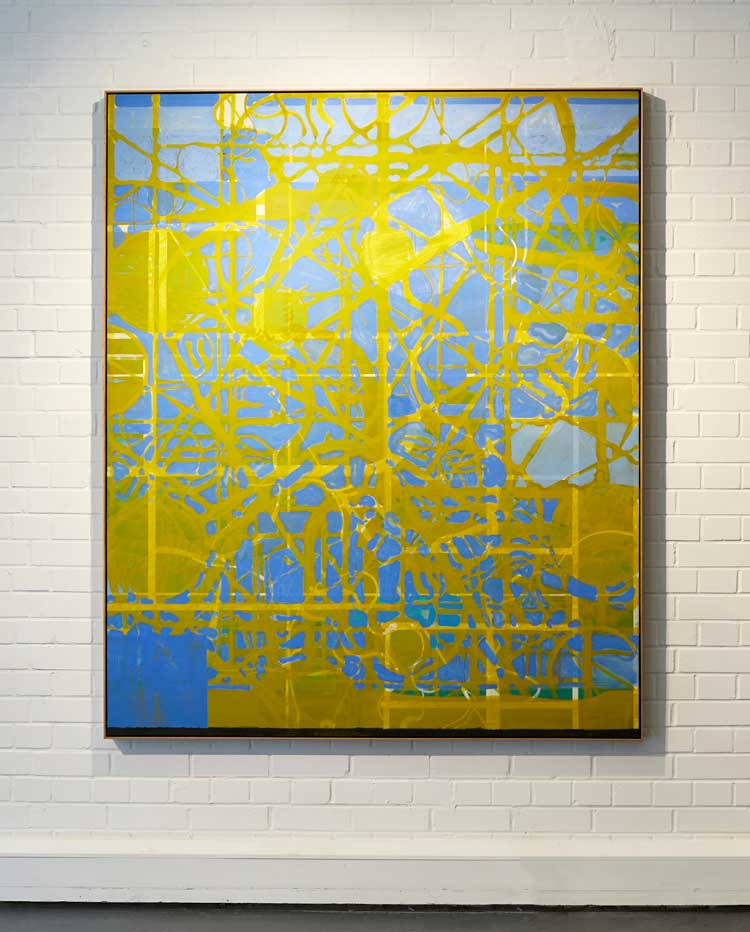
Matthew Burrows. Gatescape, 2019. Oil on board, 180 x 149 cm.
In O’Haire’s Tragicomic Triggers 4 (2021), the artist presents five silver metal boxes, each containing different metallic shapes and compositions, almost like lunch trays or washing racks, but featuring found objects in a variety of textures and shades. Matthew Burrows’ painting Gatescape (2021) – a large-scale abstract piece featuring a complex, chaotic and yet balanced pattern in yellow over shades of blue – looks at once like paint splattered across the floor, and the map of a grid-like city plan.
.jpg)
Alison Goodyear. Dusk, 2022. 4k film of virtual abstract painting plus imagery of physical paint palettes.
There is also an impressive digital work, or “slow painting film work” by Goodyear, which is over three hours long. Even a short immersion in the work proves fascinating, though, as splashes of paint and abstract arrangements float around one another in free form, creating a living painting that transforms as you sit with it.
.jpg)
Libby Heaney. Teletities (Study of Quantum Entangled Relations Between Images), 2021. Single channel video without sound, 60 min duration.
Also exploring the promise of the digital realm of fine art, Heaney shows Teletities (Study of Quantum Entangled Relations Between Images), using quantum computing to entangle and merge three open-source images that she found on Wikipedia, suggesting new interconnected ways of understanding and representing change and turbulence. Heaney says: “Through almost imperceptible change, Teletities aims to disrupt the accelerating binary logic of our current internet and digital imagery, proposing instead an alternative queer way of seeing. Individual images – the Earth, a cephalopod and plants – slowly lose their identity and merge together, creating hybrid patterns and relations that could only be generated through quantum data.” This idea – and visual manifestation – of change and the destruction and reconstruction of visual identity is especially fascinating as a metaphor for the wider identity shifts individuals have been through over the past two chaotic years, and a reminder of the eventual reconstitution and new identities formed even in the midst of chaos.
Alongside these central works, QR codes in the gallery link to creative responses by key stage 4 pupils from Addey and Stanhope secondary school in Lewisham, south-east London. To underline the idea of change as a constant, moreover, there will also be a rehang halfway through the exhibition’s residency, showing a new variety of works by the same eight artists. The youth and the artists lead the way here, then, as in society more generally, in showing the fast and unpredictable pace of change with which we all must grapple, whether feeling isolated or together or, as in the past few years, together in isolation. Things Will Continue to Change … is a brilliantly curated and insightful record of a turbulent time that ultimately underlines the communal aspect of a shared trauma and the loneliness often inherent in these experiences of illness, isolation, and the confusing behaviours and relationships that have manifested from this time.

Click on the pictures below to enlarge
.jpg)
.jpg)
Histories of erasure, displacement, annihilation and colonisation are told with power, subtlety, cla...
-(8)-300.jpg)
Hurvin Anderson’s paintings, which here stretch across his career, blend his British and Caribbean...
-(c)-DACS,-London,-2026-and-Chiharu-Shiota.-300.jpg)
Chiharu Shiota: Threads of Life
Chiharu Shiota’s immersive web-like installations, fashioned from coloured thread and found object...
-(c)Rob-Battersby-6-1000-300.jpg)
Paul Eastwood, who is dyslexic, attempts to explore neurodiversity and the complexities of language,...
The artist and writer Morgan Quaintance, winner of the 2025 Film London Jarman Award among other acc...
Maggie’s: Architecture That Cares
Celebrating 30 years of the distinctive Maggie’s Centres for cancer care, this exhibition highligh...
Euan Uglow: An Arc from the Eye
His almost scientific methods of observation led Euan Uglow to take months, even years to finish a p...
A look behind the scenes of the travelling exhibition on Berthe Weill
The show celebrating the pioneering Parisian avant-garde gallerist opened in New York before travell...
Hammershøi: The Eye That Listens
A substantial retrospective reveals the mysteries and anomalies of magnetic Danish master Vilhelm Ha...
Barbados Museum & Historical Society challenges narrative around slavery
These two fascinating, interrelated exhibitions – one of a 19th-century Black Barbadian, the other...
Melania Toma explains her interest in collective and interspecies perspectives, her dynamic process,...
Ilana Halperin: What Is Us and What Is Earth
Collaborating with artists, scientists, geologists and nature itself, through her exquisite works, H...
Alberto Greco: Viva el Arte Vivo
The Reina Sofia recovers the art of a queer Argentinian maverick who believed he could turn anything...
The first major museum exhibition of Catherine Opie’s work in the UK charts her career from when s...
British-Nigerian artist Onyeka Igwe is having a busy year. She talks about Our Generous Mother, her ...
An absolute tour de force celebrates the life – and second life – of an artist who has progresse...
Rose Wylie: The Picture Comes First
Don’t be fooled by the cartoonish depictions, Rose Wylie is constantly finding new ways of thought...

This utterly compelling two-channel video installation visually and aurally reflects the fractured h...
The late Colombian artist Beatriz González’s garish colours and shiny surface belie the violence ...
This scholarly exhibition lets the pointillist pioneer Georges Seurat’s lesser-known marine painti...
Lucian Freud: Drawing into Painting
The 170 drawings, etchings and paintings on show here not only lend insight into Lucian Freud’s wo...
Aki Sasamoto: Grilled Diagrams
In her first institutional solo show in the UK, Aki Sasamoto creates a freewheeling, haphazard narra...
-John-Cook-2025--300.jpg)
Loved by the public for her colourful and humorous paintings of people enjoying themselves, she was ...
Encompassing four solo shows this exhibition challenges our views on climate change, disability, ide...
Takesada Matsutani: Shifting Boundaries, and Tetsumi Kudo: Microcosmos
A pair of exhibitions by two Japanese innovators show contrasting approaches to the plastic revoluti...
Cosmos: The Art of Observing Space
Hard science meets soaring imaginations in a show brimming with cosmologically inspired artworks...
Paper Tiger Television: It’s 8:30. Do you know where your brains are?
A poignant exhibition takes us to a lost age of anti-corporate, earnestly intellectual media – wit...
This exhibition spans 50 years, from the now 90-year-old photographer Don McCullin’s gruelling 196...
Bringing together the best of two brilliant collections, this exhibition celebrates modern British p...
Hito Steyerl: Humanity Had the Bullet Go in Through One Ear and Out Throug...
The much-garlanded German artist-essayist Hito Steyerl turns her penetrating gaze to AI, automata an...

Copyright © 1893–2026 Studio International Foundation.
The title Studio International is the property of the Studio International Foundation and, together with the content, are bound by copyright. All rights reserved.
 |
 |
 |
|---|
_2025_Libby-Heaney_Photo-Max-Colson-2-300.jpg) Shadowscapes: Heaney, JMW Turner and Quantum
Shadowscapes: Heaney, JMW Turner and Quantum Libby Heaney – interview: ‘The point of the work is to destabilise you’
 Matthew Burrows – interview: ‘I think as an artist and I make as a painter’
 The impact of Covid-19 on artists, part 5: the long-term outlook and the growth in online offerings
 The impact of Covid-19 on artists, part 4: artistic responses to the coronavirus and the prescient zeitgeist