





Olukemi Lijadu, Feedback, 2026. Two-channel video. Courtesy the artist.
Spike Island, Bristol
31 January – 10 May 2026
by DAVID TRIGG
The high-pitched screech of audio feedback is an unpleasant assault on the ears. Occurring when a microphone picks up its own amplified sound from a speaker, which is then re-amplified in a continuous, howling loop, it is the bane of audio engineers, musicians and gig-goers alike. Thankfully, there are no aural upsets in Olukemi Lijadu’s two-channel video installation Feedback (2026), in which the Nigerian British artist, film-maker and DJ uses the phenomenon as a metaphor for the transmission of West African sonic traditions and cultural codes throughout the African diaspora. From the polyrhythms of traditional African drumming to the drum machines of Chicago’s house music pioneers, to dance floors and festivals around the world, Lijadu’s richly layered audiovisual collage traces how beats and rhythms reverberate and are re-amplified across continents, cultures and generations.
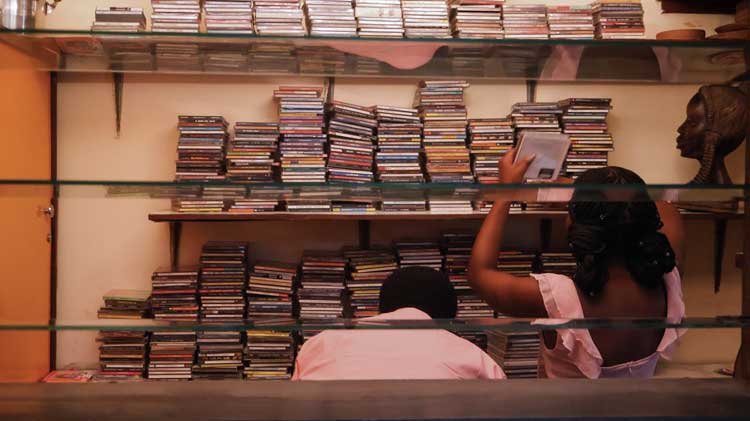
Olukemi Lijadu, Feedback, 2026. Two-channel video. Courtesy the artist.
Eschewing narrative structure in favour of idiosyncratic montage, Feedback visually and aurally reflects the fractured history of the African diaspora. It draws on concepts put forward by Paul Gilroy in his groundbreaking 1993 book The Black Atlantic: Modernity and Double Consciousness, which proposes that the modern black experience cannot be defined solely as African, American, Caribbean or British, but is properly understood as what he calls a “Black Atlantic” culture, which transcends ethnicity and nationality. Diasporic music as a means of exploring the transient nature of blackness is an important theme in Gilroy’s text and one that Lijadu has run with for her first institutional solo exhibition at Spike Island in Bristol. Combining archival clips with original footage of Nigerian musicians, a Yoruba linguist, DJs, and the artist’s family members, Feedback is the result of extensive research in Chicago, Detroit, Lagos and Bristol. Fast-moving and continuously shifting gears, the concise and highly personal video essay leaves little time for protracted contemplation, yet the result is utterly compelling.

Olukemi Lijadu, Feedback, 2026. Two-channel video. Courtesy the artist.
After an eclectic opening sequence featuring a spinning figure skater, jazz drummer, rope jumpers and people dancing to Rufige Kru’s seminal 1992 track Terminator (one of the most influential in the history of jungle and drum’n’bass), we see and hear various African hand drums being played on a Lagos beach as waves break on the shore. The drummers’ rhythms are joined by melancholic synth chords and shots of clubbers, making a direct connection between ancient beats and modern grooves, between the Middle Passage and the evolution of electronic music. Ocean waves appear at several points during the film, a seeming metaphor for the forced and voluntary migration of African people across history as well as, perhaps, a nod to the sound and electrical waves by which black music has been, and continues to be, globally disseminated.
The powerful influence that musical rhythms exert on the human body is a recurring theme. At one point we hear a DJ recounting an incident where a woman became so immersed in the music he was playing that she seemed possessed. The track she “lost it” to was Josh Milan’s Acts 2 and 4 (2020), which the DJ links to the coming of the Holy Spirit as recorded in the New Testament book of Acts. “She caught the Holy Ghost,” he suggests, likening the episode to the ecstatic spiritual experiences of some Pentecostal Christians. Milan’s joyful deep house track reverberates around Spike Island’s cavernous exhibition space, accompanied by looping clips of energetic dancers in clubs and festivals and, briefly, a shaman in a trance. Here, music transcends entertainment, becoming a catalyst for movement, exhilaration and deep, sacred connection.
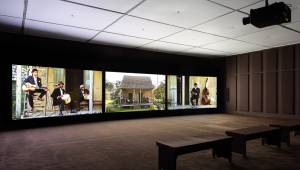
-32.jpg "Olukemi Lijadu: Feedback, 2026. Installation view, Spike Island, Bristol. Image courtesy the artist. Photo: Rob Harris.")
Olukemi Lijadu: Feedback, 2026. Installation view, Spike Island, Bristol. Image courtesy the artist. Photo: Rob Harris.
Milan frequently references the influence of the church on his musical style and, in another sequence, Lijadu makes explicit the connection between black religious musical traditions and modern dance music. A gospel choir singing “amen” in a church is juxtaposed with a snatch of The Winstons’ 1969 B-side, Amen, Brother, whose much-sampled seven-second drum break has formed the backbone of countless jungle and drum’n’bass tracks for decades, one of which blasts from an enormous speaker stack at a lively street party in another clip.
Through its looping, sampling and jump-cut editing, Feedback moves back and forth through time, revealing the persistence of rhythm as a communal force. Finding inspiration in early abstract cinema, rhythm is embedded in its structure. But this is not a formalist experiment. Indeed, it feels closer to Mark Leckey’s Fiorucci Made Me Hardcore (1999) or John Akomfrah’s Vertigo Sea (2015) than, say, works by Walter Ruttmann or Hans Richter. And it is as much an aural experience as a visual one, with the exhibition space designed for listening in comfort: plush carpet, bean bags and mighty speaker stacks courtesy of Bristol-based sound system Ramsham Hi-Fi.
For Lijadu, the history of music is a living archive of shared memory and overlooked relations. In Feedback, she posits the drum as a symbol of rhythmic interconnection and collective feeling. As the Chicago-based writer and editor Camille Gallogly Bacon writes in the exhibition notes: “A talking drum in Lagos influences the emergence of House music in Chicago, which influences the birth of techno in Detroit, which influences the inception of drum’n’bass in Bristol, which influences the innovations in West African sonic tradition.” The tunes may have evolved and the technology advanced, but the rhythms remain imprinted with a rich cultural history that, although fractured and dispersed, continues to loop back on itself, refusing to be silenced.
Click on the pictures below to enlarge
-30.jpg)
-34.jpg)

Copyright © 1893–2026 Studio International Foundation.
The title Studio International is the property of the Studio International Foundation and, together with the content, are bound by copyright. All rights reserved.

 |
 |
 |
|---|




-300.jpg)

-300.jpg)
 John Akomfrah: Ballasts of Memory
 Glasgow International Festival 2018
 The Place Is Here
 John Akomfrah – interview: ‘The question of discourse is absolutely central’
 Secret Surface: Where Meaning Materialises