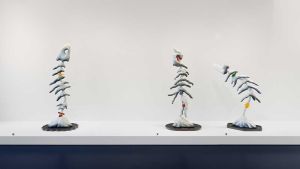

-Beatriz-Gonzalez.jpg)
Beatriz González. Telón de la móvil y cambiante naturaleza (Backdrop of a Moving and Changing Nature), 1978, installation view, Barbican, London, 25 Feb – 10 May 2026. Photo: Barbican Art Gallery, David Parry © Beatriz González.
Barbican Centre, London
25 February – 10 May 2026
by JOE LLOYD
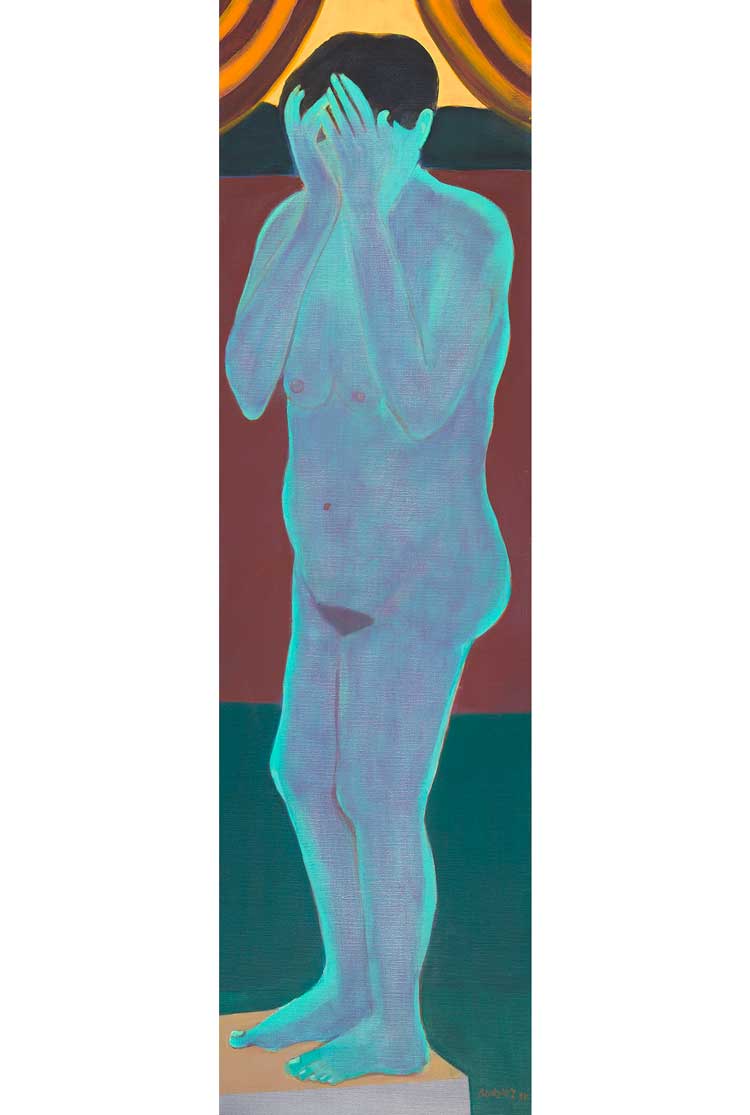
The Colombian artist Beatriz González (1932-2026), who died in January, turned colours up to 11. Cast your eyes around the Barbican Centre’s new retrospective and you will see smooth, often flat planes of rich hues, as dazzling as stained glass on a summer afternoon. Her painted figures sometimes look like the result of a particularly creative children’s colouring book, with glowing burgundy, aquamarine and orange skin. Her works in enamel blaze even brighter: Christ has the skin tone of a Smurf; the Mona Lisa gazes out from above a vomit-green sky. These two images are mounted on a bed and in place of a mirror respectively, the high matter of painting bound to lowly household furniture. González grew up in Bucaramanga, in the north of her country, and she would later claim the city’s candescent sunsets inspired her palette. Yet the luminous tone of her works belies their often maudlin, sometimes downright horrific subject matter. González’s art frequently chronicles the story of her country, a tale in which violence plays a starring role.
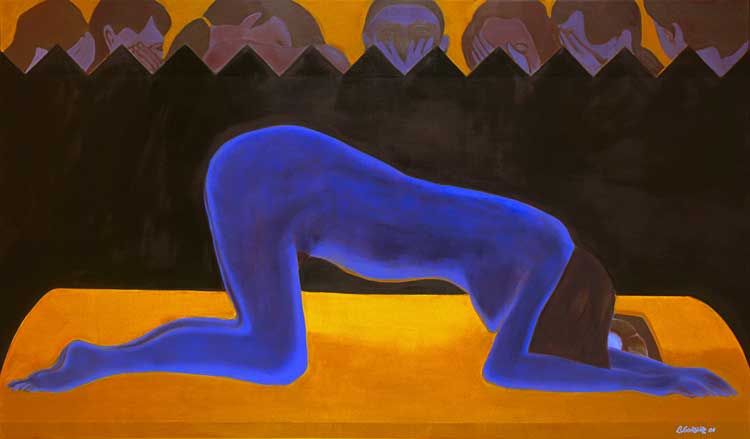
Beatriz González, Empalizada (Palisade), 2001. Collection of Andrés Matute, Ignacio Goñi, Fernando Goñi. © Beatriz González. Courtesy the artist. Photo: Juan Camilo Segura.
González was interested in what she termed the “joy of underdevelopment”, which she used to describe the ways in which “third world” countries interpreted and repurposed the visual culture of the developed west. So, the Mona Lisa might become decor for the working-class home. González was fascinated, in particular, by the output of Gráficas Molinari, a workshop that produced cheap prints, often taking old master art and turning it into colourful kitsch. These garish images – of saints, of Simón Bolívar, of children frolicking with animals – were enormously popular in mid-to-late-20th-century Colombia, forming a constant graphic backdrop to the country.
González’s work is often saturated with the lurid colours and drama of this matter. She told El Tiempo newspaper in 1968: “My paintings are of deliberately bad taste, that is why I do not sell.” Her works might not have sold, but they certainly garnered a share of acclaim – she had her first solo exhibition at the Museo de Arte Moderno de Bogotá in 1964, two years after graduation, and the same year won second prize at the National Salon of Colombian Artists. She repeated the trick the year after, then in 1971 was chosen to represent Colombia at the São Paulo Biennial, and in 1978 at Venice. Inspired in part by the fashion for abstract painting sweeping Latin America in the 60s, her earliest oil paintings deconstruct masterworks by Velázquez and Vermeer, turning, for instance, the latter’s The Lacemaker into glowing blocks and patches. Her colours aimed to reflect those of mass-produced objects, such as a cigarette company’s annual calendars.
-Beatriz-Gonzalez.jpg "Beatriz González, África adios (Goodbye Africa), 1968. Alonso Garcés Galería, Bogotá. © Beatriz González. Courtesy the artist. Photo: Juan Rodríguez Varón.")
Beatriz González, África adios (Goodbye Africa), 1968. Alonso Garcés Galería, Bogotá. © Beatriz González. Courtesy the artist. Photo: Juan Rodríguez Varón.
At the time, there must have seemed clear parallels to the candy-shop palette of Andy Warhol. Like Warhol, she had an eye for mass media, especially appropriating images of iconic figures – Christ, Bolívar, Princess Anne. Unlike the pop artist, there was a vital political aspect to these depictions. A 1968 portrait of Elizabeth II is titled Goodbye Africa, alluding to the British empire’s withdrawal from the continent. González also began to cover humbler subject matter. Searching newspapers for inspiration, she stumbled across a photograph of a couple who had jumped off a dam. The Los Suicidas del Sisga (1965) series comprises three interpretations of this couple, each different in colour and exact pose. Their faces are blurred, as if they are already disappearing from memory.
-Beatriz-Gonzalez.jpg "Beatriz González, installation view, Barbican, London, 25 Feb – 10 May 2026. Photo: Barbican Art Gallery, David Parry © Beatriz González.")
Beatriz González, installation view, Barbican, London, 25 Feb – 10 May 2026. Photo: Barbican Art Gallery, David Parry © Beatriz González.
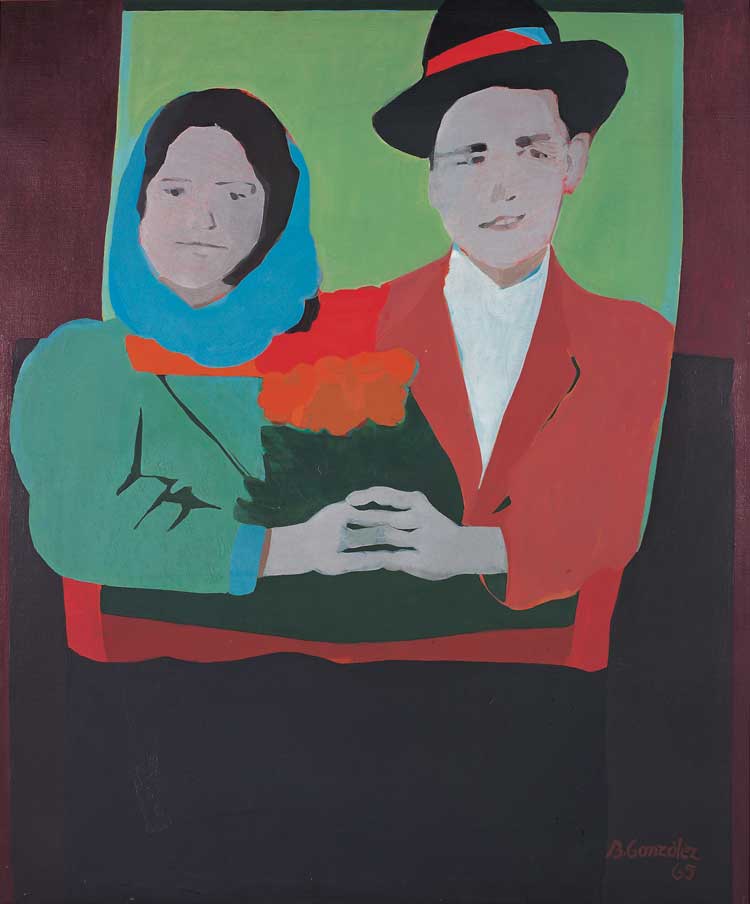
Beatriz González, Los suicidas del Sisga I (The Sisga Suicides I), 1965. Collection of Diane and Bruce Halle, Phoenix, Arizona. © Beatriz González. Courtesy the artist. Photo: Oscar Monsalve.
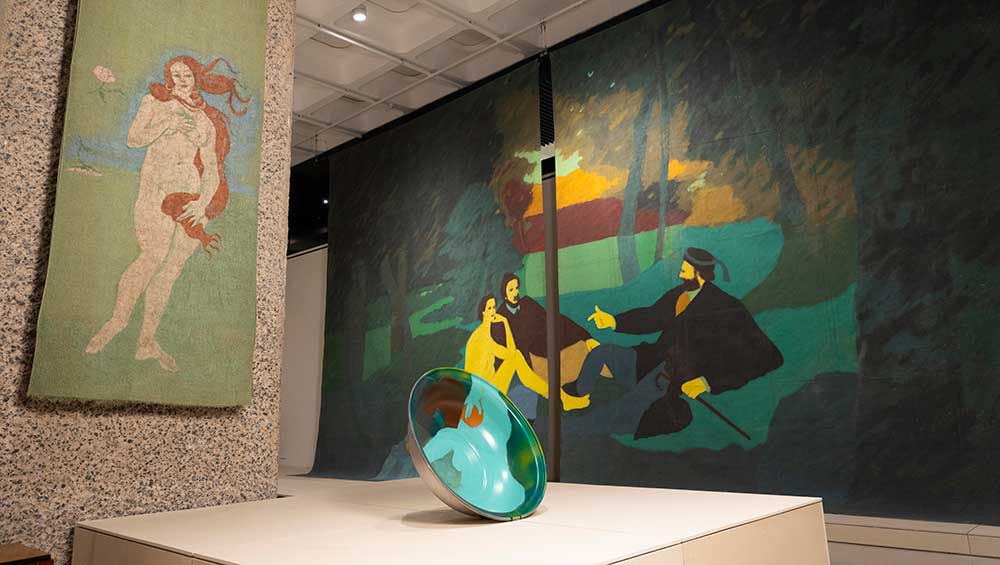
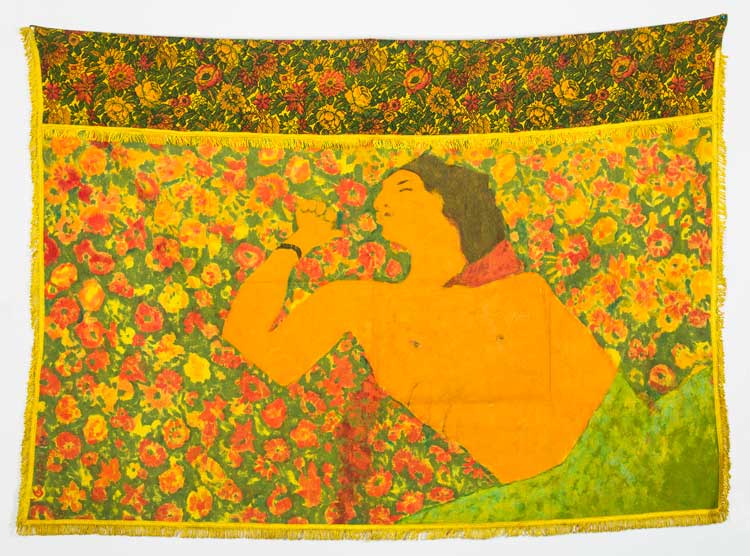
González gradually came to understand her art as a way to create monuments to such stories, as well as the wider political situation in her country. One room contains a harrowing trio of textiles, on which González has painted two victims of murder, lying as if asleep against backgrounds of flowers and nature scenes. Some of her most striking works satirise President Julio César Turbay, whose draconian security clamped down on freedom of expression (pushing the already celebrated Gabriel García Márquez into self-exile). Given the climate, González keeps her satire relatively ambiguous. She placed the president’s face on a TV screen (1980), referencing a speech he gave to announce the arrival of colour television to the country; she printed an image of him partying on a 140-metre-long curtain (1981). The medium referenced his propensity to screen his repressive politics behind a veneer of modernisation and jollity. A later linocut series, Frieze of Comedy (1983), shows him as a bloody red silhouette attaching a medal to a dignitary, in a manner that resembles a strangulation.
-Beatriz-Gonzalez.jpg "Beatriz González, installation view, Barbican, London, 25 Feb – 10 May 2026. Photo: Barbican Art Gallery, David Parry © Beatriz González.")
Beatriz González, installation view, Barbican, London, 25 Feb – 10 May 2026. Photo: Barbican Art Gallery, David Parry © Beatriz González.
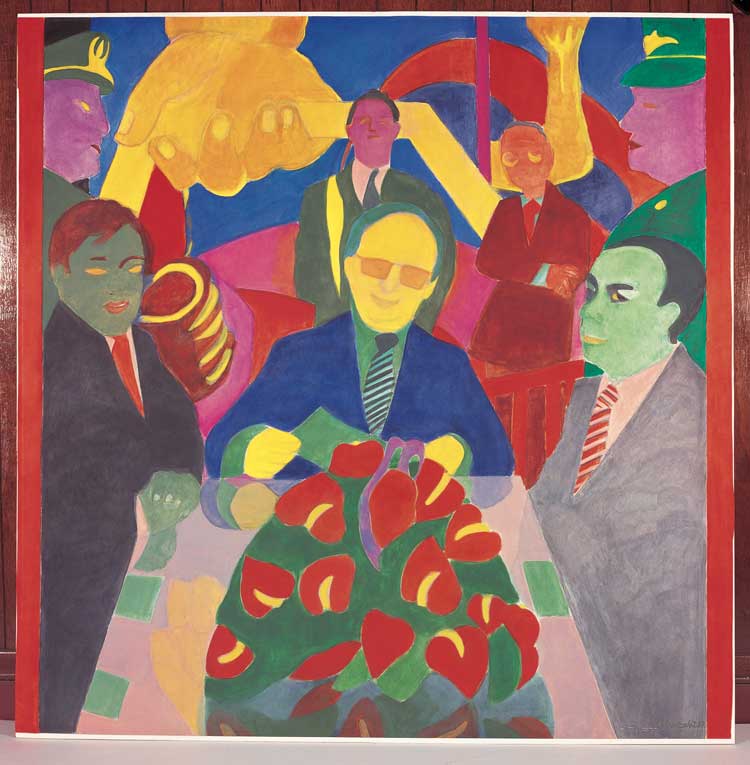
Beatriz González, Señor presidente, qué honor estar con usted en este momento histórico (Mr President, What an Honor To Be with You at This Historic Moment), 1987. Casas Riegner, Bogotá. © Beatriz González. Courtesy the artist.
Colombia suffered waves of violence throughout González’s life, including the La Violencia (1948-58) civil war between supporters of political parties and the still-active conflict between the government, crime organisations, guerrillas and paramilitaries that followed. But it was in the 80s that she began to focus on the horror more directly. In 1985, the leftist M-19 guerrilla group besieged the country’s Palace of Justice, keeping all those inside hostage. When the army stormed the building, it burned down, killing 98 people. González responded to this crisis with Mr President, What an Honour to Be With You at This Historic Moment (1987), a painting showing president Belisario Betancur and his goblin-faced ministers sitting around a bouquet of flowers, calmly acting as if nothing irregular has occurred. The Parrots (1987) imagines this cabinet as a row of lava-red ghouls in military uniform.
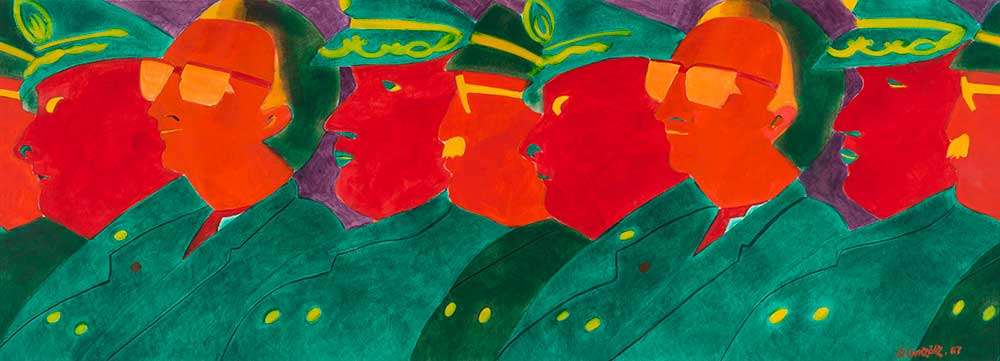
Beatriz González, Los papagayos (The Parrots), 1987. Collection Pérez Art Museum Miami, gift of Jorge M. Pérez. © Beatriz González. Courtesy Pérez Art Museum Miami. Photo: Oriol Tarridas.
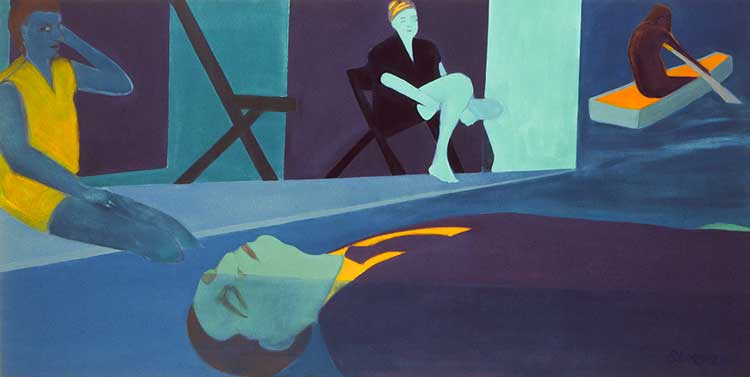
Beatriz González, La pesca milagrosa (Miraculous Catch), 1992. Museo de Arte Moderno de Barranquilla, MAMB, Colombia. © Beatriz González. Courtesy the artist. Photo: Julio Cesar Florez.
From around this time, much of the work at the Barbican is given over to memorialising the victims of violence throughout Colombian history, from the Indigenous people cleared away by colonialism to the women left mourning dead family members. The palette remains rich, but darkens. Some of these later paintings have a haunting clarity. Others are harder to parse: Miraculous Catch (1992) has a corpse floating in a pool while a bather dips her legs into the water. While she once sampled western conventions, here González seems to disrupt them. Burial at the National Museum (1991) is a cacophony of grieving figures. Paintings from the early 00s feature rows of mourners overlooking the action, like a chorus in a tragedy. Her final work, Anonymous Auras (2023), saw eight images of attendants carrying corpses placed on to the 8,956 graves in Bogotá Central Cemetery devoted to the poor and unknown dead. An installation at the Barbican captures something of this solemnity. It is a fitting capstone for an artist whose work asks us to remember.
Click on the pictures below to enlarge
-Beatriz-Gonzalez.jpg)
-Beatriz-Gonzalez.jpg)

Copyright © 1893–2026 Studio International Foundation.
The title Studio International is the property of the Studio International Foundation and, together with the content, are bound by copyright. All rights reserved.
 |
 |
 |
|---|


-300.jpg)
-300.jpg)