



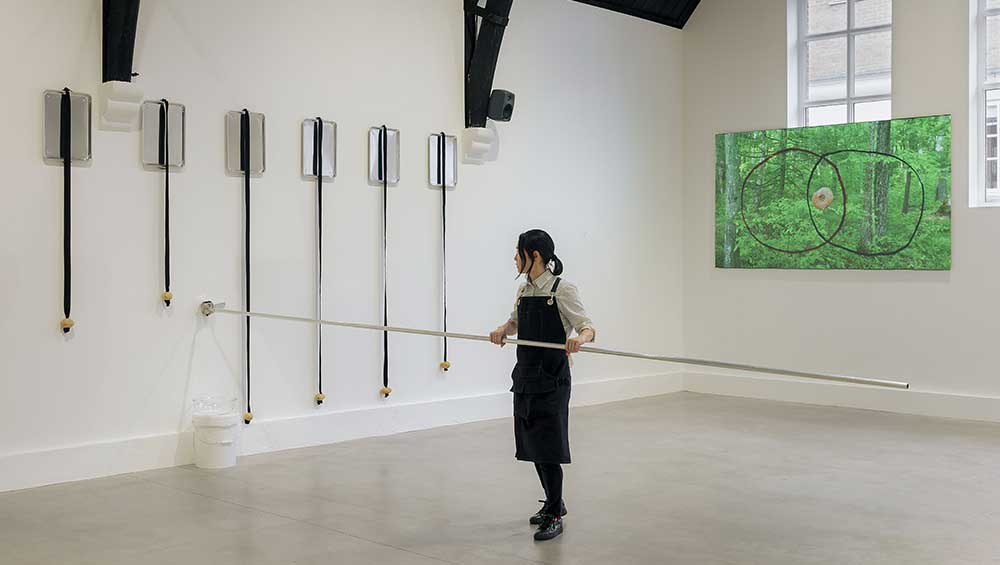
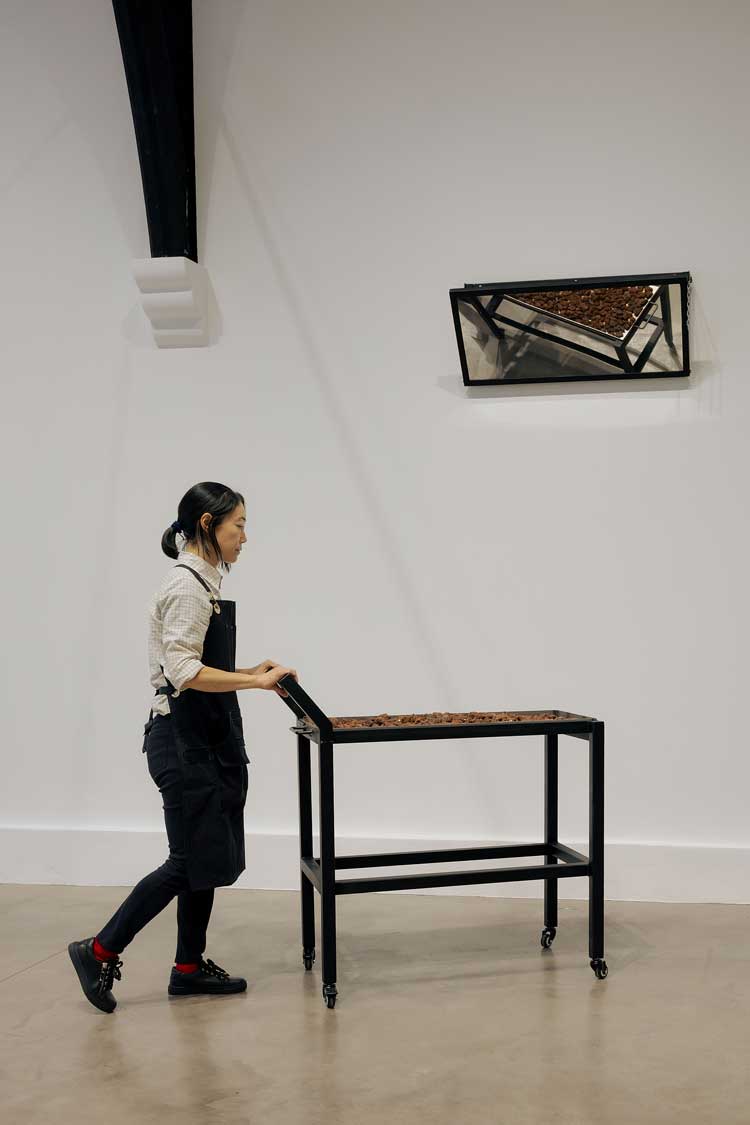
Aki Sasamoto, Grilled Diagrams, 2026. Installation view, Studio Voltaire, 2026. Commissioned and produced by Studio Voltaire. Image courtesy of the artist, Bortolami Gallery, Take Ninagawa and Studio Voltaire. The film Do Nut Diagram is courtesy Akeroyd Collection, the Time-Based media facet of the Shane Akeroyd Collection. Photo Sarah Rainer.
Studio Voltaire, London
4 February – 19 April 2026
by TOM DENMAN
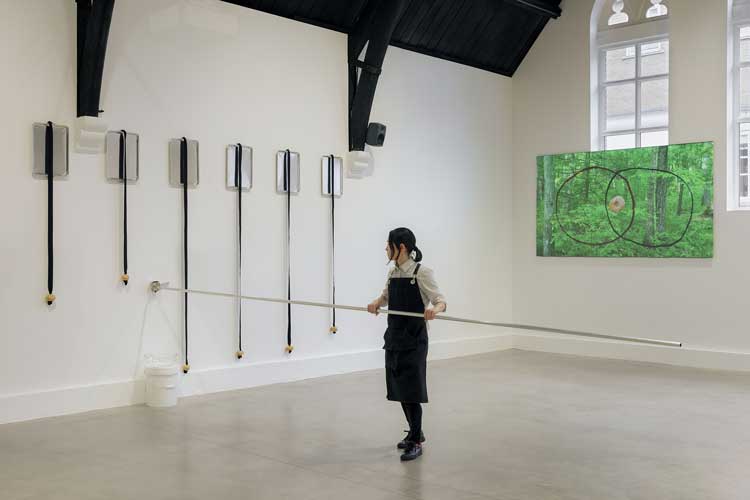
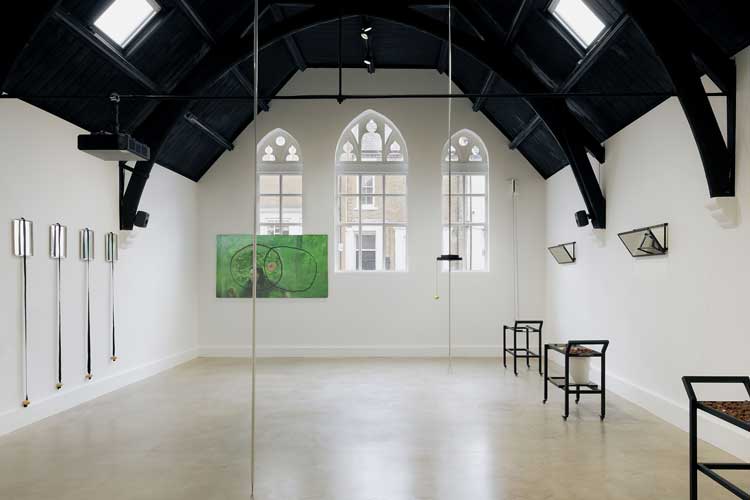
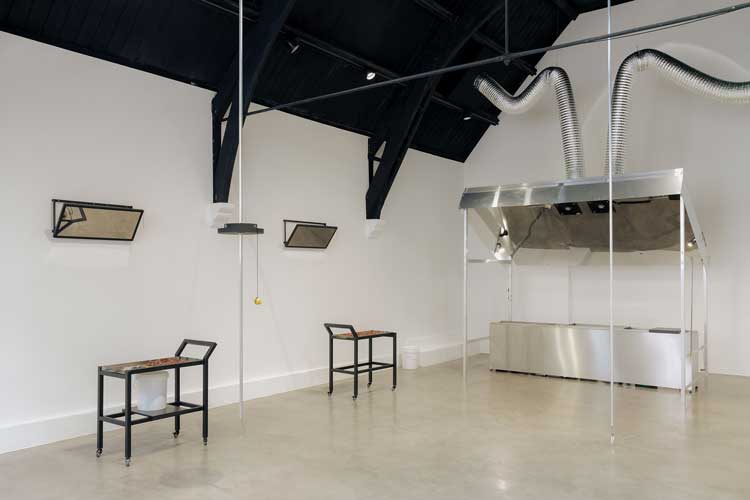
Everything is hanging, and in suspension is suspense. “Let’s stay away from the knife,” says J, another critic I’ve bumped into here, who has already seen a version of the performance that is about to take place. One of several items of industrial kitchenware that make up Aki Sasamoto’s installation in the main gallery at London’s Studio Voltaire, said blade is bayonetted to a long metal rod, hung vertically against the back wall of the converted mission hall – to the right of a triad of gothic windows – pointing down. In the middle of the room hangs a similar pole with a whisk at the bottom and a black disk from which hangs a lemon, on string, at roughly eye height – like a classroom model illustrating centripetal force – about two-thirds of the way up. A barbecue with a towering metal frame and aluminium extractor pipes dominates the far end of the room, near the doorway where J and I came in. The curator announces that the performance involves sharp objects and heating elements, and I find myself noting this down, as if it were important. As Y (arriving late) will point out when I tell him what he has missed, this health and safety proviso has the theatrical (albeit unintentional) foreboding of Chekhov’s Gun.
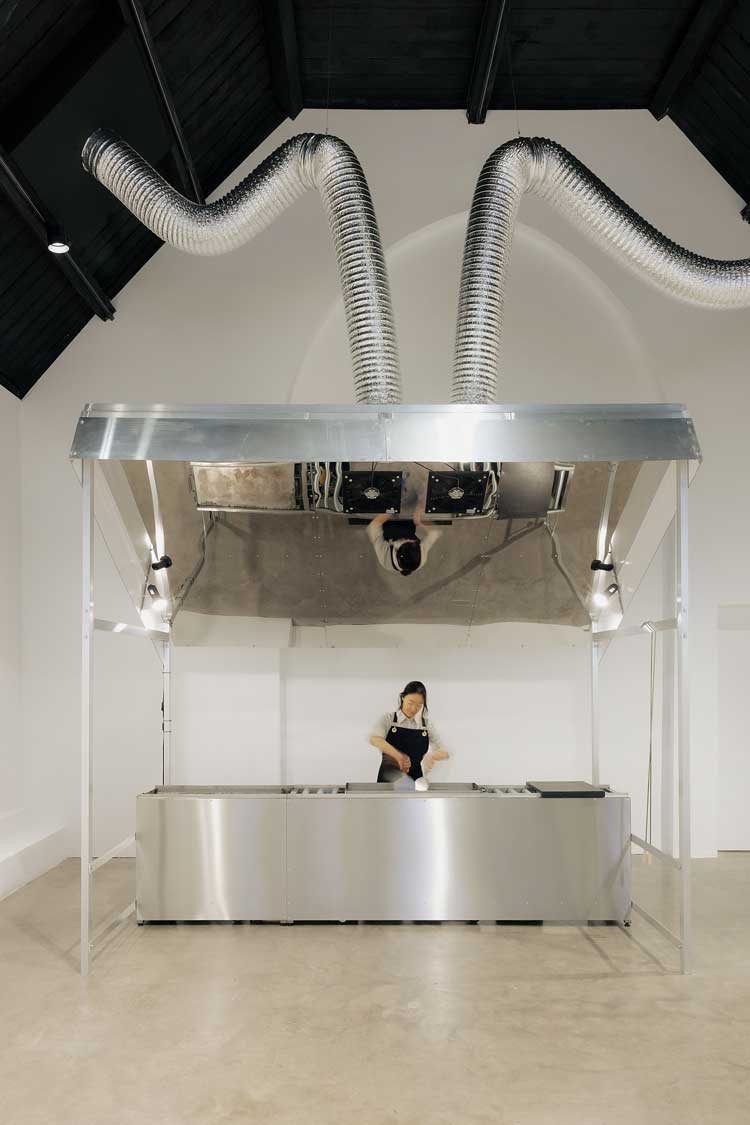
Aki Sasamoto, Grilled Diagrams, 2026. Installation view, Studio Voltaire, 2026. Commissioned and produced by Studio Voltaire. Image courtesy of the artist, Bortolami Gallery, Take Ninagawa and Studio Voltaire. Photo Sarah Rainer.
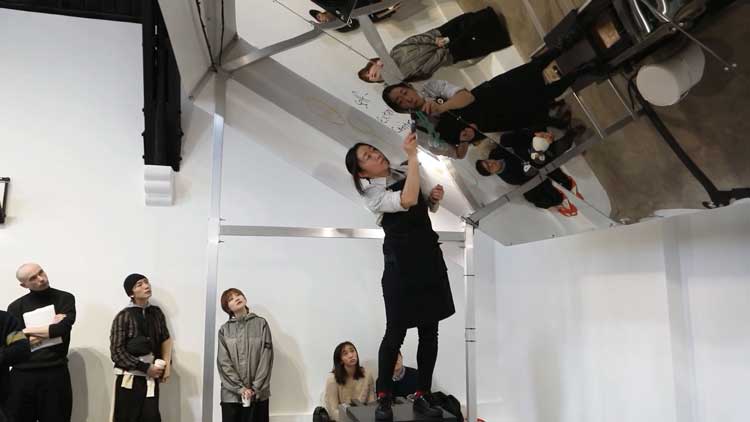
Sasamoto enters determinedly, gazing straight ahead, her movements almost robotic. Her black apron signals work, that the things in this room are meant to be used. As she heads towards the pole with the lemon, she touches another one, letting it swing – I had not noticed it until now, even though I passed it on the way in. Holding it between her palms, she spins the pole with the whisk at the bottom, the lemon elevating and orbiting, while the pole behind her – it has a two-pronged fork attached – continues to pendulate. She dodges the mini yellow planet – as if playing some sort of ball game: as she sets the installation in motion, it sets her in motion. She proceeds to the far corner, pulls a steel kitchen trolley a short way along one of the walls and takes from underneath it a white plastic bucket, which she puts on the floor. She takes the lower shelf from the trolley and places it on the bucket, stands on the shelf and, on a hinged mirror, angled downwards – one of three along that wall – writes with a green marker pen: “How to find | How to form”.
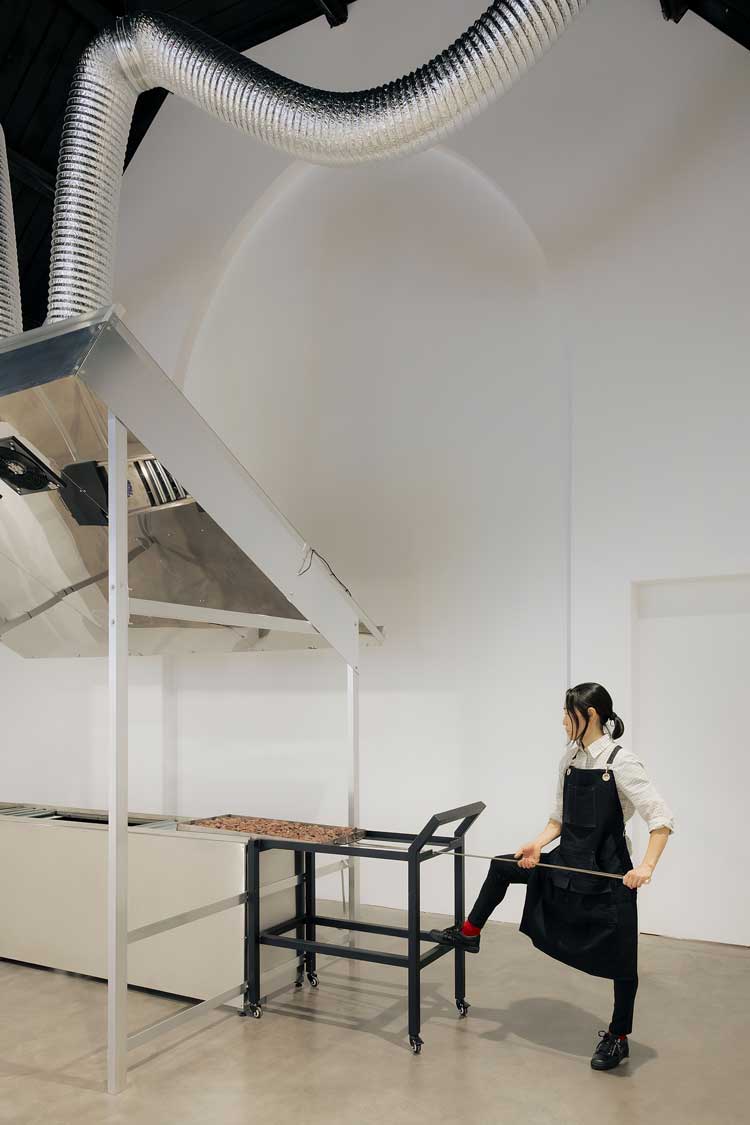
Aki Sasamoto, Grilled Diagrams, 2026. Installation view, Studio Voltaire, 2026. Commissioned and produced by Studio Voltaire. Image courtesy of the artist, Bortolami Gallery, Take Ninagawa and Studio Voltaire. Photo Sarah Rainer.
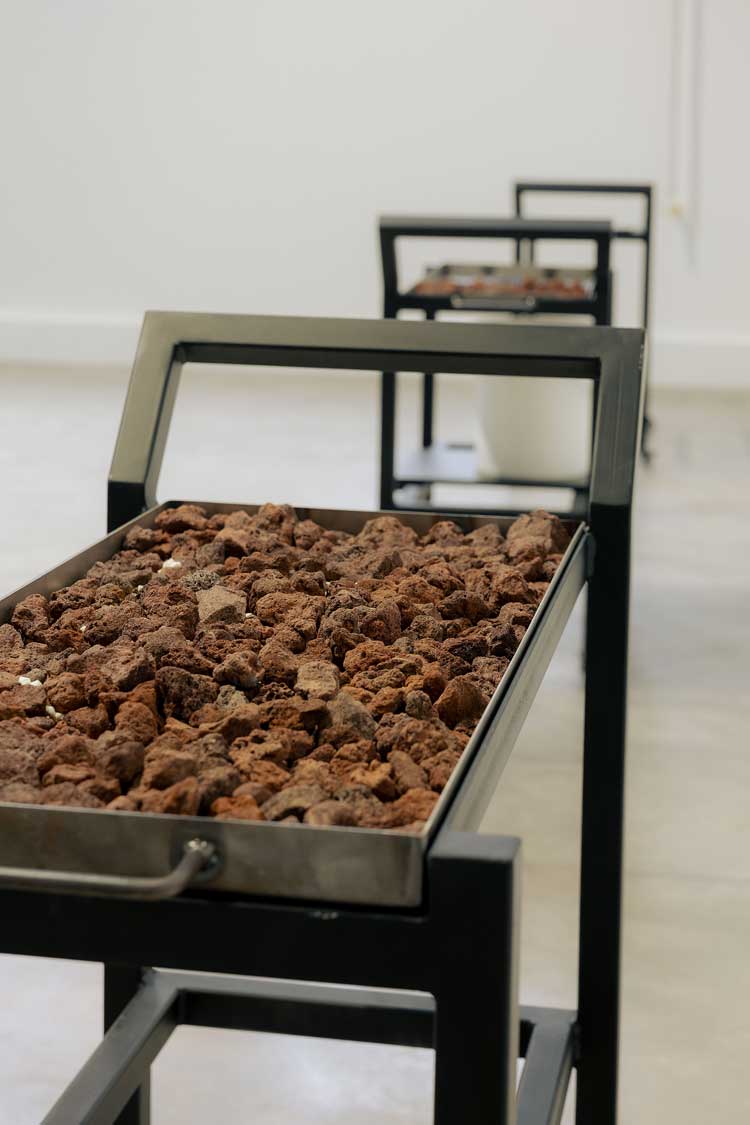
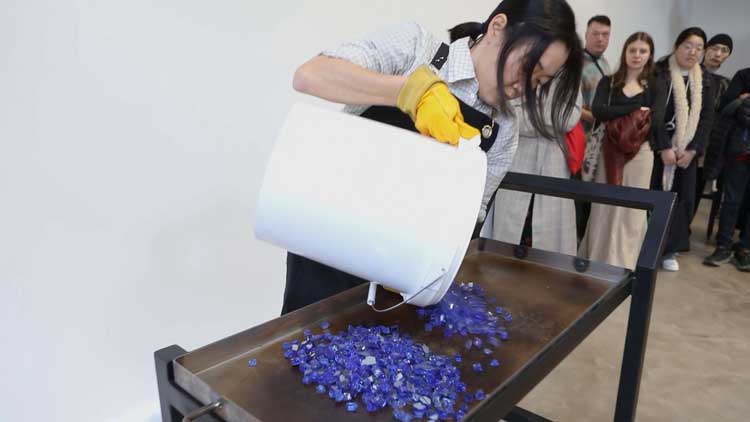
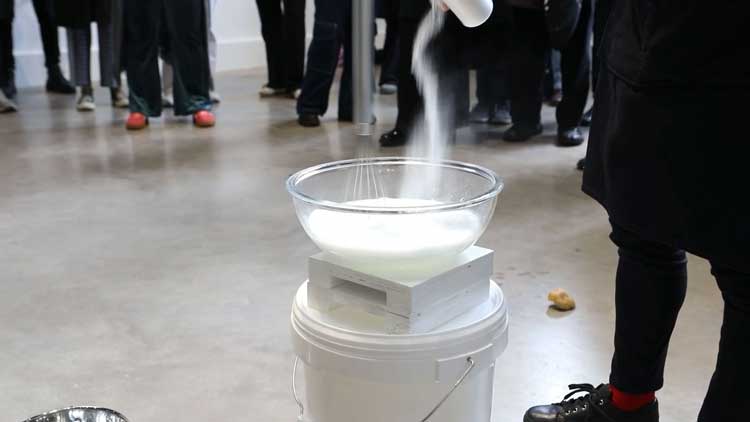
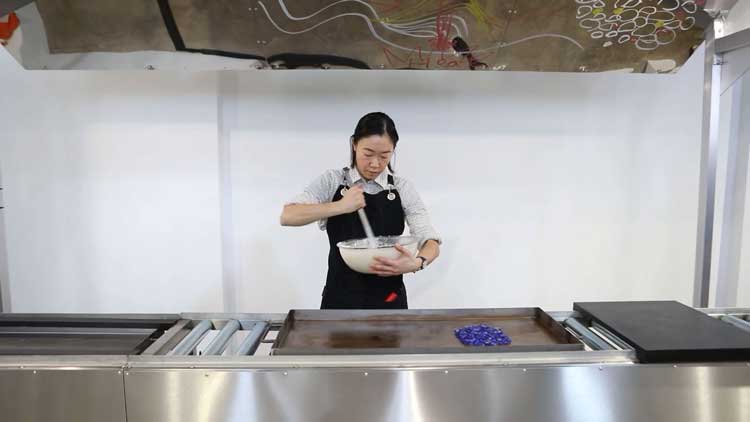
There is something idealistic in the phrasing, perhaps, although we don’t have time to contemplate its meaning, if it has one – soon she is herding her audience with the trolley, while seeming not to notice us. She parks it, heads to the wall where I am standing. High on this wall is a row of baking trays (like classical metopes), suspended from which are long pieces of black fabric, each held taut by a baking potato threaded at the end. The material turns out to be elasticated as she pulls on a potato (walking back from the wall, the audience moving around her again), lets it fly and crash against its tray, repeating the action along the wall. The messy absurdity garners laughs. Then she detaches the now-static forked pole and lowers it, manoeuvring about the room, milling us with her weapon as she says, “Dig, sift, sort” – what she is doing to her audience, perhaps. But soon she is drawing a winding river on another mirror, talking about (dug, sifted and sorted) rock formations, playing with blue transparent glasslike stones on one of the trolleys – which she later takes to the barbecue and cooks amid what looks like pancake dough. Hard and soft, heat-resistant and heat-reactive, sifting, sorting.
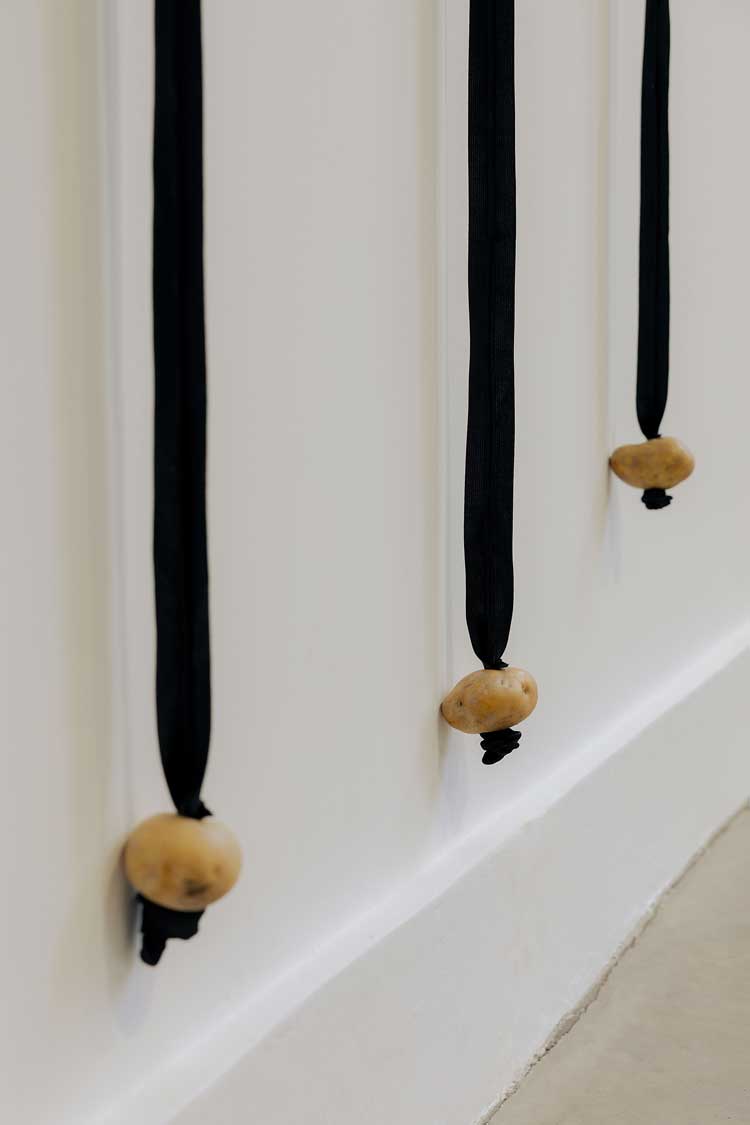
Aki Sasamoto, Grilled Diagrams, 2026. Installation view, Studio Voltaire, 2026. Commissioned and produced by Studio Voltaire. Image courtesy of the artist, Bortolami Gallery, Take Ninagawa and Studio Voltaire. Photo Sarah Rainer.
We surrender to Sasamoto’s improvisation, feel the words as they emerge and mutate in coincidental or not-so-coincidental relation with her actions, actions like punctuation, like context. Let language do what it will within the interplay of forces but do not let them define this interplay as much as affect and be affected by it. As she sets the installation in motion, it sets her in motion, and the audience in motion, and the words and the diagrams get tangled up in this dance of causality. Her stony gaze – it is as if she were in a separate dimension, its rules analogous to the rules we live by, but altered – suggests detachment, but our moving around her evidences the opposite, if only one-sidedly, or so it would seem to us. There is something quantum about all this energetic (or metaphorically energetic) interconnectivity, I note, with only a layman’s knowledge of the science.
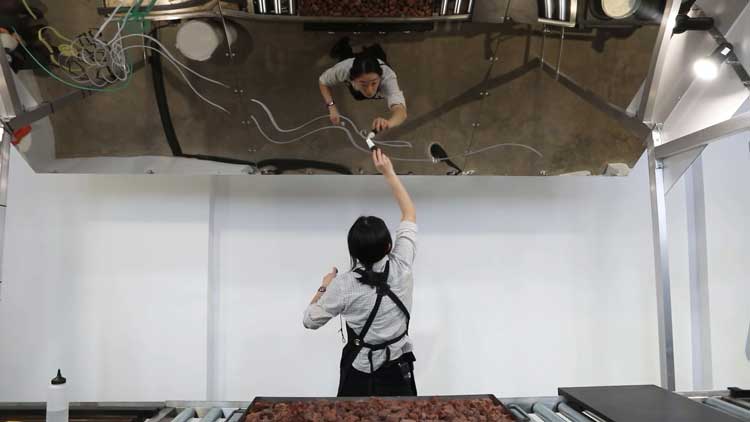
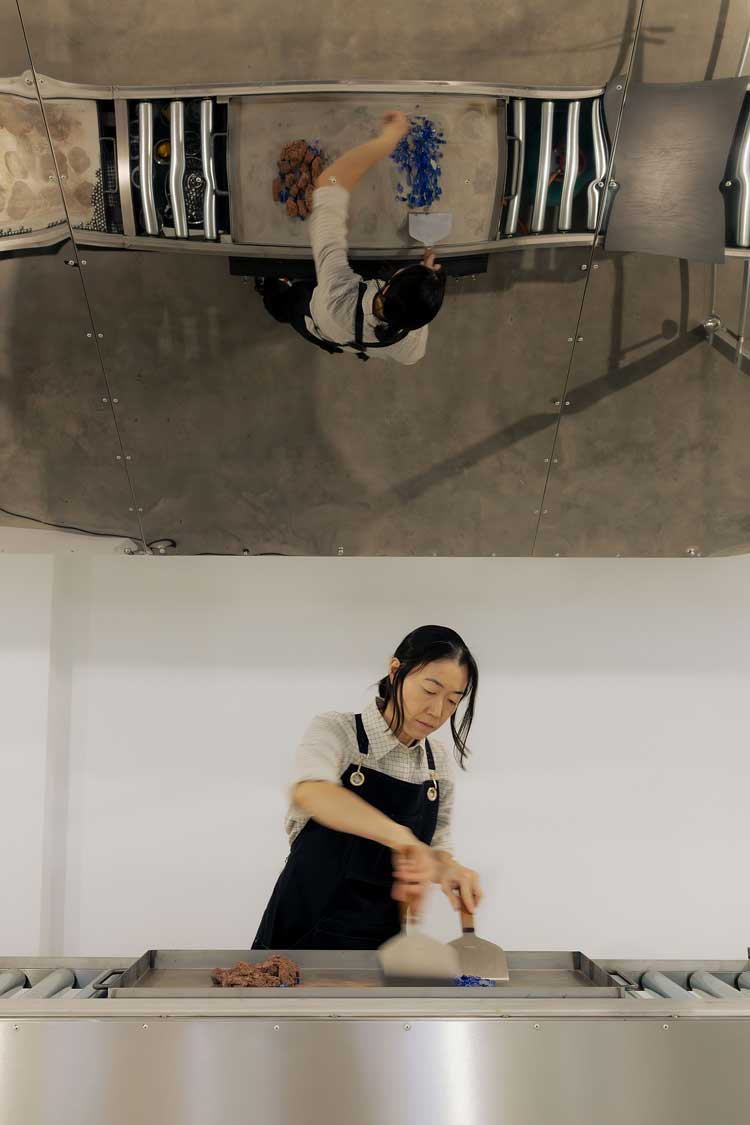
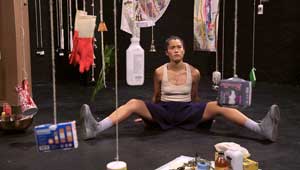
Aki Sasamoto, Grilled Diagrams, Performance, February 2026. Video still. Courtesy of the artist and Studio Voltaire. Video: Dor Even Chen.
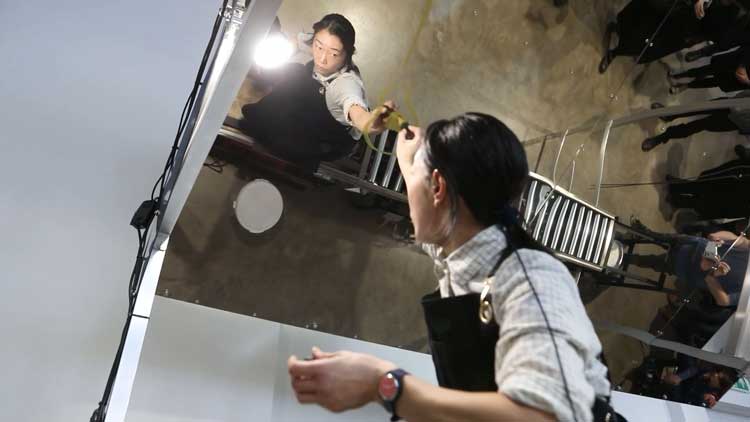
The diagrams she draws on the mirrored underside of the barbecue’s roof obliquely reflect her actions and our reactions, quasi-scientifically illustrating the way things – and maybe people too – energetically impinge on each other in indeterminate ways. They begin as infographics made up of lines, circles and squares in yellow and green and the words “urge”, “self”, “external”, “control”, the shapes gradually becoming more pictorial. As she keeps drawing – moving across the surface from left to right – her marks briefly evolve into a yellow mess resembling the whisking of pancake mix (performed by her earlier). Out of this then stretches a white energy wave or indeed another river or some kind of underground passage, actually, because out of one bend grows a volcano, which then spouts red lava as she keeps drawing – jumping up and down to reach where the lava needs to go – adding the words “heat” and “pressure”, then making the molten rock come down on a bunch of white circles. This is followed by a narration Sasamoto gives about a recently deceased friend: a “baker”, she says, and she draws a large yellow circle – a brioche, perhaps – turning it into an equation of sorts by adding “+ x”. The “X factor”, she says, was butter. And so, even if it is hard to tell if our reactions in any way influence her performance, here she alludes to a deeper internalisation of the lives of others – indeed, eating her friend’s brioche is a heartfelt metaphor for this, as eating together is more generally.
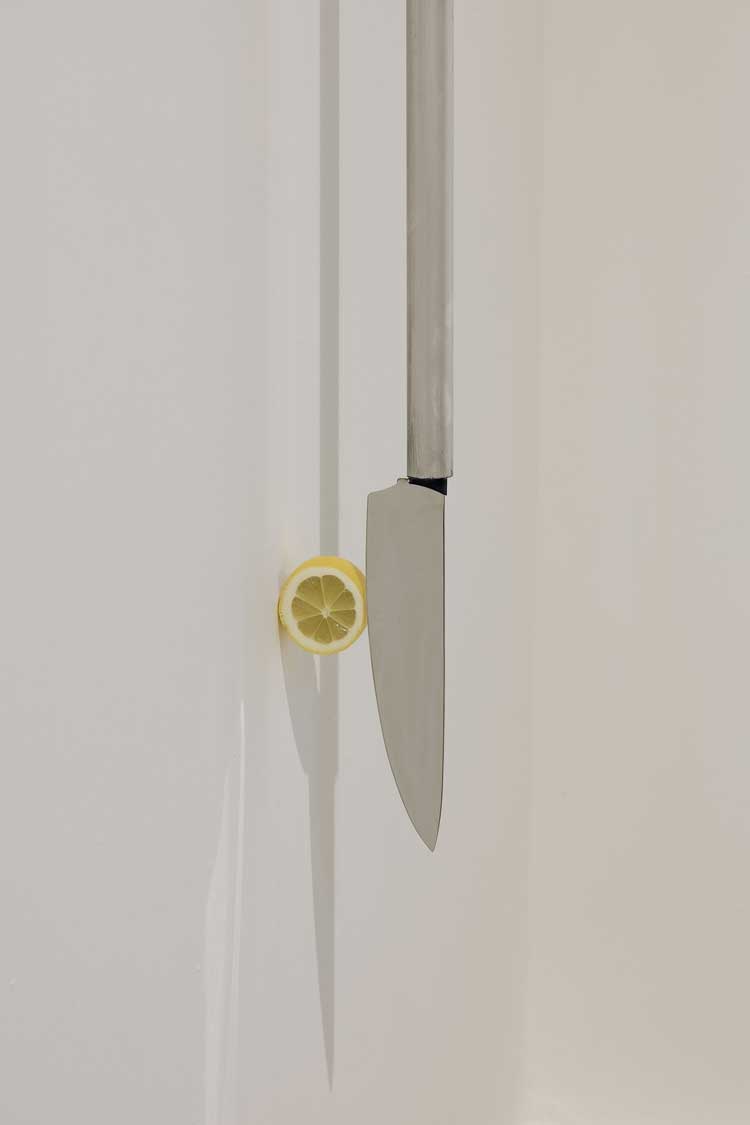
Aki Sasamoto, Grilled Diagrams, 2026. Installation view, Studio Voltaire, 2026. Commissioned and produced by Studio Voltaire. Image courtesy of the artist, Bortolami Gallery, Take Ninagawa and Studio Voltaire. Photo Sarah Rainer.
Oh, and before I forget, that knife over there … the pole it’s attached to is hinged at the top, I tell Y. At some point Sasamoto attached the lemon on the wall, raised the blade, and when she had enough leverage – when the blade was level with her eyes – she let it thwack the lemon in two. Yes, like Chekhov’s Gun, according to which principle a rifle on the wall, in any narrative, must be fired at some point (ie, a storyteller must avoid mentioning anything extraneous to the story), which somewhat pertains to Sasamoto’s play on causality. Except what she does has less to do with narrative necessity or economy than the reality that everything is in relation anyway, embodying the potential to affect us, and a whole course of events beyond our frame of vision. As I’m discussing this with Y, Sasamoto is cleaning up: collecting the severed lemon, replacing the potatoes, wiping the mirrors – renewing, it seems, her installation’s potential. I am reminded of theorist Donna Haraway’s notion of sympoiesis: the way we create – and let’s think of cooking as an archetypal act of creation that shapes community – and metamorphose interdependently. Water is guided by and sculpts a river’s course.
Click on the pictures below to enlarge

Copyright © 1893–2026 Studio International Foundation.
The title Studio International is the property of the Studio International Foundation and, together with the content, are bound by copyright. All rights reserved.
 |
 |
 |
|---|
-300.jpg)

-300.jpg)
 Gabriel Chaile and Laura Ojeda Bär – interview: ‘We’re really into the power of art to transform and transmute places and objects and people’
 Scott Covert – interview: ‘For me, each brushstroke is a lifetime’
 Every Ocean Hughes: One Big Bag
 Amelie von Wulffen: The Misjudged Bimpfi
 Aki Sasamoto: ‘I enjoy how much I can push meaning with the wrong answers’