




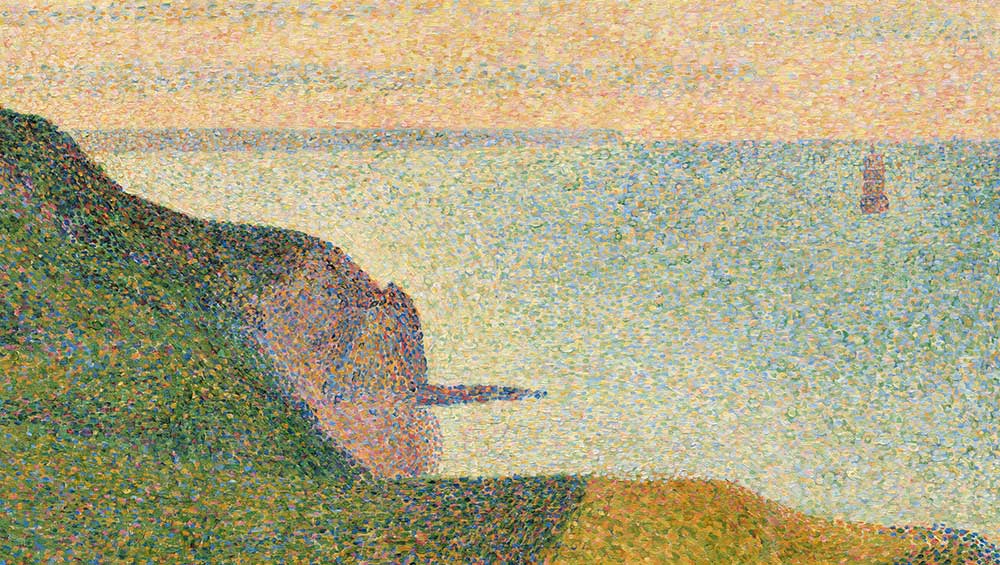
Georges Seurat, Seascape at Port-en-Bessin, Normandy, 1888 (detail). Oil on canvas, 65.1 x 80.9 cm. Gift of the W. Averell Harriman Foundation in memory of Marie N. Harriman, National Gallery of Art, Washington D.C.
The Courtauld, London
13 February – 17 May 2026
by JOE LLOYD
The 19th century ended with a whirlwind of painterly innovation. Movements and techniques blossomed and wilted at a remarkable clip. While Vincent van Gogh was producing his astonishingly expressive oeuvre in the south of France, on the other side of the country another doomed young artist was pushing paint in a very different direction. The latest exhibition at the Courtauld allows us to cast an attentive eye on this equally radical artist’s scintillating work.
The life of Georges Seurat (1859-91) was as uneventful as Van Gogh’s was tempestuous. Born in Paris to a wealthy property speculator, he lived in bourgeois comfort, supported by his family. He studied at the École des Beaux-Arts for a year before taking up voluntary military service in Brest. Afterwards, he returned to Paris and laboured away, working slowly but surely. Facing rejection from the Paris Salon, in 1884 he co-founded the Société des Artistes Indépendants with a group of kindred spirits. From then on, he would exhibit annually, attracting cheerleaders and naysayers, until he died aged 31 of an unknown disease. He left behind his mistress, Madeleine Knobloch, who was then pregnant with their second son, and their first son, Pierre-Georges.
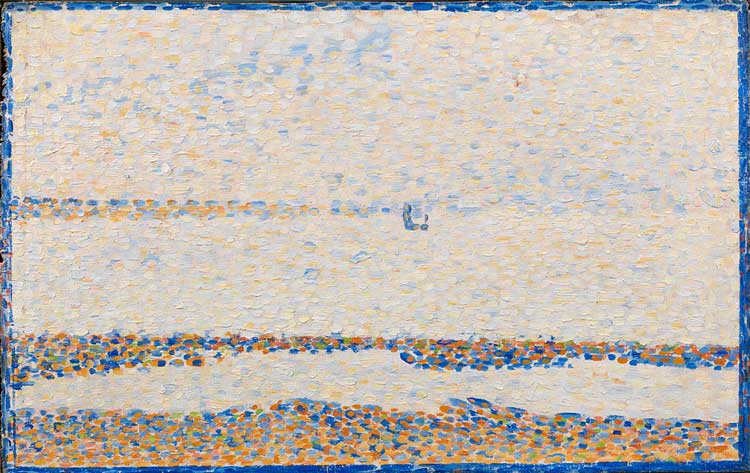
Georges Seurat, The Beach at Gravelines, 1890. Oil on panel, 16 x 24.5 cm. Courtauld Gallery, London (Samuel Courtauld Trust) ©
Courtauld.
Seurat’s regimented life belies the revolutionary exuberance of his technique. Dubbed pointillism by critics – Seurat preferred the term chromoluminarism – it saw him paint using tiny, separate dots of wildly contrasting colours. When one looks closely at a Seurat canvas, one sees these teeming points of pigments, as opaque as a shower of Skittles. Move further away and they become a shimmering plane, in Seurat’s hand often achieving an exceptional luminosity, as if one is beholding light itself.
This process, shared with Seurat’s friend Paul Signac, has often been cast as scientific, as if its artists were following a precise formula – a claim latterly bolstered by its superficial similarity to pixels. And Seurat was inspired by contemporary colour theories that explored the separation of colours, how certain hues complimented others, and how the eye processes different shades into clear colour. Yet, equally, his technique feels very human. The visibility of each individual spot of colour makes the working of his hand particularly palpable.
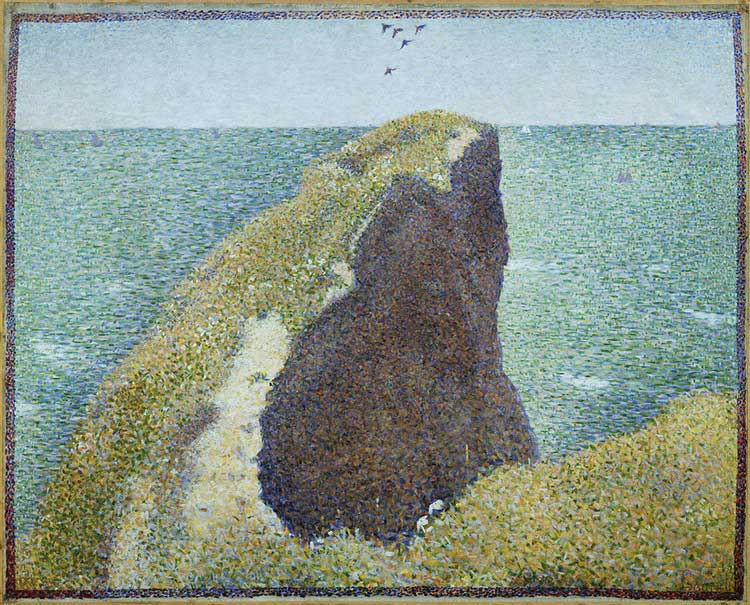
Georges Seurat, Le Bec du Hoc, Grandcamp, 1885. Tate purchased 1952 © Tate, London 2025. Photo: The National Gallery, London.
Seurat is today most famous for a pair of large figural paintings – Bathers at Asnières (1884, at the National Gallery) and A Sunday Afternoon on the Island of La Grande Jatte (1884-86, at the Art Institute of Chicago) – that depict Parisians of various social classes lounging alongside the Seine. Yet he produced only a handful of works with prominent human figures; another, Young Woman Powdering Herself (1889), hangs in the Courtauld just outside the present exhibition. Instead, the bulk of his corpus was taken up by his seascapes or “marines”. Twenty-four of the 38 canvases he exhibited in his lifetime stem from his five summer trips to the northern French coast: to Grandcamp (1885), Honfleur (1886), Port-en-Bessin (1888), Le Crotoy (1889) and the ominously named Gravelines (1890).
Astonishingly, this is the first ever exhibition to focus on these marines. There might be several reasons for their neglect, including the historical interest of the bathing scenes, which have become banner images of late-19th-century urban life. Seurat used his “marines” to experiment with his technique, which he would then apply to his winter work.
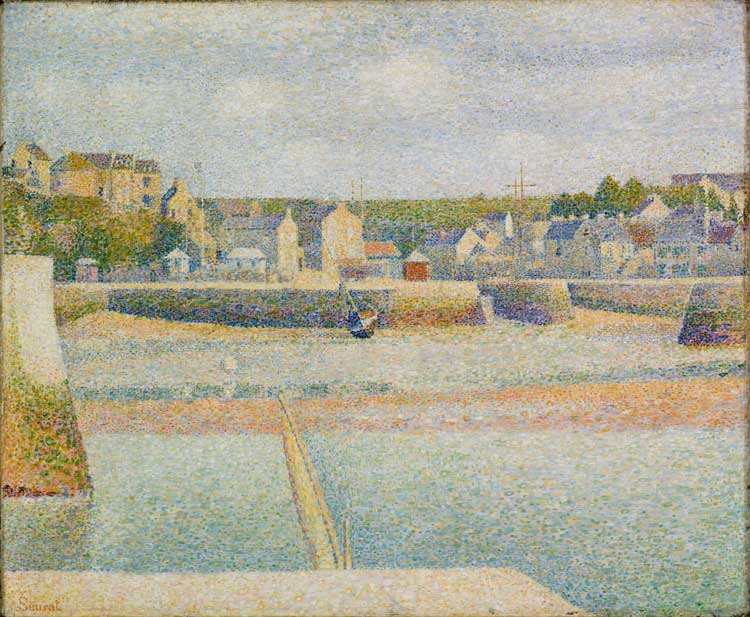
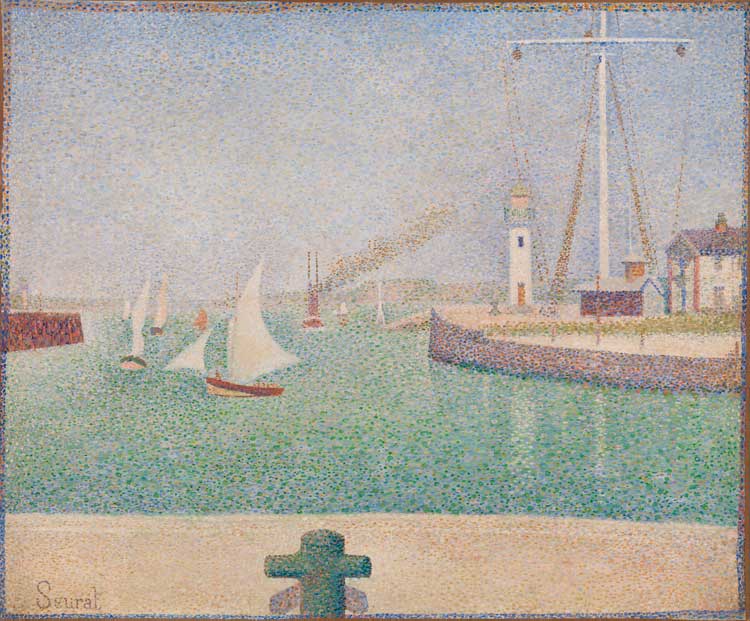
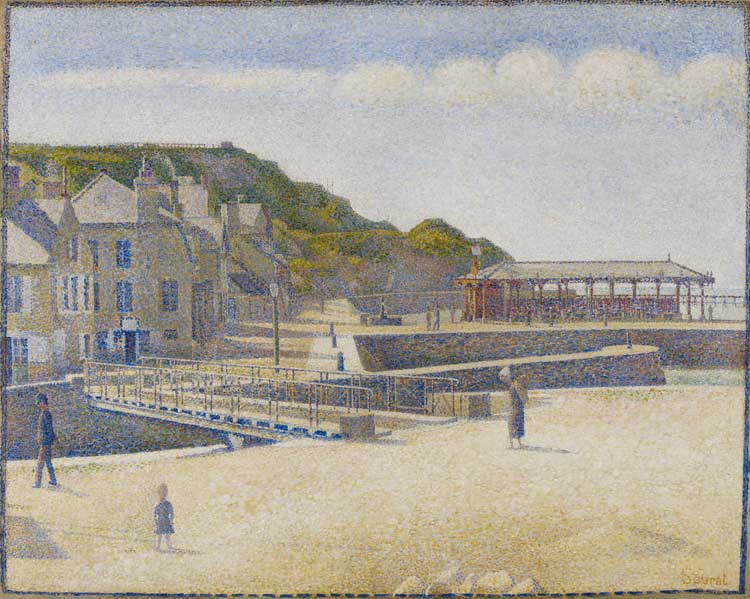
Georges Seurat, Port-en-Bessin, Outer Harbour Low Tide, 1888. Oil on canvas. Saint Louis Art Museum, Museum Purchase. Image: Saint Louis Art Museum
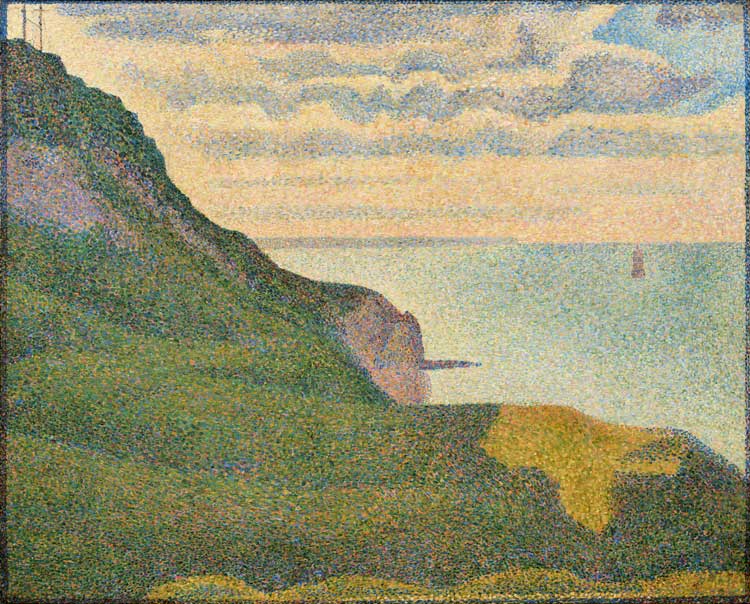
It is likely also because his seascapes are, almost to a piece, exceptionally muted. For a touch of the natural sublime, one could look at his 1885 depictions of the Bec du Hoc, a moderately noteworthy promontory outside Grandcamp, and his masterly 1888 painting of The Semaphores and the Cliff outside Port-en-Bessin. But, by and large, Seurat chose to paint the paltry harbours of humdrum villages, and flat, unremarkable stretches of coastline. He liked views featuring the most mundane bits of seaside infrastructure, such as anchors, lamp-posts and bollards. This tendency increased with time. By his final trip to Gravelines, he was painting places that would give few travellers reason to pause.
There are hardly ever people present. Sailboats are apparently without crews. Those few humans who do appear have the stolidity and stillness of inanimate objects, like vases in a Giorgio Morandi still life. Despite the boats, there is not much movement. Perhaps the most kinetic subjects in the entire exhibition are the fluttering flags attached to boats in Port-en-Bessin – A Sunday (1888), which flap in a mild sea breeze. A selection of preparatory drawings in black crayon show that Seurat could work with a lyrical fluidity. So why did he decide to capture such stasis with his paint?
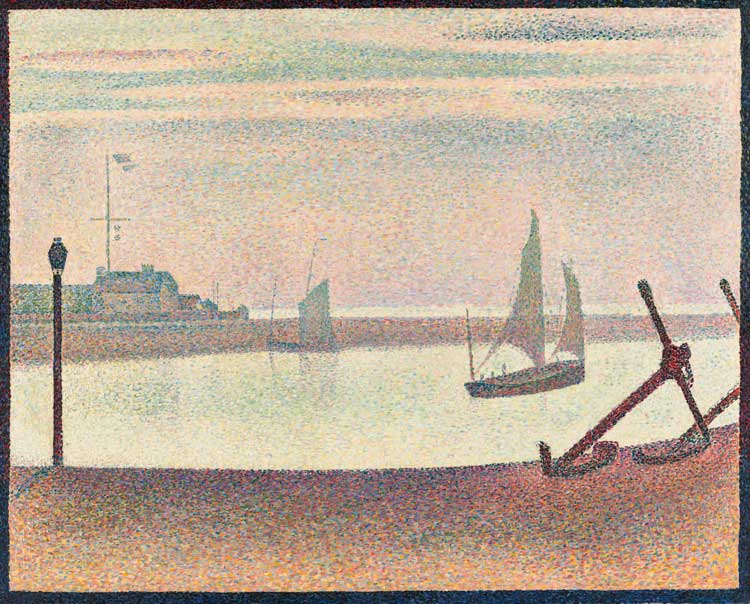
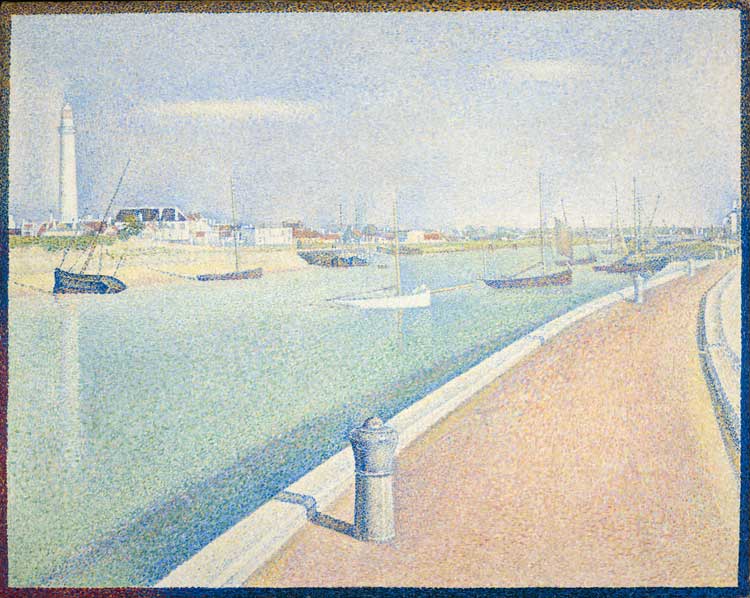
Georges Seurat, The Channel at Gravelines, Evening, 1890. Oil on canvas. The Museum of Modern Art, New York. Gift of Mr. and Mrs. William A. M. Burden, 1963, Digital image, The Museum of Modern Art, New York / Scala, Florence.
The Courtauld’s curators have arranged these laconic works in chronological order, so we can see the incremental growth of Seurat’s technique. The Grandcamp works feature flurries of dash-shaped strokes, which vary in size and direction depending on what he is painting; the sky, the sea, greenery or shadowy cliffside. Later, these spots become round and more regular. By Le Crotoy (Downstream) (1889), the dots are almost as regular as mass-produced confetti. Seurat becomes gradually more adept at using slight modulations in his dots to create texture: the pillowy clouds above Le Crotoy are created by a mild change in the colour of the marks. He also gradually came to use more surprising combinations of colour. The dusky dock in The Channel at Gravelines: An Evening (1890) is composed from almost the entire spectrum. It is fascinating to see Seurat’s technique up close – and not a little mind-boggling. Moderate the balance of colours just slightly, and the overall effect might change significantly.
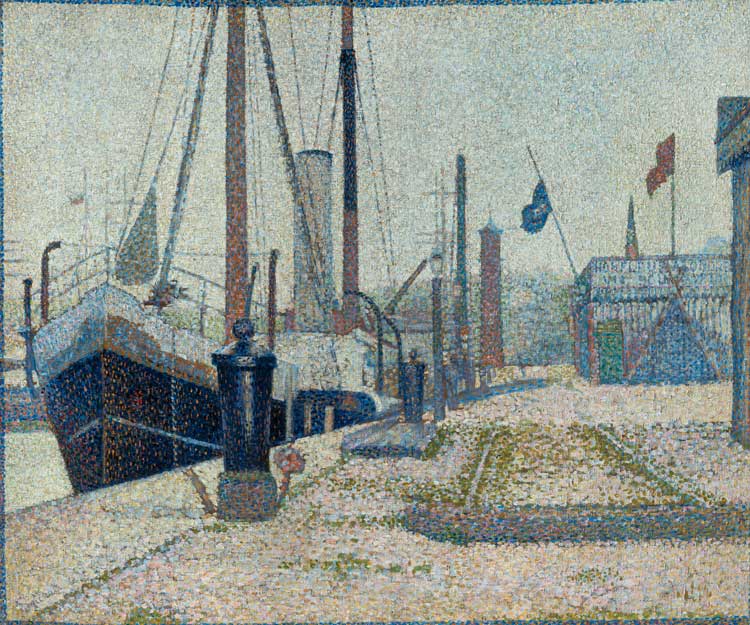
Georges Seurat, La Maria at Honfleur, 1886. Oil on canvas. National Gallery, Prague. Photo © National Gallery Prague 2025.
There is much to ponder in Seurat’s motives. Although the marines were finished in the studio and not plein-air, they sit in an impressionist tradition that sought to capture the real. At the Courtauld, some works are accompanied by contemporary postcards so that we can grasp the verisimilitude of Seurat’s painting. Yet the emptiness and static quality of his scenes renders them stage-like. The grainy gauze of his technique makes them seem antithetical to the clarity with which our eyes perceive the world. The marines are thus simultaneously studied depictions of reality and oddly unreal simulacrums.
Fellow pointillist Charles Angrand later remarked that Seurat “was not a slave to nature, oh! no; but he was respectful of it, not being imaginative”. Yet there is surely more than a splash of imagination in his choice to depict the world in such an eccentric, specific manner. Long after his death, Seurat remains as enigmatic as he is dazzling.
Click on the pictures below to enlarge

Copyright © 1893–2026 Studio International Foundation.
The title Studio International is the property of the Studio International Foundation and, together with the content, are bound by copyright. All rights reserved.

 |
 |
 |
|---|
-300.jpg)


 Van Gogh Self-Portraits
 Bridget Riley
 Bridget Riley: Learning From Seurat
![Moses Harris. The Natural System of Colours Wherein is displayed the regular and beautiful Order and Arrangement, Arising from the Three Premitives [sic], Red, Blue and Yellow, The manner in which each colour is formed, and its Composition, 1769/1776. Royal Academy of Arts, London.](/images/articles/m/making-colour-2014/smallpix/X8384-300.jpg) Making Colour
Making Colour Project Space: Inverted House – Tina Gverović and Siniša Ilić