




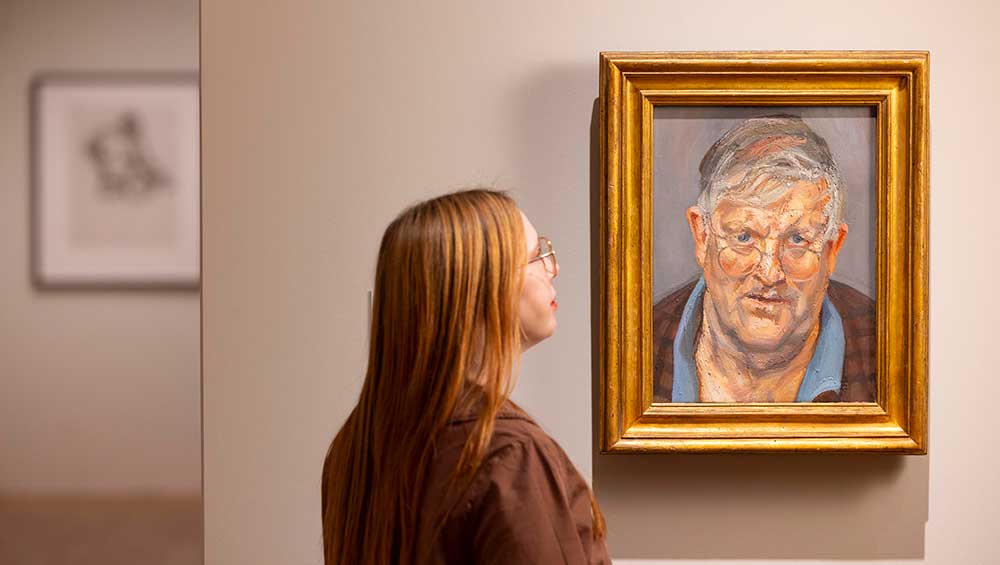
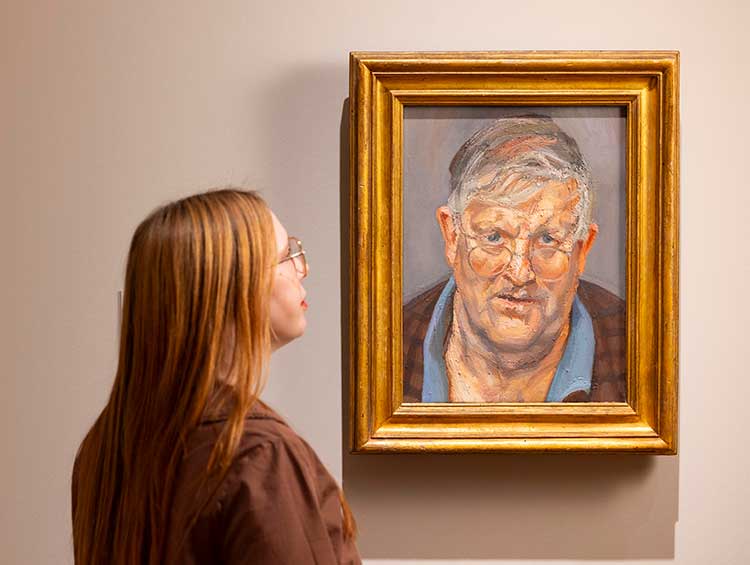
Installation view, Lucian Freud: Drawing into Painting, National Portrait Gallery, London. David Hockney, 2002, Lucian Freud, Oil on canvas © The Lucian Freud Archive. All Rights Reserved 2026 / Bridgeman Images, Lent by a private collection. Photo copyright © David Parry.
National Portrait Gallery, London
12 February – 4 May 2026
by BETH WILLIAMSON
There is no doubt that Lucian Freud was a consummate draughtsman. The important place of the portrait, and especially the self-portrait, in his work is undeniable too. Yet, as the first intimate room in this exhibition tells us, everything is a portrait here. Quoting the artist himself: “Nothing ever stands in for anything. Nobody is representing anything. Everything is autobiographical and everything is a portrait, even if it’s a chair.”
The simple yet clear argument in this new exhibition of Freud’s work at the National Portrait Gallery is that drawing was central to the work of this figurative painter. I do not doubt this, although it is not clear to me why this is the revelation it is claimed to be. Don’t misunderstand, I am delighted to see these 170 drawings, etchings and paintings by Freud on display together. It is always a joy to see works previously not displayed, or rarely seen, especially when they lend further insight into the artist’s creative process and working methods. I just don’t think it is a surprise that drawing was so important to Freud.
,-1995.jpg "Lucian Freud, Bella in her Pluto T-Shirt (etching), 1995 © The Lucian Freud Archive. All Rights Reserved [2026] / Bridgeman Images. Collection: National Portrait Gallery.")
Lucian Freud, Bella in her Pluto T-Shirt (etching), 1995 © The Lucian Freud Archive. All Rights Reserved [2026] / Bridgeman Images. Collection: National Portrait Gallery.
While there is, in my view, no revelation here, it does not detract from the works on show, which demonstrate how acute observation and prolonged time spent with sitters brings not only likeness but a sympathetic understanding of character and mood. As the senior curator, Sarah Howgate, explains it, Freud was “one of the greatest observers of the human condition in the 20th century”. Of course, as we see in the well-known Self-Portrait with Hyacinth in Pot (1946-47), Freud was equally adept at drawing plants. Meanwhile, the ink drawings Dead Monkey (1944) and the familiar Dead Cock’s Head (1951) show his skills in portraying animals.
Going back to Freud’s early years in Berlin, where he was born in 1922, then his school education in England (Dartington Hall in Devon, then Dane Court in Surrey), the exhibition shows a number of childhood drawings and letters he made between the ages of six and 11.
There is a jaunty portrait of Cedric Morris (1940), with pipe and cravat, painted when Freud was just 18. Morris was Freud’s tutor at East Anglia School of Painting and Drawing (1939-42). In 1939, Freud and his friends David Kentish and Stephen Spender spent three months in Snowdonia. Freud and Spender’s joint enterprise, Freud-Schuster, resulted in a number of drawings shown here. In the early 40s, Freud attended Goldsmiths College in London for a period but resisted the formality of life classes and preferred to draw sitters he knew well in familiar poses. Drawing remained important to him and he explained: “I would have thought I did 200 drawings to every painting in those early days. I very much prided myself on my drawing. My work was in a sense very linear.”
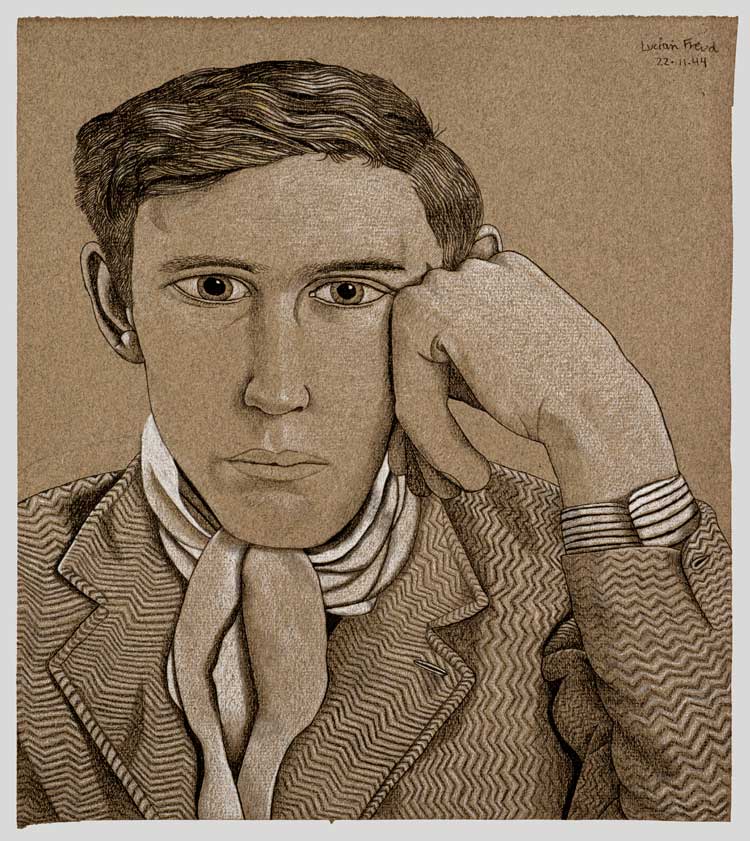
Lucian Freud, Portrait of a Young Man, 1944. Black crayon and chalk on paper. © The Lucian Freud Archive. All Rights Reserved 2026 / Bridgeman Images, Lent by a private collection.
Some of the most captivating drawings in the show come quite early on. Boy on a Sofa (1944), Portrait of a Young Man (1944) and Christian Bérard (1948). Boy on a Sofa is probably a portrait of Charlie Lumley, a young neighbour. The piercing eyes and confident demeanour reflect a relationship built around Lumley’s sharing of streetwise knowledge and Freud’s provision of trips to the West End in return. Portrait of a Young Man is not dissimilar in its intense gaze and self-assured manner. The subject this time is Freud’s friend John Craxton. The different textures of Craxton’s hair, jacket, shirt and scarf are evident in a drawing that skilfully combines crayon and chalk. This is surpassed in Freud’s drawing of Bérard where, with black and white conté on paper, Freud creates a realistic beard and a dressing gown texture that resembles an animal pelt.
Freud’s drawings of his elderly mother, beginning in 1972, are incredibly poignant. Freud said of his mother, Lucie: “I started painting her because she’d lost interest in everything, including me. Before then I always avoided her because she was so intuitive that I felt my privacy was rather threatened by her … But then also, I did it to cheer her up, to give her something to do.” Between 1972 and her death in 1989 the pair met daily, chalking up about 1,000 sittings and making her his most frequent sitter other than himself. These tender studies of old age are gently and deeply observed.
Drawings of Freud’s well-known sitter Sue Tilley are voluptuous. Tilley was introduced to Freud by the performance artist Leigh Bowery, another of his sitters. Freud said of the pair: “I want to observe them and paint them as they are and feel.”
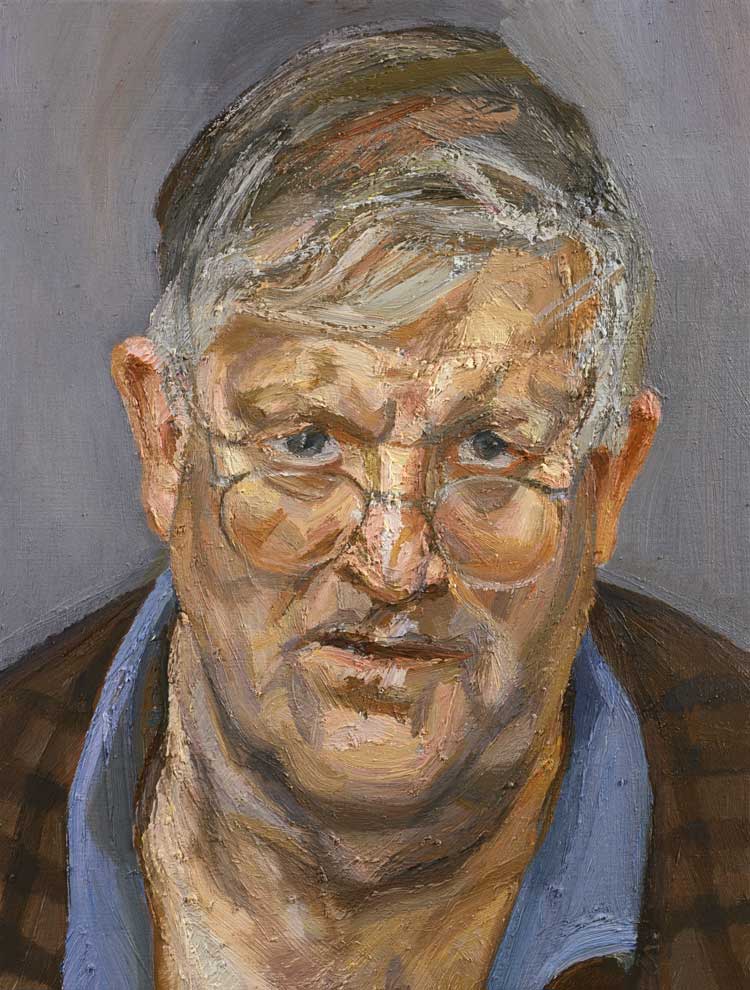
Lucian Freud, David Hockney, 2002. Oil on canvas, 40.6 x 31.1 cm. © The Lucian Freud Archive. All Rights Reserved 2026 / Bridgeman Images, Lent by a private collection.
One section of the exhibition, titled Portraits of Paintings, turns to Freud’s occasional practice of looking at historical paintings not simply as an academic exercise in painting, but rather in order to portray paintings that meant something to him. Close studies of paintings by Jean-Siméon Chardin, John Constable, JMW Turner and Jean-Antoine Watteau feature here. Chardin’s The Young Schoolmistress (c1737) was one painting Freud had the opportunity to study closely at the National Gallery. He said: “I don’t want to copy the Chardin, I simply want to get as near to it as I can. It’s a labour of love.” Freud’s After Chardin (large) and After Chardin (small), both painted in 1999, are self-evidently labours of love. They are painted with such utter tenderness and care and, make no mistake, Freud makes the subject his own. Bringing the two figures closer together and dispensing with what he regarded as extraneous details, Freud focuses on the relationship between the young schoolmistress and her charge. Using his own expressive technique, this becomes a homage to Chardin rather than a copy.
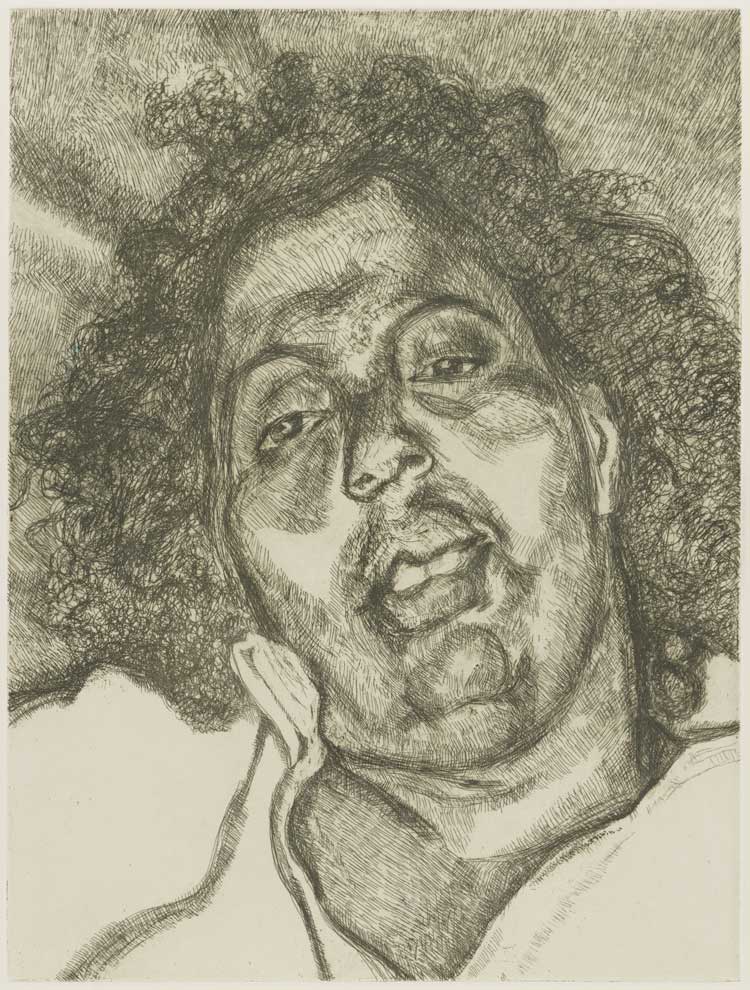
Lucian Freud, Solicitor’s Head, 2003. Etching. © The Lucian Freud Archive. All Rights Reserved 2026 / Bridgeman Images. Photo © National Portrait Gallery, London, National Portrait Gallery, London. Accepted in lieu of tax by H.M. Government and allocated to the Gallery, from the estate of Lucian Freud, 2024.
Watteau’s exquisite Pierrot Content (c1712) is another historic work that Freud responded to. This time, he created Large Interior, W11 (after Watteau) (1981-83). Replacing Watteau’s figures with his own family and others close to him, he also altered the position of the figures in the large interior of his spacious new studio in west London. The Watteau painting apparently enabled him to think through a group portrait. The interesting thing here, apart from the fact that none of the five sitters look at each other, or at Freud, is that he proceeded to make a series of drawings and sketches as the painting came to completion. Rather than drawing leading to painting, it was the painting that spawned more drawings and then seemingly a dialogue between the two mediums until a satisfactory conclusion was reached. The same thing happened with his newfound passion for etching in the 90s as he made etchings after becoming familiar with his sitters through painting. His painting of the restaurateur Jeremy King (2006-07), in this exhibition, is shown alongside the unfinished copper etching plate Head of Jeremy King (2008-11). It is a poignant reminder of Freud’s passionate engagement for every medium he used.
• Lucian Freud: Drawing into Painting tours to Louisiana Museum of Modern Art, Humlebaek, Denmark, from 10 June to 27 September 2026.
Click on the pictures below to enlarge
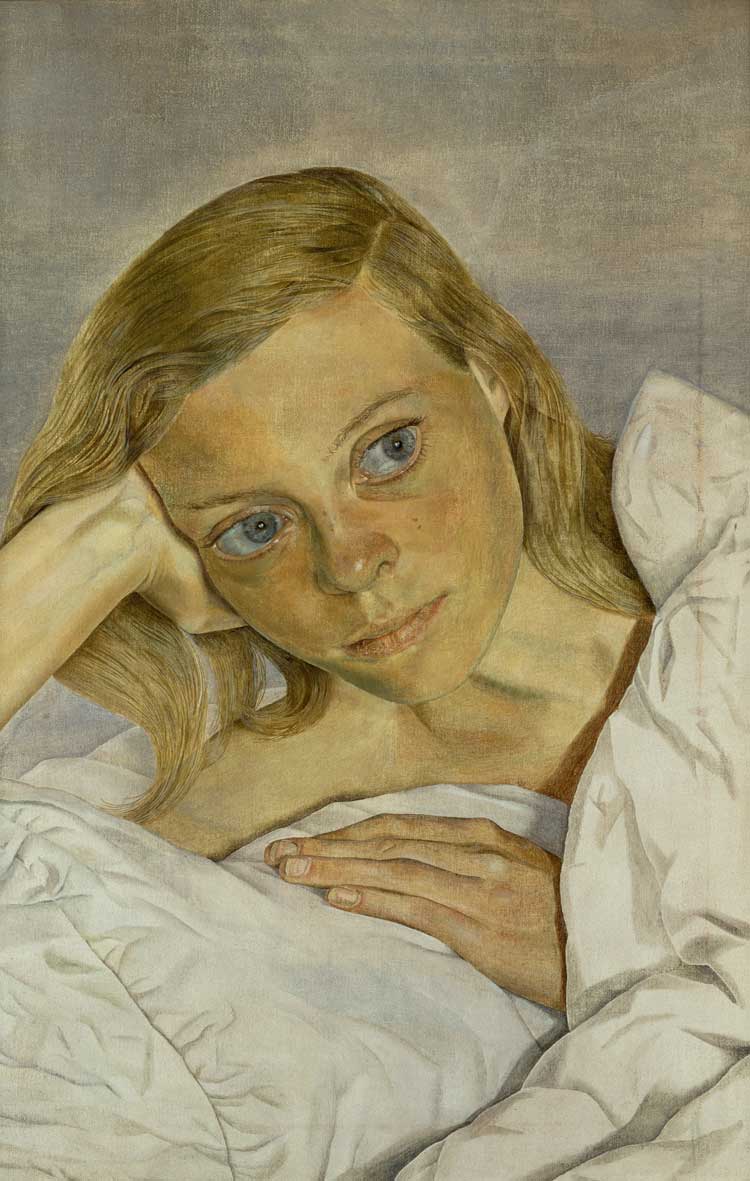

Copyright © 1893–2026 Studio International Foundation.
The title Studio International is the property of the Studio International Foundation and, together with the content, are bound by copyright. All rights reserved.
 |
 |
 |
|---|

-1000-300.jpg)
 Beth Fisher: Grisaille Legacy
 Artists’ Laboratory 02: Stephen Farthing RA – interview
 ARC: I Draw for You
 The 43 Uses of Drawing
 Book review: One Thousand Drawings by Tracey Emin