




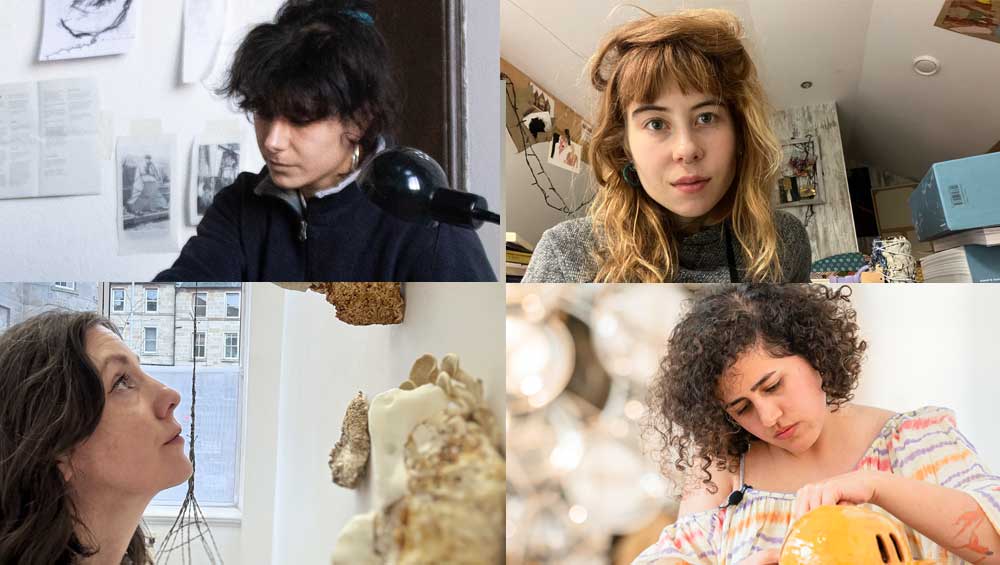
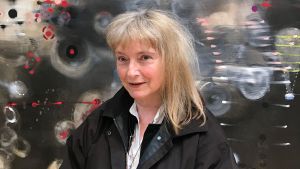
Clockwise from top left: Molly Wickett, Kasia Oleskiewicz, Taraneh Dana, and Eilidh Appletree. Photos of Molly, Kasia and Eilidh copyright and courtesy of the artists. Photo of Taraneh by Tom Morley, courtesy of New Art Exchange.
by JANET McKENZIE
Catalyst: Art as Activism comprises four solo exhibitions that position the work of artists whose sculpture practice challenges social and political injustice and the climate crisis. Subjective and conceptually conceived, the work compels the audience to respond; lived experience is presented as a site of knowledge, agency, and change.
Catalyst asserts activism as an imperative, to expose ecological destruction and capitalist extraction; the varied work interrogates the reality of migration and disability.
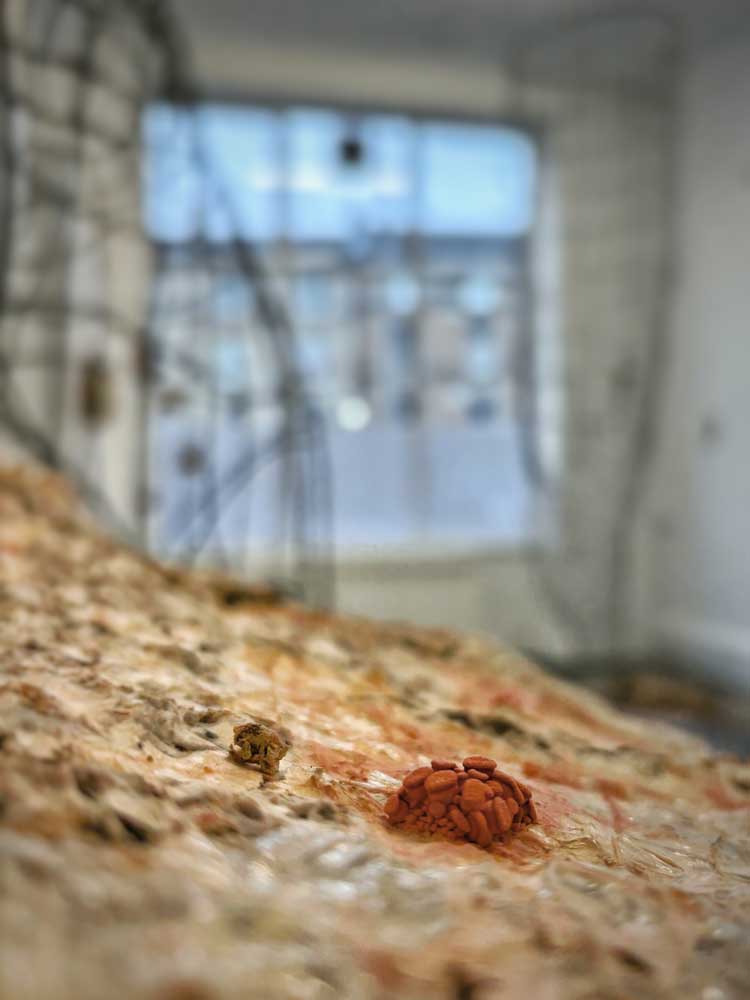
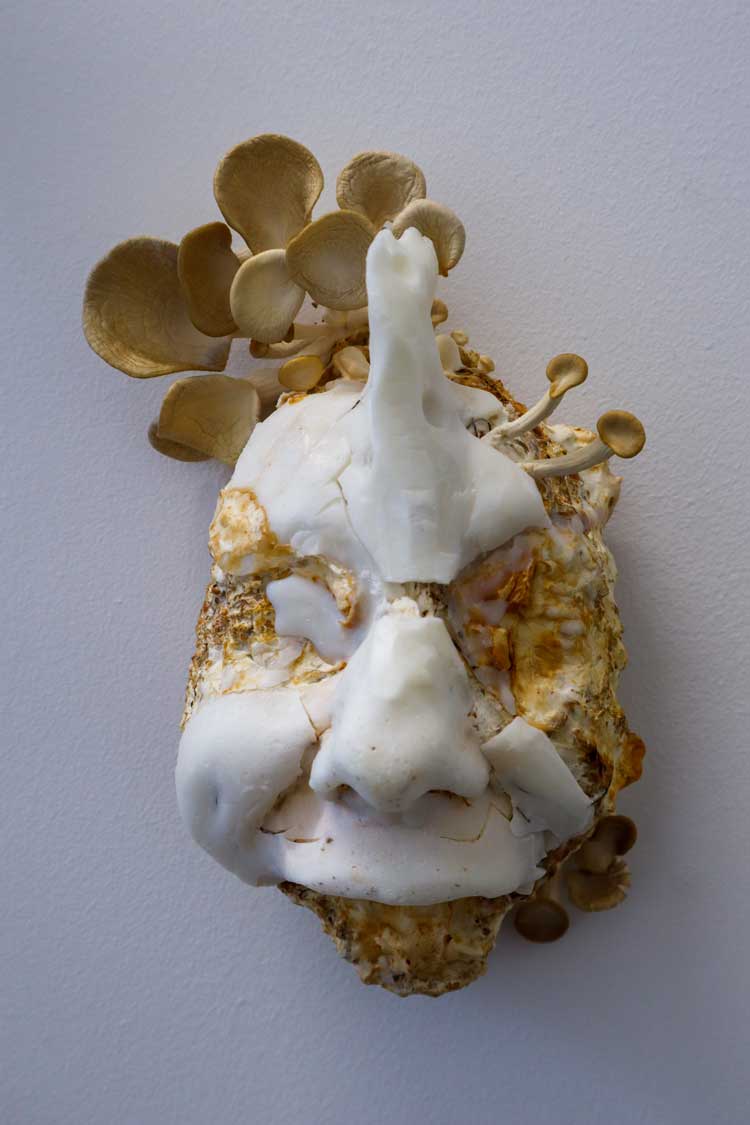
Eilidh Appletree’s exhibition, Net Worthy, explores how capitalism endangers all life on Earth; it accelerates biodiversity loss through extractive systems embedded in industrial agriculture and aquaculture. Appletree’s background in theatre and a love of storytelling her activism has prompted an installation that is unsettling and familiar, and which acts as a warning of the ramifications of the climate change on all living creatures. She has created a submerged seascape where steel fishing nets resemble marine life, fish with human faces sprout fungi, and once-fertile ground seems to scream as it collapses into sand.
The seabed is a world that most of us will not encounter, but Appletree warns: “It’s a world our actions have a great impact on. And if it is destroyed, our world will shortly follow. I hope that through creating this sense of submersion and curiosity, I can evoke a compassion and feeling of urgency in the audience.”
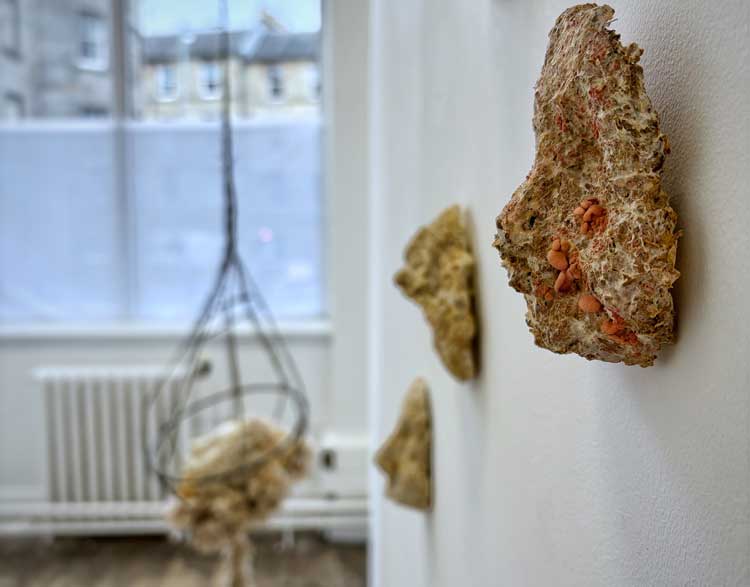
Eilidh Appletree, installation view, Net Worthy, part of Catalyst: Art as Activism, Summerhall Arts, Edinburgh, 31 January – 29 March 2026. Courtesy of the artist.
Positioning capitalism as a system that endangers all forms of existence Net Worthy exposes the devastation left by profit-driven food production; visiting her exhibition one experiences a sense of complicity in the aftermath of damage to animal life. Appletree is interested here in the beauty of destruction using materiality (mycelium, soya wax, sand and rhododendron petals) to conjure symbolic meaning through association – to compel her audience to engage with the reality of capitalist food production and the devastation it leaves in its wake. “Sand is a material most people will have a relationship with and it’s a significant feature of the Scottish landscape which many animals and organisms depend on for life,” she says. “It forms some of the seabed. On the darker side, it’s a symbol of desertification: a process by which our lands are turned infertile often due to overgrazing, overcultivation and deforestation. Here, I have formed the sand into faces, faces that look distressed. Rhododendron petals seem to be growing out of them: an invasive species in Scotland, a major contributor to biodiversity loss, particularly in the Highlands.”
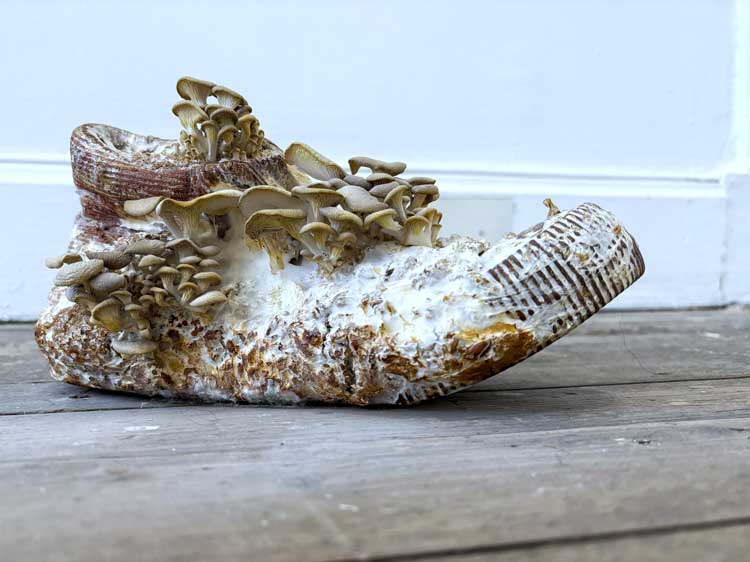
Eilidh Appletree, installation view, Net Worthy, part of Catalyst: Art as Activism, Summerhall Arts, Edinburgh, 31 January – 29 March 2026. Courtesy of the artist.
Net Worthy uses fungus to represent death, she says: “Mycelium is the vegetative part of a fungus. Here, I have grown this mycelium into moulds of human faces. This has allowed me to control these living mycelium networks and reshape them into something unnatural to them. I’m interested in how this reshaping of the mycelium in the mould mirrors the human experience under capitalism: how we are going against our own nature to fit into the capitalist mould.” Appletree also works in community arts, seeing this as interconnected to her practice. She is particularly interested in working with young people from a similar working-class background to herself, offering opportunities to the arts that they may not otherwise have access to. “Art is inherently political; working-class creativity is, in itself, an act of resistance.”
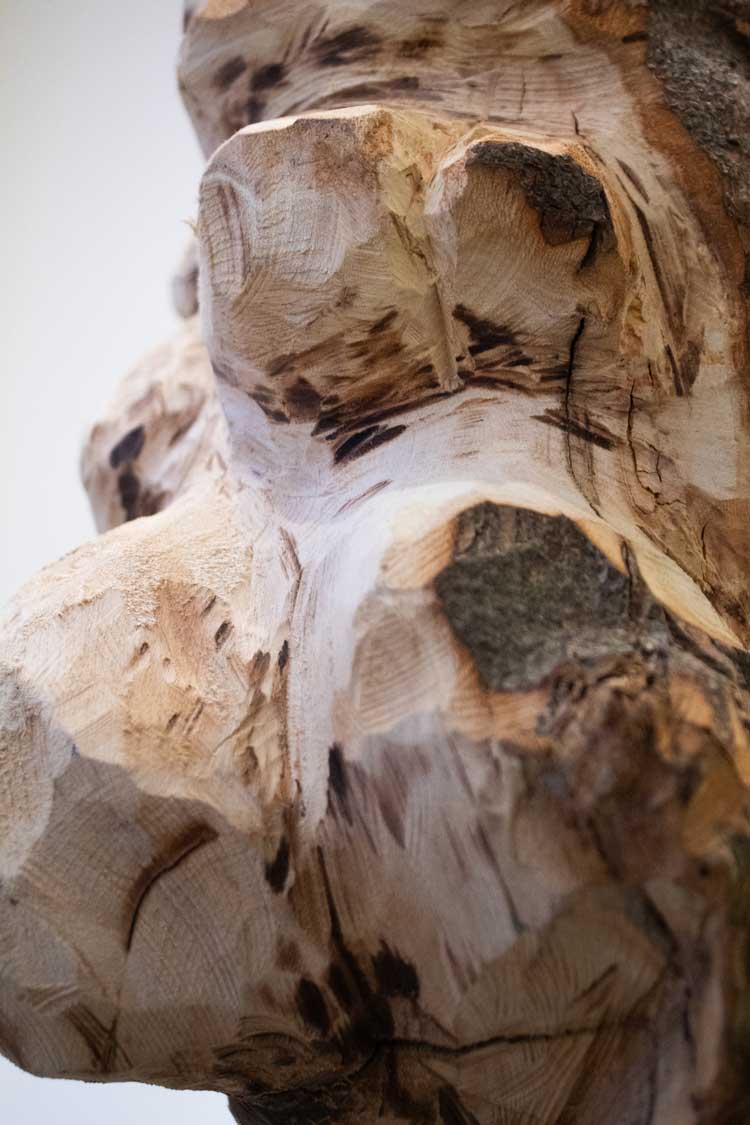
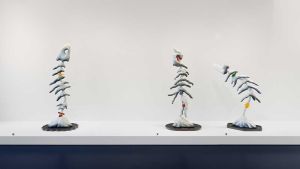
All Day, Waiting for Another Sun to Rise by Molly Wickett creates a post-apocalyptic landscape through a disabled and queer lens. Her carved and chiselled tree trunks push against the confines of the small gallery, creating a sensory experience of drama and tension due to the powerful forms that conjure decay. Yet, in blurring distinctions between dystopias and utopias, aspects of transformation show that regrowth can exist. The sculptural landscape reframes ecological breakdown as a site of hope.
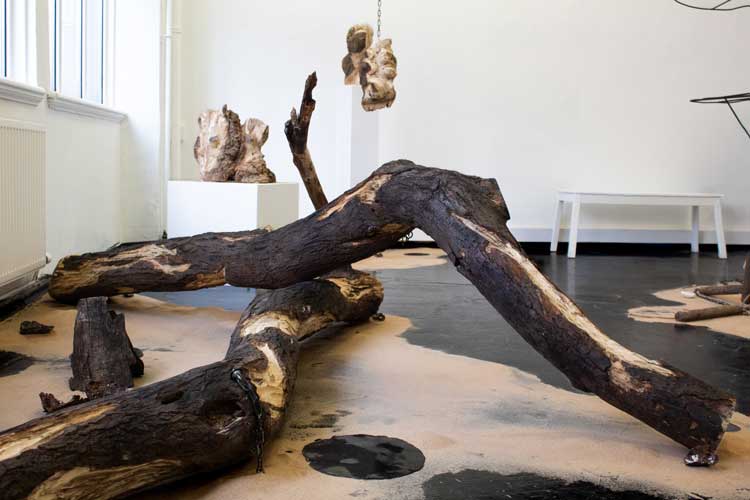
Molly Wickett, installation view, All Day, Waiting for Another Sun to Rise, part of Catalyst: Art as Activism, Corner Gallery, Summerhall Arts, Edinburgh, 31 January – 29 March 2026. Courtesy of the artist.
The artist’s disability forms the impetus to create an installation using materials that embody time and that disrupt the viewer’s perception of time. “The way I interact with the environment is also very sensory, and this heightened sensory experience is one I translate into the work, without it becoming overwhelming or painful. I want the scale of intense encounters to be reflected in the scale of the material environment I build,” Wickett says. Encountering Cornelia Parker’s Cold Dark Matter as a student was pivotal to the art practice she presents now: “Cold Dark Matter’s exploded shed stuck with me, how something that held so much movement could be so still and suspended in the air.”
Materials with dystopian associations are transformed: “Sand surrounding the sculptures [implies] an unviable ecosystem, referencing expanding deserts or rising sea levels. Decaying and drying wood also hold dystopian elements, without leaves to signify life. But fungi that decays wood are a sign of a healthy lifecycle, of regrowth. Smaller, forged fungi in the sand invite you to look again, closer. These small details invite you to look closer, to shift the narrative away from a dystopian one into something else: there are signs of life in the sand.”
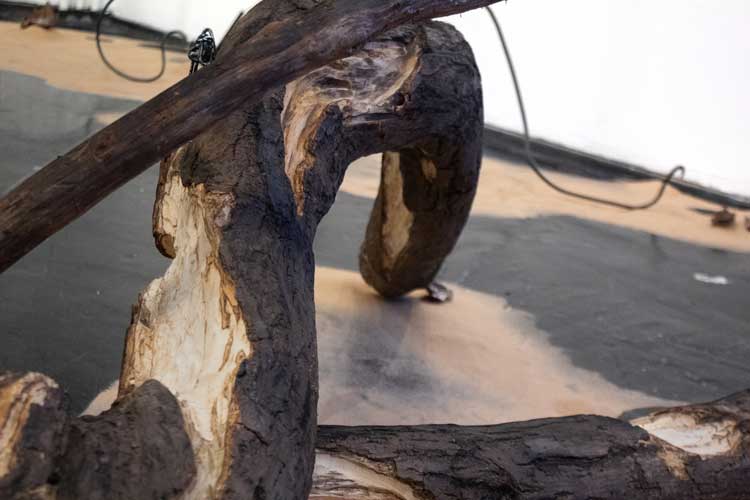
Molly Wickett, installation view, All Day, Waiting for Another Sun to Rise (detail). Carved and torched alder, steel chain and sand. Part of Catalyst: Art as Activism, Corner Gallery, Summerhall Arts, Edinburgh, 31 January – 29 March 2026. Courtesy of the artist.
Aspects of queer culture enable and inspire Wickett to rethink the connection communities hold to the environment. “I was really curious about why so many queer people felt drawn to nature, and how it became a space of solace for so many. There’s scientific evidence that disputes so much of what people will argue is biologically true, with gender in the natural world being anything but straightforward.”
Exploring “crip time” allows an understanding of otherness to become possible. She explains: “Crip time is the theory of time impacted by disability; how pain can expand time, how hyperfocus can speed it up, or, for example, how my delays in processing mean I react more slowly because my brain hasn’t processed that you’re speaking yet. This manifests in how time is present in the work, in the suspension of the sculptures – things that grow and move appear frozen – and the work itself is shifting [as] the metal corrodes, the wood ages. The environment I’m creating in this work reimagines a future that has already happened, and one which we view in our present moment. In social theory, the ‘other’ has been contextually defined relative to a dominant group, as deviant or ‘abnormal’. In many ways, crip time is already implicated in otherness. But by creating an environment that directly embeds material understanding to diverge from a prescriptive future, otherness is made possible.”
Kasia Oleskiewicz’s forceful activism in Any Body Home is the outcome of her feminist research and the assertion of the rights of nonhuman animals. As an artist and art historian she is committed to making a significant contribution to collective thinking. All her artworks, she states, can be viewed as made from an understanding of Dariusz Gzyra’s theory of “Sentiocene” (2025) where “commenting on the present is from a futuristic, utopian perspective - where an anti-speciesist, anti-discriminatory approach and equality of all sentient persons have become common”.
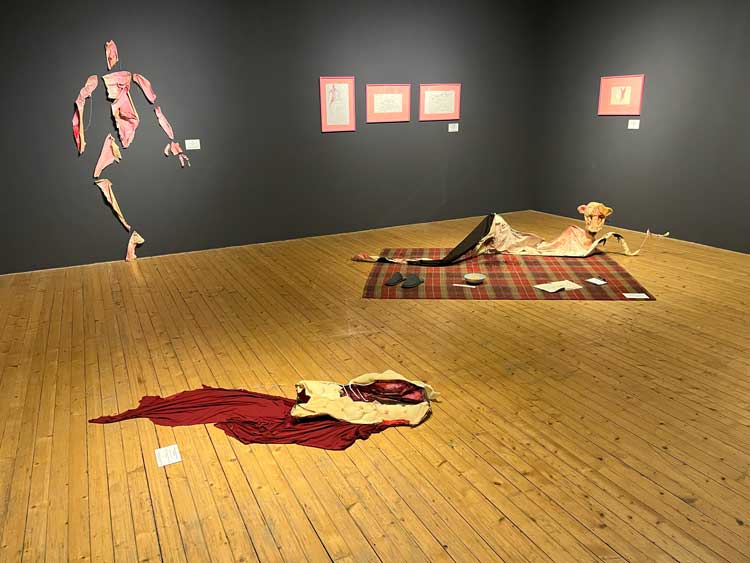
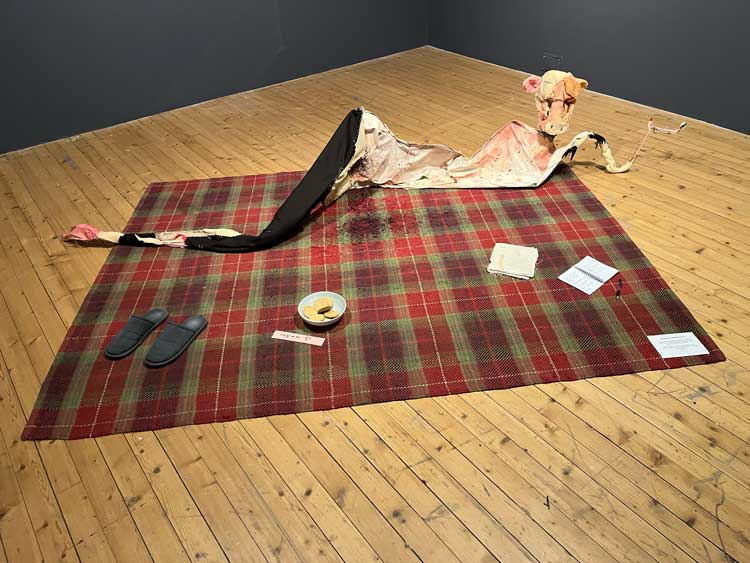
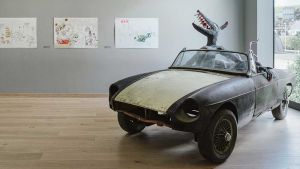
Kasia Oleśkiewicz, installation view, Any Body Home, part of Catalyst: Art as Activism, Summerhall Arts, Edinburgh, 31 January – 29 March 2026. Courtesy of the artist.
The title of the exhibition, Any Body Home, is a play on words where “any” and “body” are separated, creating a statement not a question – thereby asserting that she refers not only to human beings. She explains: “The title expresses a dream, a vision where each body both is and feels safe wherever they go. It breaks with demands or any normativity category – any body doesn’t need to meet expectations to be welcome. I try to imagine a space which is radically inclusive. [It is] particularly relevant in the current reality of rising fascisms, fear of the ‘other’, closing the door instead of welcoming.”
Oleskiewicz’s art practice seeks to highlight how patriarchal culture and discrimination contribute to brutal violence. “This interest originates in my passion for intersectional theories, particularly from critical animal studies. As an activist in an animal rights organisation, I was exposed to unbearable information about and documentation of violence against nonhuman animals at industrial farms – legal violence. In spite of [available] information and documentation, many people still cannot picture giving up meat or animal products. Simone de Beauvoir wrote: ‘It is not in giving life but in risking it that man is raised above the animal’ – and this is a reason that our culture recognises superiority not of the sex that gives life but ‘that which kills’.”
.jpg "Kasia Oleśkiewicz, Memorial to Victims of Violence in Shared Spaces, (foreground), installation view, Any Body Home, part of Catalyst: Art as Activism, Summerhall Arts, Edinburgh, 31 January – 29 March 2026. Courtesy of the artist.")
Kasia Oleśkiewicz, Memorial to Victims of Violence in Shared Spaces, (foreground), installation view, Any Body Home, part of Catalyst: Art as Activism, Summerhall Arts, Edinburgh, 31 January – 29 March 2026. Courtesy of the artist.
Any Body Home addresses the deep connections between violence against women and animals. Visceral installations such as Memorial to the Victims of Violence in Shared Spaces (2024) leave the viewer feeling uncomfortable, but it is also the manner through which we achieve the capacity for change. Oleskiewicz suggests: “I believe it’s mainly through grief that we can imagine a better reality. When I think of futuristic, utopian visions, they are built on mourning – and it is from there that we can move further towards building more sensitive communities. Rebecca Solnit wrote: ‘The past equips us to face the future.’” By creating commemorative monuments to any body, Oleskiewicz works to create empathy through memorialisation, by focusing on a body’s universal sentience of unjustified suffering. Her works are the very antithesis of those found in exisiting public spaces replete with traditional monuments, such as men on horses, that embody and reinforce patriarchal structures where grief is taboo.
Materiality is important in the work of all four artists in Catalyst. Oleskiewicz creates hybrid “creatures” to assist in raising consciousness, and to assert the need to address crime against women. “Textiles, combined with welded metal and paint, convey impressions of bodily forms, relations between body, flesh, meat, pain, harm. Textiles feel meaningful to me as they are immediately associated with a body – also in our daily space. They cover us. That can evoke care, warmth, but also shame. I see textiles as holding a great potential of dramaturgy: left clothing feels empty, an absence of the person who wore it.” Oleskiewicz’s hope is to provoke questions, critical thinking, imagination; to create a gap within established narratives and open a space for alternative visions.
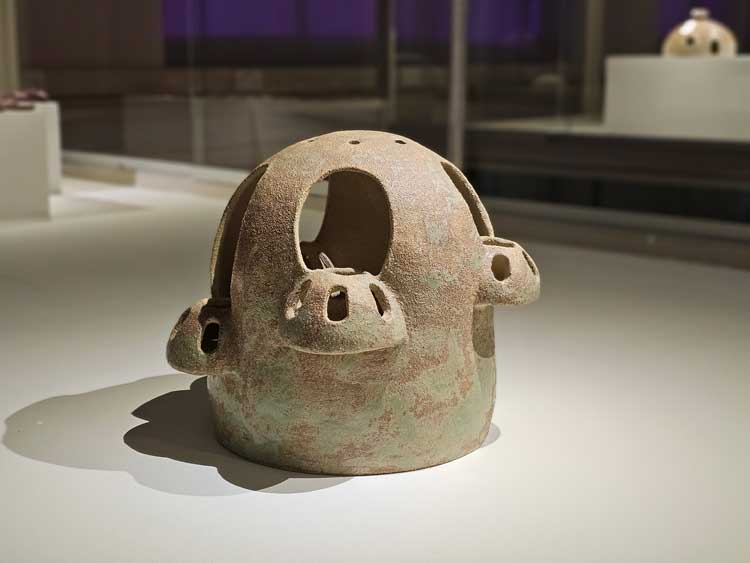
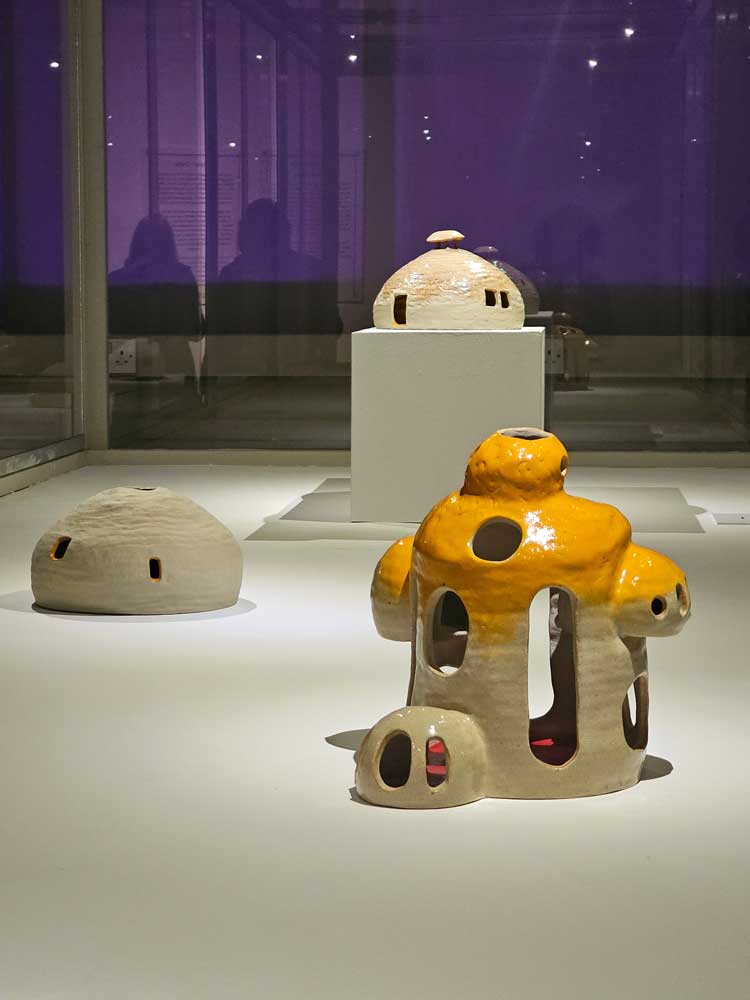
Taraneh Dana’sexhibition, A Heart in Exile, investigates complex themes of identity and displacement. An immigrant artist from Iran, Dana settled in the UK in 2021, to study for an MA in painting at University of the Arts London (via a crowd-funding campaign for tuition fees). She had previously studied architecture at the Bahá’í Institute for Higher Education, which is sometimes called an underground university. As a member of the Bahá’í faith, a religious minority in Iran, Dana was denied access to conventional higher education under the Islamic Republic’s regime. Her clay sculptures were made following the completion of her UAL studies; they chart the harrowing transition from Iran to the UK, the imprisonment of her parents on religious grounds and their subsequent migration with her grandmother to Canada. A Heart in Exile is a testament to loss, fear and loneliness.
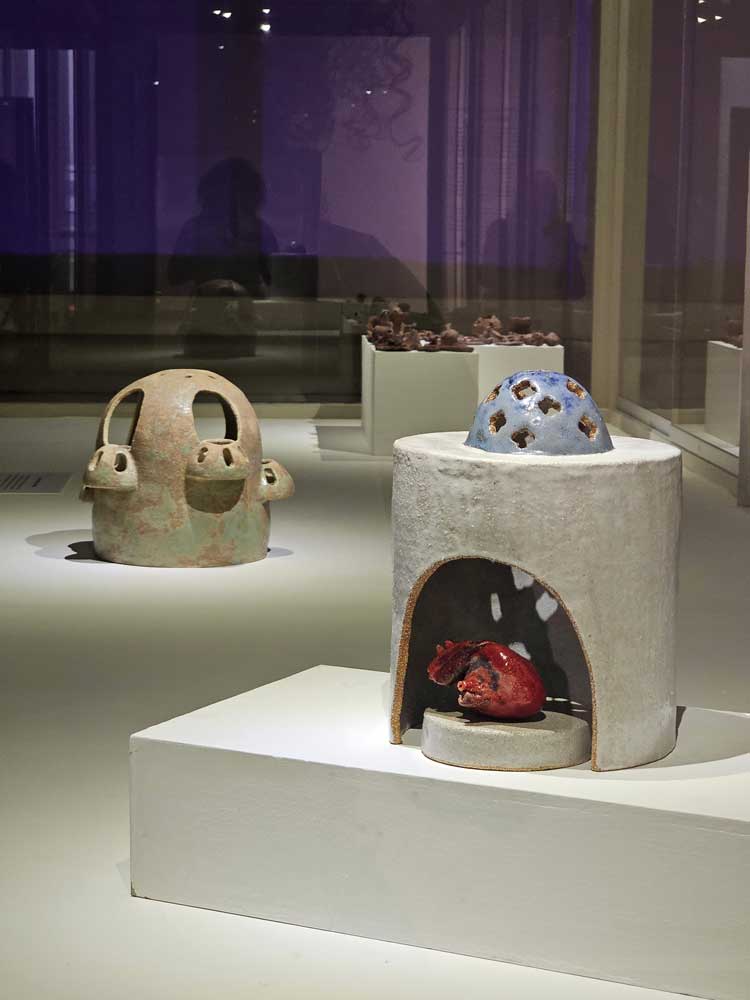
Taraneh Dana, installation view, A Heart in Exile and Container for No-Land’s Soil, part of Catalyst: Art as Activism, Summerhall Arts, Edinburgh, 31 January – 29 March 2026. Courtesy of the artist.
“Working with clay is a slow and delicate process that engages a range of sensations,” she says. “The way touch shapes a ceramic piece during its making, and its fragility at different stages, makes this medium a sensual tool that connects with my unconscious in a way no other material can. Clay takes me on an inward journey that I find deeply valuable, both for my artistic practice and for my growth as a person.”
The denial of basic human rights under the Islamic regime created ongoing trauma that Dana addresses through art. Ceramic vessels and house-like pieces represent the self; they are metaphors for containment, acceptance and safety. She says: “Many of my ceramic vessels and house-like forms refer to the idea of containment and holding. Living in exile has made these ideas more present. I can connect physically to Iran by encountering ancient Iranian ceramics in museums in the UK. Seeing these objects and containers creates a profound sense of connection to my ancestors, to my people and to the land I come from. I feel that I am part of a long continuum of making, shaping clay into containers as a way of preserving memory, identity and culture.”
The idea for Container for No Land’s Soil “emerged from my experiences of not feeling that I belonged, as a member of marginalised communities in Iran and later as an immigrant navigating visas and their never-ending processes. The piece includes a large container that holds the imagined soil of No Land, along with countless small balls of clay that I make as a way of marking the time I spend thinking about these questions.”
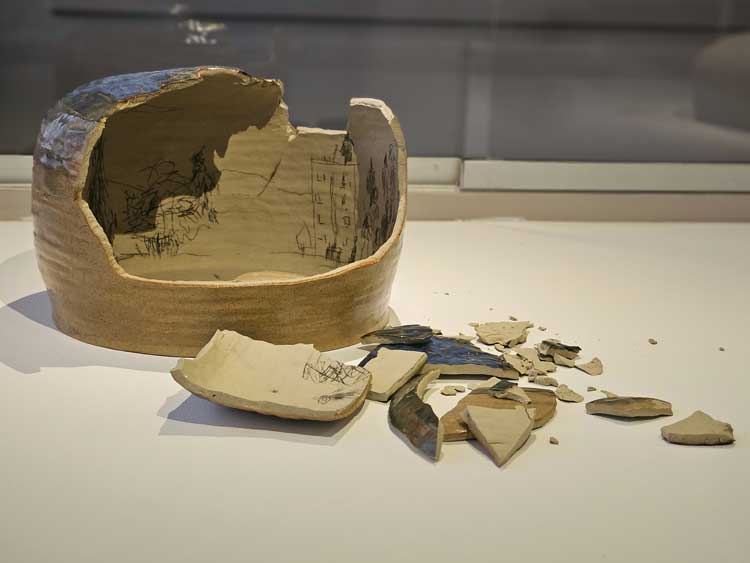
Taraneh Dana, Concepts That Changed Deeply After Immigration – Grief, installation view, A Heart in Exile, part of Catalyst: Art as Activism, Summerhall Arts, Edinburgh, 31 January – 29 March 2026. Courtesy of the artist.
Concepts That Changed Deeply After Immigration consists of seven house-like structures, each dedicated to a concept written on the second anniversary of the artist’s immigration: Otherness, Freedom, Loneliness, Prosperity, Longing, Peacefulness and Grief: “Grief was the largest ceramic piece I made. I broke the piece before firing it because I think grief has two dimensions. One is the loss of something you deeply cared about, and the other is the loss of what might have been. By breaking the piece before firing, I denied myself the possibility of ever seeing what life could have become. Inside the fragments are drawings of landscapes of Iran, its nature, its cities and its people.”
She describes London as her second home, believing now that vulnerability is her resilience: “After the recent massacre carried out by the Islamic Republic against innocent Iranians fighting for freedom, I feel a stronger responsibility than ever to continue making work, to remain open and vulnerable, and to keep faith with the hope that one day we will all be free. At a time like this, continuing to make, to speak and to insist on humanity feels not only necessary, but essential.”
• Catalyst: Art as Activism is at Summerhall Arts, Edinburgh, 31 January – 29 March 2026.
Click on the pictures below to enlarge
.jpg)

Copyright © 1893–2026 Studio International Foundation.
The title Studio International is the property of the Studio International Foundation and, together with the content, are bound by copyright. All rights reserved.
 |
 |
 |
|---|
-300.jpg)
-300.jpg)

 Isabel Rock: Things Fall Apart, The Centre Cannot Hold
-300.jpg) Zanele Muholi
Zanele Muholi-(1)-300.jpg) Women in Revolt! Art and Activism in the UK 1970-1990
Women in Revolt! Art and Activism in the UK 1970-1990.-You-Mountain,-You-River,-You-Tree,-2022-1000-300.jpg) Persones Persons: Biennale Gherdëina 8
Persones Persons: Biennale Gherdëina 8 Alberta Whittle – interview: ‘No one can find Barbados on a map, whereas everyone can find the UK. That level of inattention galvanises so much of my work ’