




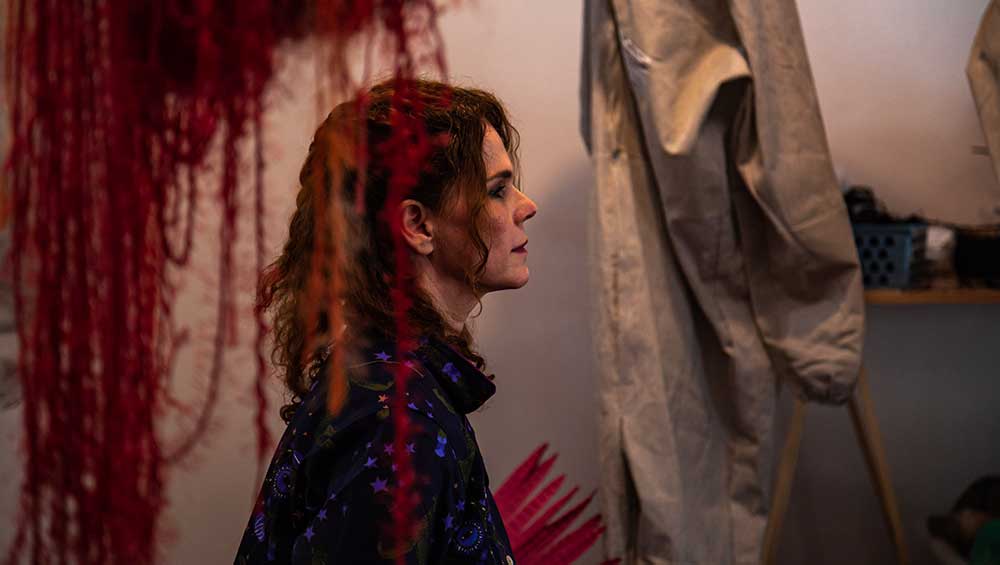
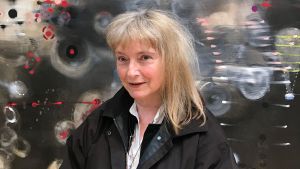
Laura Lima. Photo: A Gentil Carioca / Maria Baigur.
by SABINE CASPARIE
Born in 1971, Laura Lima grew up in Brazil’s countryside region of Governador Valadares, before moving to Rio de Janeiro, where she still lives. Initially a law student, Lima changed degrees to complete a BA in philosophy, realising her interest in the subject after her younger brother had a stroke, and she asked herself some important questions: “What is life, what is language and what is normality? What does it mean to exist?” Around the same time, she started attending a free art school, the Escola de Artes Visuais do Parque Lage. It was important to her “that there were no preconceived ideas or rules, and that it wasn’t about technique, but about ideas”.
This freedom and irreverence are apparent in Lima’s works. Best known is Balé Literal, her ongoing series of installations: fabrics and objects that move through the space, hanging from a pulley, animated mechanically in an adjoining space so that the inanimate objects appear as if they are dancing. In The Drawing Drawing, her current exhibition at the ICA and her first solo show in the UK, there is a “dancing”, bright-red parasol in the upper galleries, but Lima also made a new, site-specific work. The titular installation occupying a large room in one of the lower galleries, The Drawing Drawing (2025), takes the form of a life drawing class, complete with a model, props and easels. Except that in Lima’s unique iteration, no one is teaching and everything is moving. The model is a professional, but the audience are invited as artists, both sitting on mechanised platforms, orbiting one another in unpredictable ways. When I visited Lima at the ICA, I tried it out myself, of course; as an art historian who doesn’t make art, the delightfully disorienting experience felt liberating.
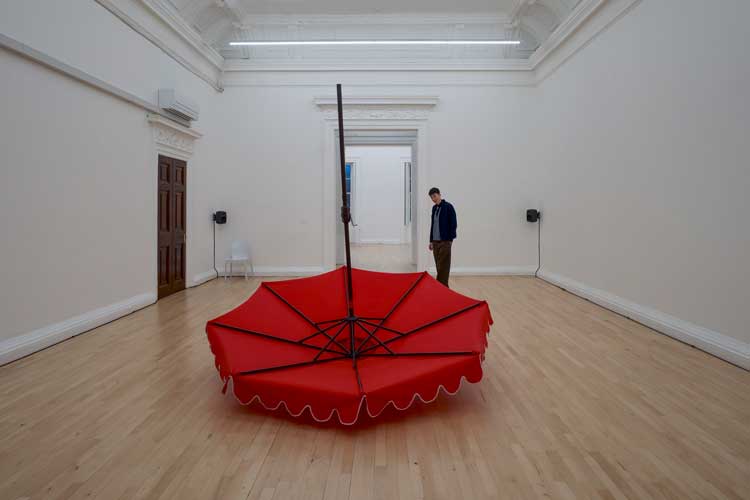
Laura Lima, Parasol Deux, 2023/2026. Red parasol, metal, motors, electrical components, wheels, sound. Audio composition by Laura Lima and Ricardo Siri. Installation view, Laura Lima: The Drawing Drawing, Institute of Contemporary Arts, London. Photo: Anne Tetzlaff.
The philosophical angle shines through mostly in the way the artist talks about her work. Resisting the category of “performance art”, Lima approaches her installations of moving objects, people and animals in a conceptual way. She sees the people in her work as its material, always telling them that “they are matter”. Her ideas about the ephemerality of artworks are expressed in a new version of the Imagens Congeladas (Frozen Images, 2025), first installed in her apartment in Copacabana. A freezer contains trays with abstract collages, gently arranged through tentative placement; the audience is invited to take out these “frozen images” and view them, seeing them change as they thaw.
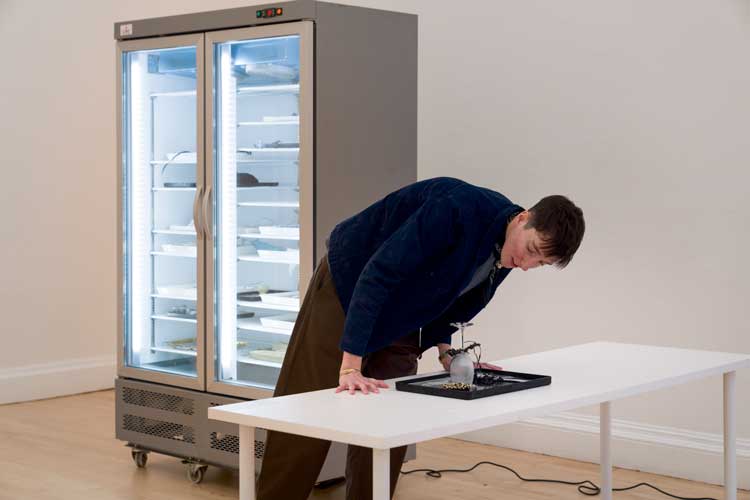
Laura Lima, Imagens Congeladas [Frozen Images], 1993/2026. Freezer, plastic trays, ice, various materials. Installation view, Laura Lima: The Drawing Drawing, Institute of Contemporary Arts, London. Photo: Anne Tetzlaff.
Lima is inspired by her homeland’s traditions of Carnival, “a banquet of life and luxury and of body and flesh”, but she equally draws on the art historical canon of Brazilian artists such as Lygia Clark, Cildo Meireles and Hélio Oiticica; artists who, like Lima, embrace a thorough conceptual practice with elements of uncertainty, irreverence and play.
Lima spoke to Studio International over Zoom from her studio in Rio, ahead of the opening of the exhibition.
Sabine Casparie: What does it mean for you to exhibit at ICA?
Laura Lima: I first came to the ICA around 20 years ago. Jens Hoffmann [director of exhibitions at the ICA from 2003 to 2007] visited my studio in 1999 and found it really interesting that I was proposing performative pieces, which at that time were not common. Hoffmann wanted to create a show with me and Tino Sehgal, but in the end it didn’t happen, so it was great when the current curator, Andrea Nitsche-Krupp, invited me again.
SC: This is your first solo exhibition in the UK. Have you thought about how people in Europe will view your work?
LL: Working in your own country, you use the tools and traditions that you have around you, but the history of Brazilian art is connected to the history of European art. Of course, we are connected in the world not just through what is produced in art, but also in the bigger themes. There may be references that people from other countries miss, but to me that is not a big deal. I believe that each artwork has a soul, and it will be interesting to see how the work plays out in a new space. What I can tell you is that in Latin America we are very interested in conceptual art.
.jpg "Laura Lima, The Drawing Drawing, 2026. Mechanised platforms (wood, metal, motors, electrical components, wheels), life model, paper, pencils and pens, still life display, ICA visitors. Installation view, Institute of Contemporary Arts, London. Photo: Anne Tetzlaff.")
Laura Lima, The Drawing Drawing, 2026. Mechanised platforms (wood, metal, motors, electrical components, wheels), life model, paper, pencils and pens, still life display, ICA visitors. Installation view, Institute of Contemporary Arts, London. Photo: Anne Tetzlaff.
SC: Your Balé Literal installations have become some of your most recognisable works. Fabrics and objects that move through the space, hanging from a pulley, are animated and take on human forms. But you decided to show something different at the ICA.
LL: The Balé Literal was a starting point. The work was very influential, and it contains many ideas that have occupied me for decades. But the curator challenged me to do something different, and I like a challenge. So, I came up with The Drawing Drawing. The installation on the ground floor takes the form of a life drawing class, except that no one will be teaching. People can sit down behind easels on platforms, and they will have paper and materials to draw. Everything is moving in the room. Someone is posing, nude if they feel comfortable, and that person is moving, too. I want to explore what happens when the borders are not fixed and when perspectives change. For me, a work of art is not static but constantly evolving.
SC: I have a feeling that elements of risk and chance excite you.
LL: I like working with people who have never done my proposed actions before. When people take part in my work, I want them to be comfortable, but I also want them to understand the ideas behind the work. I also like proposing a risk to the institution, which for me involves thinking about the work poetically and philosophically. I have been giving instructions to institutions for many years.
SC: You become the curator of your own work, in a way.
LL: It is more abstract than that. When I started in the 90s, critics would say: “This is performance.” I was working with people, so they didn’t consider the work conceptual. But I strongly relate to the conceptual in art; I was really trying to construct a glossary, a vocabulary, for my work. One of my works, for example, has a person sleeping in the gallery. The museum would say: “Laura, we can have the person present on the first day.” To which I would reply: “No!” I don’t want to put my work in a video and to be displayed as documentation. I want people doing things for the entire duration of the exhibition.
.jpg "Laura Lima, The Drawing Drawing, 2026. Mechanised platforms (wood, metal, motors, electrical components, wheels), life model, paper, pencils and pens, still life display, ICA visitors. Installation view, Institute of Contemporary Arts, London. Photo: Anne Tetzlaff.")
Laura Lima, The Drawing Drawing, 2026. Mechanised platforms (wood, metal, motors, electrical components, wheels), life model, paper, pencils and pens, still life display, ICA visitors. Installation view, Institute of Contemporary Arts, London. Photo: Anne Tetzlaff.
SC: It is as if your work is a philosophical take on the very idea of performance itself. The work has performative elements, but you resist the term “performance art”.
LL: Yes, I do. My work is about the idea, but also about the material. The people in my work are the material. I always tell them: “You are matter.” I want them to understand the ideas behind my works, which are material as much as conceptual. We don’t rehearse. My work is about experimentation, something that is also at the core of Brazilian art history. I find it amazing to be able to share that aspect with people abroad.
SC: How will you direct the work when you go back to Brazil?
LL: I leave instructions for the gallery, and the work will take its own course. I have done it before, when I set up a tailor shop as an exhibition. I am OK leaving the work alone; it has a soul, and the ideas are already there. When I make a work in my studio, I say: “Hello, stranger!” I am matter and the work is matter. It is about control and letting go. The same thing happens when I put works out in nature and they decompose. We are deceiving ourselves when we say that things are static and that we have control. Paintings in the 18th century oxidated; they keep changing. Everything changes all the time.
SC: Labour is an important element in your installations. You often allow people to get a behind-the-scenes view. Can you elaborate on the notion of labour in your work?
LL: There are several layers. I know that the labour is there in the work, and I show it. I talk about my work in a formal way – the artwork is matter, and so the people in my work are matter. But the labour is also political. I am interested in the organisation of labour, in the syndicate. I was raised in a Marxist family, and I studied philosophy. I am proposing the flesh as something political. In Balé Literal, I am asking the public: “Who is dancing”? My work is constantly playing and proposing.
.jpg "Laura Lima, Ascenseur, 2008/2026. Person’s arm, set of keys, wall. Installation view, Laura Lima: The Drawing Drawing, Institute of Contemporary Arts, London. Photo: Anne Tetzlaff.")
Laura Lima, Ascenseur, 2008/2026. Person’s arm, set of keys, wall. Installation view, Laura Lima: The Drawing Drawing, Institute of Contemporary Arts, London. Photo: Anne Tetzlaff.
SC: Your work seems to veer between the metaphysical and the practical.
LL: Yes, it is both. In my studio, we think and we play. I see it as socialist.
SC: What inspired your interest in philosophy?
LL: I started studying law, and then my younger brother had a stroke. We lost him – he became another person. His communications didn’t make sense, and I absorbed that in a poetic way. It was fascinating. It led me to some very important questions: what is life, what is language, and what is normality? What does it mean to exist? Around the same time, I went backpacking through Europe. In London, I saw something in a museum. I don’t remember what it was, but I do remember that it blew my mind. I had always thought that “art” equalled “painting”, but at that moment I realised that I could be an artist and bring in philosophy. Without telling my parents, I took the exams to study philosophy, and at the same time I started frequenting a free school of art. It was important to me that there were no preconceived ideas or rules. It wasn’t about technique; it was about ideas. My earliest work played with the idea of the “frozen image”. It is a metaphor used in photography, but I started thinking about the frozen image as something tangible. I constructed collages of photographs on a tray and froze them at home in my freezer. The work Imagens Congeladas [Frozen Images] at the ICA is a new version. I am always thinking about issues of conservation of artworks, and whether it is important to conserve them in the first place.
SC: You use a lot of fabrics in your work. What is the importance of textiles for you?
LL: First, it was about working with what was around me – I had a sewing machine at home. But I also like the fact that fabrics have been around for thousands of years, that they were as valuable as paintings, and that they could contain abstraction. In addition, there is something feminist about using fabrics as a material for art. At the ICA, there is a new work using fabric that builds on the Balé Literal: a large parasol operated by someone from the gallery with a joystick, so that the parasol seems to be dancing. For the score, I worked with the amazing musician Ricardo Siri.
-2004.jpg "Laura Lima, Gala Chickens, 2004. Image courtesy of the artist.")
Laura Lima, Gala Chickens, 2004. Image courtesy of the artist.
SC: Are you inspired by the Rio Carnival?
LL: Yes. Carnival is a banquet – a banquet of life and luxury and of body and flesh. Carnival is about the pure joy of existence. In my work Gala Chickens (2004), I put carnival feathers on real chickens with glue used for hair extensions; I loved bringing people from the carnival and from the farms together. I also created a banquet for pheasants. I am interested in the concept of “ornamental philosophy”: creating an abundance with a simple idea, even when you do not have a lot of material things. It comprises a certain spirit of irreverence that you see a lot in Brazilian art: Lygia Clark, Cildo Meireles, Hélio Oiticica.
SC: I read that you started dancing when you were young?
LL: I attended a dance school and, when I was 14, the owner had to step away because of a family situation and asked me to lead the lessons. So, I had to come up with the choreography! I started thinking about movement and lighting; I drew all the garments. But when I started making my artwork, I saw the movement in my work not as dance, but as sculpture – as three-dimensional drawings. I would make that point each time I showed my work, and it became the history of my practice. Now I am a bit more relaxed about those distinctions.
SC: You seem to resist closed forms or structures. What is it about ambiguity that attracts you?
LL: When you see a work of art, you have your own perspective: your existing knowledge and the angle from which you physically approach the work. There also is the passing of time, something you can’t control. It is impossible to take in everything at once when you experience an artwork, and that is OK. I like this opacity. For me, in the opacity, there is freedom.
SC: I love reading, so I like to ask artists this question. What are you currently reading?
LL: I would love to read more, but I don’t find the time. At this moment, I am reading Itamar Vieira Junior’s Torto Arado, a novel about a young writer in rural Brazil. What I like about it most is that it has many different narrative viewpoints in one story.
• Laura Lima: The Drawing Drawing is at the Institute of Contemporary Arts, London, until 29 March 2026.
Click on the pictures below to enlarge
.jpg)
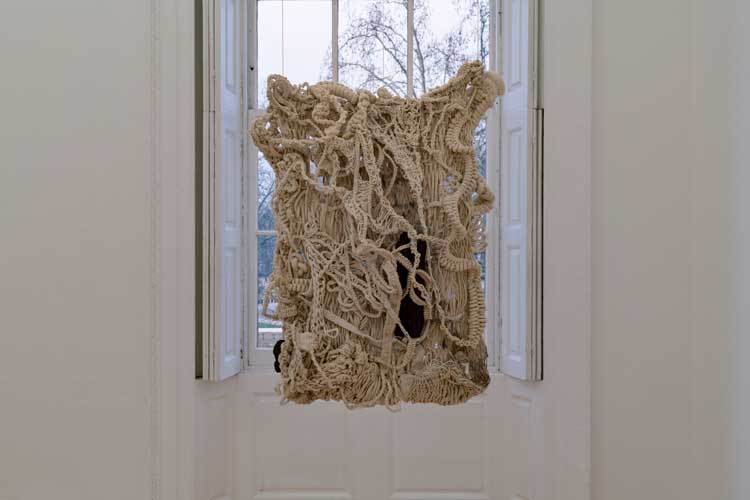
![Laura Lima, Imagens Congeladas [Frozen Images], 1993/2026. Freezer, plastic trays, ice, various materials. Installation view, Laura Lima: The Drawing Drawing, Institute of Contemporary Arts, London. Photo: Anne Tetzlaff.](/images/articles/l/018-lima-laura-2026/10-Laura-Lima-Photo-Anne-TetzlaffDSC03730-(1).jpg)
![Laura Lima, Imagens Congeladas [Frozen Images], 1993/2026. Freezer, plastic trays, ice, various materials. Installation view, Laura Lima: The Drawing Drawing, Institute of Contemporary Arts, London. Photo: Anne Tetzlaff.](/images/articles/l/018-lima-laura-2026/11-Laura-Lima-Photo-Anne-TetzlaffDSC03714-(1).jpg)
![Laura Lima, Imagens Congeladas [Frozen Images], 1993/2026. Freezer, plastic trays, ice, various materials. Installation view, Laura Lima: The Drawing Drawing, Institute of Contemporary Arts, London. Photo: Anne Tetzlaff.](/images/articles/l/018-lima-laura-2026/12-Laura-Lima-Photo-Anne-Tetzlaff-DSC03906-V1.jpg)

Copyright © 1893–2026 Studio International Foundation.
The title Studio International is the property of the Studio International Foundation and, together with the content, are bound by copyright. All rights reserved.
 |
 |
 |
|---|
-300.jpg)

-300.jpg)
 Siobhan Davies Dance: Table of Contents - video review
 Table of Contents, a live installation
 Mira Schendel: “You shall see the difference now that I am back again”
 Laure Prouvost wins Turner Prize 2013
 Frieze Art Fair London 2013: Reaching new audiences