




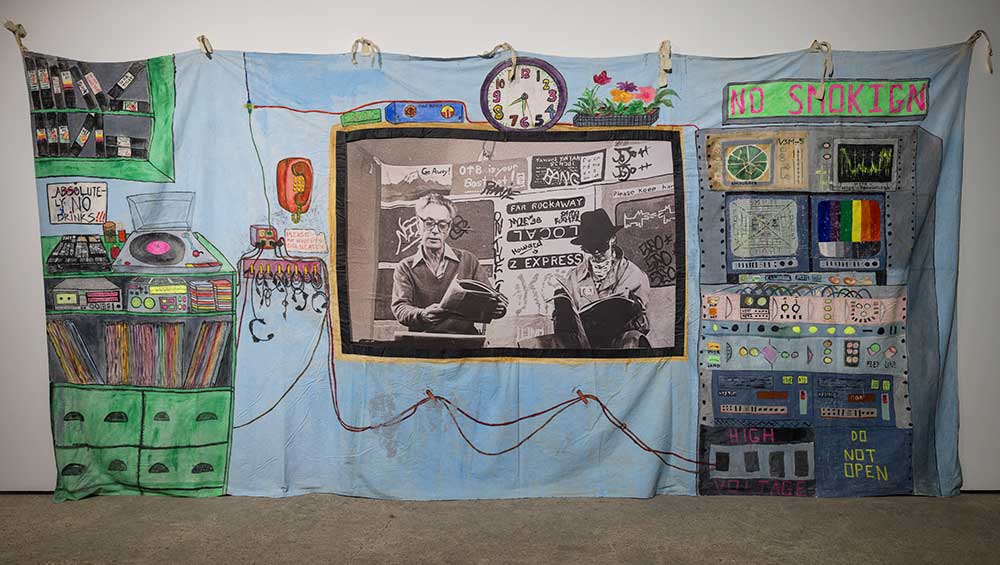
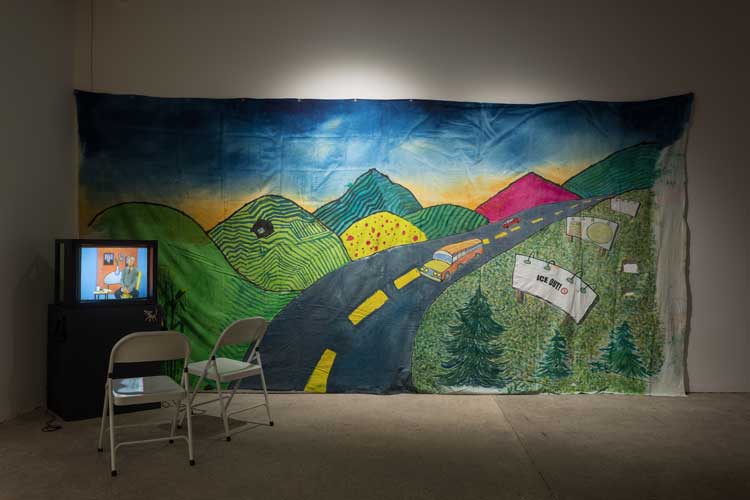
Paper Tiger Television, It’s 8:30. Do you know where your brains are? Installation view, Goldsmiths Centre for Contemporary Art. 30 January –19 April 2026. Courtesy Goldsmiths CCA. Photo: Rob Harris.
Goldsmiths CCA, London
30 January – 19 April 2026
by JOE LLOYD
John Paul II wants to suck your blood. And he is not alone: Ronald Reagan, Margaret Thatcher, Deng Xiaoping and Mikhail Gorbachev also stare out from their lairs with vampiric fangs, waiting to sink their teeth into an acquiescent public. The fangs were added to Los Angeles Times adverts by activists associated with the Californian branch of Paper Tiger Television (PTTV), a public access network with a difference. Created in 1981 by the film-maker and activist DeeDee Halleck, PTTV used 30-minute television slots to analyse and interrogate US media. “The power of mass culture rests on the trust of the public,” reads its manifesto, and “this legitimacy is a paper tiger”. Over the next three decades, a roving group of activists would seek to comprehensively critique their country’s media and the structures that prop it up.
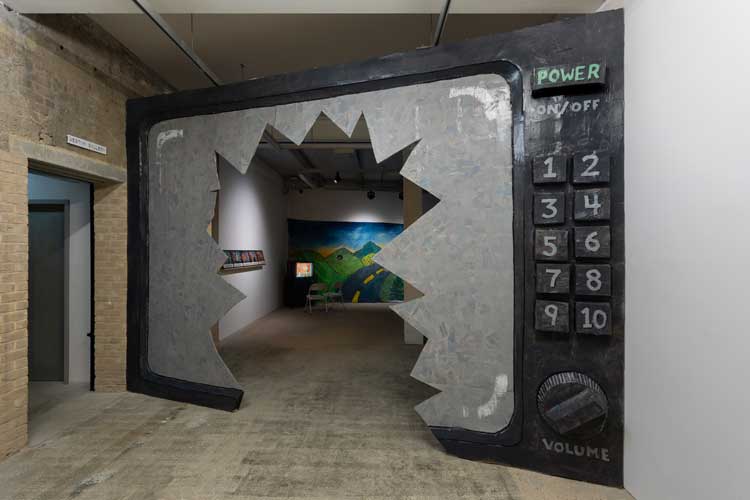
Paper Tiger Television, It’s 8:30. Do you know where your brains are? Installation view, Goldsmiths Centre for Contemporary Art. 30 January –19 April 2026. Courtesy Goldsmiths CCA. Photo: Rob Harris.
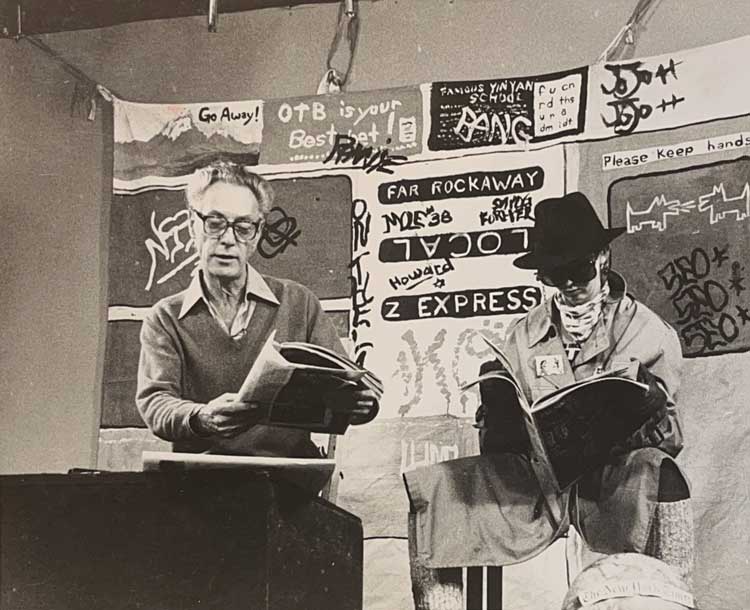
A new exhibition at Goldsmiths CCA showcases 40 of the nearly 400 films that PTTV produced from 1981 to 2008. Entered through an installation in the form of a giant shattered TV screen by artist Mark Couzens, it mixes screening monitors with ephemera from the project’s lo-fi productions. They are lo-fi in the truest sense of the term. The first film, Herb Schiller Reads the New York Times (1981), sees the late media theorist sit in front of a crudely painted backdrop and deliver a lecture straight to camera about the newspaper’s power to set the agenda on the behalf of hegemonic corporate interests. These interests are explained through diagrams on pieces of card, held up to the camera by a gloved hand. Schiller’s monologue is broken only by an interlude of photographs soundtracked by Joe Jackson’s new wave song Sunday Papers.
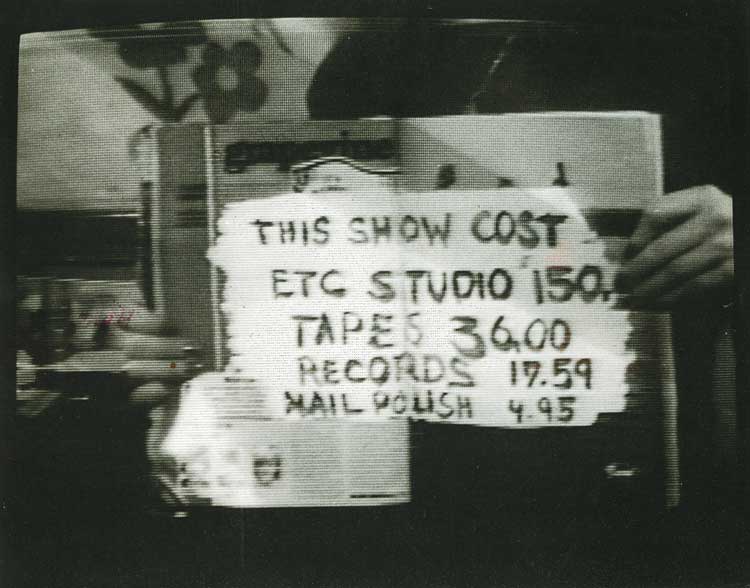
Paper Tiger Television, Ynestra King Reads Seventeen: Selling the All-American Girl,1982 [still]. Painted by Johanna Vanderbeek.
The first set of videos followed this formula, with various commentators presenting a Roland Barthes-esque “reading” of a publication. Soon the purview widened to cover television, cinema, political reports, the production of socks and other consumerist phenomena, but the approach – a live take without post-production – retained a radical honesty. At the end of each episode, a card would explain how much the broadcast cost, which was invariably very little. The videos often leavened their analysis with jots of humour, while seldom losing the impression of being made by very serious people not much given to laughter. There is often jaunty music in the background, implicitly casting the channel’s enemies as clownish. Donna Haraway Reads the National Geographic on Primates (1987) sees the eminent scholar of technology pose in a gorilla mask, eat a slice of cake and stand next to a man clad in underwear to discuss the formation of the concept of nature. Haraway does not seem entirely comfortable with the set-up.
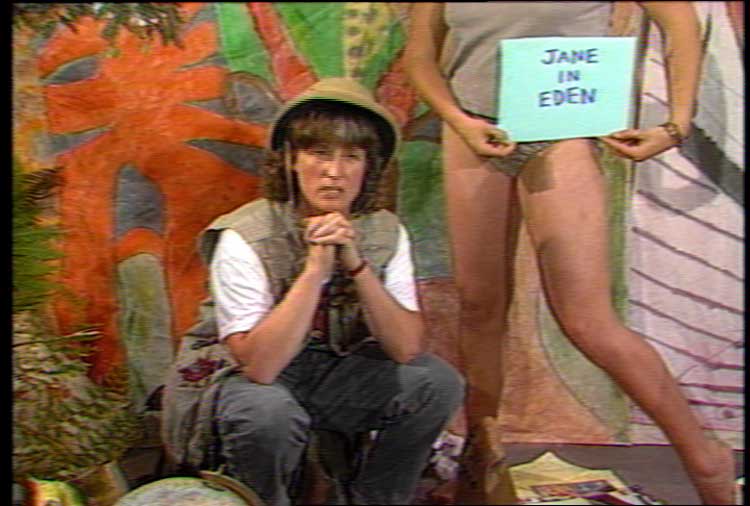
Paper Tiger Television, Donna Haraway Reads the National Geographic on Primates, 1987 [still].
PTTV’s best videos function as complete works of art. Martha Rosler Reads Vogue (1982) sees the artist comb back and forth through an issue of the fashion magazine while unleashing a mellifluously paratactic monologue. Her critique slides suddenly into a fictional first-person account of an affair with its proprietor, Condé Nast, her fingers grasping the page with an increased firmness as she describes a non-consensual sex act. Another superb outlier, Joan Does Dynasty (1986), in which the artist Joan Braderman offers a critique of the 1980s soap opera, is a case in point. Braderman imposes her face and body on to salacious clips from the show. She variously hovers at the side like a gargoyle, lies down with her feet to the camera and stands front and centre. She sometimes opens her cardigan to reveal an invisible chest, through which images from the sitcom can be seen: at one point, the eyes of a hunk shine through her stomach. Braderman has an admirable turn of phrase – Joan Collins’s Alexis Colby is “a designer castrating machine” in a cast of “dressed-to-kill aliens” – but never lets her verve dilute her analysis of the show’s consumerism and anti-feminism. Sometimes minute Dynasty snipers are repeated again and again, as if a record has jammed – an editing technique that I associate more with absurdist Adult Swim comedies than critical lectures.
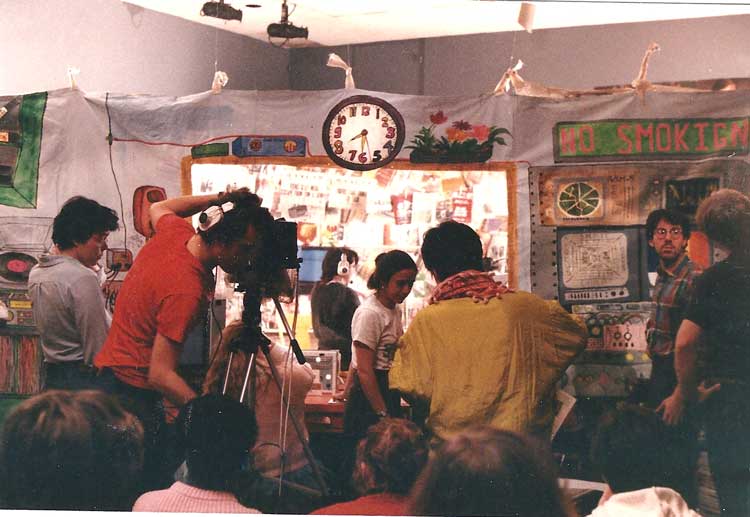
Production of Paper Tiger Television, Paper Tiger at The Whitney: Youth and the Media; Escape From Tom and Jerry, 1985. Photo: Diane Neumaier.
Later videos experimented with further animation and editing. In PTTV Flushes Rush (1993) the ultra-conservative shock jock Rush Limbaugh is flushed down a toilet. This full-throated take down of Limbaugh – a ghoulish figure whose dog-whistle provocations and faux-everyman persona pre-empt today’s popular right – is best when it allows its subject’s abhorrent views to hang themselves, rather than when its solemn presenters explain matters. There was also another shift, away from media readings and towards a broader consideration of political and social issues. Several of the videos capture activists on the gamut of progressive causes. Perhaps the most impressive project is the 10-part Gulf Crisis TV Project, one section of which is shown at Goldsmiths. This investigates the US depiction of the first Gulf war and documents the protests against it.
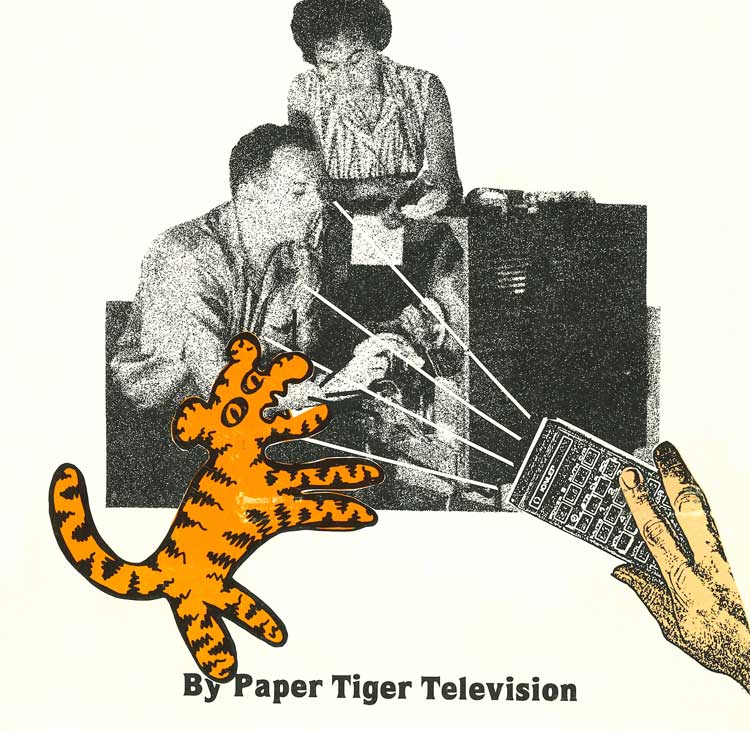
Paper Tiger Television, The Paper Tiger Guide to TV Repair!, 1992.
At times, the PTTV videos feel like dispatches from a lost world. They have an earnest belief in the power of television to inform, in their audience’s capacity to sit still for half an hour to watch a media theory dispatch. There seems to be a faith that well-reasoned lectures, backed up by fact and righteous indignation, can win out. PTTV’s ethos is antithetical to our age of misinformation, where flashy short-form videos are becoming the default mode of communication for entertainment and politics. There is, perhaps inevitably, the sense of a mission failed: 45 years after Schiller analysed the corporate interests behind the New York Times, the Washington Post has become the plaything of one of the world’s richest men; fewer, larger companies dominate the global economy; and Limbaugh’s descendants are running the world. The latest video on show, Infiltrating the Underground: The Corporatization of Radical Culture (2008), feels like a poignant ending: what future for an anti-corporate media when the corporations have turned the alternative into just another market?
Yet PTTV also contains the seeds of some contemporary media forms: most specifically the cultural theory video essays of influencers such as ContraPoints, but also the wider YouTube phenomenon of dissecting media artefacts, albeit seldom with the same intellectual hinterland, nor with PTTV’s decision to keep in goofs including background noise and missed cues. The professorial authority of many of its speakers – which can sometimes come off as smug – is far from contemporary fashion. But their messages remain as relevant today.
Click on the pictures below to enlarge
![Paper Tiger Television, Peter Wollen Reads the U.S. Press: People Magazine and Scientific American in the Same Breath, 1988 [still].](/images/articles/p/&084-paper-tiger-television-2026/01.jpg)
![Paper Tiger Television, Joan Does Dynasty, 1985 [still].](/images/articles/p/&084-paper-tiger-television-2026/06.jpg)

Copyright © 1893–2026 Studio International Foundation.
The title Studio International is the property of the Studio International Foundation and, together with the content, are bound by copyright. All rights reserved.
 |
 |
 |
|---|
-300.jpg)


-300.jpg)

 The Birth of Cinema … and Beyond: An Exhibition of Painting and Video
 Rediscovering the Silver Age of Russian Art
 Frieze Art Fair 2007