




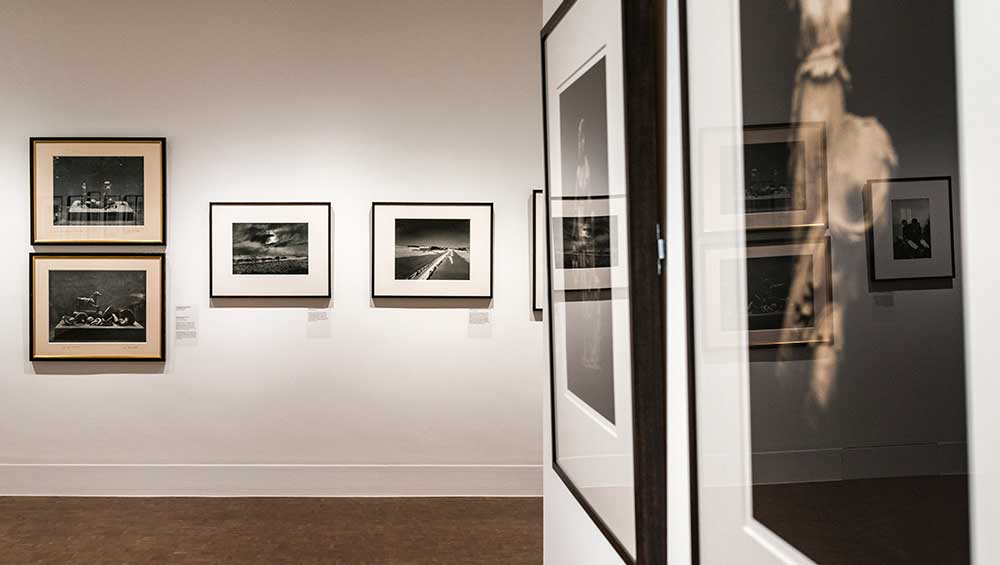
Don McCullin: Broken Beauty, installation view, Holburne Museum, 2026 © Don McCullin. Courtesy the artist and Holburne Museum. Photo: Jo Hounsome.
Holburne Museum, Bath
30 January – 4 May 2026
by TOM DENMAN
In a world of constant scrolling, how do we prevent ourselves from becoming coldly immune to photojournalism? While images can, in certain limited respects, bring us closer to lives in peril (albeit without bringing them closer to our own privileged position), accelerated overexposure to the plight of others risks rendering us numb to what we are supposed to witness. Arguably, therefore, it can subdue the empathy intended when photojournalism is deployed to inspire solidarity or expose the darker truths of a propagandised war. Spending time with the best of such images – or those that make us bear witness to suffering, provoking contemplation of our own responsibility to others while protecting their dignity – might restore some of this feeling. Or at least highlight the importance of holding on to it.
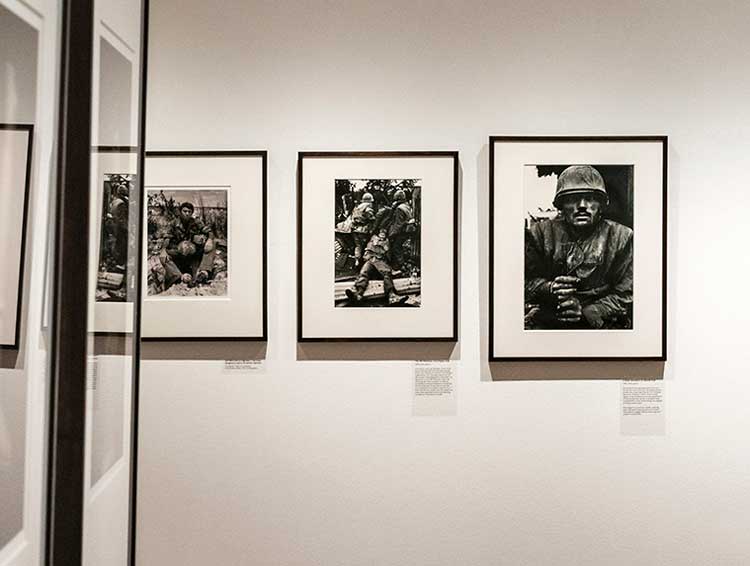
Right: Shell-shocked US Marine, The Battle of Hue. Installation view, Don McCullin: Broken Beauty, Holburne Museum, 2026 © Don McCullin. Courtesy the artist and Holburne Museum. Photo: Jo Hounsome.
A bystander’s guilt is hard to shake off, especially for the nonagenarian giant of photojournalism Don McCullin, who witnessed so much atrocity, a feeling he has often voiced. Still, the receptivity of his lens is an enduring empathic bridge for the most of us who weren’t there, and the aestheticisation of his subject matter – a bugbear of his – bestowed the humiliated with dignity. (The same can be said of Letizia Battaglia, who expressed a desire for her photo-reportage of the Sicilian mafia wars of the 1970s and 80s to be burned, concerned that she had glamorised gang violence, yet her graceful approach restored dignity to a ridiculed island.) McCullin’s most famous photograph, Shell-shocked US Marine, The Battle of Hue (1968), exposed the traumatic undertow of imperialist military might. We cannot see what the soldier has seen – and probably continues to see, inwardly – but we sense that these sights have rattled him in ways to many of us unfathomable. Instead of the horror itself, we witness a vacant stare imprinted with that horror. Just because we cannot see it, this does not mean it is not happening. The work is about distance as much as proximity, a distance as psychic as much as it is geographic. Bystanding does not equate to hands-on action (pulling troops out of Vietnam, for instance, or psychotherapy for veterans), but when it is of this calibre it can sustain an emotional encounter – down the decades – that reminds us of our need to be responsible as well as our complicity.
-Don-McCullin.jpg "Don McCullin, A 15 year old boy crying at his father’s funeral, who died of Aids, Ndola cemetery, Zambia, 2000. © Don McCullin. Courtesy the artist and Hauser & Wirth.")
Don McCullin, A 15 year old boy crying at his father’s funeral, who died of Aids, Ndola cemetery, Zambia, 2000. © Don McCullin. Courtesy the artist and Hauser & Wirth.
One of the key takeaways from this retrospective is how photography can record first and foremost the photographer’s psychological response to his subject – a response that is somehow moral and exemplary – especially when the photographer is as gifted as McCullin. The show’s autobiographical format and breadth throw this into relief, as does its occupation of a single room, putting different themes and emotional registers in relation. The most gruelling photographs date to the 1960s and 70s. They depict an impoverished east London and the badlands of England’s industrial north, the Biafran famine, the Cyprus Crisis, The Vietnam war and the Beirut war. The dishevelled man in Aldgate, London (1961) heaves his upper lip into a grimace. Yet the eyes looking at us are softer and more vulnerable, and on closer inspection his expression could be changing from defensiveness to trust – note the way his raised bandaged arm seems to retreat – our sense of this developing in real time with the mutual recognition between him and the photographer.
-Don-McCullin.jpg "Don McCullin, A Turkish woman mourning the death of her husband, Cyprus, 1964. © Don McCullin. Courtesy the artist and Hauser & Wirth.")
Don McCullin, A Turkish woman mourning the death of her husband, Cyprus, 1964. © Don McCullin. Courtesy the artist and Hauser & Wirth.
In Turkish woman mourning the death of her husband, Cyprus (1964), McCullin could be very near the scene, the suddenly bereft, wailful people nearest the camera cropped from the waist up. But nobody – apart, perhaps, from a boy in the background – seems to notice his presence, as if everyone in the frame were too distraught to do so. Two women and a boy hold on to her, consoling her as well as, it seems, holding her back from what she sees beyond the frame. McCullin has taken care to find this moment, this measure of proximity and distance, and to attend to the crevices of the widow’s anguished face in the darkroom, but his lens does not penetrate. Different from the more piercing war photography of today – whose rawness is more suited to the passing glance – these images honour the impossibility of us really knowing what it is like to see what she sees, as she sees it. McCullin asks us to contemplate our ignorance (and the limits of mediated vision) as much as what we are shown.
-Don-McCullin.jpg "Don McCullin, Still life with mushrooms and horse statue, c1989. © Don McCullin. Courtesy the artist and Hauser & Wirth.")
Don McCullin, Still life with mushrooms and horse statue, c1989. © Don McCullin. Courtesy the artist and Hauser & Wirth.
From the early 80s onwards, McCullin turned much of his attention away from the horrors of war and poverty to more tranquil scenes – relentless exposure to violence having become too much of a psychological burden. This was when he began photographing arrangements of objects in his garden shed. Still life with mushrooms and horse statue (1989) attends to every crack and crevice and speck of dust on the wall, plinth, statuette and fungi, reinvigorating age-old dichotomies of endurance and decay. The richness of the print, picking up more than would be detectable to the naked eye – along with the diffuse darkness – seems to have absorbed the world’s perils: quietude offset by memories of its opposite. The photographs of rural Somerset, McCullin’s home for the past four decades, bear a similar stamp. The detail he brings out in the rotting, struggling, leafless, threatening trees, the sense of raw contact with the elements, elicits atavistic hardship as much as calm.
-Don-McCullin.jpg "Don McCullin, Somerset Levels near Glastonbury, 1990. © Don McCullin. Courtesy the artist and Hauser & Wirth.")
Don McCullin, Somerset Levels near Glastonbury, 1990. © Don McCullin. Courtesy the artist and Hauser & Wirth.
As might be expected of an exhibition of photojournalism spanning nigh-on seven decades, an important subtheme here is time. We witness remarkable instances of change – the Aldgate of 1961 would be unrecognisable to anyone familiar with that area of London now. But more poignant are the continuities. Young Christians beside the body of a teenage Palestinian girl, Beirut (1976), depicts a line of boys laughing, singing and playing music in front of the girl’s corpse splayed out in the foreground, barely visible for the muddy road. Maybe it is the kid with the machine gun who has just killed her. It is especially shocking because they are in the middle of an open street, in broad daylight, their mirth regarded as boys-will-be-boys silliness. Maybe they will get a slap on the wrists, maybe they will be lauded, if anyone cares at all. A Palestinian woman returning to the ruins of her house, Sabra, Beirut (1982) is a scene familiar to anyone looking at the news today, recording an effect of Israel’s invasion of the Palestinian districts of Beirut, deemed a genocide by the UN the following year. The story is ongoing.
-Don-McCullin,-courtesy-of-the-artist-and-Hauser-and-Wirth.jpg "Don McCullin, Venus, Palazzo Massimo, Rome, 2022. © Don McCullin. Courtesy the artist and Hauser & Wirth.")
Don McCullin, Venus, Palazzo Massimo, Rome, 2022. © Don McCullin. Courtesy the artist and Hauser & Wirth.
Time also underpins McCullin’s most recent body of work, a series of photographs of ancient Roman sculpture – a crouching Venus or the fragmented legs of a soldier, for instance. In the darkroom, he renders them as luminous apparitions hovering in a black void, lovingly attending to the rough surfaces where limbs have been severed, faces rubbed away, buttocks pockmarked and heads decimated – the statues appear more lifelike than they would in a museum, the blemishes empathically experienced as pain. In the context of the show, there is something almost therapeutic in this – an extension of the still lifes and landscapes, even if these latter strike as being more personal and multifaceted, making for more rewarding viewing. It is as if McCullin were using these remains to externalise what his camera and mind absorbed in earlier decades, to reorient himself, and the viewer, within a much broader temporal framework (maybe turning 90 also has something to do with this). If much of his photographic mercy has been to give dignity to the humiliated, here he explores the fragility of even the most hallowed vestiges of power.
-Don-McCullin.jpg "Don McCullin, Feet from a statue of Artemis, Istanbul Archaeological Museum, Turkey, 2022. © Don McCullin. Courtesy the artist and Hauser & Wirth.")
Don McCullin, Feet from a statue of Artemis, Istanbul Archaeological Museum, Turkey, 2022. © Don McCullin. Courtesy the artist and Hauser & Wirth.
Click on the pictures below to enlarge
-Don-McCullin.jpg)
-Don-McCullin.jpg)
-Don-McCullin.jpg)

Copyright © 1893–2026 Studio International Foundation.
The title Studio International is the property of the Studio International Foundation and, together with the content, are bound by copyright. All rights reserved.
 |
 |
 |
|---|


-300.jpg)

 Guy Bourdin at the V&A. Fashion photography as art
 Keith Arnatt: I'm a Real Photographer
 Diane Arbus: Revelations
 Nobuyoshi Araki: Araki: Self, Life, Death