



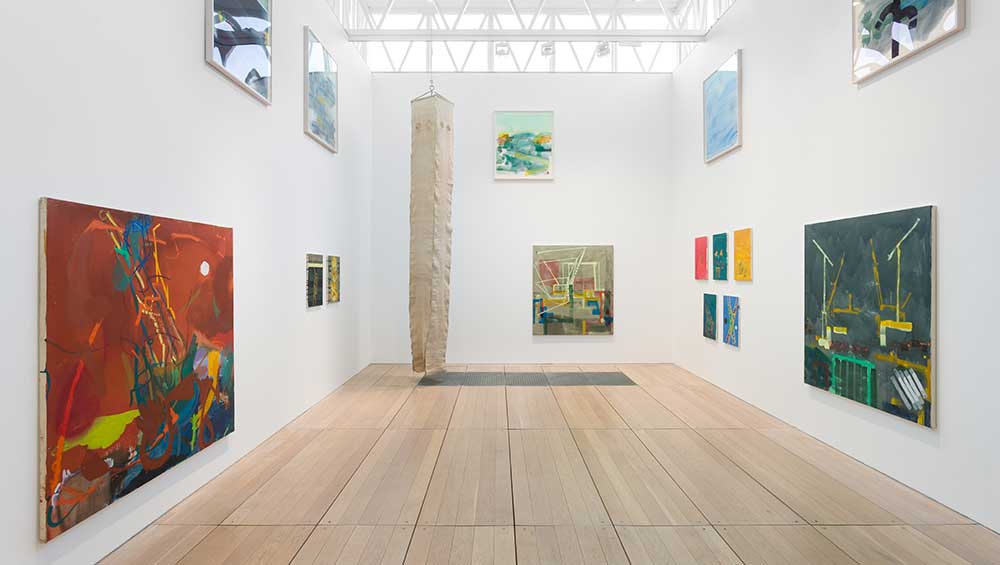
Christina Mackie, Material Reality, installation view, Goldsmiths Centre for Contemporary Art, London, 30 January –19 April 2026. Courtesy Goldsmiths CCA. Photo: Rob Harris.
Goldsmiths Centre for Contemporary Art, London
30 January – 19 April 2026
by ANNA McNAY
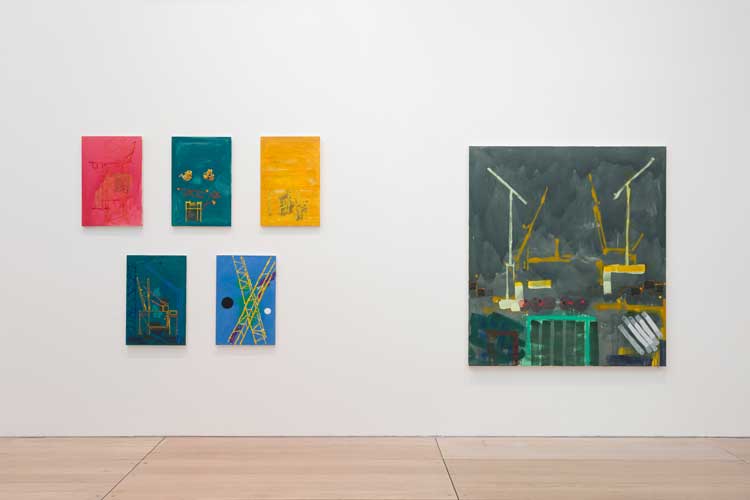
Walking into the first room of Christina Mackie’s solo exhibition at Goldsmiths Centre for Contemporary Art is like entering a shipbuilding yard – all at once you are surrounded by towering cranes. These are a suite of paintings, some new and some dating back to 1985, when her work, although still decorated with her trademark “splats”, was a lot heavier and more loaded with paint. In fact, the works in this room, which make up an installation called Dissolve, are hung according to their material weight, with the upper row comprising diaphanous, yet still industrial, watercolours.
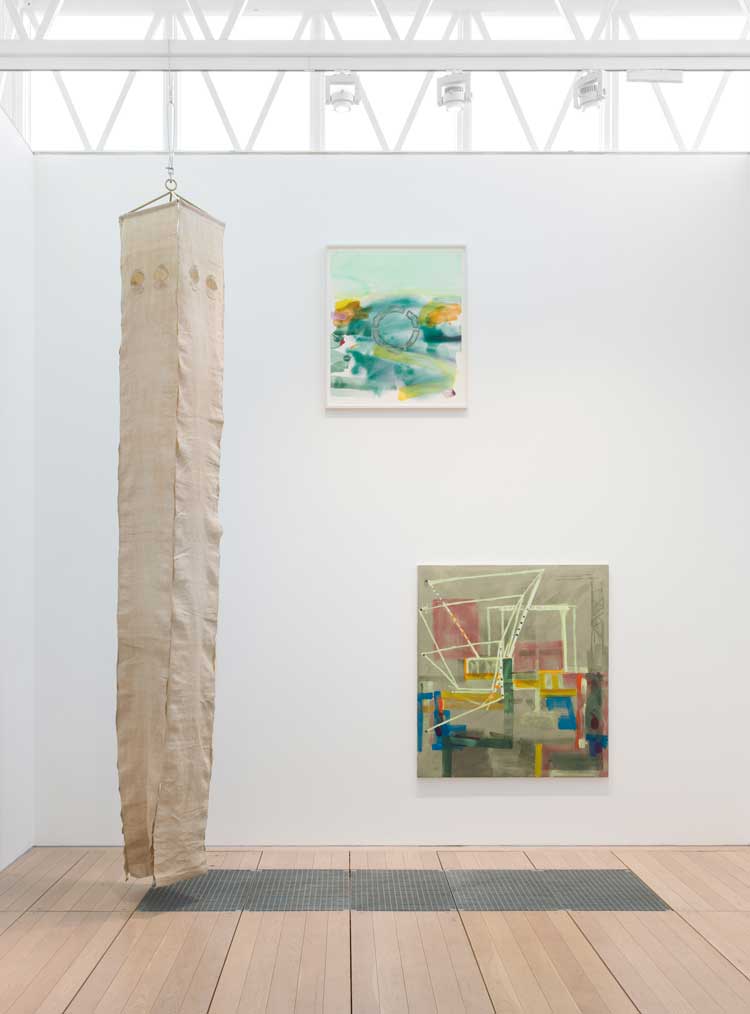
Christina Mackie, Material Reality, installation view, Goldsmiths Centre for Contemporary Art, London, 30 January –19 April 2026. Courtesy Goldsmiths CCA. Photo: Rob Harris.
In the corner, reaching up to this skyline is a rough, linen, cylindrical sculpture, with eyes cut into it at the height of the paintings – suggesting something about the vantage point of the works, of the cranes, of the skyline … Turn around and a video is playing, showing the reality of just this – the view from Mackie’s cabin on Mayne Island, just off the coast of Vancouver. The title Dissolve is appropriate on a number of levels: in the film, the view itself dissolves into the mist, with lights flashing from the cranes; in the paintings, the cranes dissolve into abstraction, reduced to their basic circular and rectangular forms; and in two paintings, which stand out from the rest, two human forms dissolve into the light, barely silhouetted against its ferocity, pigmenting in its biting rays.
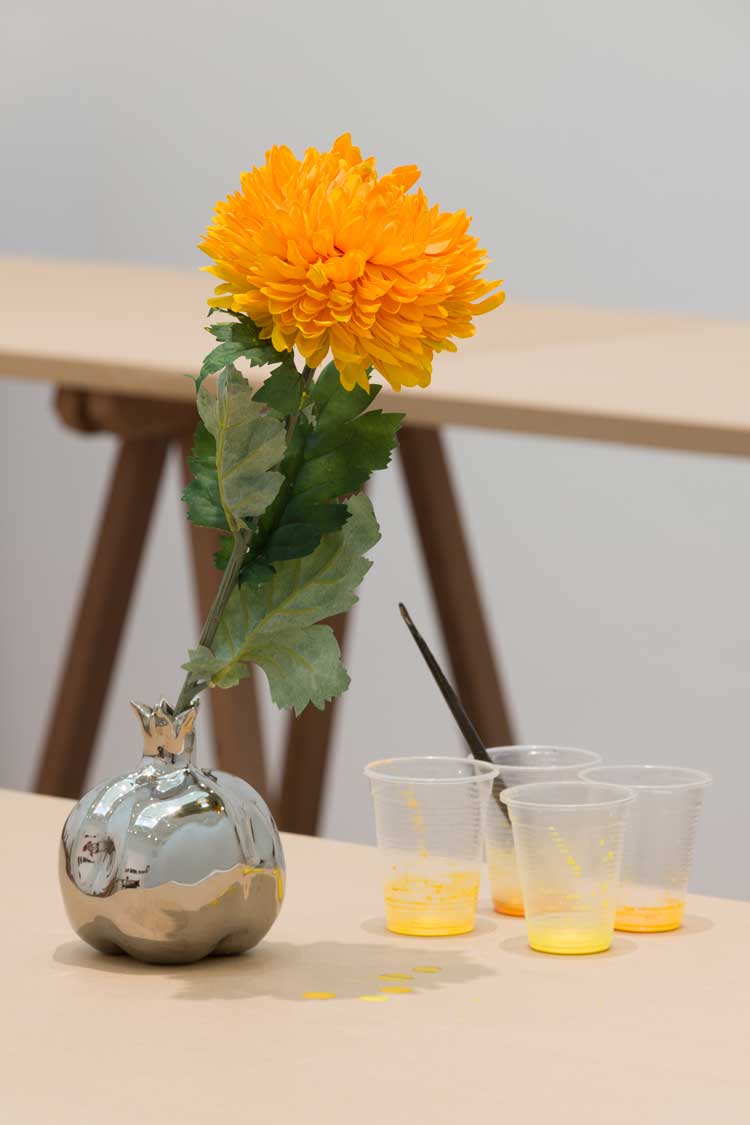
Christina Mackie, Material Reality, installation view, Goldsmiths Centre for Contemporary Art, London, 30 January –19 April 2026. Courtesy Goldsmiths CCA. Photo: Rob Harris.
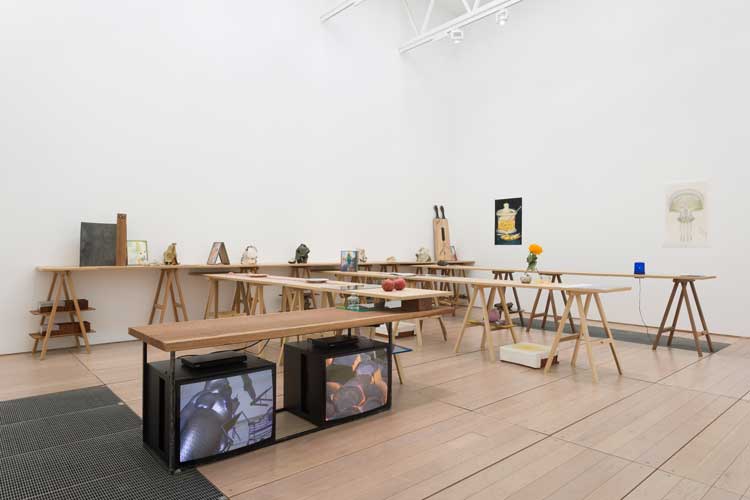
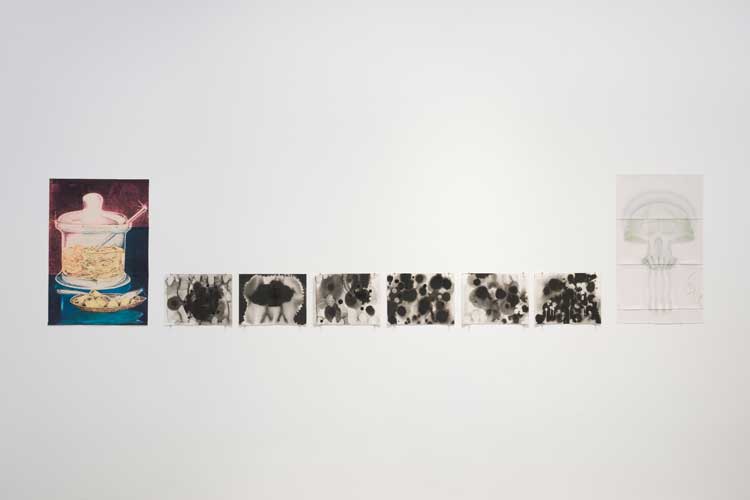
Pigment is important to Mackie, and in the Bridget Riley Gallery, a fabulous paint-drenched plastic marigold “drips” its colour into empty plastic cups beneath its petals. This is one of many disparate yet linked objects in the room’s overall installation, The Judges II (2011), which approximates Mackie’s studio, and which she describes as an “open system” in which “no one reading is dictated”. The installation was loosely inspired by a visit to the lava tubes of an extinct volcano in Australia, and the room also includes scientific illustrations of jellyfish, made up from thousands of tiny dots, which closely resemble the shape of the atomic cloud also pictured. Then there are several abstracted clay objects, which, if looked at closely, morph into human faces, reflecting the phenomenon of pareidolia – seeing faces in things – and echoing those Mackie saw in the petrified folds of magma. A series of Indian ink drawings – splat upon splat upon splat, in a most beautiful manner – are derived from nuclear test images. Everything in this room has been carefully selected and placed, and the wooden trestle tables were made by Mackie’s own hand, too, from tulip, walnut or cedar. Throughout the installation, Mackie pivots between intentional creation and contingency; the inks, clay and pigments have been manipulated rapidly to allow for unforeseen possibilities and to mimic geological forces.
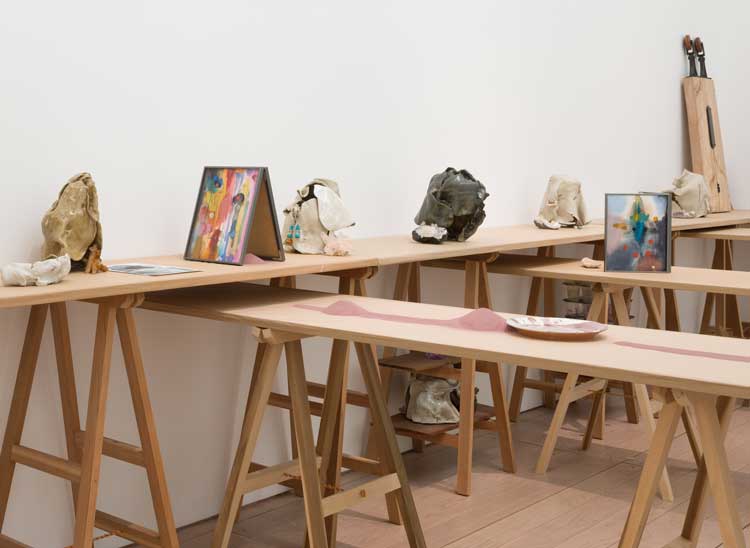
Christina Mackie, Material Reality, installation view, Goldsmiths Centre for Contemporary Art, London, 30 January –19 April 2026. Courtesy Goldsmiths CCA. Photo: Rob Harris.
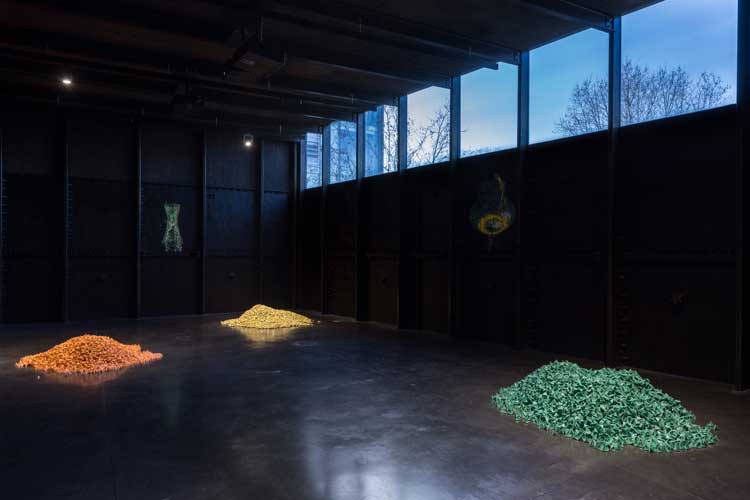
Christina Mackie, Material Reality, installation view, Goldsmiths Centre for Contemporary Art, London, 30 January –19 April 2026. Courtesy Goldsmiths CCA. Photo: Rob Harris.
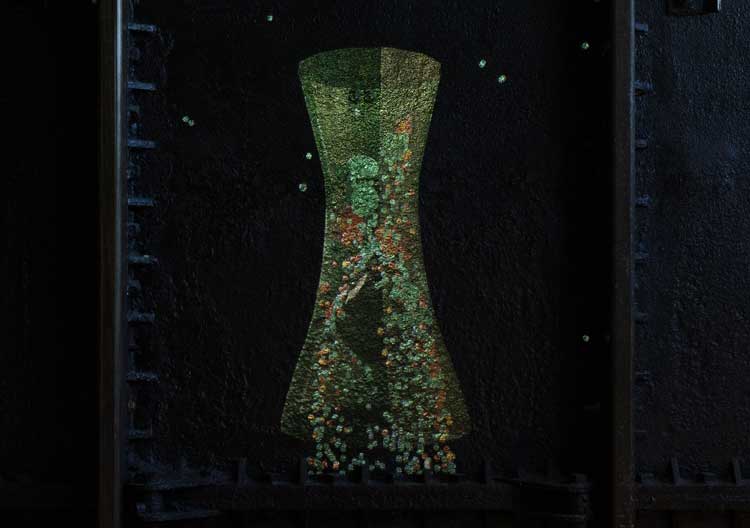
On the farthest trestle are heaps of pink sand from a beach in India, industrially used to cut knives. These are echoed in the final room – the rather fabulous Daskalopolous Tank Gallery – in which coloured materials, looking like Toblerone triangles, are piled up, sorted by colour, on the floor. Edible as they may look, these are, in fact, tumbling media, used for finishing and polishing manufactured parts in a rotating machine. They represent in solid form the particles in the four procedural animations projected on the scarred black walls. This backdrop has the effect of rendering the images ephemeral, twinkling as if made from foil chocolate wrappers. Sand running through a timer, liquid swirling in a flask, a cauldron-like vase with gold pigment being poured in – these animations appear alchemical and gossamer, at once industrial and magical.
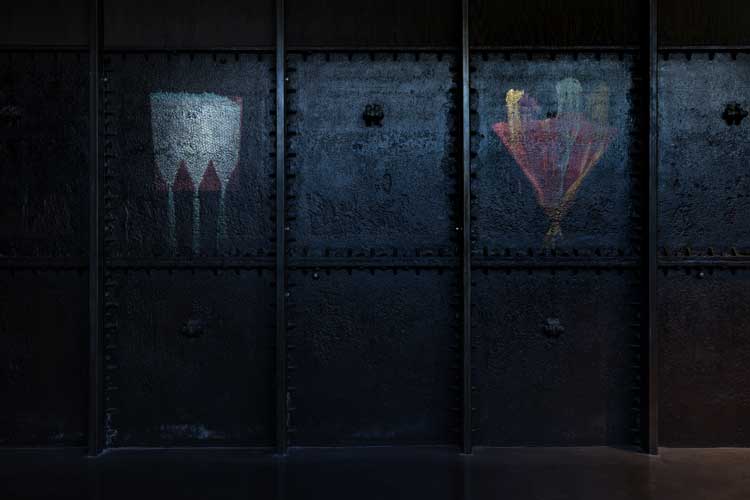
Christina Mackie, Material Reality, installation view, Goldsmiths Centre for Contemporary Art, London, 30 January –19 April 2026. Courtesy Goldsmiths CCA. Photo: Rob Harris.
In all three galleries, Mackie insisted that the blocked windows were opened to let the daylight flood in. This adds another layer of contingency, especially to the visibility of these animations, with light, once again, nibbling round the edges of our vision. Much to my surprise, the animations, titled Powder Dynamics, model the behaviour of people in crowds, squeezing through bottlenecks of transport systems, for example. Mackie intends them to raise questions about the uses of data and its mining, which she suggests leads to a “degradation of democracy”, a breakdown of trust between the state and the individual, and ultimately an “atomised society”. Once again, ideas from one gallery feed into those of another, albeit allowing words to be read for all their various connotations and collocations and associative logic.
Mackie’s exhibition is serious, inasmuch as it raises some serious issues; but, at the same time, it is wildly playful, inviting the visitor to draw parallels and play word games, questioning how they look at and read the world.
Click on the pictures below to enlarge

Copyright © 1893–2026 Studio International Foundation.
The title Studio International is the property of the Studio International Foundation and, together with the content, are bound by copyright. All rights reserved.
 |
 |
 |
|---|
-1000-300.jpg)
 Episode 10: Kara Chin – Concerned Dogs
 Testament
 Mohamed Bourouissa – interview: ‘I see art as a playground’
 Issy Wood: All The Rage
 How Chicago! Imagists 1960s & 70s