



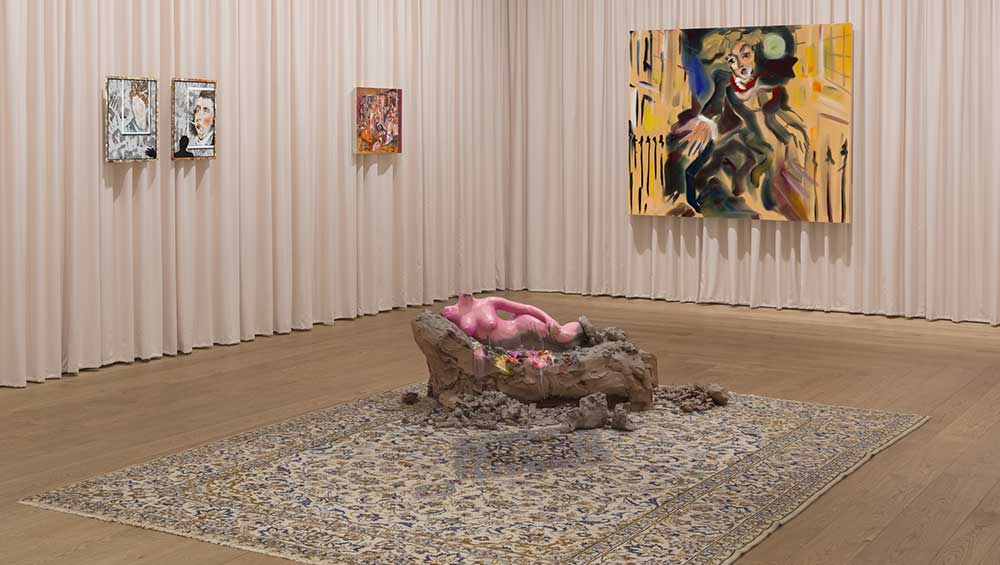
Lord Arthur Savile's Crime, installation view, Sadie Coles HQ, Savile Row, 21 January — 21 March 2026. © The Artist/s. Courtesy the Artist/s and Sadie Coles HQ, London. Photo: Katie Morrison.
Sadie Coles HQ, Savile Row, London
21 January – 21 March 2026
by ROCHELLE ROBERTS
Lord Arthur Savile’s Crime, at Sadie Coles HQ’s new Savile Row gallery, brings together an eclectic mix of artists working across painting, drawing, sculpture and film to reflect on Oscar Wilde’s short story of the same name. Like much of Wilde’s writing, Lord Arthur Savile’s Crime is a satirical tale that critiques and mocks the exuberant upper-class characters, their flimsy morals and selfishness.
Set within Victorian London, one night the titular character meets a palm reader who tells him he is destined to be a murderer. Caught in despair and convinced this destiny will ruin his plans to be married, Authur Savile decides to get on with the job. A series of farcical failed attempts ensue, involving an attempted poisoning and an explosive clock. At the end of his wits, Savile has a chance encounter with the same palm reader and, taking advantage of the situation, pushes him into the river. After hearing in the news of the palm reader’s death, Savile is elated and marries his bride-to-be. It is only at the end of the story that we discover the palm reader was a fraud, suggesting Savile’s murderous ways were of his own doing.
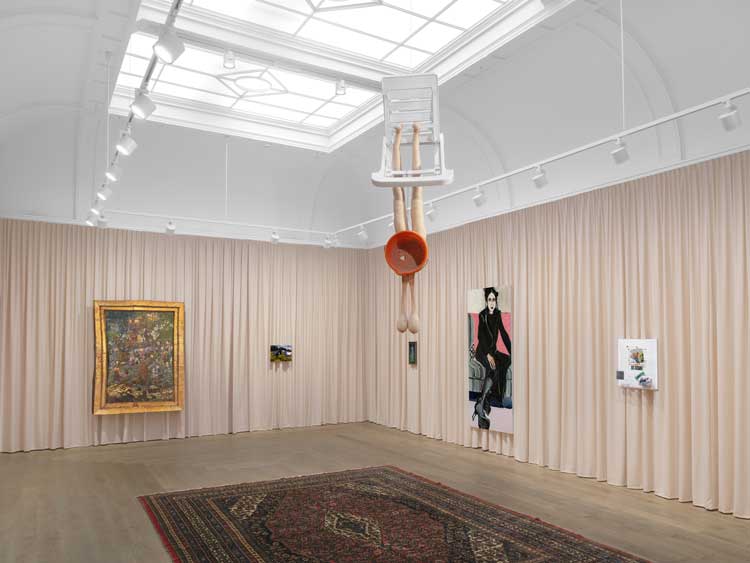
Lord Arthur Savile's Crime, installation view, Sadie Coles HQ, Savile Row, 21 January — 21 March 2026. © The Artist/s. Courtesy the Artist/s and Sadie Coles HQ, London. Photo: Katie Morrison.
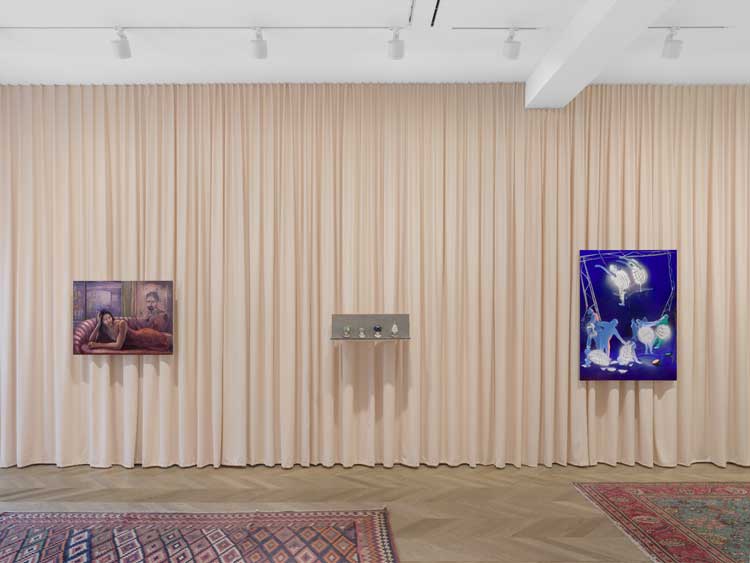
For this exhibition, the gallery space is transformed into an intimate, homely interior that brings to mind the settings for salons and society gatherings, with pale-pink curtains lining the walls and various ornate rugs underfoot. Paintings of varying sizes hang delicately against the curtain backdrop. But what makes this exhibition interesting and exciting is how it also brings in artists who disrupt the space, who shatter the perception of a clean and tidy, serious and well-presented interior, and by extension, person. This is seen most evidently in Urs Fischer’s sculpture 4 1/2 1AP (2014). A woman’s naked pink body reclines on what could be described as a chaise lounge made of clay. The brown clay is smeared across her stomach and legs, chunks strewn on the carpet beneath, muddying it. While Wilde’s upper-class characters try to adhere to a presentability that comes with a certain level of social standing, Fischer’s sculpture, in the context of this exhibition, shatters this perception, revealing the monstrous underside that Wilde himself alludes to.
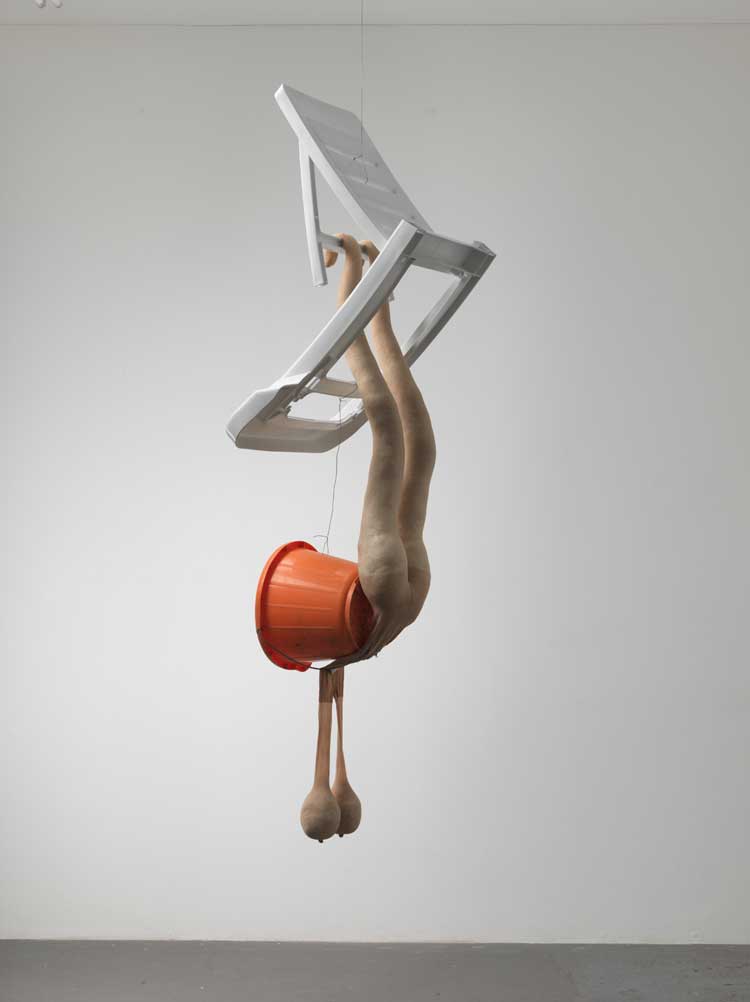
Sarah Lucas, Loungers #1, 2011. Tights, fluff, plastic bucket (orange), plastic lounger, 186 x 62.5 x 55.5 cm (73 ¼ x 24 ⅝ x 21 ⅞ in). © Sarah Lucas. Courtesy Sadie Coles HQ, London.
Another fantastic work included in the show is Sarah Lucas’s Loungers #1 (2011). Stuffed flesh-coloured tights in the vague shape of a person hang by the legs from a white plastic sun lounger suspended from the ceiling. Gravity causes the comically elongated breasts to hang low, dangling above the heads of visitors. Lucas’s work is exaggerated and over the top. It is a perfect match for Wilde’s humour and posits a kind of farcical excessiveness.
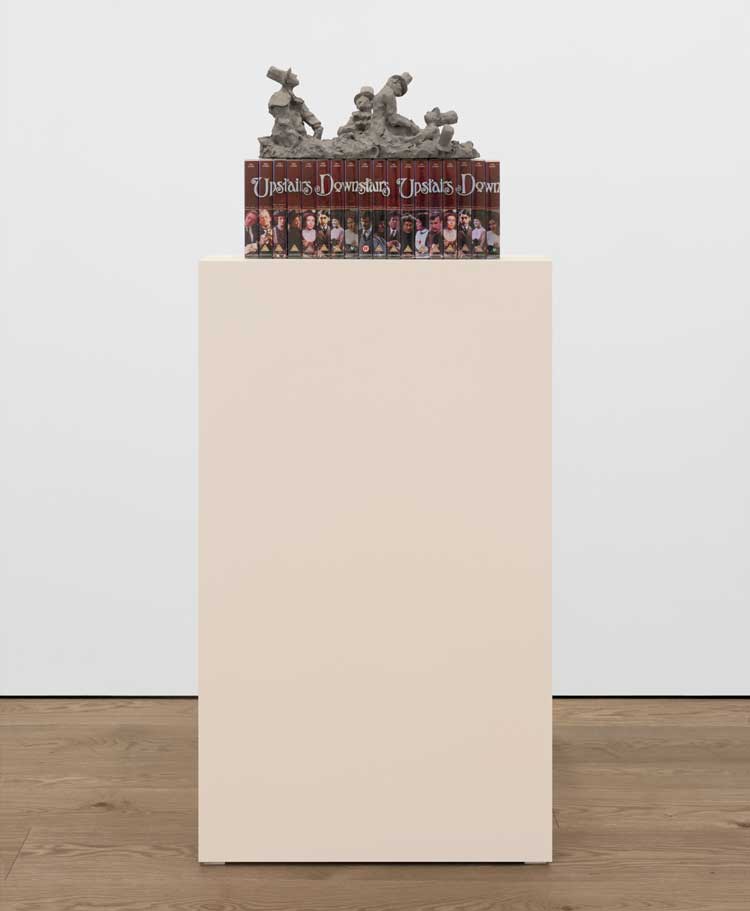
Nicole Wermers, A Gay Crime, 2025. Reinforced air dry clay, VHS tapes and covers, overall 41 x 54 x 23 cm (16 ⅛ x 21 ¼ x 9 in), clay sculpture: 20 x 48 x 23 cm (7 ⅞ x 18 ⅞ x 9 in), VHS tapes: 21 x 54 x 12 cm (8 ¼ x 21 ¼ x 4 ¾ in). © Nicole Wermers. Courtesy the Artist and Sadie Coles HQ, London. Photo: Katie Morrison.
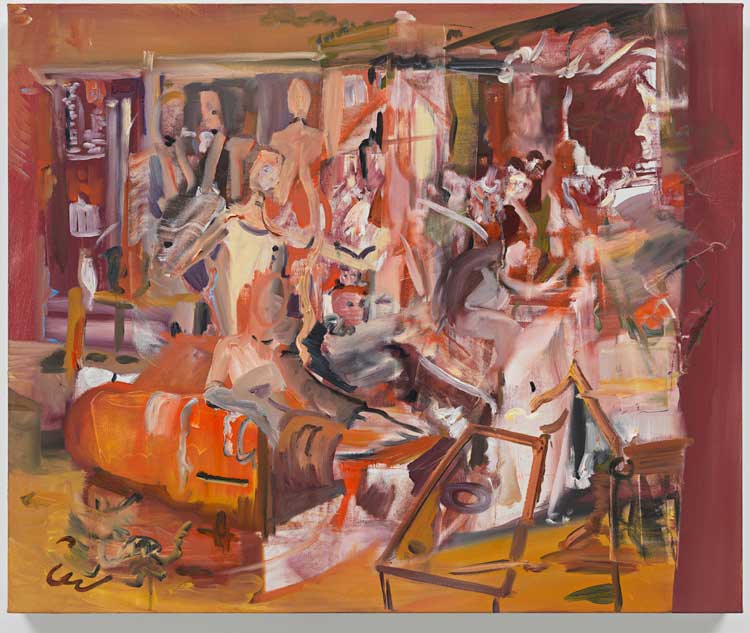
Given the show was inspired by and named after Wilde’s story, it makes sense that there are a fair few works that seem to be direct responses to the story. These include: Nicole Wermers’s A Gay Crime (2025), showing clay figures of upper-class men in top hats lounging on the complete video set of Upstairs Downstairs, a TV series that interrogated the disparity between the upper and lower classes; Jonathan Lyndon Chase’s two works Life, Love and Death Psychic Map of Palms and Psychic Energy and Lifeline Energy Blossoming (both 2025), which incorporate symbols such as a heart, skull, flowers, hands and eyes to explore the theme of divination and destiny through chiromancy; and Ambera Wellmann’s The Pure Present (2025), showing a man having his palms read by a skeleton while what could be his would-be victims are gathered in the background.
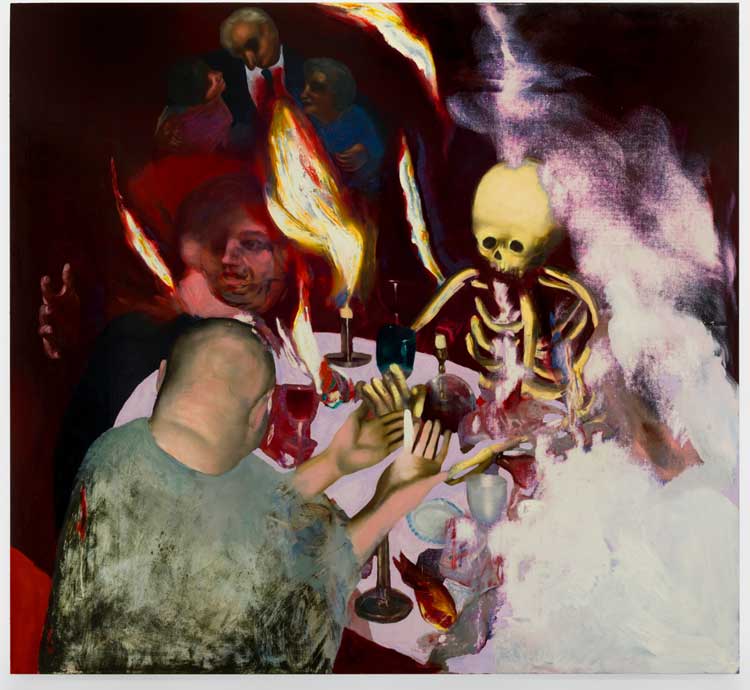
Ambera Wellmann, The Pure Present, 2025. Oil on canvas, 147.3 x 160 x 3.2 cm (58 x 63 x 1 ¼ in). © Ambera Wellmann. Courtesy the Artist and Sadie Coles HQ, London. Photo: Katie Morrison.
Other works seem to be included because of their affinity to Wilde and his story, rather than direct interpretations of it. Paul Noble’s drawing I (2015), although not created with Wilde in mind, uses similar surrealist imagery, including an open hand instead of a doorknob, an eye staring through the peephole of the door and a pendulum clock (Arthur Savile attempts to murder the Dean of Chichester with an explosive clock). Elizabeth Peyton’s beautiful painting Oscar and Bosie (1998) appears to be included simply for being a depiction of Wilde with his lover, while paintings by Somaya Critchlow and Gillian Carnegie (positioned on the landing and the stairwell of the gallery, respectively) offer quietly intense interior reflections that feel slightly menacing. Carnegie’s painting, in particular, which shows a view of a staircase with a black cat sitting on one of the steps, is quite unsettling, especially as it is hung beside another painting of a cat with its entrails spilling out over the bloody floor.
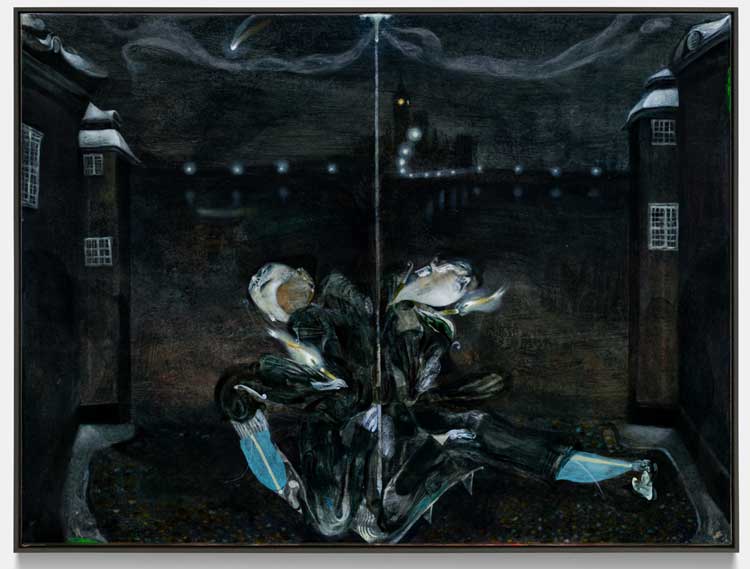
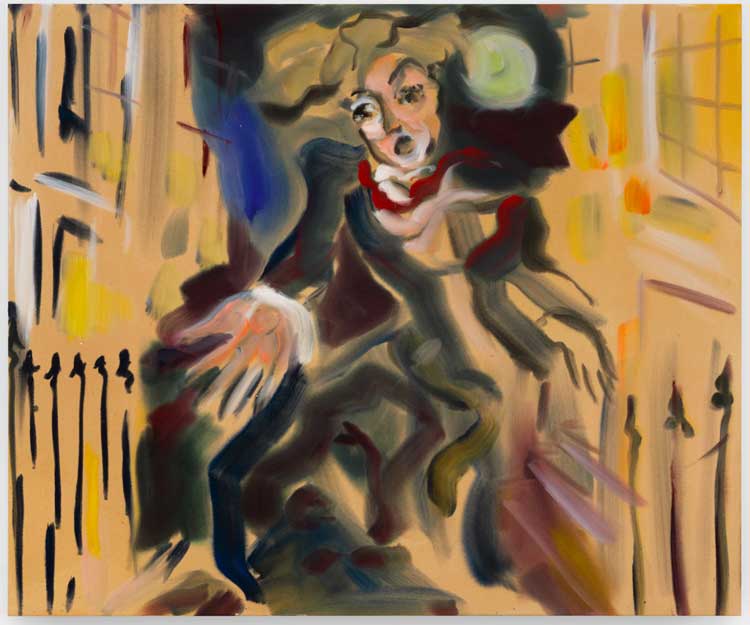
Guglielmo Castelli, The Expectation of Guilt, 2025. Oil on canvas, site size: 60 x 80 cm (23 ⅝ x 31 ½ in), frame size: 62 x 82 x 7 cm (24 ⅜ x 32 ¼ x 2 ¾ in). © Guglielmo Castelli. Courtesy the Artist and Sylvia Kouvali, London / Piraeus. Photo: Nicola Morittu.
Another work that explores the darker side of the story is Guglielmo Castelli’s The Expectation of Guilt (2025), a moody painting in blacks and greys that mirror-images two figures seeming to be different sides of the same coin. They lean away from each other in strange and contorted positions (writhing in guilt?) against the backdrop of city buildings across a dark and murky river. Critchlow’s painting also brings up the theme of the double image – a naked woman looking at her reflection in a mirror – which speaks to the idea of the true self exposed from beneath the veneer of pretence in Wilde’s story.
Lord Arthur Savile’s Crime is an exhibition that successfully and playfully explores the complexities of persona and performance, while also drawing a nice parallel with the roots of the building housing Sadie Coles’ new gallery which was built as an arts club in 1870, 17 years before the publication of Wilde’s story.
Click on the pictures below to enlarge

Copyright © 1893–2026 Studio International Foundation.
The title Studio International is the property of the Studio International Foundation and, together with the content, are bound by copyright. All rights reserved.
 |
 |
 |
|---|

-300.jpg)
-300.jpg)
 Aubrey Beardsley
 Queer British Art 1861-1967
 Inside: Artists and Writers in Reading Prison
 Ryan Sullivan: ~ / –
 Maggi Hambling: ‘Some paintings you’ve just got to cut up. There’s enough bad art in the world’