




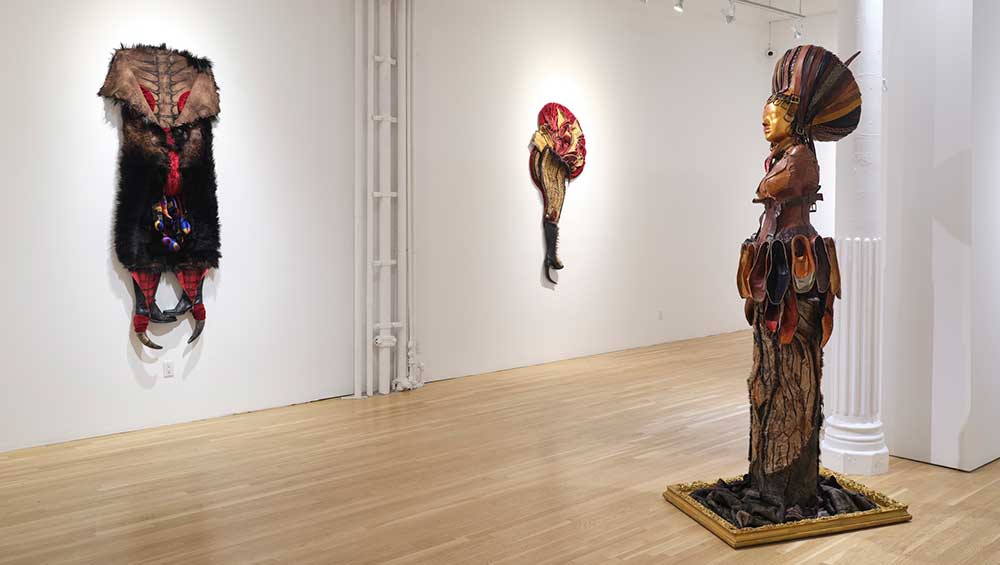
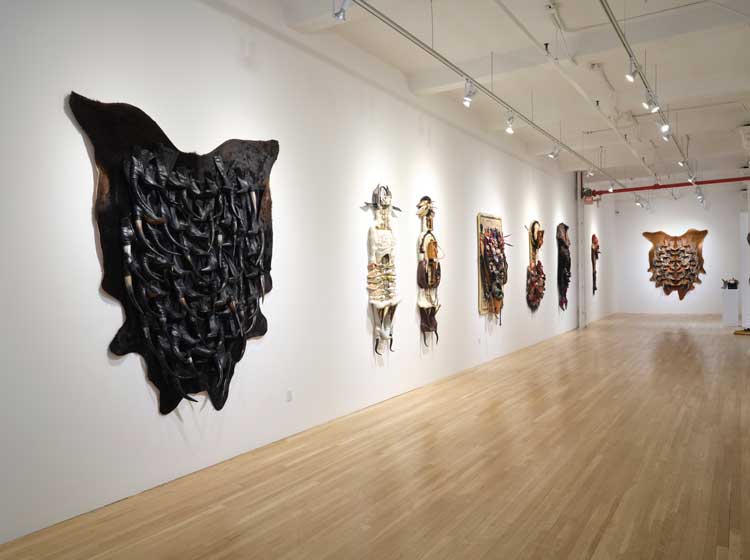
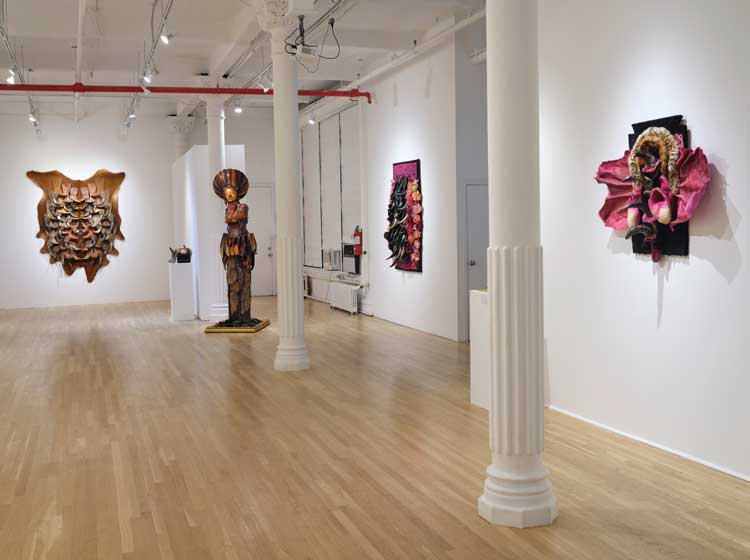
Anindita Dutta: The Shadows of Duality, installation view, The Sylvia Wald and Po Kim Gallery, New York, 15 October –19 December 2025. Photo: Martin Seck
The Sylvia Wald and Po Kim Gallery, New York
15 October –19 December 2025
by LILLY WEI
Anindita Dutta (b1973 born in what is now Dhanbad in the state of Jharkand, India), a sculptor, installation and performance artist based in New York and New Haven, is best known for working with clay as well as for a maximalist, razzle-dazzle approach to materials and craft. Recently, she radically shifted gears – at least in her choice of materials – as is evident in her latest solo exhibition, The Shadows of Duality.
The approximately two dozen impressively scaled works on view, made during the last two years, are ingeniously conceived constructions cobbled together from a hotchpotch of shoes, purses, animal hides, leather coats, fur, horns, belts, rugs, fabrics – all previously used, a word she pointedly includes in all her wall labels. (Her studio in New Haven at the not-for-profit community arts hub NXTHVN, where she is in residency, is overflowing with her scavenged acquisitions, stuffed into drawers and on to shelves, tables, piled on the floor and binned in stacks of containers – a recycler’s paradise). Flanking the viewer, they are mounted along the facing walls of the gallery like a ritual procession. One is freestanding, Abhay (Fearless) (2024), an imposing 7ft- (2.1 metre-) tall golden female figure sheathed in leather, adorned with belt buckles, crowned with a bulbous headdress, cinched at the waist by what turns out to be shoes that have been turned inside out.
.jpg "Anindita Dutta, Abhay (Fearless), 2024, installation view, Anindita Dutta: The Shadows of Duality, The Sylvia Wald and Po Kim Gallery, New York, 15 October –19 December 2025. Photo: Martin Seck")
Anindita Dutta, Abhay (Fearless), 2024, installation view, Anindita Dutta: The Shadows of Duality, The Sylvia Wald and Po Kim Gallery, New York, 15 October –19 December 2025. Photo: Martin Seck
Most, however, are wall reliefs, fashioned from the same trove of materials that have been ripped, cut up and otherwise transformed and reassembled, sharing a disruptive, provocative presence. They might be cult altarpieces, intimations of shaman figures or warrior queens, talismanic objects of protection and succour, and more. Strikingly idiosyncratic, they are persuasive as archetypes – if newly minted – and project a fierceness, regality and strangeness that is somehow curiously reassuring.
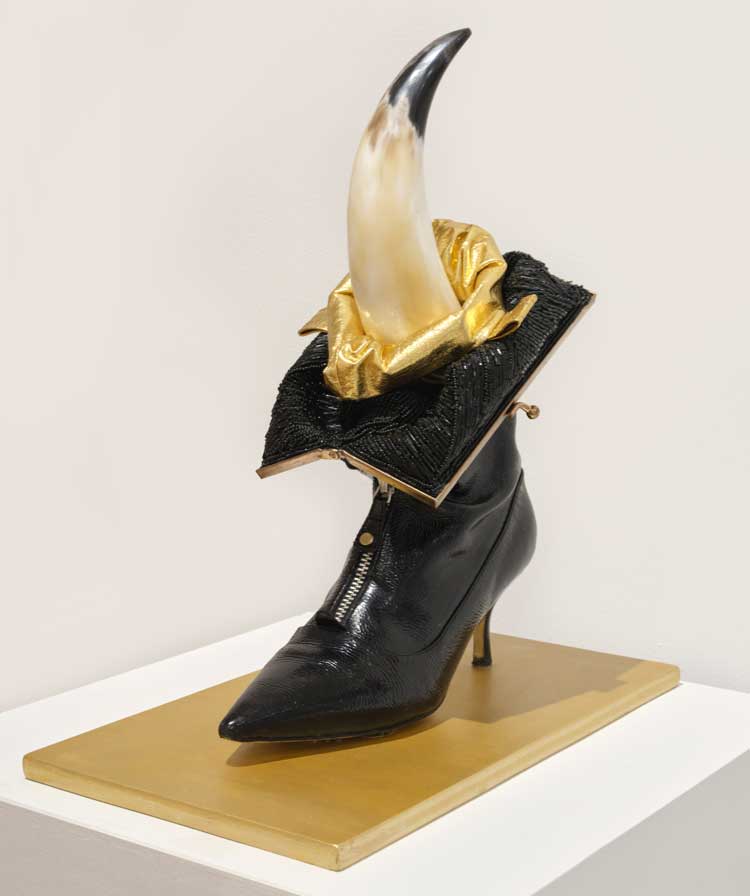
Anindita Dutta, Sex, Sexuality, and Society – AUSTRALIA, 2023, used shoe, used clutch bags, animal horn, 14 ½ x 5 ½ x 10 ½ in. Photo: Martin Seck
Dutta animates by contrasts, by juxtaposing the soft, seductive and embracing with the sharp and the threatening, as well as by a process that searches for revelations that are not entirely possible, more conjecture than otherwise, reflecting the conditions of our existence. Her impulse to pair opposites is driven by a desire to offer a more complete, a truer picture. Chiaroscuro, which she wields as a metaphor, is one significant factor in her works’ visual bravura, her sense of the theatrical a natural outgrowth of the performative side of her practice, a video in the show, Too Much With Us, documenting a recent project. These works might also be seen as a continuation or a paralleling of her performances, echoing the visual stylisations and conventions that characterise centuries-old dramatic disciplines such as the Peking Opera, Kabuki, Noh, Kathakali, or commedia dell’arte, with their set roles and repertoire, derived from folk and religious traditions. And, as integral to the casting, they are scene-stealers, the mundane, even comic, twisted into something more profound.
Dutta addresses the feminine and feminism in these works as she has elsewhere. If you’re an artist who is deeply engaged in representing women’s lives, it seems logical, if also toying with cliches, to focus on shoes and handbags, arguably among the most gendered of objects. Freud (in)famously asked: what do women want? And while he never found the answer, some might say they want shoes and handbags – think of the six-figure price asked for certain Hermès Birkins. Dutta, however, is more interested in how these objects are surrogates for their vanished owners and lost stories, in personal traces. Her more considered acts of reclamation and repurposing of materials is commendable, since more than a few artists of environmentally themed works are not recycling used materials for their work but ordering them new, and, even more ironic (and shameful), when deinstalling the project, have not made provisions to dispose of them properly, adding to the problem of overconsumption and waste.
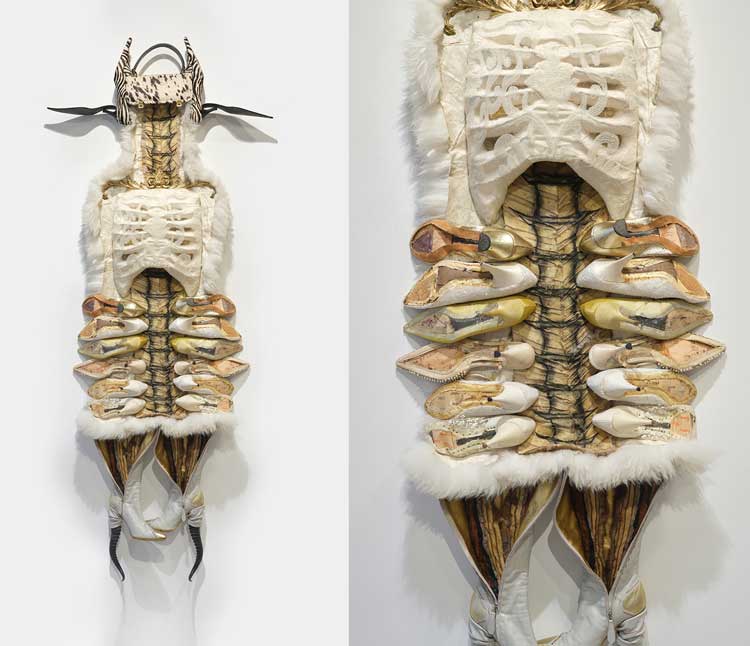
Anindita Dutta, Garden of Ripped Shoes - 01, 2025, used shoes, animal horn, purse, animal hide, hand stitched rib cage, used leather coat, 81 x 33 x 7 in. Photo: Martin Seck
Two of the exhibition’s most uncanny, ominous sculptures are from a series called Garden of Ripped Shoes, both 2025, hung side by side, one pale, the other dark, ribcages showing, to be approached warily, as all totemic figures should be. Another, Botswana, is from the Sex, Sexuality and Society series (2023) – there are others from the same series here – a blackened animal hide spread out to resemble a cape or perhaps a (vague) approximation of the country’s outlines. The surface is networked by gleaming black horns, again radiating a kind of supernatural charm, the components alchemised.
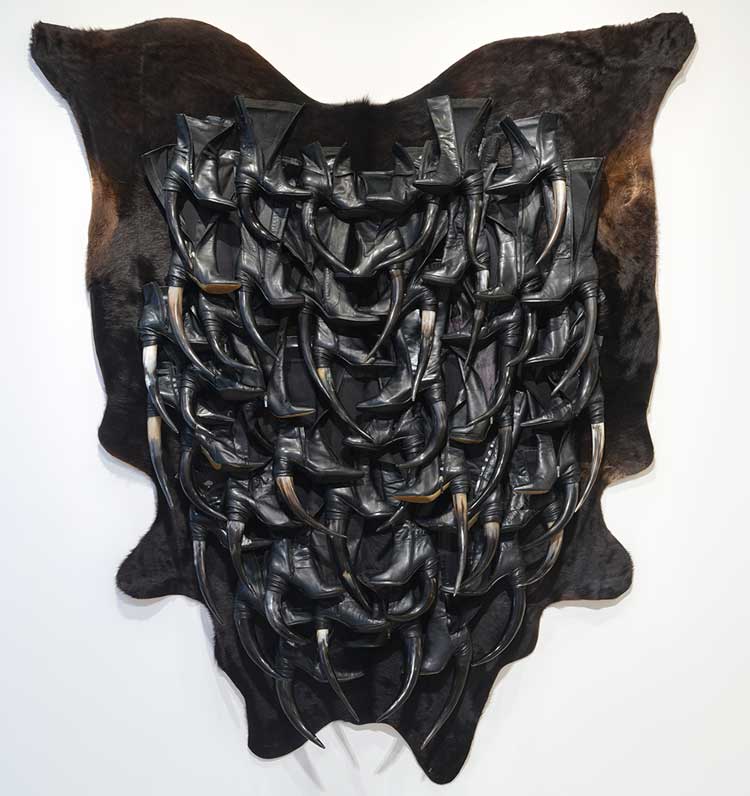
Anindita Dutta, Sex,Sexuality and Society - BOTSWANA, 2023, used shoes, animal horn, hide, 91 x 81 x 13 in. Photo: Martin Seck
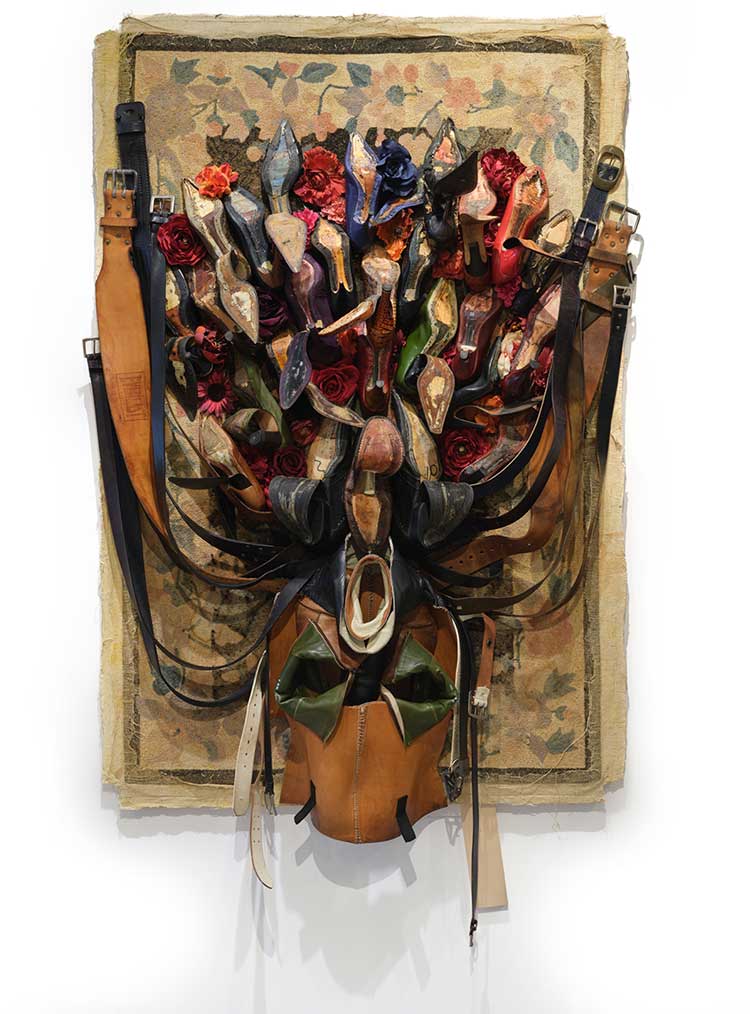
Anindita Dutta, Song Under the Carpet, 2025, carpet, used shoes, belts, artificial flowers, 80 × 49 × 12 in. Photo: Martin Seck
Often, the works are semi-abstract but imply the corporeal, the open purses equivalent to female orifices, or a ritual mask, such as in the Song Under the Carpet (2025), the array of shoes and belts that comprise its imagery particularly elaborate, backed by a carpet. Hall of Open Purses (2024), a cruciform wall relief, suggests a double-edged version of the Madonna della Misericordia, say, at once maternal and a witch, her skirts opened to reveal a kind of fearsome, emasculating vagina dentata, once central to misogynistic cautionary tales.
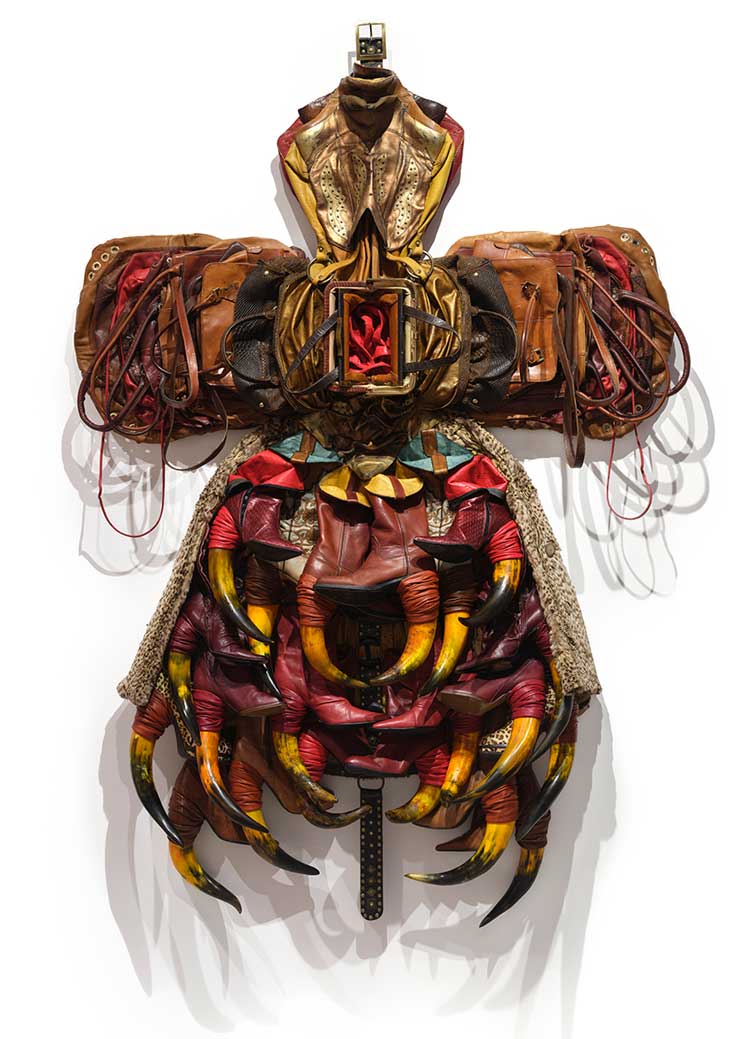
Anindita Dutta, Hall of Opened Purses, 2024, leather belt, bag, boot, fur coat, dyed animal horns and dyed flowers, 79 × 58 × 8 1/2 in. Photo: Martin Seck

Anindita Dutta, Field of flowering bones, 2025, used shoes, used leather coat, human hair, purse, broken frame, artificial flowers, 79 × 39 × 13 in. Photo: Martin Seck
Field of Flowering Bones (2025), composed of two circular forms, the larger at the bottom pulling it downward, is disturbingly fringed by human hair, again suggesting a relic of some kind from an esoteric culture, or something feral, the exact nature of which we might not want to know. Then there is Orchard Within the Hide (2025), made of dark animal hide lined by a soft velvet cloth, the red adding a bright note. It seems comforting, offering sanctuary, shelter, despite the naked spine that runs up the back. Other works are festooned by the addition of dyed flowers that are disarming, but like the animal hides and the shoes, emblems of the vanished, the dead.
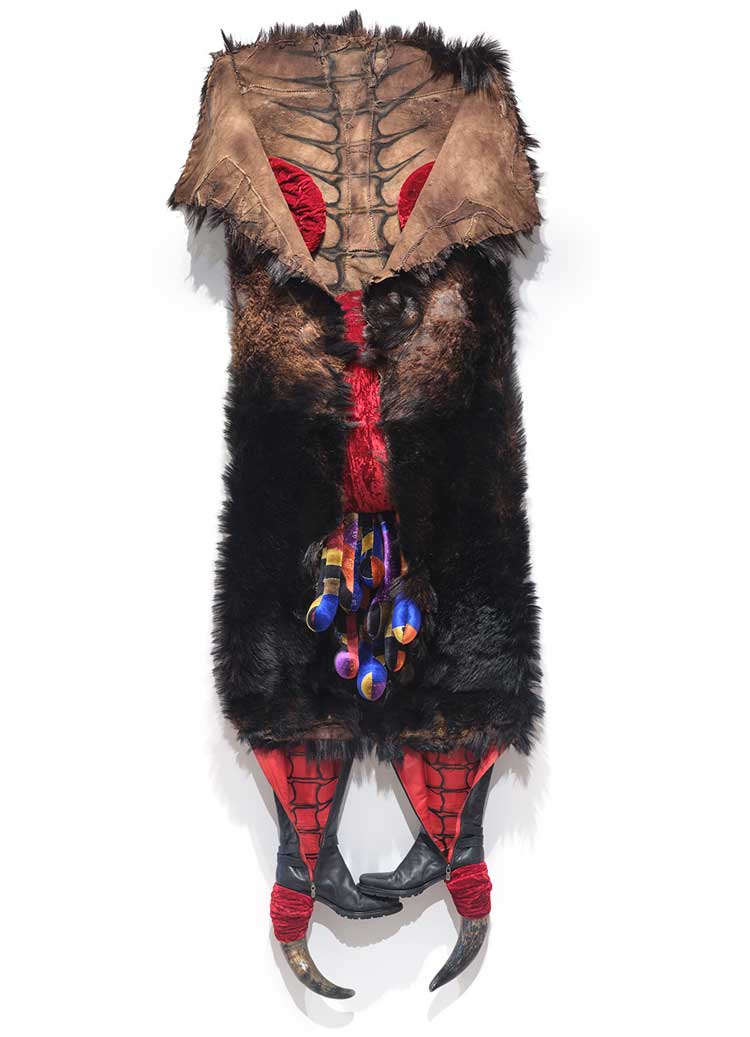
Anindita Dutta, Orchard within the hide, 2025, animal hide, horn, shoe, velvet cloth, 83 × 32 × 12 in. Photo: Martin Seck
In the end, Dutta arrives at an improbable, incantatory dark beauty, reverberant with the residuum of our existence, what we possessed and what we left behind, a nod to the implacability of time. There are no glass slippers here, nor a prince, for that matter.
Click on the pictures below to enlarge

Copyright © 1893–2026 Studio International Foundation.
The title Studio International is the property of the Studio International Foundation and, together with the content, are bound by copyright. All rights reserved.
 |
 |
 |
|---|




-1000-300.jpg)


 Intersection: International Art and Culture
 Anindita Dutta: MAYA
 Earthy Transitions: India Art Fair 2014
 Luis Camnitzer
 Reality Check. Two Performances by Anindita Dutta at Fukuoka Asian Art Museum, Kyushu, Japan