




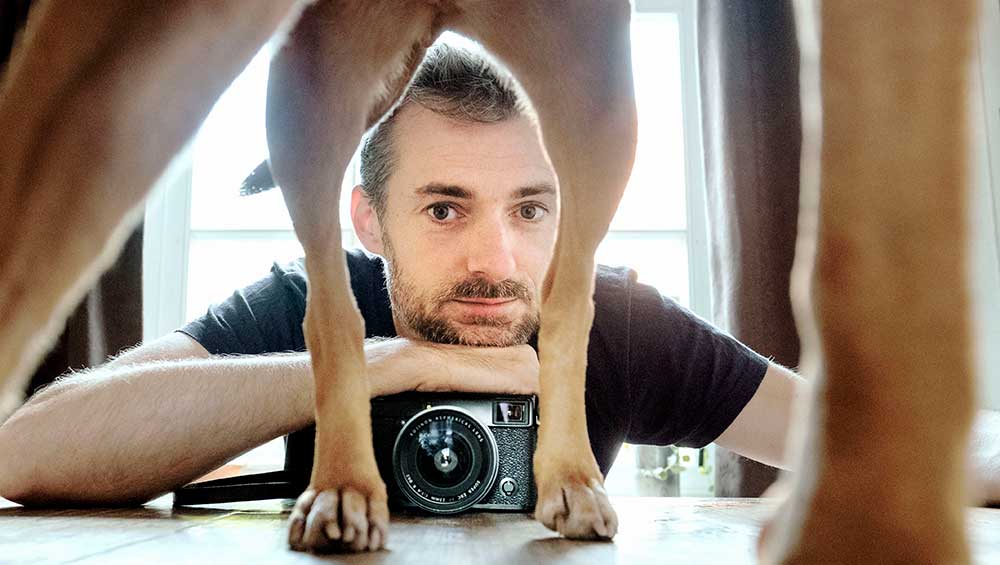
Merlin Daleman.
by SABINE CASPARIE
When I first saw photographs from Merlin Daleman’s photo book Mutiny (2025) in the Guardian, I was struck not only by the book’s topic – northern England post-Brexit – but also by the photographs’ artistic qualities, their composition and lighting, reminding me of Dutch old master paintings. Daleman was born in the UK but has spent most of his life in the Netherlands, where he moved, aged five, with his Dutch mother. Having made the opposite journey, I was interested in Daleman’s take on British life through the – literal and symbolical – lens of an outsider.
“I was very surprised by the Brexit vote, as many of us were,” Daleman tells me over Zoom. “Nobody I know had voted for Brexit, so I asked myself the question: ‘Who are the 52%?’ (Actually, my sister voted for Brexit, but she kept that very quiet.) I compiled a list of the top 15 councils that had the highest Brexit vote and, by coincidence, at least 12 of them were also the most impoverished areas in the UK.” Daleman decided to visit these places, resulting in the photo book Mutiny, published in August.
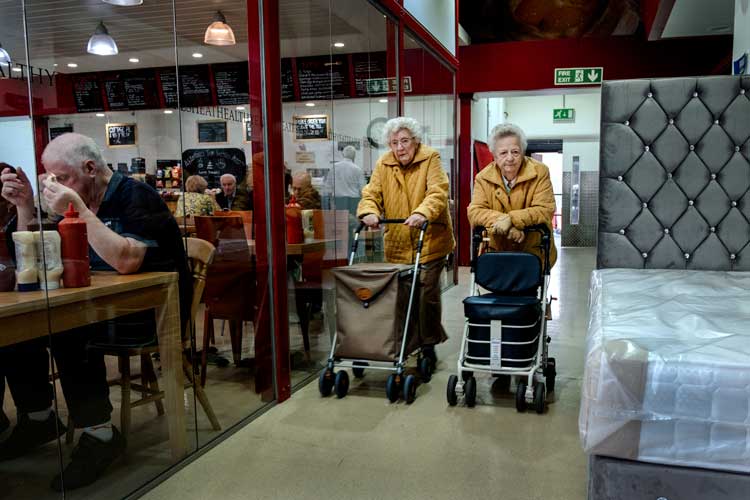
Two ladies stand in a shopping centre in Romford, June 2018. "69.7% voted for Brexit in the London borough of Havering, England." – Merlin Daleman.
Daleman was born in 1977 in Birmingham and studied at South Devon College, Torquay, the University of Central England (now Birmingham City University) in the UK, and at the Royal College of Art in The Hague, the Netherlands. He works as a freelance documentary photographer for leading Dutch publications, including NRC Handelsblad, Dagblad Trouw, Financieel Dagblad and De Groene Amsterdammer. He is the recipient of awards including the Silver Camera awards for Documentary Photography in the Netherlands in 2008 and 2010.
Daleman talked to Studio International over Zoom.
Sabine Casparie: Can you tell me how your photo book Mutiny took shape?
Merlin Daleman: I made three trips to the UK, in 2017, but I soon realised it would be very costly, so I got in contact with someone at NRC Handelsblad, who commissioned me to collaborate with a journalist from NRC on Brexit-related stories. This meant I could finance my further trips. Through interviews, I found out that the vote for Brexit had more to do with a north-south divide, and that it was part of a larger socioeconomic downfall, which probably started in the early 80s with Margaret Thatcher. I interviewed Philip McCann, professor and chair of urban and regional economics at Alliance Manchester Business School. McCann uses the term the “economic north” to describe the north-south divide, which I found very interesting. Many things fell into place: I realised that I was taking pictures of the economic north. All the power went to London, but they were making policies that didn’t have any effect on the north. Brexit was just one element in the larger scheme of things. That’s when the whole puzzle came together.
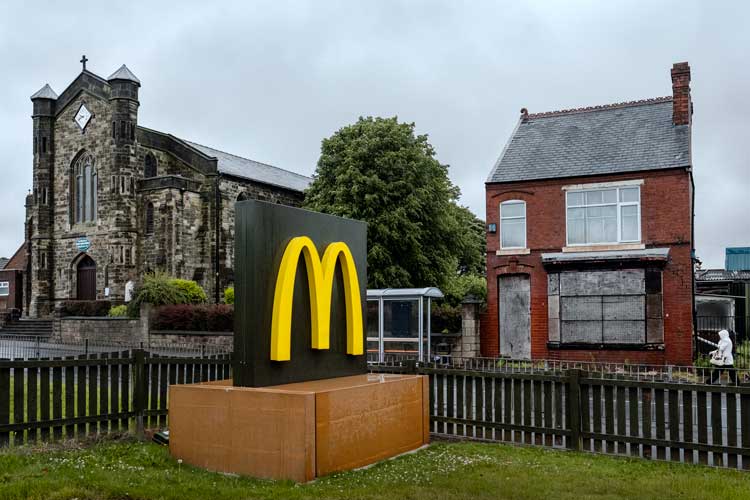
Merlin Daleman. A boarded-up house and a church behind a McDonald’s sign, Dudley, October 2017.
SC: How was it exploring the UK when you no longer lived there?
MD: It is a strange combination, like an inside/outside look. In the Netherlands, if you go away for a few years and come back, you notice new buildings, new roads, but in England everything stays the same. I could visually witness the not-progressing there, much more easily than my sister who still lives in the UK.
SC: Do you think anything has changed following Boris Johnson’s “levelling-up” policies that were part of the 2019 Conservative party manifesto?
MD: No, the same lines are continuing. Keir Starmer tries, but it is still problematic. London’s economy as a whole is bigger than the largest 14 UK councils combined. The rest of the country is getting poorer and poorer, and getting fewer opportunities, but also less ability to govern themselves.
SC: What is the Netherlands doing differently, in your view?
MD: The Netherlands has a very strong middle layer of government through the 12 provinces, with officials elected by the public. This layer between the government and local councils ensures that national policies and local policies are in line. In England, you have the national government, and then you have the councils, with nothing in between. The result is that the government can’t help all its citizens. The councils are trying to manage with their hands behind their backs.
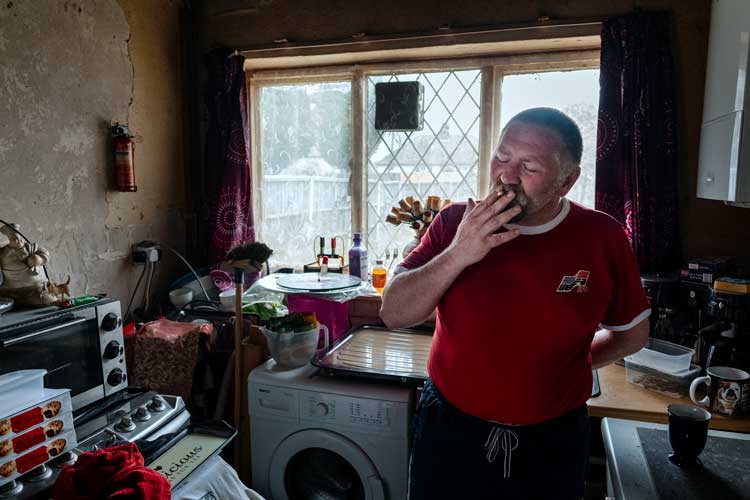
Malcolm at home, Brierley Hill, June 2017. "He has had a difficult life and struggles with mental health issues, but he’s trying to make the best of it. He finds it increasingly hard to be around people and that’s tricky while trying to hold down a job." – Merlin Daleman.
SC: I read somewhere that, during your project Mutiny, you had a conversation with a homeless man, who bought you a cup of tea.
MD: The person you are referring to is Malcolm. He was a friend of a customer of a food bank we visited. He had ADHD and was sensitive to stimuli from outside, and working was hard for him. During his work breaks he would go to the forest to feed the ducks. As he got older, life got harder: he was about to lose his home. But he still invited me back to his place, made tea, and shared his last Kipling cakes with me. I spent half a day with him.
SC: In general, how do you make the people you photograph feel comfortable?
MD: I have my opinions and ideas, but I do tend to approach people open-mindedly. I am curious by nature. When I roam the streets, I never hide that I am a photographer, and that is usually a nice opener: they see me with a camera, ask me what I am doing and, before I know it, we are talking, and when it’s raining, they will invite me into their homes. We also go to community centres, where it’s easy to talk to people, and tag along when they go out. It turns out that people really like talking about themselves!
SC: I guess it makes them feel heard?
MD: Yes, and they feel taken seriously. To see that you are spending time and energy to talk to them creates a bond.
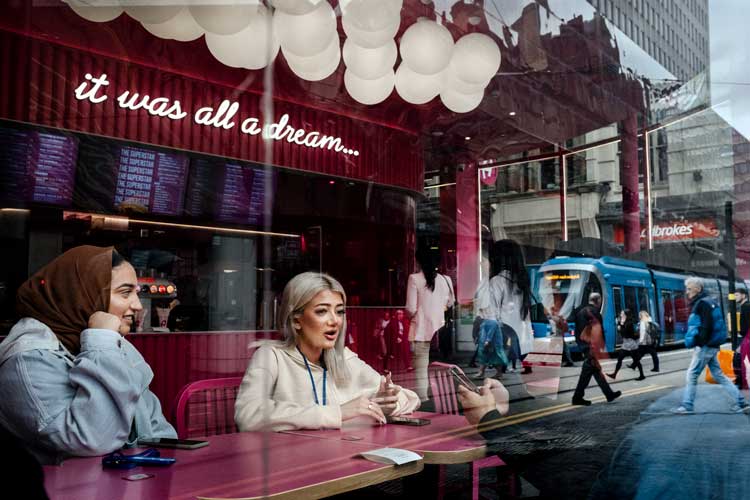
Merlin Daleman. A reflection of in the window of Archie’s Burgers in Birmingham, July 2022.
SC: What strikes me most in your Mutiny series is how great the photographs are compositionally. You often use mirroring, literally through mirrors or glass, but also in more subtle ways, as in the McDonald’s arch mirrored in the arched facade of the church, or the silhouettes of the two covered women mirrored in the balloons around a mannequin. Can you tell me a bit more about your photographic style?
MD: There are two streams of photography I love. One is the old-school documentary photography and reportage style of people like Tony Ray-Jones and Chris Steele-Perkins, and the early work of Martin Parr [who died shortly after this interview took place]. The other is the photography of people like Harry Gruyaert and Alex Webb: very colourful and complex; lots of see-throughs, shadowing and reflections. I feel happiest with a picture when these two elements come together. Sometimes, I only notice it when I have the finished book in my hands! It often happens subconsciously, and to then see it throughout a series is really rewarding.
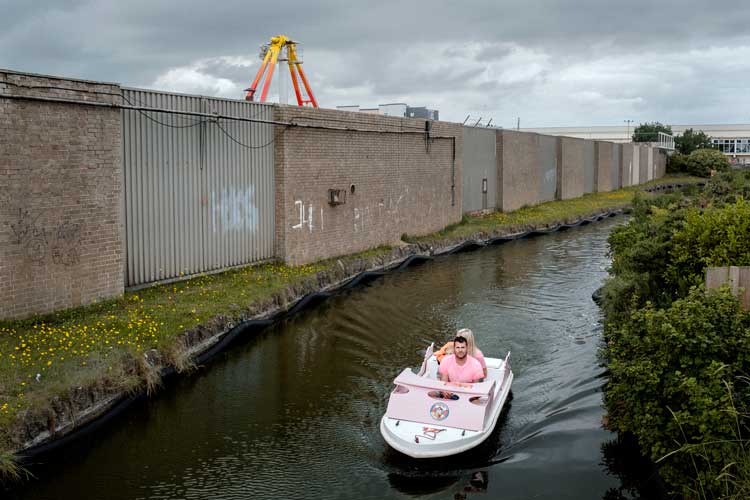
A couple in a pleasure boat ride along the exterior of Pleasure Beach, Skegness, July 2019. "I found it remarkable that someone would pay money to sit in a boat that goes along a ride with no view." – Merlin Daleman.
SC: Your image of the boat ride near Skegness Pleasure Beach has really captured critics. Why do you think that is?
MD: It captures the story of the book in one image. The positivity of the people in the boat, dressed in pink, having a nice day together, but then you look at what they are seeing: a wall with broken drainpipes and graffiti on it!
SC: This brings me back to Parr. You mentioned his early work as influential. What is it about his early work that attracts you?
MD: Sometimes I hear people say about my work, “It’s quite Parr-esque”, but I think they are referring to his earlier, black-and-white photographs. I think that in terms of composition and documentation, Parr’s work is most interesting up until his photobook The Last Resort (1986). Like Parr, I also try to get a bit of humour in.
SC: Yes! I was going to ask you about that!
MD: Well, I am British … humour is everything! It is such an important part of life. I am from the Black Country, and our humour is dark. Visually it draws people into the backstory: a bit of humour and darkness triggers people, and then hopefully they will think about the bigger context. I am not taking the piss, though! That is important. It is very easy to overstep the line and make fun of people.
SC: Yes, Parr has been accused of that.
MD: Making the book, I was really happy to work with Stuart Smith [founder and director of the book’s publisher, Gost Books], to make that fine line into a clear, big line. There are no images that I have doubts about. Well, maybe there is one that is quite sensitive …
SC: Would you mind sharing which one that is?
MD: [laughs] Well, maybe you can pick up on it? The guy behind the slot machine, who parked his kid in a stroller. His whole demeanour is depressing, and the setting raises so many questions. This is, of course, partly the result of the neglect of our government over such a long time.
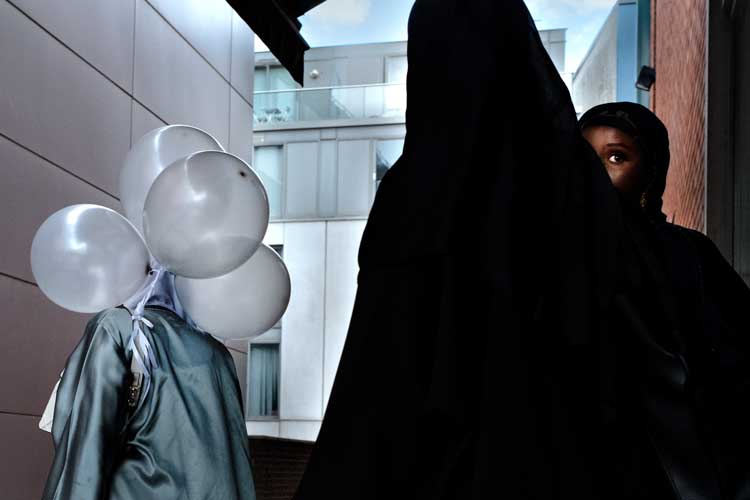
Mailbox, Birmingham, July 2024. "I spotted the young ladies walking into a coffee shop, hoping to catch them on their way out, when the girl on the left looked over in my direction." – Merlin Daleman.
SC: Do the people you photographed know their photo has ended up in a book?
MD: Many people I photographed on the street were not that interested in photography per se, but they were, of course, aware that I was taking their photograph and they didn’t mind. I have been to so many places – about 60 – so it’s hard to track down everyone!
SC: Would you like these photographs to be exhibited somewhere?
MD: There was a big exhibition at the Kunsthal in Rotterdam [My Brexit 52/48 was shown from 19 September 2020 until 14 February 2021]. That was really nice, as they hadn’t had a documentary photography exhibition for a while. There were about 20 big prints, and we had three whole walls plastered with pictures, 4x5 metre prints.
SC: Is there anyone in the UK who you wish could see your book?
MD: Londoners! You would be surprised how many people in London don’t know their own country that well. Also – and this is a long shot – I wouldn’t mind people in the government seeing it. I am curious about what they would think of it.
SC: I remember talking to another photographer, Mark Neville, about the complex realm of documentary photography. The work raises important issues, but that can sometimes make it harder to commercialise it. It is always a balancing act, as artists do need to make a living.
MD: [laughs] It’s a poor existence! But it is a choice. There is often a divide between art shown in galleries and the broader space of image-making. My work has never been on the gallery-side of things, although it would be interesting to see how people would look at my photographs if they were shown in a gallery.
SC: Can you talk some more about two other projects you worked on: documenting the black lung epidemic in Kentucky, US, and labour migration in Ukraine? Were these similar to Mutiny?
MD: They are all human-interest stories, and they all involve people who are not outspoken about the issues they face. I wanted it to be personal, so I befriended one mine worker in Kentucky, whom I visited and followed around on three different occasions. Unfortunately, he passed away before the project could turn into a book. That project was different from Mutiny in that I covered the story of one person against the backdrop of a bigger theme, whereas in Mutiny I photographed many people, and it felt more like gathering evidence.
SC: Living in the Netherlands, what is your view on the Dutch? The Dutch are very direct, which most people know, but there is also a more subtle trait, the thinking in boxes. Traditionally, the Netherlands has been very compartmentalised: it used to be what church you go to and which TV channel you subscribe to, and now it’s things like what newspaper you read, which university you attended. How do you see that?
MD: Yes, all of that is true! I am married to an Italian, so that makes for an interesting mix, and another view on things. And although the Dutch are open, they can also be a bit “achterbaks” [a great Dutch word, something in between hypocritical and manipulative]. If you are open, be open and don’t go and stab somebody in the back.
SC: When I was a teenager, everyone was saying how tolerant the Dutch were.
MD: Yes, but a lot has changed. Like everywhere, we are seeing the rise of extreme rightwing views. We are at the end of an era, and the beginning of a new era, a digital one. Every era has its political tension.
SC: Do you feel threatened by the digital era?
MD: As a photographer, no – but as a human being, yes. A couple, friends of ours, recently moved to Italy to be cut-off from the world, living a non-digital life. It made me wonder if I am missing something. What worries people, in my opinion, is the fear of the unknown. It was there during the Industrial Revolution, but that fear was more tangible. If an industry was harmful, you could stop it. The digital revolution is different: you can’t just pull the plug and stop it. The scary thing is the loss of control.
SC: I completely agree. What will you be working on next?
MD: I am interested in regional divisions, so I am thinking about doing something in East and West Germany or maybe Flanders and Wallonia. I recently went to that side of Belgium and was struck by how poor certain areas are.
SC: Finally, something I like to ask every artist: what are you reading at the moment?
MD: I am not reading anything right now. Is that bad? I listen to podcasts as I travel often. In fact, I am heading to Paris Photo in 15 minutes.
SC: Enjoy!
MD: Thank you. And thank you for this interview – it is really great to have my project Mutiny highlighted again in the UK.
• Mutiny by Merlin Daleman is published by Gost Books, price £45.
Click on the pictures below to enlarge

Copyright © 1893–2026 Studio International Foundation.
The title Studio International is the property of the Studio International Foundation and, together with the content, are bound by copyright. All rights reserved.
 |
 |
 |
|---|
-300.jpg)
-300.jpg)
 Guy Bourdin at the V&A. Fashion photography as art
 Keith Arnatt: I'm a Real Photographer
 Diane Arbus: Revelations
 Nobuyoshi Araki: Araki: Self, Life, Death