




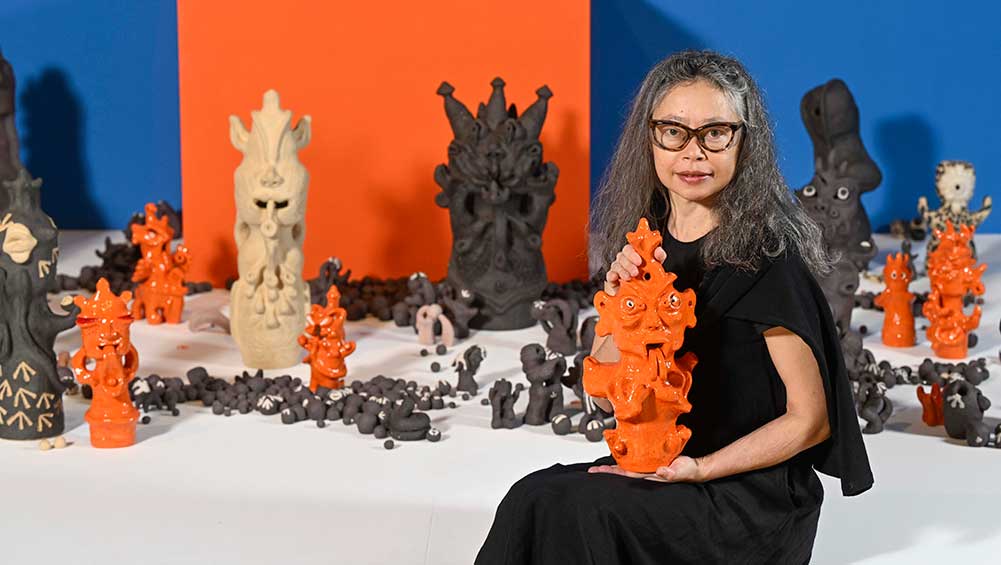
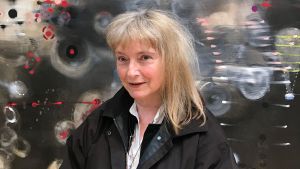
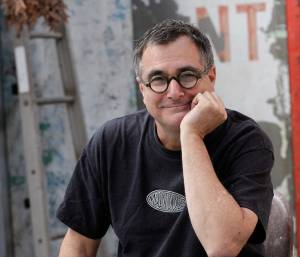
Mai Nguyễn-Long, Talbot Rice Gallery, University of Edinburgh, 2025. Photo: Neil Hanna.
by JANET McKENZIE
Mai Nguyễn-Long was born in 1970 in Tasmania, Australia, to a Vietnamese father and an Australian mother and grew up in Papua New Guinea and the Philippines (1975-88), where her parents were based for 20 years. As an adult, Nguyễn-Long has lived in Australia, China and Vietnam, experiencing the aftermath of the 1955 to 1991 conflicts in Vietnam. As a witness to intergenerational trauma, her practice interrogates the role that culture and the visual arts can play in assuaging the colonising power of trauma. Nguyễn-Long was haunted by the experience of visiting her father’s hometown as a child.
She took Asian studies and art history at the Australian National University, followed by museum studies at the University of Sydney. She studied Chinese language for eight years when she was unable to learn about Vietnamese language and art history – unattainable before the internet and absent from formal syllabuses in Australia. Her mother, the art historian Kerry Nguyễn-Long, was a member of the Oriental Ceramic Society of the Philippines and the Museum Volunteers of the Philippines, and from the late 80s forged meaningful relationships in Vietnam, including with Professor Nguyễn Bích at the Vietnam Fine Arts Museum in Hanoi. His invitation enabled Mai to study there, and he supervised her research on đình wood carvings. The largest structure in a village, the đình was centrally located and typically managed by village elders. Practical and multifunctional, it served the spiritual and administrative needs of an entire village. Three decades on, the wooden carved sculptures that she encountered in 1994 have been revisited to inspire her art of resistance: “I was blown away by the đình wood carvings in the Red River Delta; they really fed my imagination – decades on, I realised they held an important key to visually thinking through the competing historical traumas I’ve been exposed to.”
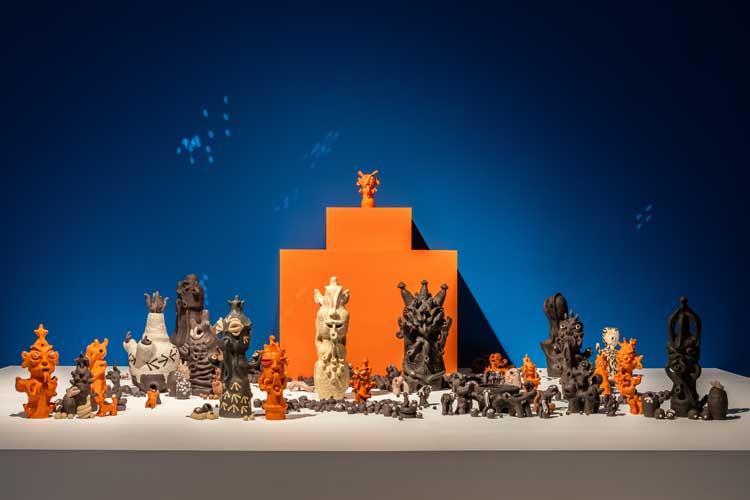
Mai Nguyễn-Long, Vomit Girl: Grounding, 2025, The Children are Now, exhibition view, Talbot Rice Gallery, the University of Edinburgh. Photo: Sally Jubb.
Nguyễn-Long’s art practice, specifically her doctoral research, evolved from the research she carried out during Vietnam fieldwork across 2018, 2019 and 2020 developing a methodology to translate the centuries-old wood carvings into her own artworks in clay. The physicality of the process enabled her to interrogate “the ongoing challenges faced by the generations following the traumatic historical events of 1955 to 1975 – what is called the American war in Vietnam, and the Vietnam war in Australia”. Her courageous and arresting installation of more than 90 handmade, variously sized sculptures and more than 1,000 Poo Balls that comprise Vomit Girl: Grounding at the Talbot Rice Gallery in Edinburgh this winter is a tour de force. They are a unique manifestation of spiritual and personal defiance; the product of a creative strategy that decolonises trauma by reconnecting the artist with her ancestral culture.
Nguyễn-Long’s practice-based research project explores the manner in which contemporary art can be used as a creative strategy to overcome her own deeply troubled sense of belonging in Australia and a disconnect with her Vietnamese culture and to assuage the “diasporic acculturated intergenerational trauma” that has deeply impacted her life. The new body of work for this project, Vomit Girl: Grounding, began in 2017 with The Vomit Girl Project: Vigit-Worana-Doba and was developed as a consequence of a creative strategy to reconnect culturally with her community identity in Australia and with contemporary art and folkloric practices in Vietnam. In effect, the conceptual and the subjective are used to create a powerful interface between art, politics and identity.
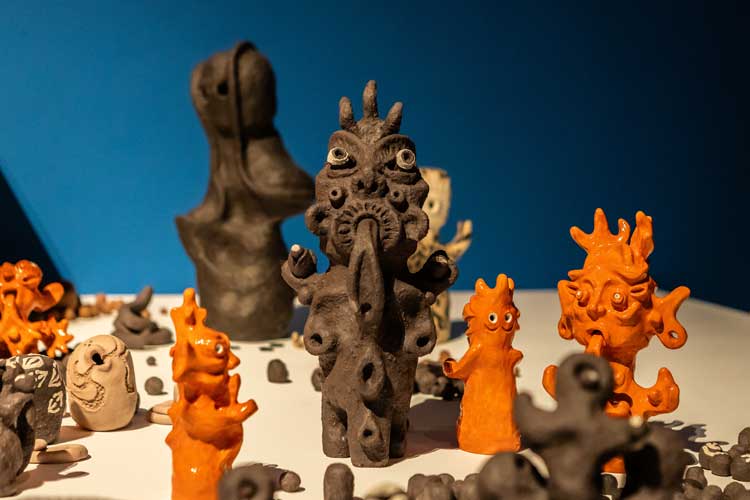
Mai Nguyễn-Long, Vomit Girl: Grounding, 2025, The Children are Now, exhibition view, Talbot Rice Gallery, the University of Edinburgh. Photo: Sally Jubb.
As a means of resistance, Nguyễn-Long introduces the aesthetic of mộc mạc, an appropriate translation of which is “earthy”. “Conceptually, I wanted to insert mộc mạc because, otherwise, Vietnamese art has been considered only through an external lens, such as Eurocentric or Sinocentric, for instance,” she says. Vomit Girl speaks to shame and trauma. Symbolic use of colour references Agent Orange, which contains dioxin, one of the most toxic chemicals in existence and used on a vast scale by American forces in the Vietnam war to destroy jungles and vegetation. It caused serious diseases in the civilian population, especially in children and infants in utero; decades later, the Vietnamese are still gravely affected. Orange in visual terms is equated with the longevity and the aftermath of trauma, the intergenerational suffering that was carried throughout the world with the postwar diaspora.
The subject of Nguyễn-Long’s doctorate encompasses the unique path in her own creative development of the power of making, the use of the grounding material of clay, and the assuagement of trauma through visualisation: “Vomit Girl Beyond Diasporic Trauma: Interconnecting Contemporary Art and Folkloric Practices in Vietnam”. A sense of belonging was forged by a sequence of challenging cultural phenomena, as well as the inherited trauma of her father and his family and encountering the grim reality of postwar poverty on their first trip as a family. In addition, the marginalisation of Vietnamese culture expressed as colonial rule, and the clumsy application of the external western lens had a parallel with her childhood and young adulthood, of being rejected by the Vietnamese community in Australia for having the “wrong accent” and experiencing all this within the ironic context of Australia’s unique colonial histories. Learning the language in her 20s, a “northern Vietnamese accent” led to her to being considered a “communist enemy”; her work was pilloried, and she received death threats. The result was that she felt she could not identify as Vietnamese or Australian. This acute sense of absence and disconnect that she experienced is reflected in her choosing to work in the international health sector, becoming a 1999 Australian Youth Ambassador for Development with the Ministry of Health in Fiji.
By contrast to her deeply felt confusion and loss, Nguyễn-Long’s career has also been influenced by her mother, whose 2023 book Vietnam Visual Arts in History Religion & Culture is a comprehensive scholarly survey of the art and culture of the dynastic period of Vietnam, from 1009 to 1945. The publication received an award from the Government of Vietnam and Professor Nora Annesley Taylor recently described Kerry as the foremost authority on the premodern art of Vietnam. Kerry’s many published articles include subjects such as the đình wood carvings of the Red River Delta. It is the wood carvings of the 16th to 18th centuries that Mai has found defiantly playful and intriguing. In her own research, Mai used these as a site to evidence a vast database of folklore; she then formed a conceptual bridge with folkloric practices in her father’s southern hometown. Tracing different periods of history, she notes folkloric practices that have come under scrutiny through key periods in Vietnam’s story: challenged during the Chinese occupation, during French colonial rule and the American war, during the communist regime after the war (and before 1986 reforms), and during the anti-communist years that followed the diaspora.
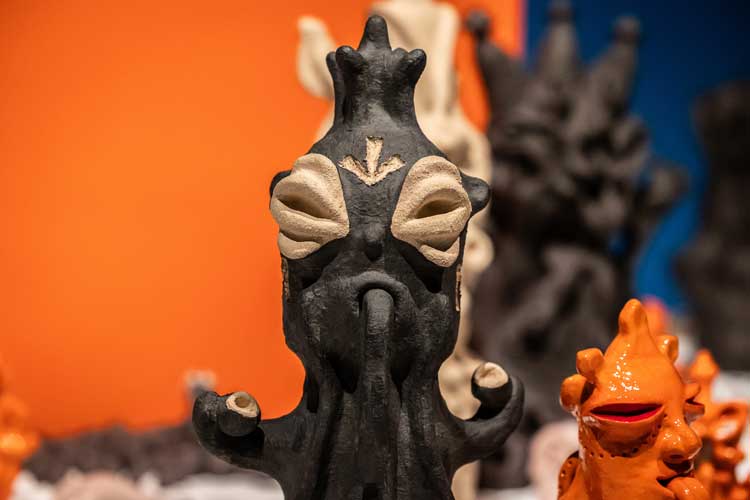
Mai Nguyễn-Long, Vomit Girl: Grounding, 2025, The Children are Now, exhibition view, Talbot Rice Gallery, the University of Edinburgh. Photo: Sally Jubb.
For Nguyễn-Long the surviving đình sculptures hold a spiritual power to overcome destructive aspects of day-to-day life in the residue of war, particularly the assertion of an exclusionary diasporic narrative. The artist found that the evolving history and function of the đình enabled her to identify with a defiant mother goddess culture that can acknowledge what she calls “the grit and messiness of humanity”. Working with the evocative materiality of clay she creates an army of spirits to resist unproductive binary forces within her personal life as a micro reflection of societal and historical dramas. The spirits evoke empathy through interconnection: continuously evolving forms, they detox inarticulated secrets and act as talismanic protectors. In the context of the outstanding Edinburgh exhibition The Children are Now, Nguyen-Long’s installation is empowering, a defiant stand against bullying. In terms of contemporary art practice, Vomit Girl intersects historic folkloric practice and disarms the colonising power of trauma through her personal process of adaptation and reinterpretation. It creates new spaces for suppressed and hidden experiences and enables new stories to emerge beyond diasporic trauma. She says: “[The] work that has resulted from [the Vomit Girl] research goes beneath and beyond the binaries of communist-anti-communist, coloniser-colonised, oppressor-oppressed, to recover lost connections and buried linkages with ‘homelands’.”
Vomit Girl has been exhibited in various iterations around the world, including: the 12th Berlin Biennale for Contemporary Art in 2022; the John Curtin Gallery, Western Australia, in 2025; and the 11th Asia Pacific Triennial of Contemporary Art, Queensland Art Gallery of Modern Art in 2024-25. Her work has been included in various group shows, including: The God of Small Things: Faith and Popular Culture, Queensland Art Gallery, until October 2026; Womb of Fire, previously at the Mơ Art Space, Hanoi, and now at Gallery Medium in Ho Chi Minh City. She was artist in residence at the Edinburgh Sculpture Workshop in the six-week period before she exhibited in The Children are Now, Edinburgh: 80% of her works in the show were made at the workshop and are shown alongside pieces she brought from her Australian studio.
Studio International talked to Nguyễn-Long at the Talbot Rice Gallery ahead of the opening.
Janet McKenzie: Vomit Girl has its roots in two visits to Vietnam, the first when you were eight, to the city in Sóc Trăng province, southern Vietnam, from which some members of your father’s family soon felt compelled to leave. Can you describe the effect of visiting the site of trauma?
Mai Nguyễn-Long: In Vietnam, all sensory impressions were intense, from the pungent smell of human faecal matter fertilising the fields surrounding the airport, to the legless waiter who served us a piping-hot bowl of phở, and everything in between. I identified with those I considered “my people”, “my family”. I changed my name from Justine to Mai.
My dad became a different person. He came alive when he was speaking his mother tongue. He was part of a large extended family and, as the eldest son, he was responsible for providing help, which he continues to do to this day. At the War Museum I saw foetuses affected by Agent Orange. We visited the Củ Chi tunnels before they were widened for tourists. The earth was wounded. The land was peppered with bomb craters. As I entered my teens, I formulated a sense that I felt that the land and people had been raped, and I felt personally assaulted in that process. The world was brutal and to be safe I needed to construct an imaginary world.
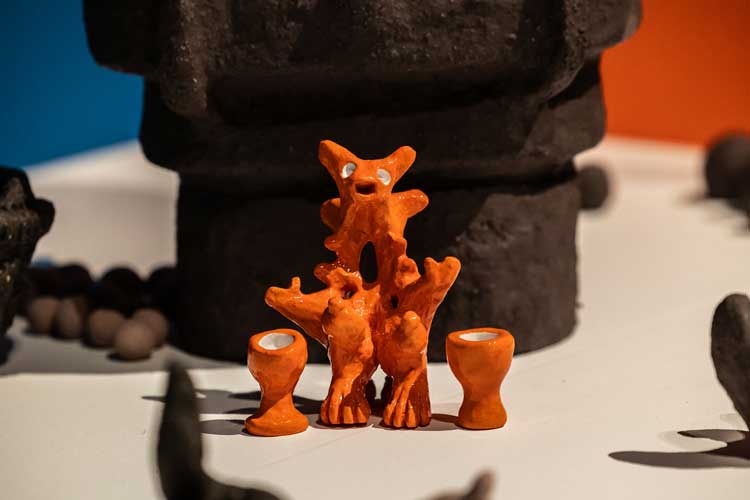
Mai Nguyễn-Long, Vomit Girl: Grounding, 2025, The Children are Now, exhibition view, Talbot Rice Gallery, the University of Edinburgh. Photo: Sally Jubb.
JMcK: Your Vietnamese story is atypical because your father travelled to Australia in 1962, as a student under the Colombo Plan; he married and was a father of four by the time the Vietnam war ended. But other members of his family had a traumatic time?
MNL: My dad was born into the instability of France struggling to maintain control of Vietnam, and Japan’s seizure of French Indochina from 1940 to 1945. His father had served in the Army of the Republic of Vietnam (South Vietnam) and was often away with his mother for long periods. Dad recounts hiding under tables in his father’s army quarters to duck bullets associated with Việt Minh efforts to repel the French. As a child, he remembers that trucks from his father’s compound would go out to pick up the dead and he recalls the gruesome sight and smell of uncovered charred bodies in different contortions piled up in the back.
Coming from a humble background, Dad was a gifted student; he would study outside under the streetlamps as well as caring for his younger siblings. The unstable years affected him deeply; he is pragmatic, unnervingly calm and emotionally subdued. In 1975, North Vietnam and South Vietnam were united. The government of the Socialist Republic of Vietnam was installed. Dad’s family forfeited their residential home and educational opportunities were compromised. While seeking better prospects, one uncle was lost at sea after 52 passing ships ignored his unseaworthy boat in international waters. Two uncles were in re-education camps. Between 1975 and 1995, 130,000 refugees fleeing the difficult circumstances in Vietnam arrived in Australia through various resettlement programmes. I have extended family in Australia as well as in Vietnam.
Cultural trauma research has reported that between 1954 and 1975, as many as 8 million people died or went missing. After 1975, more than 1 million became refugees; 3 million suffered from herbicide poisoning; the country was gripped by famine. The impact and ramifications of this horror remains, and it is not openly spoken about, the lost opportunities, and hopeful futures curtailed, the hardship. It tore my parents apart to know what was happening to Vietnam. As the eldest son, my dad has assiduously maintained contact with and support for his family.
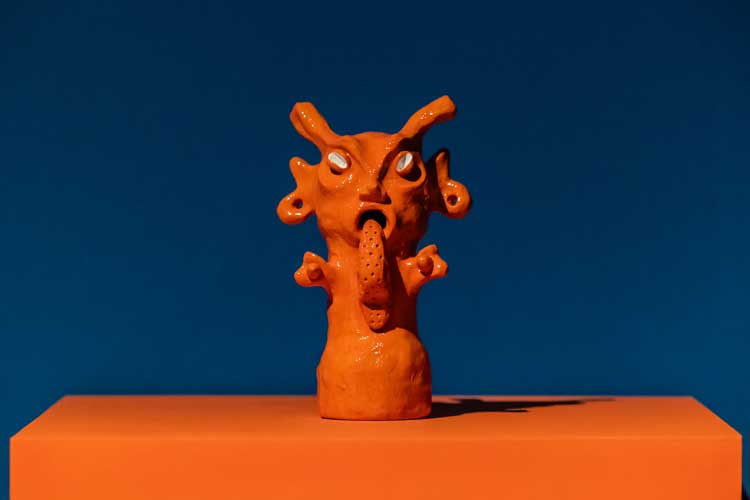
Mai Nguyễn-Long, Vomit Girl: Grounding, 2025, The Children are Now, exhibition view, Talbot Rice Gallery, the University of Edinburgh. Photo: Sally Jubb.
Vomit Girl is about breaking through either/or narratives. It is about questioning the autonomy of terms such as “victim” and “perpetrator” and instead, teasing out the multitudes of narratives from history. This is to acknowledge that there are numerous different access points to historical narratives. This kind of interrogation is not a dilution of “truth”. Rather, these insights can, as suggested by the media and communications scholar Tony Tran in 2020, “nuance and strengthen our understandings of complex global events and their aftermaths”.
JMcK: Your mother’s scholarship on the art and culture of Vietnam has been a key influence on your unique path and consequent art practice. Can you explain how your parents raised you as an artist and scholar?
MNL: My hyper-awareness of the “anti-Vietnam” stance in Australia made me feel suspicious and ashamed of my parents’ engagement with Vietnam for decades. Only when Vomit Girl appeared, incessantly, in my drawings, did I realise I needed to return to Vietnam, and also to read and study my mum’s publications. Eventually, I came to view her research and publications as an act of resistance to counter the erasure and destruction she experienced to achieve understanding. Coming from a teaching background, she felt it important for English speakers and a younger generation to know how rich and unique the art and culture is.
Both my parents tried to steer me away from art, and they were concerned about my capacity to support myself. They were the first and only members in their families to go to university, their opportunities the result of new and progressive political policies at the time. I appreciated their views and tried my hardest to suppress the urge to make art. I didn’t want to be an artist, and I tried to stop my incessant drawing.
My parents have curious minds and at weekends we were taken to artisan villages, festivals and cultural sites, museums and exhibitions. They also saved money to take us on a trip to Europe. This also made a huge impression on me, visiting the Catacombs in Italy, the Vatican, seeing Michelangelo. We also went to France and Holland. I’m so grateful for that. Having had these experiences, I felt a responsibility to process the exposure into something meaningful about human life and existence, thinking through cycles of fear, prejudices and misunderstandings, the colonising power of trauma, the impossibilities of self-reflection and emotionally crippling ripple effects of it.
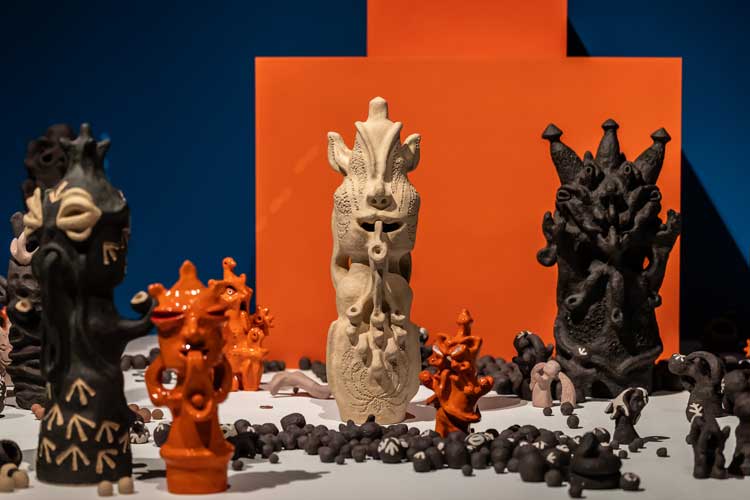
Mai Nguyễn-Long, Vomit Girl: Grounding, 2025, The Children are Now, exhibition view, Talbot Rice Gallery, the University of Edinburgh. Photo: Sally Jubb.
JMcK: Your 1994 trip to Vietnam, when you were based in Hanoi, enabled you to explore village arts on the river plains of northern Vietnam
MNL: Professor Nguyễn Bích introduced me to the wood carvings in the village đình. During this mid-90s period in Vietnam, among contemporary artists, there was a resurgence of interest in the village arts of Vietnam. I knew the wood carving carried a wealth of stories and creative wisdoms. They have a power that makes earthly life more liveable, and I was attracted to their boisterous, playful irreverence. Coming from a background where images of war and destruction had saturated my imagination as a child and young adult, I welcomed the đình wood carvings as having the capacity to rebuild an inner life. Still, it has taken decades to make sense of the overwhelming encounter, which I felt was untranslatable in the “anti-Vietnam” Australian context.
JMcK: In 2008, your papier-mache sculpture installation Phở Dog was condemned by important members of the Vietnamese community in Australia as “communist propaganda”. Can you explain the significance of such a criticism and how it made you feel?
MNL: At first, I think I was in a state of disbelief or shock. Then I felt ex-communicated embarrassed and ashamed. I felt abandoned by the institution that had supported me (even though I’d not been) and I began to suspect I’d been thrown to the lions as an intellectual exercise. I thought I was cannon fodder and, although only emerging, feared no curator or institution would ever want to work with me again, that my life as an artist was over. I had a lot of screwed-up thoughts but, essentially, I felt completely isolated and that it was always going to be impossible for me to belong. I was told I was un-Australian and un-Vietnamese.
Later, I realised that my extreme reactions had taken me directly back to when I had been ostracised for speaking Vietnamese with a northern accent. I relived numerous incidents of racial or sexual discrimination that I’d experienced. Due to the stacking effect of these experiences, I had rejected my Vietnamese language and my Vietnamese heritage. I had only just openly re-embraced that heritage through my artwork – for the first time in 10 years – when Phở Dog (2006) was immediately rejected again in 2008.
I felt it was impossible to explain how I was feeling to anyone because my experience had always been deemed marginal; my experience had never been afforded legitimacy. Besides, I did not have the words. When I tried to speak, I could only choke. That’s why I burned my papier-mache mongrel in The Burning of Godog (2009). Then Vomit Girl emerged …
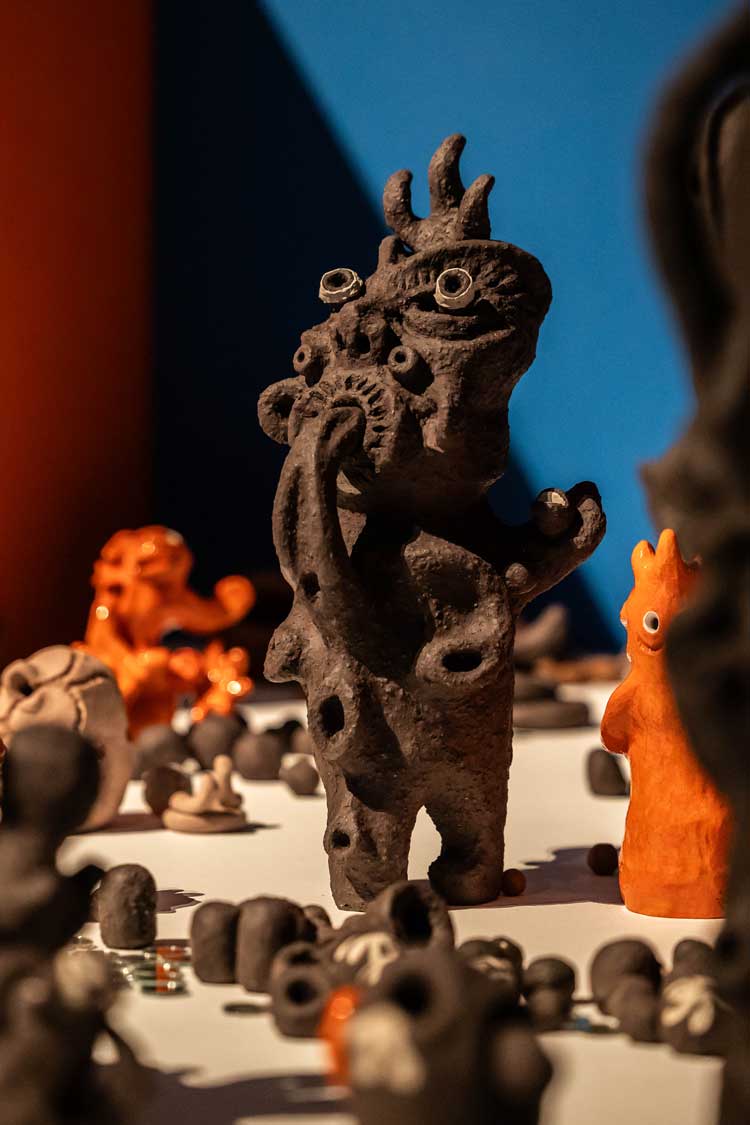
Mai Nguyễn-Long, Vomit Girl: Grounding, 2025, The Children are Now, exhibition view, Talbot Rice Gallery, the University of Edinburgh. Photo: Sally Jubb.
JMcK: Can you explain the personal benefits of your creative methodology, how the processes of making this ambitious and enormous body of work, which is ongoing, enabled you to break free from internalised racism and from the bitter legacy of the American war in Vietnam?
MNL: The dominance of the anti-communist victim narrative made it impossible to engage with contemporary Vietnam and anything good about Vietnam. The narrative allowed no room for imagining something beyond or outside of rejection, victim and perpetrator, bitterness, hate. Burying myself in my art practice enabled me to talk back, to construct a sense of belonging. Creative practice enabled me to change my response to rejection. I build and rebuild Vomit Girl. Vomit Girl is not just a girl: she is singular, plural, multiple, girl, boy, woman, man, animal, bug, shrub, poo, an interconnected everything … rooted within the earth. Vomit Girl is me, you and every little complex moving atom that drives a creative process. The world driving through my body as I wedge, coil, pinch, mark, smooth and ultimately … temper the sharp edges of my own psycho-assaults as they raise their rude heads throughout the day.
JMcK: How did Vomit Girl first appear in your drawings and how did the drawings trigger such a cathartic outpouring of emotion?
MNL: Perhaps it is more like a bodily outpouring of awareness. For the first time, I felt my heart had hooked up with my brain. Eventually, I began to think that somehow, maybe, there is a way of living without a constant fear of annihilation. I think my artwork has always had some high-level emotion of some sort. But normally it was expressed as a floating disconnection. Forms would exist in a void. I first noticed Vomit Girl in 2014. But looking back now, I think she was always there. What was different in 2014 is she was all I could draw and she would not go away. I tried to make her go away but I just kept drawing her. Sometimes she was a man or animal, sometimes with guts pouring out. One time the vomit took the form of fish. I finally realised I had to let her stay and find out why she was there in the first place.
JMcK: What is the significance of working with clay, of transposing the forms created in the 16th to 18th centuries using traditional carved wood to a material that you can mould and touch and make your own?
MNL: I encountered clay by chance in 2015 when I was offered a ceramics residency in Bát Tràng, Hanoi. An artist, Bằng Sĩ Trực, generously offered me accommodation and introduced me to an artisan, Phạm Anh Đức. It was not an easy encounter, but after five weeks I had a set of clay objects that I found delight in. Returning to Australia, I was keen to learn more, but it was not until 2017 that I was able to explore further. Without any formal instruction, the internet became useful.
Also, Mum had begun her research journey through her interest in ceramics trade routes. She was curious as to why Vietnamese ceramics were in the Philippines. Although she took me to see the stoneware jars that she was cataloguing at the National Museum of the Philippines, I did not feel a connection. But maybe the seed was planted all those years back. I now feel that my interest in clay is partly an honouring of her in some way.
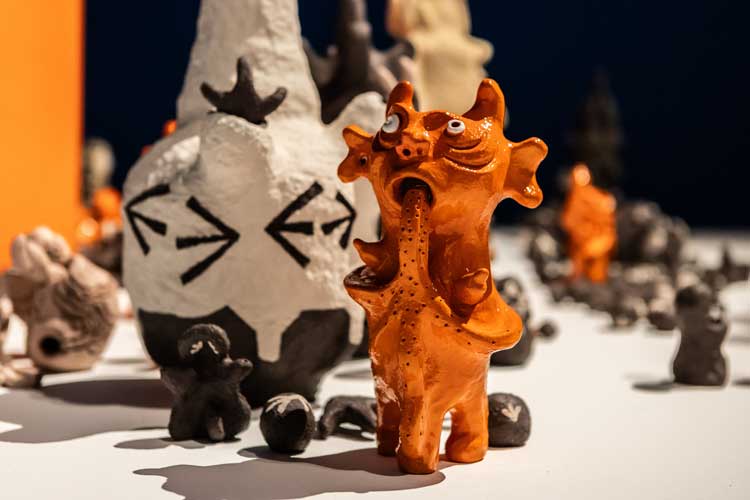
Mai Nguyễn-Long, Vomit Girl: Grounding, 2025, The Children are Now, exhibition view, Talbot Rice Gallery, the University of Edinburgh. Photo: Sally Jubb.
Finally, of course, is the nature of clay itself. It feels good. It is dirt, a cleansing dirt. The physicality involved in wedging requires me to put my whole body into it and when I build, I become ambidextrous. Both my hands are occupied, and I can’t do anything else but go into a rhythmic no-mind state and let the clay speak to and through my body. There is a ritual process dictated by the way it dries. This means I need to have several sculptures on the go at once. I don’t like an empty studio and building these, they become company for me. I speak to them. They speak to each other. They speak to me. It’s exciting when, finally, they are all finished and I get to play around with how they interact with each other. I learn from this process and from every stage of the making. The process is also high-anxiety, and I find I learn to manage my anxiety through small private rituals, then “letting go” of what I cannot control. This then translates to my everyday life. I like the challenges and problem-solving as well as the intimate, tangible sensuality of it – like a dance or a hug.
JMcK: What is the significance – in terms of the scale and theatricality – of such vast installations, of more than 200 handmade clay sculptures?
MNL: I don’t like to be too prescriptive about what is happening. However, one aspect could be the interconnectedness of everything and the endlessness of ripple effects. This is relevant to the individual sculptures and the process by which they are constructed, as much as the way the pieces are then installed. Singularly or together, they present an ambiguous, open-ended story.
However, there are some key recurring motifs. Sometimes one Poo Ball might be indicative of one year, for instance. But these are my personal reference points to make sense of a historical event. When they go out into the world and are consumed by viewers, the story becomes someone else’s. Where there is duplication, that is also like a mantra or incantation – such as the Doba cylindrical forms linked with disused bombshells. There is also a sense of urgency which propels me to keep making.
Making many instead of one or a few allows me to play with the flow and rhythm across the forms on install, not just focusing on flow within standalone objects. I like the idea of dance and movement being a creative strategy to resist fixed narratives, fixed hierarchical structures, moral propriety. In the 16th- to 18th-century đình wood carvings, there was room to defy the moral rigidity of patriarchal Confucianism which had been introduced to matriarchal Vietnam through Chinese rule.
The many instead of a few is indicative of a community, a society. As I’ve felt I’ve lacked one and not belonged to a “community”, perhaps I am going through the motions of creating one. In my Vomit Girl society, if you like, there is space for multi-deities and ambiguity. There is room for polyvalent adaptability. Each repeated form also functions as an incantation, a remembering of when Vomit Girl first became a clarity to me. A reminder that she is a product of real events, not unexplained madness. Maybe my Vomit Girl installations are remembrance and acceptance. They are getting on with life, unassumingly minding their own business. Maybe. You’ll have to ask them.
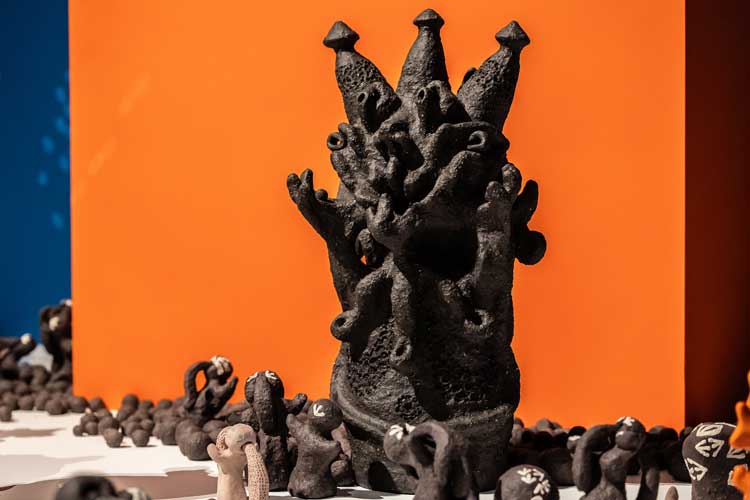
Mai Nguyễn-Long, Vomit Girl: Grounding, 2025, The Children are Now, exhibition view, Talbot Rice Gallery, the University of Edinburgh. Photo: Sally Jubb.
Working with many this way pools together the “bad” and makes it “good” by transforming the shapes, such as the cylindrical bombshell form that informs the structures of every Vomit Girl. The messiness welcomes misfits and the excommunicated, the in between as with the early historical mother goddess rituals. These rituals also have a way of weaving together historical fact and imagination. So also, the Vomit Girl folklore weaves its own story, and each installation is differently nuanced as it progresses to different venues, geographic locations, responding to and absorbing different stories of resistance and survival.
Vomit Girl’s ongoing iterations (The Vomit Girl Project) continue to draw from Vietnam’s art history to educate myself and redress the absence of information during the years when I so desperately wanted to learn about Vietnam beyond the Vietnam war / American war sinkhole. Vomit Girl: Grounding has now, for the first time, also drawn in coded references to Irish migrant history – to honour my mother’s Irish roots – in Australia, such as my Potato Shells.
Vomit Girl’s focus is not on trauma but on building knowing and learning new stories. These can be learned through working with clay. Hence, discovering new clay histories and methodologies, techniques that carry new stories are all of interest to my studio research. It’s all about decolonising the enemy within me, focusing on what I can do with myself rather than how I can change others. I am also wary of where compassion becomes condescension. Everything feels so complex. Clay helps cast off the non-essential chatter. I’d rather be in the studio right now than struggling to put all of this into words.
Orange glaze contrasts with the unglazed earthenware feel. My making them all instead of outsourcing is about the nature of labour. Taking pride in labour. The challenge to my body and mind. The challenge to see how I can apply myself. This plus the forms I make are an embrace of the so-called uncivilised, uncouth, primitive; a strategy to own the shame; an experimental lab perhaps, in living beyond fear.
Vomit Girl refuses orthodoxy, as learned from the đình wood carvings. This stance is celebrated through Poo Balls and more recently, as developed in Edinburgh, through the Perpetual Pukers and Dancers, Imurgents, Potato Shells, Worana (Worm Dragon Snakes), Doba (Dinh Bombshell Bell Axis), Poo Swirls, the forms are non-elitist and base, bodily produced as if spat out. Unapologetic.
In Vomit Girl: Grounding I have used tiny roundel mirrors for the first time. The residency/exhibition model has been instrumental here. Working closely with the curator, James Clegg, we were able to have more conversation and experimentation in the process. While mirrors were used previously as a water/reflective and fractured references and continue to do this, this time they are not smashed mirrors but add a feel of night stars – connecting sky with Earth, and portals for spiritual transformation as drawn from ritual practice I have observed.
JMcK: The Children are Now at Talbot Rice Gallery, is a moving exhibition where your autobiographically informed installation takes centre stage. Do you feel it assumes greater authority now in a new political and social context, dominated by a global refugee crisis and the vulnerability and marginalisation of children?
MNL: The Children are Now exhibition is an expanded context for my work and highlights different aspects about my project, which does have many layers and contexts. Vomit Girl: Grounding and The Vomit Girl Project is not about me or you. It is about us. In my case, reconnecting with Vietnam helped me find something stabilising to work with, something deeper, more intangible and expansive. This replaced a belief that I deserved to be disposed of, decolonising my imagination. But what happens to the soul when the spiritual umbilical cord is irreparably severed? I live. I love. I die. I do not have children. My clay sculptures are what I leave behind.
• The Children are Now is at Talbot Rice Gallery, University of Edinburgh, until 7 February 2026. The God of Small Things is at Queensland Art Gallery until October 2026. Dạ Lửa – Womb of Fire is at Gallery Medium, Ho Chi Minh City, until 23 Jan 2026. Mai Nguyễn-Long is represented by Michael Reid Sydney and Berlin.
Click on the pictures below to enlarge

Copyright © 1893–2026 Studio International Foundation.
The title Studio International is the property of the Studio International Foundation and, together with the content, are bound by copyright. All rights reserved.
 |
 |
 |
|---|

-300.jpg)
-300.jpg)

 Grayson Perry: The Pre-Therapy Years
 In the Land of the Gods. Marc Chagall and the Greek World
 The Extended Mind
 Michael Sherrill – interview: ‘I’d call myself a student of art’
 Jonathan Baldock: Facecrime