




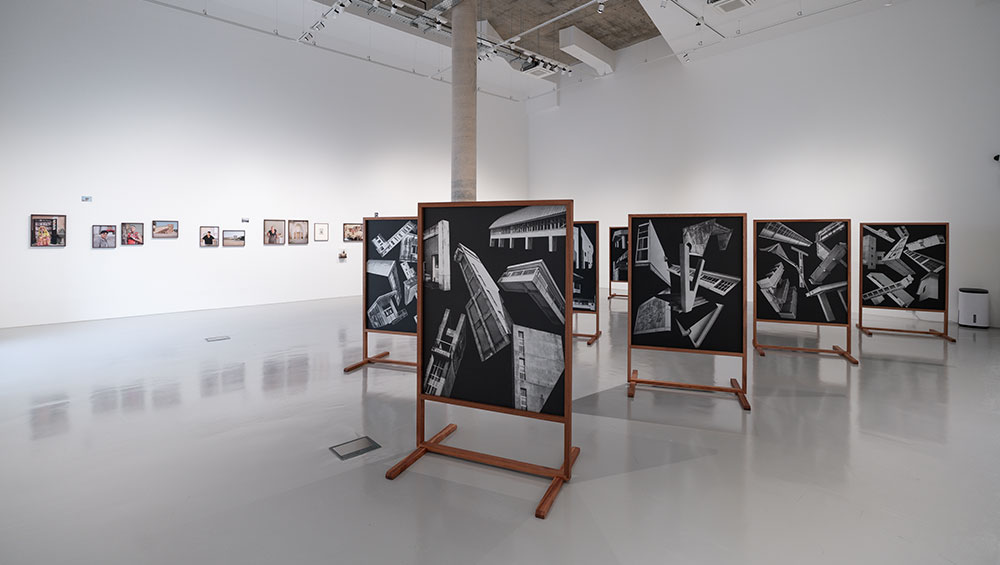
Jerwood / Photoworks Awards 5, installation view, Drawing Room and Tannery Arts, London. Photo: Studio Deew. Courtesy of Photoworks.
Drawing Room and Tannery Arts, London
10 January – 8 February 2026
by BETH WILLIAMSON
The latest recipients of the latest Jerwood/Photoworks Awards are Roman Manfredi and Sayuri Ichida. Manfredi and Ichida present two solo shows (including photography, moving image, sound and installation) within this one exhibition that will tour the UK throughout 2026 and, on the face of it at least, the two shows could not be more different. While Manfredi’s TRA and Ichida’s 空席 (Kūseki) both address questions of lost or hidden communities, they do so in different ways and, it turns out, are a perfect counterpoint to one another.
When an old photograph of Manfredi’s grandmother (nonna) was uncovered, the artist’s curiosity was piqued. There was Nonna, lined up with three other women, in the heart of the Italian countryside. One woman holds a bunch of wild flowers. Another, dressed in hat, suit and shirt, has her arm around the woman next to her and they appear as a couple at their wedding. Manfredi was told the photograph was probably taken during the “Carnevale” (carnival) when, historically, people played with notions of status and identity, including cross-dressing. It was this that prompted the lens-based artist of Italian heritage to delve into individual experience and the associations between class, gender and sexuality in Italy.
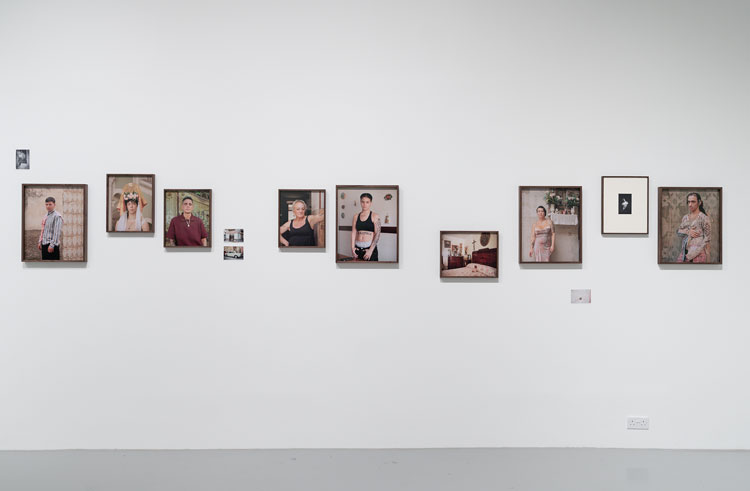
Roman Manfredi, TRA. Jerwood / Photoworks Awards 5, installation view, Drawing Room and Tannery Arts, London. Photo: Studio Deew. Courtesy of Photoworks.
Manfredi’s project is called TRA, Italian for a state of being between, among and within. At the heart of this is the Napoli “femminielli” a historic and revered third gender, moving fluidly between masculine and feminine and defying definition. Dating from the 16th century, with a history particularly in working-class districts, the femminielli, who challenge cultural norms, are admired rather than disparaged for their difference. Through a series of portraits, film and fragments, TRA circles around the historic photograph of Manfredi’s nonna while anchoring the experience of individuals and communities in a Neapolitan cityscape beyond its Unesco-listed historic centre. In areas such as Torre Annunziata and Torre Del Greco on the periphery of Naples, Manfredi dedicated eight months to an analogue project that required the tricky business of winning trust and the need for persistence in pursuit of artistic goals and inclusiveness, as well as patience and respect for people’s competing priorities.
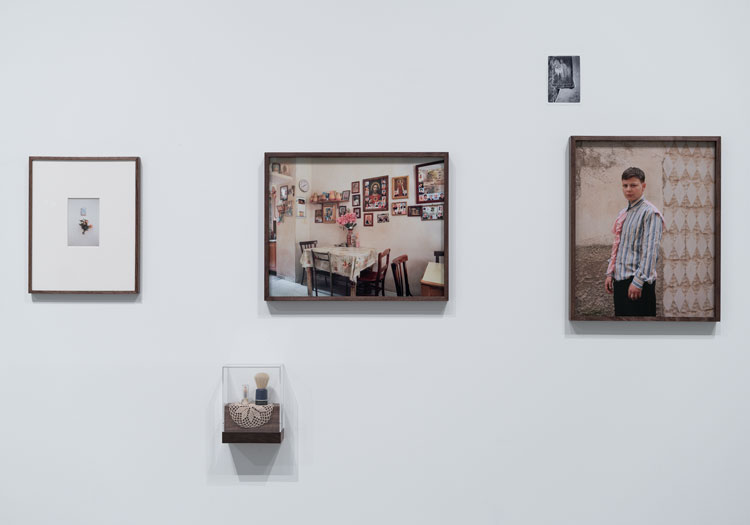
Roman Manfredi, TRA. Jerwood / Photoworks Awards 5, installation view, Drawing Room and Tannery Arts, London. Photo: Studio Deew. Courtesy of Photoworks.
As the artist explains in the introductory text to the exhibition: “While dual-spirited identities have often been acknowledged in male-assigned bodies, female-born expressions of gender variance have historically been dismissed or disparaged, often carrying cultural and class-based stigma. This body of work includes masculille [masculine-presenting individuals in Naples, who were assigned female at birth] in an attempt to reclaim that space with dignity.” What is striking in Manfredi’s work is that, despite its historical and architectural rootedness, two things that undoubtedly lend it strength and potency, it confronts individual experience here and now. Further, while the artist’s photographic portraits show individuals who seem secure in their identities, they also reveal a degree of vulnerability and tenderness, something that is hugely to Manfredi’s credit in recognising and conveying these aspects of individuals through the use of analogue photography. These are people photographed with reverence and love.
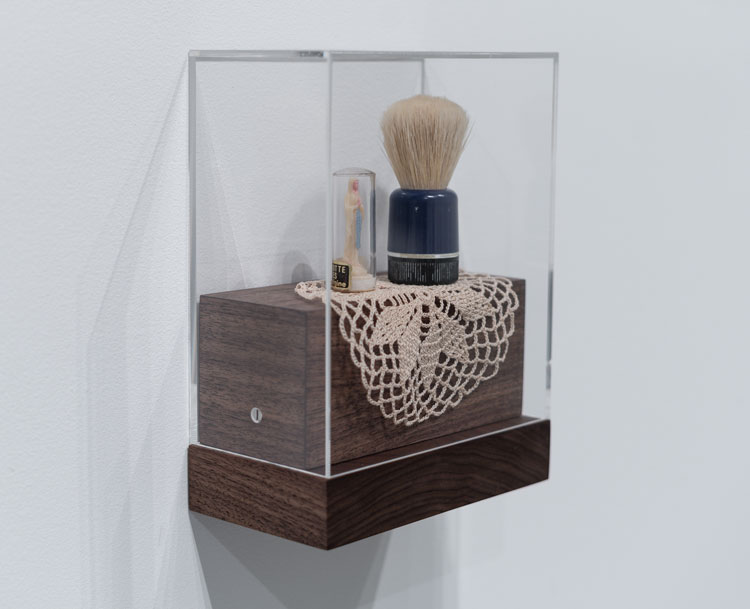
Roman Manfredi, TRA. Jerwood / Photoworks Awards 5, installation view, Drawing Room and Tannery Arts, London. Photo: Studio Deew. Courtesy of Photoworks.
Alongside the photographs, a tiny Perspex box fixed to the wall at waist-height contains three small personal items: a shaving brush that belonged to the artist’s father and a lace place mat and a minuscule religious icon, a Madonna, that belonged to artist’s mother. Including these familial items in the exhibition extends further the sense of generosity in Manfredi’s work. In a short grainy Super 8 film shot in black and white, the viewer is welcomed into a site of celebration, a femminielli wedding that Manfredi was able to film at the end of the eight-month stay in Naples. This ritual is not about marriage but a rites-of-passage wedding performed to hand over the tradition on the femminielli from one generation to another. It is a true celebration and for Manfredi the perfect way to end this important period of research.
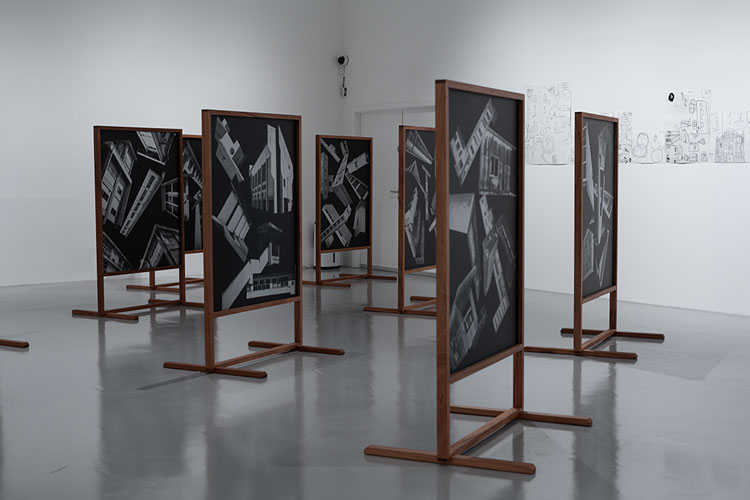
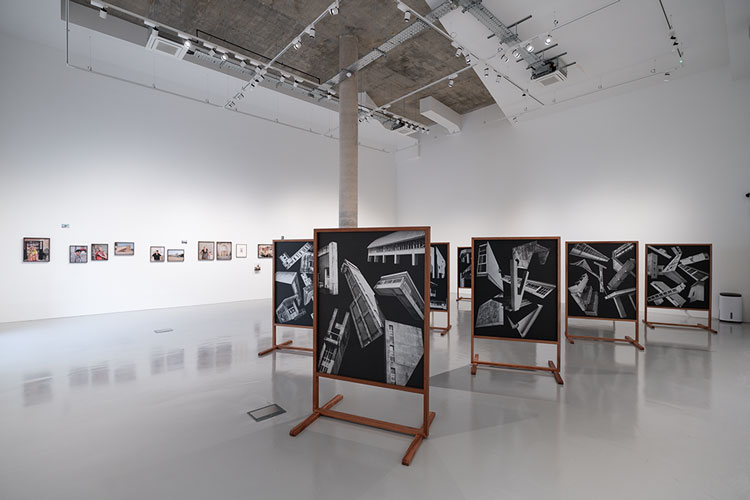
Sayuri Ichida, 空席 (Kūseki). Jerwood / Photoworks Awards 5, installation view, Drawing Room and Tannery Arts, London. Photo: Studio Deew. Courtesy of Photoworks.
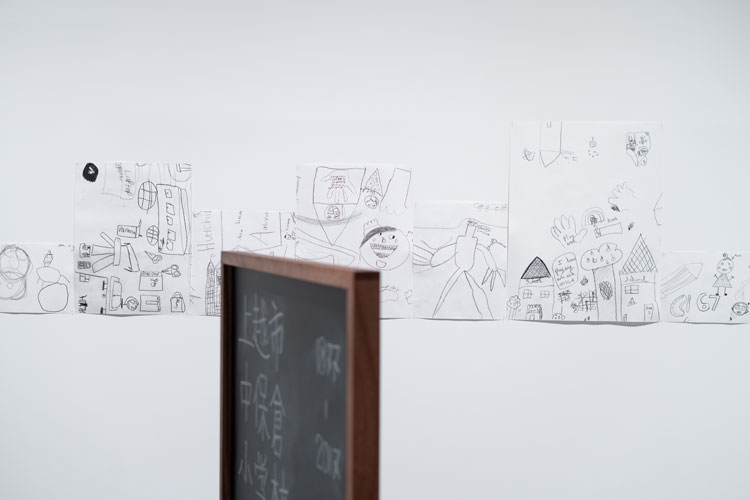
The title of Ichida’s work, 空席 (Kūseki), means “empty seats”, and is a truly haunting analysis of Japan’s rapid population decline, with rural communities suffering the impact most. In the 18 years from 2002 to 2020 almost 9,000 schools closed. It is pleasing that Ichida’s work uses the pedagogical tools of its subject (chalkboards and chalk) to critique the changing landscapes of population and education that, in the end, alter the essence of community life. Those same tools act to educate the viewer, a pedagogical prop that takes centre stage in explaining how falling birth rates and shrinking towns lead to empty schools, their presence gradually fading, their spaces closing and disappearing entirely. Ranging across photography, collage, sound and sculpture, 空席 (Kūseki) acts as a material and conceptual response to this continuing disappearance.
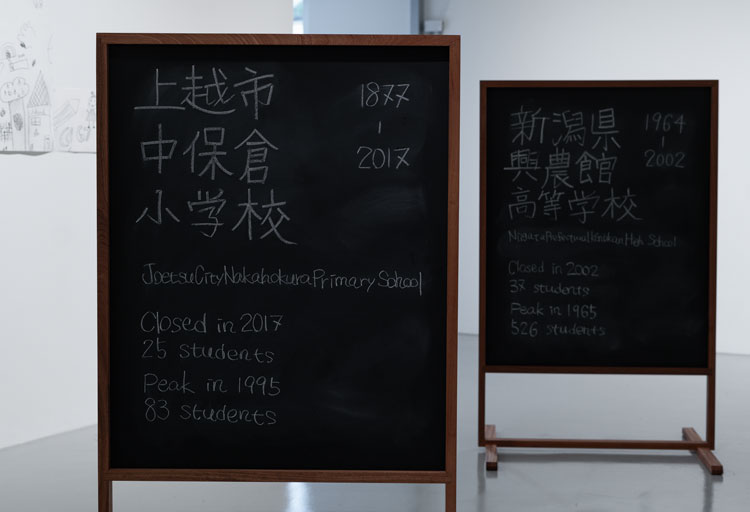
Sayuri Ichida, 空席 (Kūseki). Jerwood / Photoworks Awards 5, installation view, Drawing Room and Tannery Arts, London. Photo: Studio Deew. Courtesy of Photoworks.
The forest of chalkboards that populate the gallery space draw people into their orbit in an inquiring, meandering sort of way, as if visitors simply happen upon one example after another of these losses. This cumulative effect is, of course, deliberate. There is no single path through the installation but each board shares information on both sides. On the front of the boards are the artist’s handcut prints of the buildings. Images of each school building are disassembled and reassembled in a disjointed fashion. These fragmented collages are screen printed on to chalkboards.
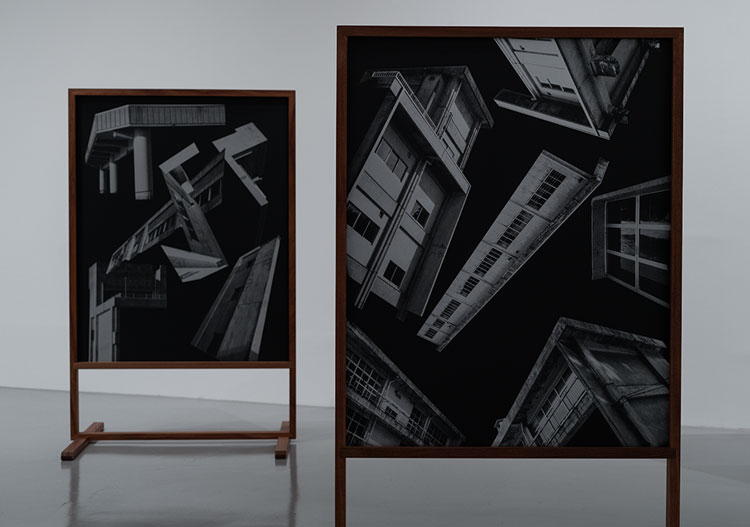
Sayuri Ichida, 空席 (Kūseki). Jerwood / Photoworks Awards 5, installation view, Drawing Room and Tannery Arts, London. Photo: Studio Deew. Courtesy of Photoworks.
As if in another nod to pedagogical histories, it seems to me that Ichida’s collages also recall the photographs of Iwao Yamawaki, the Japanese photographer and architect who trained at the Bauhaus in Dessau. Yamawaki, like Ichida, began working in a commercial career (he in architecture, she in commercial photography) before undertaking further training and turning to art photography. On the back of the chalkboards are the shocking facts and figures of the decline and closure of each of the 10 schools presented by Ichida. The oldest, Nishidani primary school in the city of Nagaoka, which opened in 1872, closed on 31 March 2015 with eight students enrolled. At its peak in 1972, the student population was 103. One of the largest losses was seen in Minami Sabaishi primary school in the city of Kashiwazaki, which opened in 1921 and closed in 2011 with 30 students enrolled. At its peak, in 1947, the student population was 935, a shocking decline by any standards.
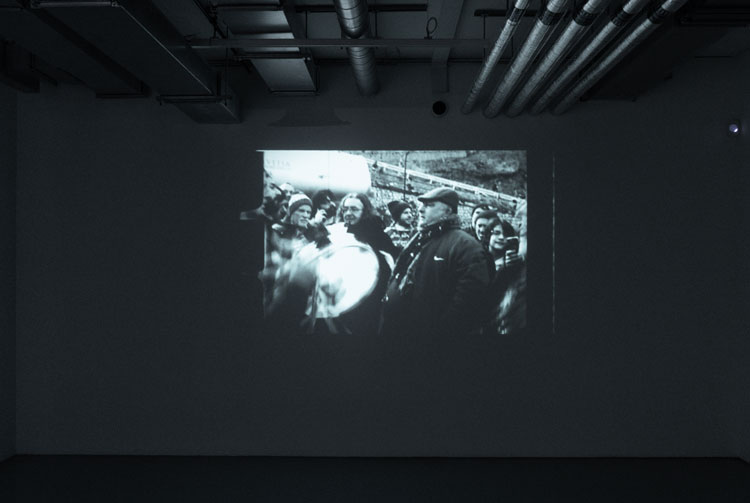
Roman Manfredi, TRA. Monochrome Super 8 film. Jerwood / Photoworks Awards 5, installation view, Drawing Room and Tannery Arts, London. Photo: Studio Deew. Courtesy of Photoworks.
Two further dimensions of the installation 空席 (Kūseki) remain to be spoken about. Ichida worked in collaboration with the Japanese composer Satoshi Fukushima to create a soundscape that visitors can experience on wireless headphones as they walk through the forest of chalkboards. Fukushima began with field recordings from his children’s primary school. The fragments were pieced together, like a collage, always leaving gaps between, “giving space for every sound to breathe and be experienced”, in the same way that Ichida’s collages float in space. Woven around this are piano melodies that interrupt the sound of steps and voices in school corridors – now all gone. This sonic element acts somewhat like the ghost in the machine, the animating essence of the closed school buildings echoing across time and space. As writer Cindy Sissokho says in her catalogue essay, the scene is “further animated by the creative voices of children local to the UK through drawings on the gallery walls”. The result of Ichida’s workshops with local schoolchildren, they bring new life to the installation too.
These two bodies of work from Manfredi and Ichida may look and feel very different from one another, and that is OK. Yet, they both resonate with a desire to bring lost and overlooked communities into clear view. Visitors to this exhibition should certainly consider each show on its own merits, but there is still more to be gained by looking at them together.
• Jerwood/Photoworks Awards 5 will be at Barnsley Civic, Yorkshire, 21 February to 25 April 2026, Ffotogallery, Cardiff, 7 May – 4 July 2026 and Street Level Photoworks, Glasgow, 12 September – 6 December 2026.
Click on the pictures below to enlarge

Copyright © 1893–2026 Studio International Foundation.
The title Studio International is the property of the Studio International Foundation and, together with the content, are bound by copyright. All rights reserved.
 |
 |
 |
|---|
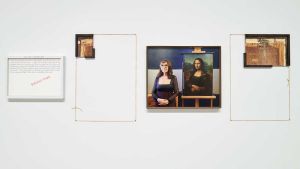
-300.jpg)

-300.jpg)

 Guy Bourdin at the V&A. Fashion photography as art
 Keith Arnatt: I'm a Real Photographer
 Diane Arbus: Revelations
 Nobuyoshi Araki: Araki: Self, Life, Death