




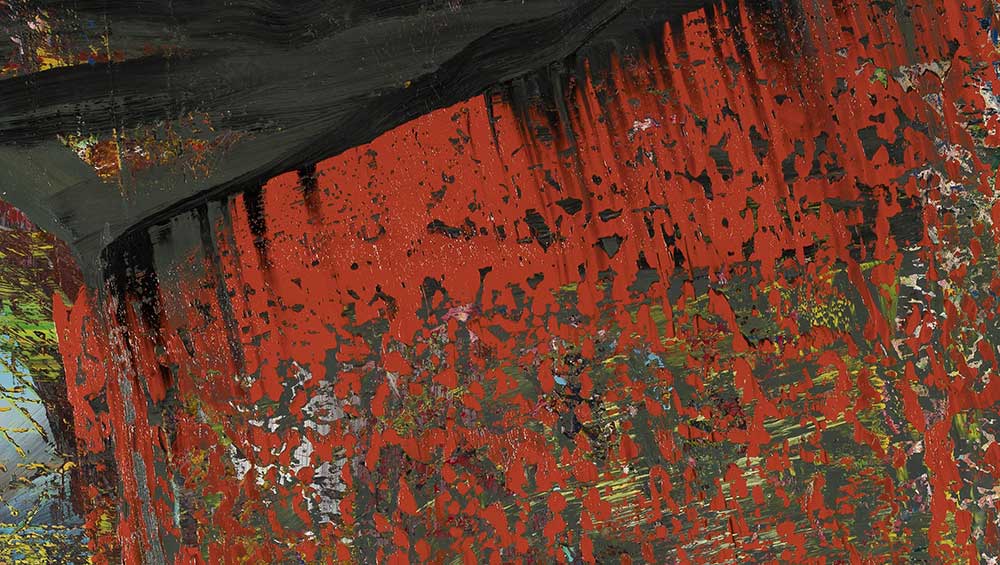
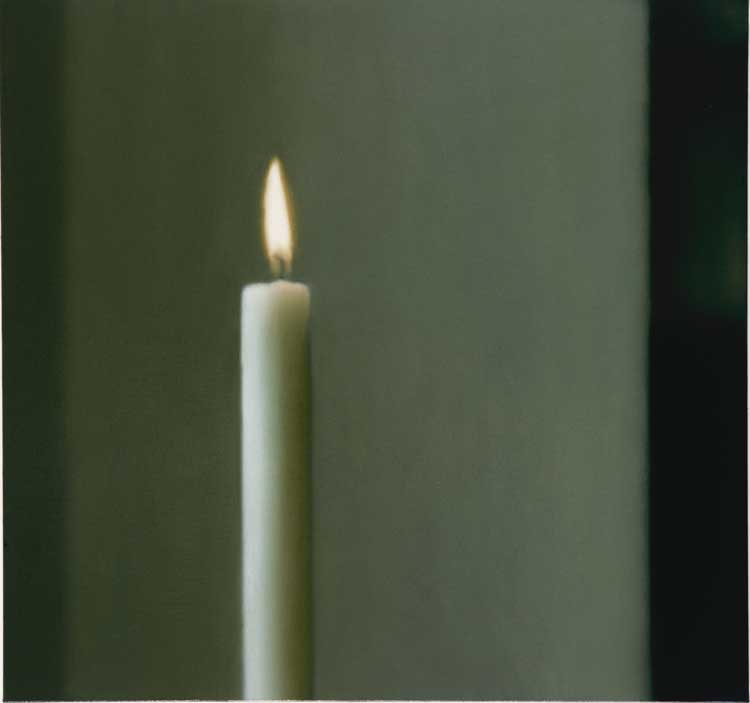
Gerhard Richter, Gudrun, 1987 (detail). Oil on canvas, 250 x 250 cm. Fondation Louis Vuitton, Paris. Photo: Primae / Louis Bourjac © Gerhard Richter 2025.
Fondation Louis Vuitton, Paris
17 October 2025 — 2 March 2026
by JOE LLOYD
How do you reckon with an artist whose own website declares him “one of the most important artists of the 20th and 21st centuries”, a claim that seems almost modest compared to the proclamations of critics? A painter whose Atlas – a collection of more than 4,000 photographs and cut-outs used as source images for his paintings – has itself become a foundational work of modern art? Gerhard Richter is a colossus bestriding contemporary art. There are few dissenters to his worth. His works fill museum and oligarchic collections alike. His story, fleeing from East to West Germany weeks before the Berlin Wall went up, has even inspired a three-hour romantic film, which Richter himself has disavowed.
The challenges faced by the Fondation Louis Vuitton’s gargantuan retrospective – which contains 275 works across four storeys – are to make Richter’s work approachable and to knit together the myriad branches of his practice. Richter’s oeuvre resists linear narratives. He did not run through styles and subjects so much as add them to his arsenal. The coolness and precision of his figurative paintings – whether portraits of his wives, natural features such as icebergs and rivers, the corpses of Baader-Meinhof gang leaders or still lives of plain wine bottles – can seem a world apart from the wild, near-garish colours of his abstracts, which sometimes blend the eye-melting hues of pop with the unruly, congealed surfaces of abstract expressionism.
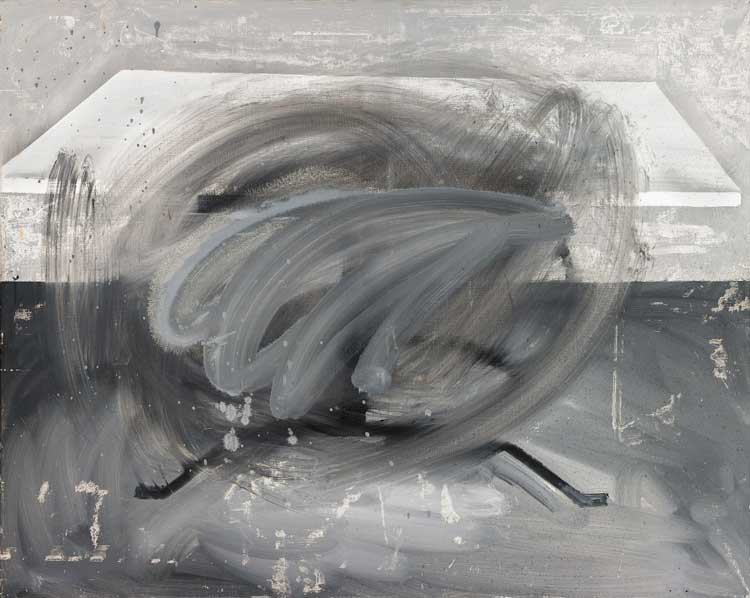
Gerhard Richter, Table, 1962. Oil on canvas, 90 x 113 cm. Private Collection. Photo: Jennifer Bornstein. © Gerhard Richter 2025.
The curators, Dieter Schwarz and Nicholas Serota, have wisely organised the exhibition chronologically, allowing Richter’s different modes and themes to enter organically. It begins with a blur. Tisch (1962) depicts a sleek white-topped table, painted from a photograph in an old issue of Domusmagazine. Richter was dissatisfied with his first reproduction, so he decided to smear the original picture with solvents. He then painted this detonated view. The room around the table warps and peels. Swirls of grey paint, variously gaseous and liquid, dominate the centre of the image, obliterating the table’s supporting structure. Richter, attuned to his own legacy, chose this as the first painting in his catalogue raisonné, cutting out the abstractions he had painted as a student at the Düsseldorf Kunstakademie, as well as everything he had produced in East Germany, in another act of erasure.
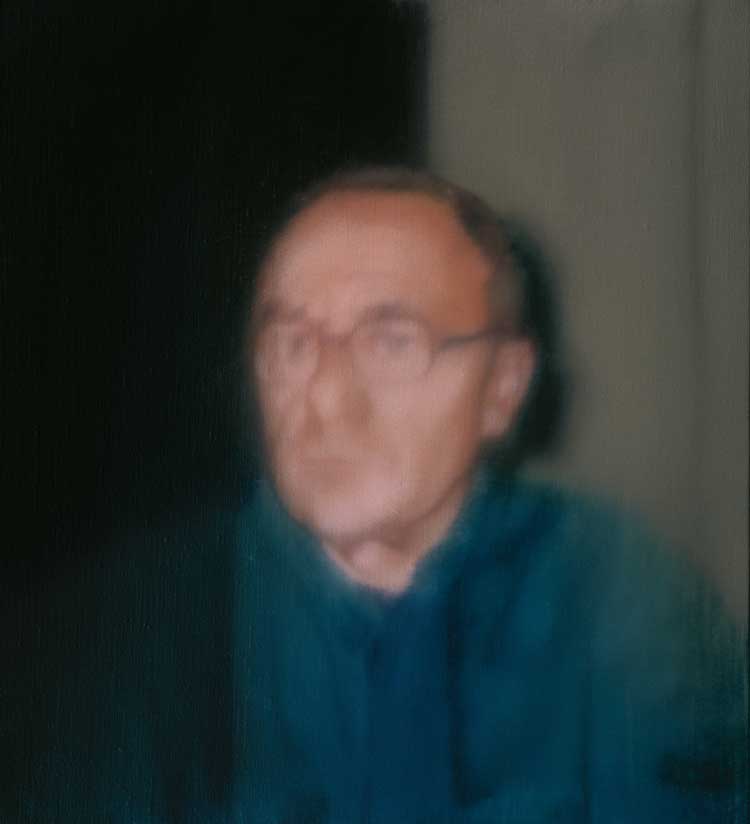
Gerhard Richter, Self-Portrait, 1996. Oil on linen, 51 x 46 cm. The Museum of Modern Art, New York. Gift of Jo Carole and Ronald S. Lauder and Committee on Painting and Sculpture Funds, 1996. © Gerhard Richter 2025.
One can see why he did this. Tisch serves well as a key to the work that followed. It is a painting of a photograph, a technique that Richter has investigated more extensively than any other artist. It evokes abstract painting despite imitating a concrete image, invoking another strand of his work. Its largely grey palette heralds the monochromes that would appear at the end of the 60s. Perhaps most importantly it signals that Richter’s is an art about perception. We live surrounded by photographic images, which we often assume capture reality but are subjective representations. By smudging and distorting his strangely lifelike paintings, Richter calls attention to this subjectivity and asks us to engage critically with image.
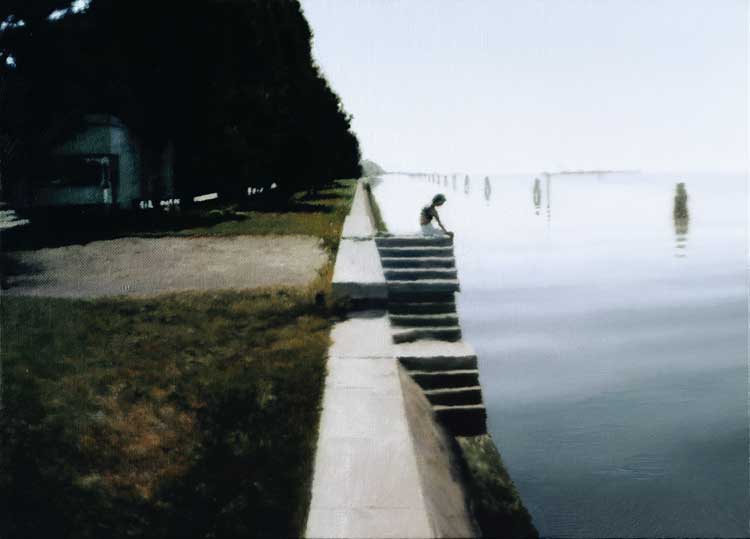
Gerhard Richter, Venice (Staircase), 1985. Oil on canvas, 51.4 x 71.8 cm. The Art Institute of Chicago. Gift of Edlis Neeson Collection. © Gerhard Richter 2025.
This is a standard critical interpretation of Richter’s photo paintings. What it fails to mention is just how mesmerising many of these works are. With some irony, they do not photograph well. Whether a wooden chair or a quasi-Romantic landscape, portraits of eight murdered nurses or his third wife, Sabine Moritz, intently reading a magazine, Richter’s figurative work is technically remarkable and hugely sympathetic. Seldom has a solitary toilet roll been rendered with such delicacy. The degree of blur itself varies immensely. Some works are delicately unfocused, paint applied with the punctiliousness of an old master. Others are smeary, from the thick but neat lines of Stadtbild TR (1968), which depicts a postwar estate, to the wholly gestural Parkstück (1971).
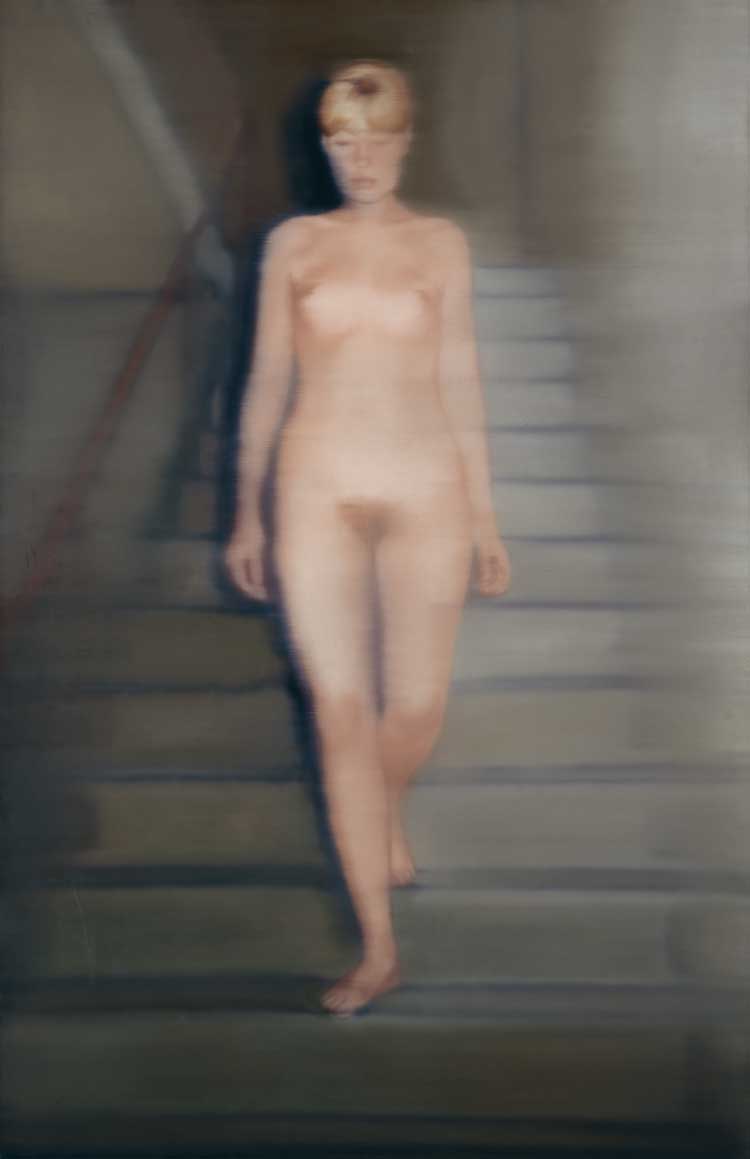
Gerhard Richter, Ema (Nude on a Staircase), 1966. Oil on canvas, 200 x 130 cm. Museum Ludwig, Cologne / Donation Ludwig Collection 1976. © Gerhard Richter 2025.
A German historical thread weaves in and out of Richter’s figurative work. Bombers (1963) shows American planes unloading their arsenal over Dresden, Richter’s childhood home; the bombs are little daubs of black paint, almost playful in their zigzagging motion. Like a Greek tragedian, Richter keeps the violent action offstage. Other early works have further distancing. Nuba (1964) is based on a photograph of the Nuba people of southern Sudan taken by Leni Riefenstahl, Hitler’s favourite film-maker; it is a ghostly echo of a censured perspective. Horst mit Hund (1965) shows the artist’s dishevelled father, forced to join the Nazi party to keep his job as a teacher and then barred from teaching after the war for having been a party member. Rather than confront history, or create works that advocate a position on it, Richter simply shows. He leaves it to us to draw conclusions. Nevertheless, there seems an undercurrent of personal meaning between them.

Gerhard Richter, Apple Trees, 1987. Oil on canvas, 67 x 92 cm. Private collection. © Gerhard Richter 2025.
Richter’s abstract side is a bumpier ride, though it began with a brace of exhilarating projects. It first emerged in 1966 with his initial colour charts paintings, based on commercial paint guides, arguably the most thorough and mesmerising investigation into colour since Josef Albers’ Homage to the Square. In 1969, he produced a series of grey monochromes executed using different applications of paint, so that each has a wildly different texture. After a trip to Venice in 1973, he tried to copy a postcard of the lower half of Titian’s Annunciation (c1559-64) from the church of San Salvador. Unsatisfied with the result, he recreated it again and again, each version further blurring the image until it becomes a miasma of colour. The final image is miraculous, with Richter’s mesmeric swatches of paint somehow still conveying the sacred forms of Titian’s original.
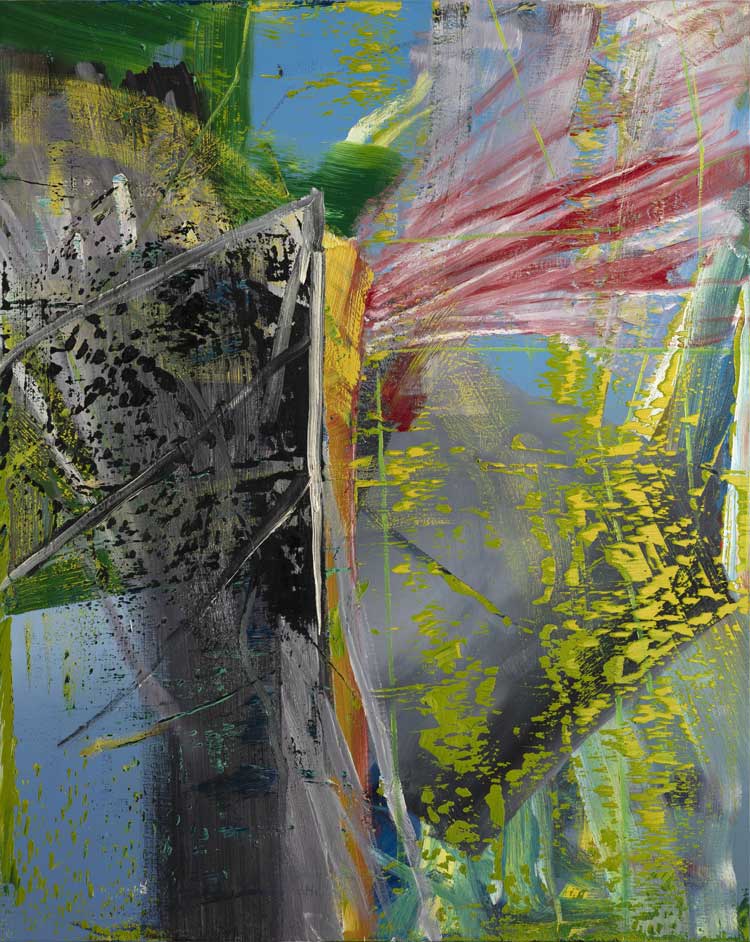
Gerhard Richter, Carrot, 1984. Oil on canvas, 200 x 160 cm. Collection Fondation Louis Vuitton. © Gerhard Richter 2025.
The leap towards abstraction as a central plank of his practice came in the mid-70s, and for me this is where Richter loses his way a little. Many of his early large-scale abstracts have a shocking garishness redolent of 80s graphic design, gunky assemblages of loudly clashing colours. They lack the lyricism of the best abstract expressionism, sometimes feeling like ideas and motifs jumbled together. This may have been part of plan: Richter once stated, “I want to end up with a picture that I haven’t planned”, works of arbitrary choice and chance. But following the mastery of his photo paintings, this extreme transition jars.
Luckily, it did not stick. By the mid-80s Richter’s abstracts hit their stride. Richter developed his method, often using brushes, knives and spatulas to build up layers of paint before using a custom squeegee to erase what was there before. Painterly intent is erased. The results, exemplified by three 1989 works named for the darkest seasons of the year, often feel like cavernous grottos of paint. Strokes ripple and crack, drip across the canvas like stalactites and sprout moss-like protrusions. Colours drip and pool like oil. There is a feeling that you could excavate the canvas layer by layer and find new forms beneath. As some of his photo paintings feel too unerringly accurate to be created by human hand, in Richter’s best abstracts the source of the strokes disappears.
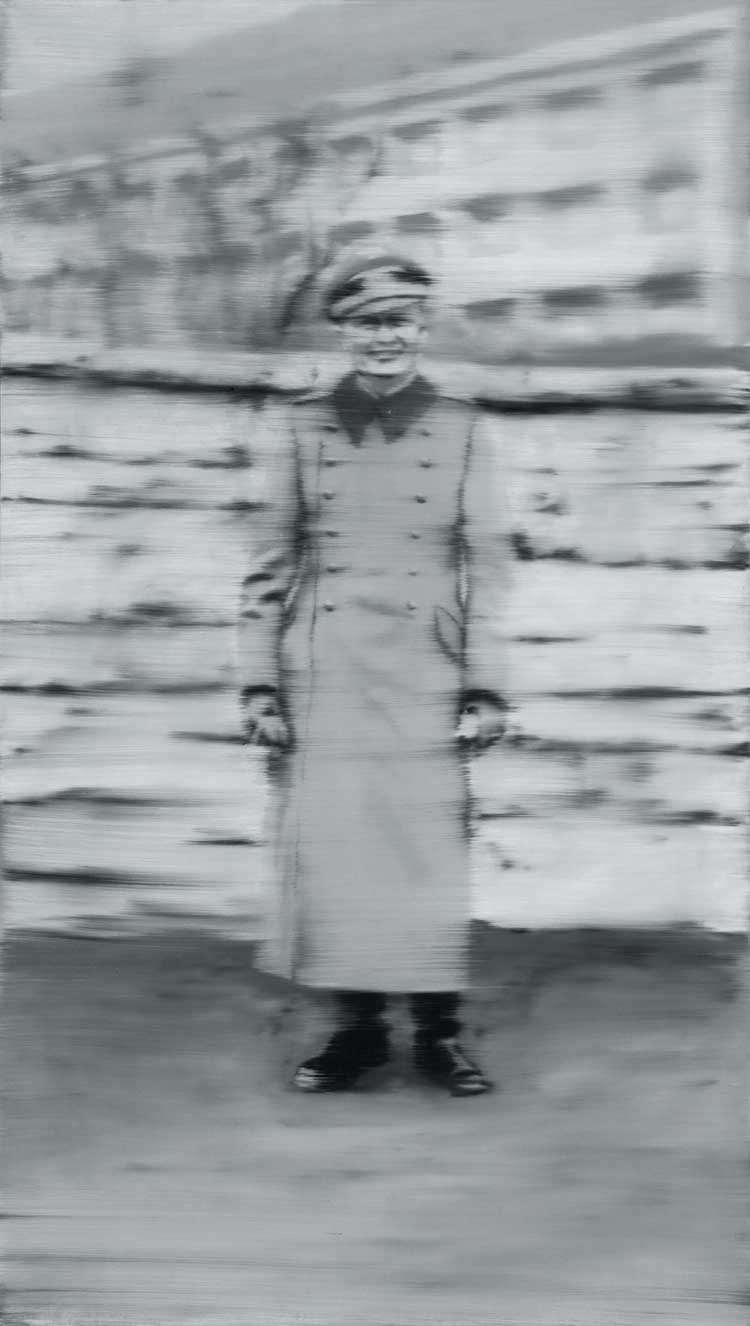
Gerhard Richter, Uncle Rudi, 1965. Oil on canvas, 87 x 50 cm. Collection Lidice Memorial, Czech Republic Photo: Richard Schmidt. © Gerhard Richter 2025.
Erasure is manifested most explicitly in his Birkenau (2014) series, which he created after a break from painting. He began with the only four surviving photographs taken by inmates from the Birkenau concentration and extermination camps, which show the burning of gassed bodies in a forest. Richter first projected these and attempted to copy them. But, as with Tisch five decades before, he was dissatisfied. He began to cover his canvases with a deluge of paint, burying his reproductions in black, grey, red and green. The grey suggests the smoke of burning bodies, the red the blood spills, the green the nature that bore witness to the crimes. Direct depiction is eschewed, as if insufficient to capture an event of unspeakable horror. Richter might be the greatest painter to show such doubt towards the capacity of painting. But these late works – and many of those that come before them at the Fondation – serve as an irrefutable reminder of painting’s continued vitality.
Click on the pictures below to enlarge
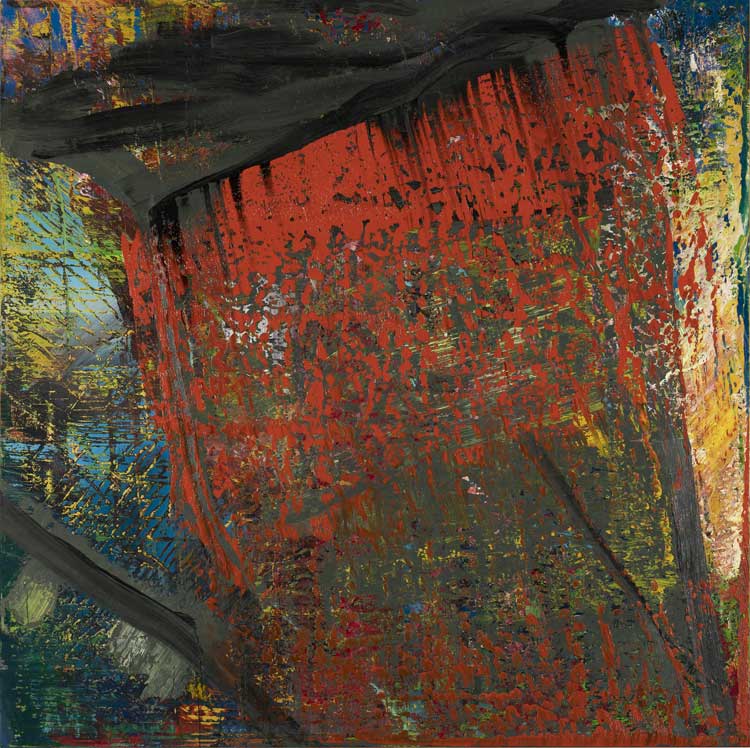
![Gerhard Richter, Reader], 1994. Oil on canvas, 72 x 102 cm. Collection San Francisco Museum of Modern Art. Purchase through the gifts of Mimi and Peter Haas and Helen and Charles Schwab, and the Accessions Committee Fund: Barbara and Gerson Bakar, Collectors Forum, Evelyn D. Haas, Elaine McKeon, Byron R. Meyer, Modern Art Council, Christine and Michael Murray, Nancy and Steven Oliver, Leanne B. Roberts, Madeleine H. Russell, Danielle and Brooks Walker, Jr., Phyllis C. Wattis, and Pat and Bill Wilson. © Gerhard Richter 2025.](/images/articles/r/014-richter-gerhard-2025/gerhard-richter-09.jpg)

Copyright © 1893–2026 Studio International Foundation.
The title Studio International is the property of the Studio International Foundation and, together with the content, are bound by copyright. All rights reserved.
 |
 |
 |
|---|
-1000-300.jpg)
 Joseph Beuys: Actions, Vitrines, Environments
 Gerhard Richter Portraits
 Gerhard Richter: Panorama
 Mediators and Messengers: Contemporary Art in the Landscape
 Douglas Gordon: Superhumanatural