




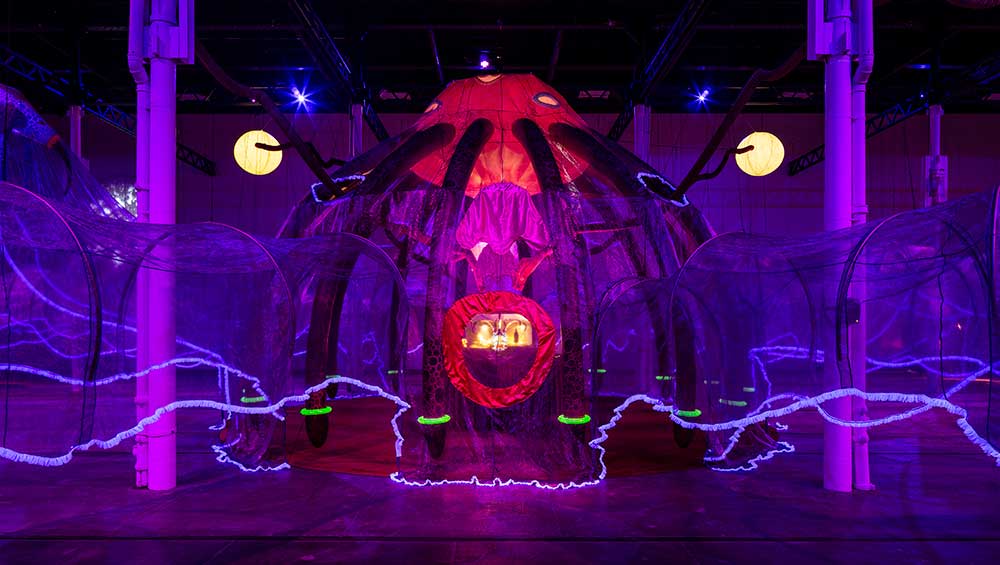
Rae-Yen Song 宋瑞渊, •~TUA~• 大眼 •~MAK~•, installation view, Tramway, Glasgow, 15 November 2025 – 16 August 2026. Photo: Keith Hunter.
Tramway, Glasgow
15 November 2025 – 16 August 2026
by BETH WILLIAMSON
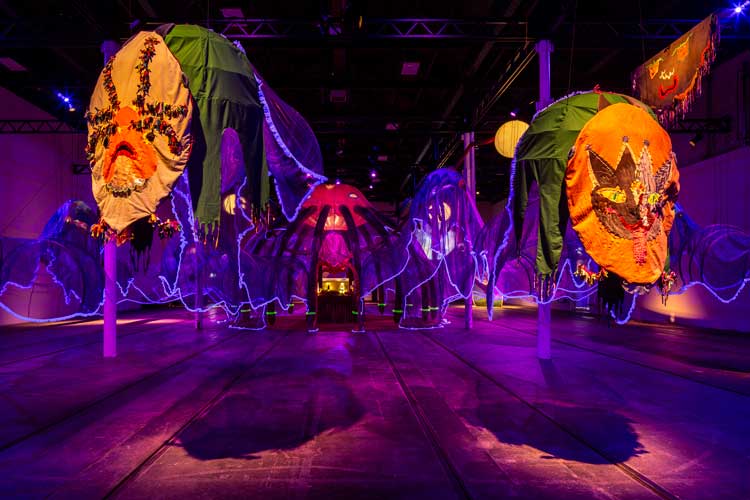
This ambitious exhibition by Rae-Yen Song 宋瑞渊 at Glasgow’s Tramway is compelling from the start. Walk into an imagined world, luminous with thought, that draws visitors to its central sanctuary, then coaxes them to trace its outer limits. A layered soundscape of spoken word, music and sounds from the natural world is, at times, confrontational but soon gives way to something more ritualistic or spiritual. From contemporary art installation to ancestral memories, from landscape to hybrid forms, from Chinese legends to Daoist ritual, from microorganisms to ecosystems, there is so much to process here in a space where sound and light continually shift, and craft and visual arts vie for position. Ceramics, animation, costume and performance all co-exist in a theatrical space like no other.
Tua Mak was Song’s mother’s sibling, who drowned at sea in Singapore in the 1950s aged 13. Song’s mother was born after this tragic death, and so this ancestor lives through memories and myths and fragmented thoughts told to the artist orally. It is something that Song brings to this space as a remembrance, a shrine, a refuge for Tua Mak. Song thinks of the exhibition space and Tua Mak’s body as a landscape or cartographic rendering, a body that has been dispersed through drowning and has become multiple others through different life cycles of eating and excreting and feeding and become many different bodies. It is a chimera or hybrid of many forms. This is also inspired by the Taoist origin story of Pangu, who by dying became the creator of the world: his body became the mountains, his blood became the sea and the rivers, his eyes became the sun and the moon, and the parasites on his body became animals and fauna.
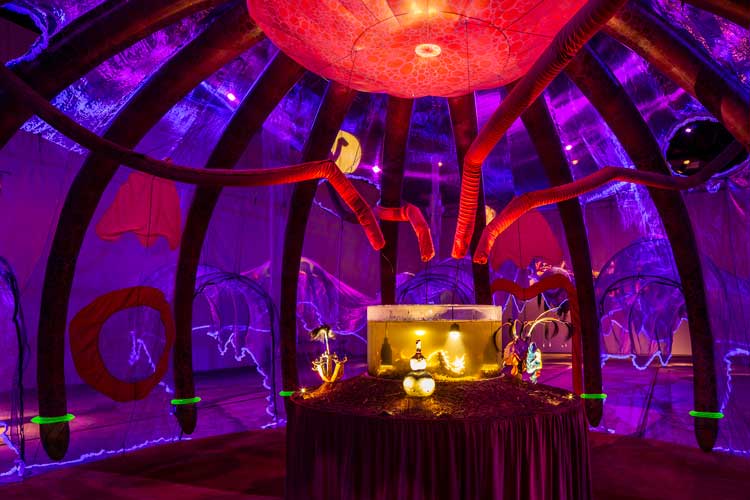
Rae-Yen Song 宋瑞渊, •~TUA~• 大眼 •~MAK~•, installation view, Tramway, Glasgow, 15 November 2025 – 16 August 2026. Photo: Keith Hunter.
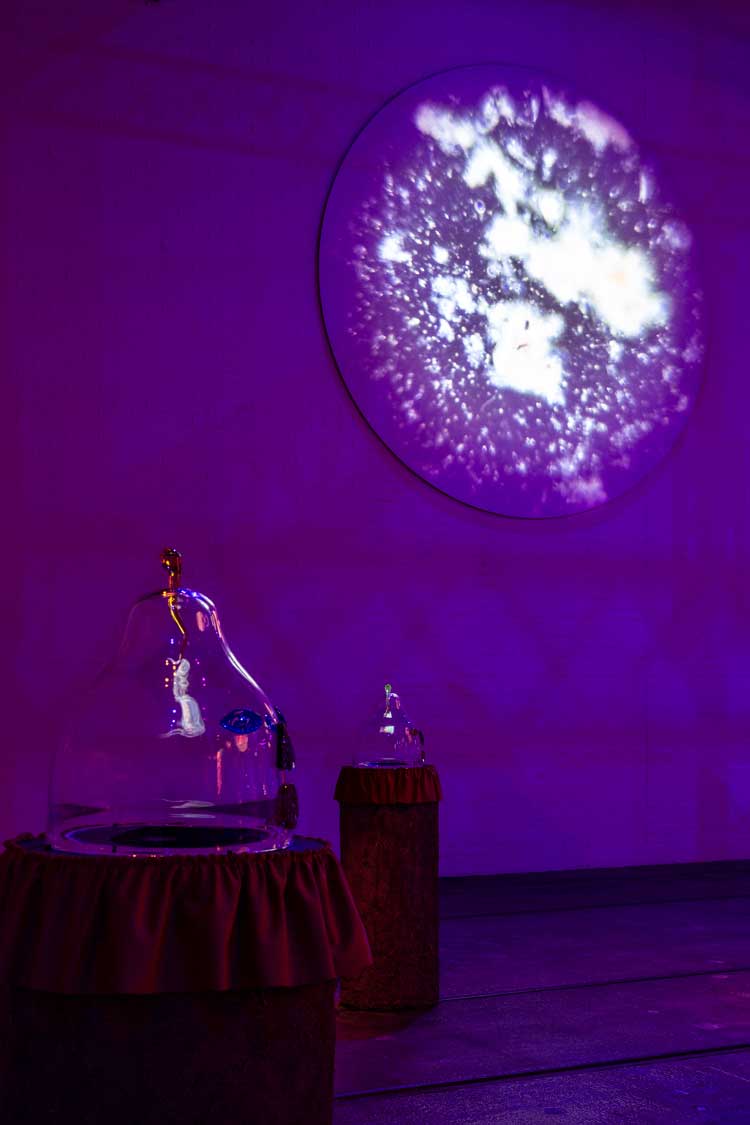
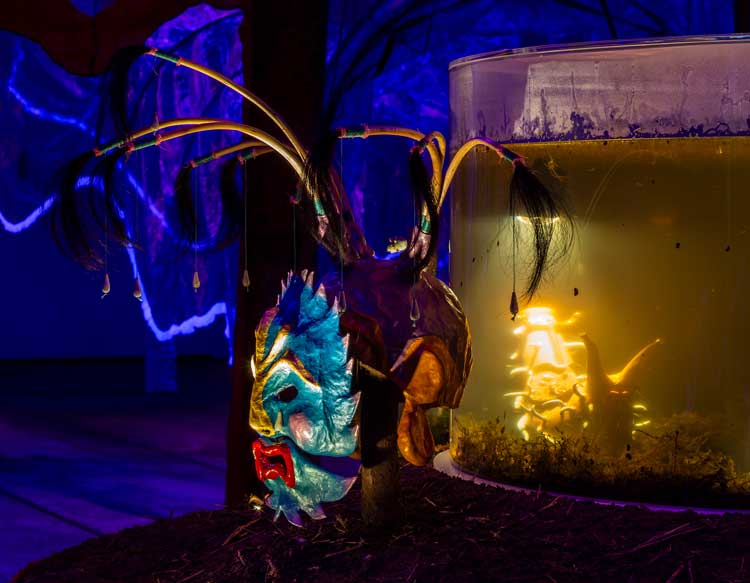
In the centre of the exhibition is a tank containing the artist’s family pond, which was transported from their garden in Edinburgh. Two submerged microscopic cameras project on to two walls, sensing and conveying the movement of microorganisms that control the sound and light. Things are always shifting, changing throughout the course of the exhibition. Song considers this pond element as the heart or brain of the space since it is controlling the light and the sound. These microscopic living organisms control the tones played in the space, tones that were recorded from the pond itself.
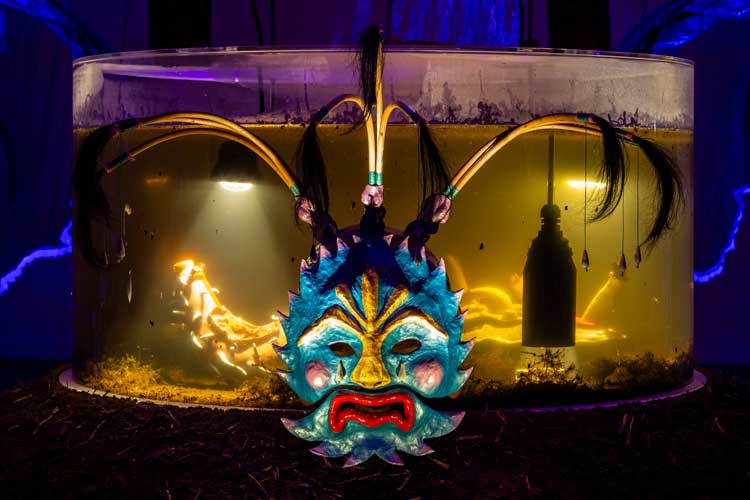
Rae-Yen Song 宋瑞渊, •~TUA~• 大眼 •~MAK~•, installation view, Tramway, Glasgow, 15 November 2025 – 16 August 2026. Photo: Keith Hunter.
Another aspect of the soundscape is a collaboration between Rae-Yen Song 宋瑞渊 and sound artist Flora Yin Wong. The many elements include sections of Song meditating and chanting with their Bubba (Father), gathered field recordings from Singapore, jungle noises, a Malay wedding and gamelan music in Indonesia. Five offerings surround the pond, to create a space of potential, including a mask of the face of Ahma (a mother figure), a gourd and a horn.
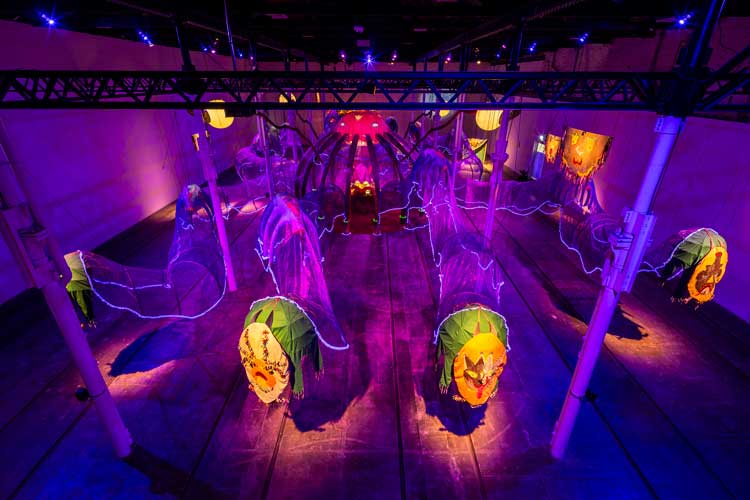
Rae-Yen Song 宋瑞渊, •~TUA~• 大眼 •~MAK~•, installation view, Tramway, Glasgow, 15 November 2025 – 16 August 2026. Photo: Keith Hunter.
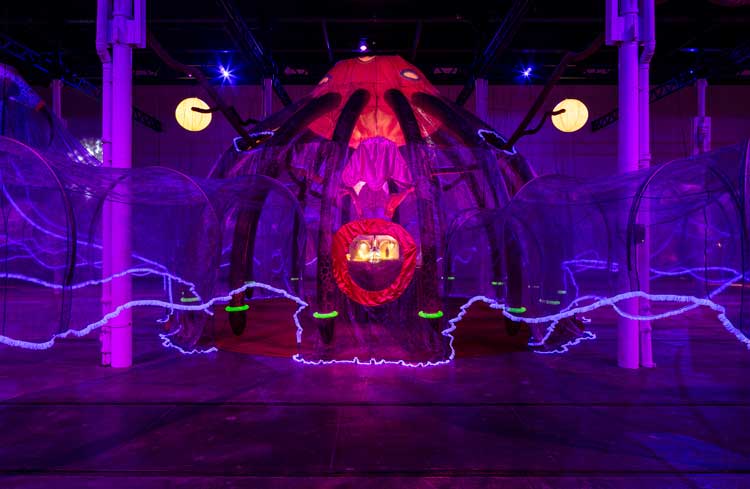
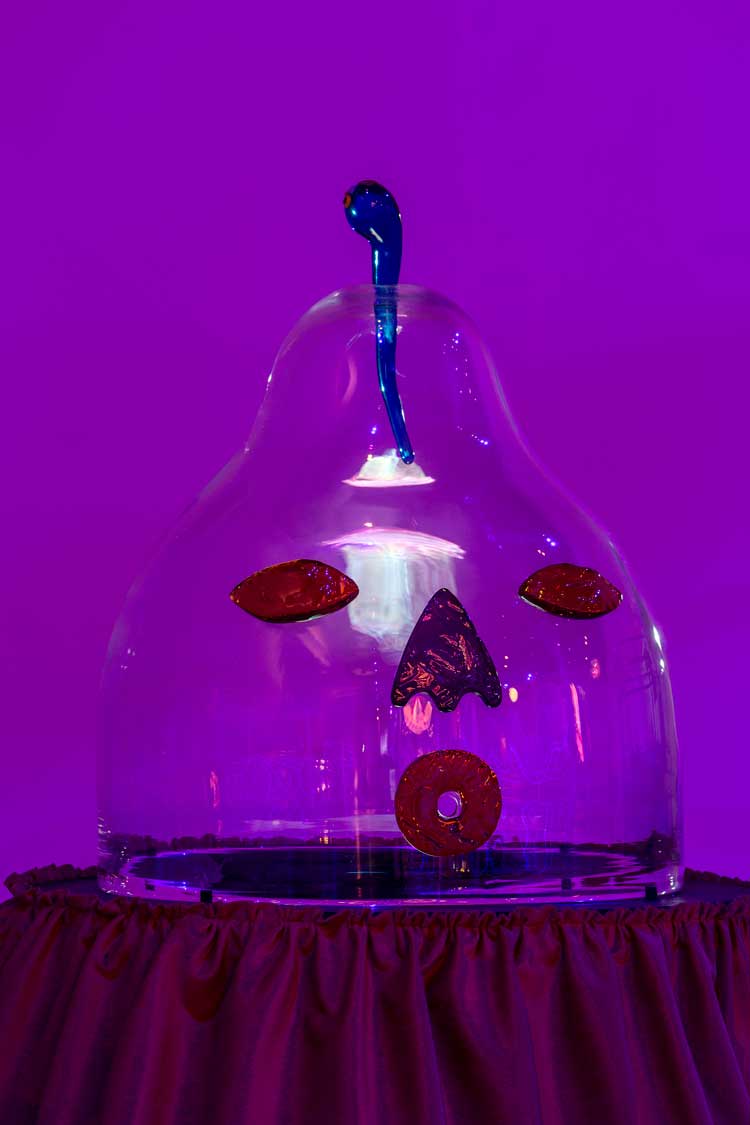
From this central sanctuary, eight tentacles spread outwards towards eight glass heads mounted on cob earth pillars – there is no conventional exhibition architecture used here. Song made eight ceramic objects earlier in the year – all tentacular and inspired by the microorganisms in the pond. These were 3D scanned and animated. It is these animations that we see in each glass dome, also reflected in the glass like a Pepper’s Ghost (an illusory technique used in theatre so that an object off-stage can be projected to appear on stage). These magical scenes are perhaps the ghosts at the edge of this landscape. Here, the artist also thinks of the Daoist idea of a golden body. In this way, they are not only proxies of a deity, but are themselves the deity. Song wanted to create deities of the pond, pond gods. As ceramics, they were in a sleeping state but as animations they are in a dancing state.
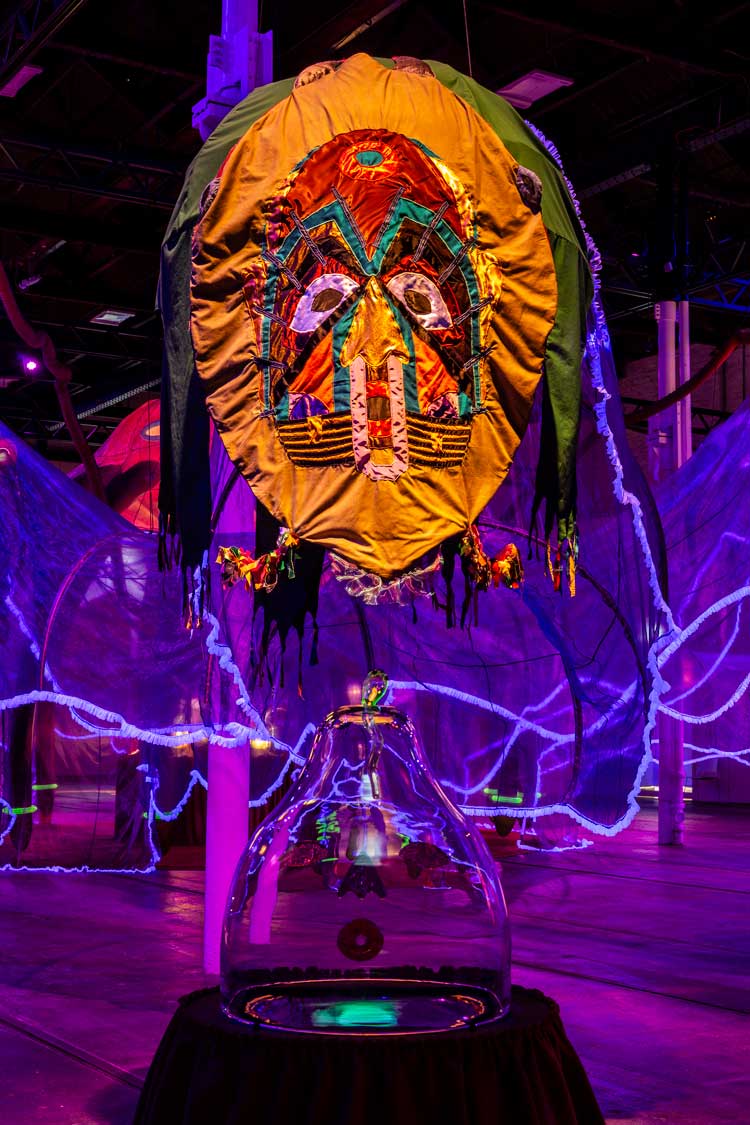
Rae-Yen Song 宋瑞渊, •~TUA~• 大眼 •~MAK~•, installation view, Tramway, Glasgow, 15 November 2025 – 16 August 2026. Photo: Keith Hunter.
Textile elements of the installation (many of the fabrics are inherited) are designed to be worn as costumes at different events and performances throughout the exhibition. The idea is to invite people to come in and be part of the space, to share their energy with the space and develop thoughts and ideas around humanity’s relationship with nature. One cloak, or suit, includes many different tiles that are carved ceramics. The entire garment echoes a jade burial suit – it was believed that jade held powers to protect the dead. This echoes the ritual of life and death, protection and guardianship, ancestors and chi. The idea is of an armour that protects but also a way of navigation that relates to the cosmos and the ancient ideas of maps. Alongside this is a mask, the design of which is influenced by a gold ring that once belonged to Tua Mak and now belongs to Rae-Yen Song 宋瑞渊. The back of the cloak depicts the moment when Tua Mak drowned. The last breath turns into cloud, falls into a deep abyss, relating back to the pond in the centre of the exhibition so that everything is interwoven and connected. Song tells the story in a textural, crafted way, using their hands to make everything with a sense of devotion to continue to tell stories that would otherwise be lost.

Rae-Yen Song 宋瑞渊, •~TUA~• 大眼 •~MAK~•, installation view, Tramway, Glasgow, 15 November 2025 – 16 August 2026. Photo: Keith Hunter.
Everything in this exhibition points to Tua Mak as what Song refers to as “a lively ghost”, who, though they died in the 1950s, is vibrating with energy in the here and now, and also in the future through other bodies, and beyond human bodies too. It is also about respecting that we are one with nature, not just as witness but acknowledging that we are nature and that we are chimeric feasts ourselves. Song’s hybrid forms of practice shift and slide, but there are aspects that echo throughout their practice. The head and a strong sense of family are common threads that resurface and unify an otherwise diverse practice. Drawing on ancestral traditions and practices, they form a new contemporary form of exploring myth, memory and identity. More than that, it is an alternative view of the present and a new vision for the future that builds on ancestry in new and exciting ways.
Click on the pictures below to enlarge



Copyright © 1893–2026 Studio International Foundation.
The title Studio International is the property of the Studio International Foundation and, together with the content, are bound by copyright. All rights reserved.
 |
 |
 |
|---|
-300.jpg)
-300.jpg)

 Maud Sulter: You Are My Kindred Spirit
 Ramesh Mario Nithiyendran – interview: ‘Part of creating the work is to explore those lines between ambiguity and familiarity’
 Khvay Samnang: Calling for Rain – Amartey Golding: Bring Me to Heal
 Tako Taal and Adam Benmakhlouf – interview: ‘This slow-motion style of festival creates a community of audience members’
 Florian Hecker: Synopsis