




-Installation-view-of-MUSCLE-(2025.jpg)
Karimah Ashadu, Muscle, 2025. HD digital film, colour with sound. single channel. Installation view, Camden Art Centre, 2025. Courtesy the artist, Fondazione In Between Art Film, Sadie Coles HQ, London and Camden Art Centre. Photo: Andrea Rossetti.
Camden Art Centre, London
10 October – 22 March 2026
by TOM DENMAN
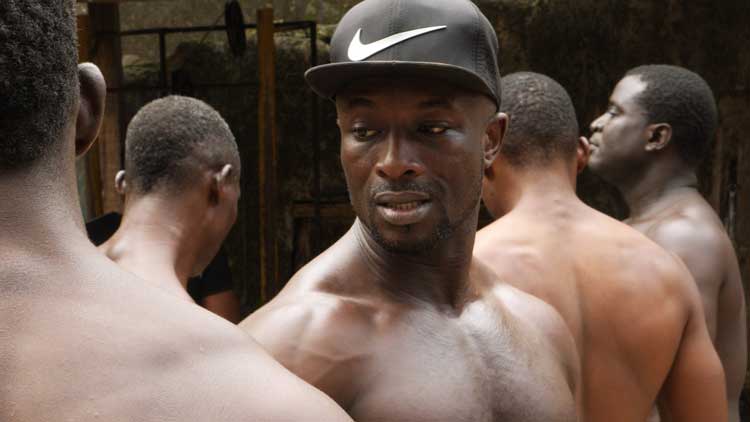
Images of communities denied self-representation beyond their immediate contexts – let alone in an art gallery – risk highlighting alterity above all else. I was reminded of this when I saw this exhibition. Of the three video works that make up this show, the hardest-hitting is the newly commissioned, 22-minute Muscle (2025). The screen filling the end wall of a Dr Caligari-like foreshortened and freshly carpeted room, the film’s subject is a group of men pumping iron in a Lagos slum. Its formal qualities and architectural framing throw into high relief the contrast between the world it depicts (a poverty-stricken part of a former British colony) and the context of viewing (an art gallery in London, Nigeria’s former colonial headquarters). Most striking is how Ashadu zooms in on the bodybuilders’ physicality. The high-definition footage is dominated by closeups highlighting every pore and droplet of sweat: it opens with a view of a man’s pulsing shoulder blade, magnified to fill the wall like brown terrain. The audio picks up on the texture of breath more vividly than we can hear our own – and, presumably, the men can hear theirs. If their physical strength surpasses that of the majority of their London viewers, their gaze is no match for the penetrability of Ashadu’s documentary equipment.

Karimah Ashadu, Muscle, 2025. Film still, HD digital film, colour with sound. single channel. Courtesy the artist, Fondazione In Between Art Film, Sadie Coles HQ, London and Camden Art Centre.
On first viewing, Muscle and its installation forbid any anthropological inclination to contain and classify. The architectural framing forces us to look squarely at the screen, artificial perspective dictating our point of view, while the sensory onslaught – pecs, sweat, grunts, moans – disarms us. Ashadu’s use of the closeup induces, in us, a feeling of passivity: we are unable to draw an outline round any of the figures; in fact, if the bodybuilders knew we were watching them (if only they could really look back), they could draw one round each of us, or move us about the room like chess pieces. However, such an inversion of the colonial gaze is potentially undermined – and revealed as a shoddy simulation, however thrilling – by the work’s redoubling of the asymmetry of power between camera and subject. Linger with the work, reflect on it when you walk out of the room, and any agency that the musclemen might initially appear to have wears thin.
--Installation-view-of-MUSCLE-(2025).jpg "Karimah Ashadu, Muscle, 2025. HD digital film, colour with sound. single channel. Installation view, Camden Art Centre, 2025. Courtesy the artist, Fondazione In Between Art Film, Sadie Coles HQ, London and Camden Art Centre. Photo: Andrea Rossetti.")
Karimah Ashadu, Muscle, 2025. HD digital film, colour with sound. single channel. Installation view, Camden Art Centre, 2025. Courtesy the artist, Fondazione In Between Art Film, Sadie Coles HQ, London and Camden Art Centre. Photo: Andrea Rossetti.
The main issue is Ashadu’s use of state-of-the-art recording technology to inspire wonderment at the subaltern Black male body – I say “use of”, but the effect is more explicitly one of weaponisation. Not only are the richness of HD and the gallery’s specially installed anti-echo purple carpet diametrically opposed to the conditions of the slum, but the contrast is all the more glaring when such technology is used to aestheticise naked corporality, evoking the familiar ultrareal semiotic of nature programmes. This latter association is by no means gratuitous: not one of the men is seen to be speaking. We only hear them grunt, the camera finding them in a state of languageless vulnerability, rendering them as bodies – with all their mental energy apparently absorbed in their physical exertion – above all things. The closeup becomes intrusive, the isolation of muscle groups verging on the medical, the images of mountainous, valleyed flesh on the cartographic.
True, a voiceover is provided by the men – in Yoruba – not an extraneous broadcaster. Yet it is heard sporadically, its quiet, matter-of-fact delivery dwarfed by the sonic ultrarealism of the gym’s sexual symphony of tension and release. But it is not the voiceover’s diminutive texture that weakens the speaker’s intellectual agency as much as its verbal content. This is what marks them as subaltern, reminding us that voice alone is an inadequate provider of real power. If we understand the term “subaltern” the way the theorist Gayatri Chakravorty Spivak does – as a subject denied the critical means of entering the hegemonic discourse of colonialism – platforming such a voice can render it intellectually naked. Doing so is the polar opposite of affording it opacity or critical autonomy.
The speakers’ articulation is neither poetically opaque nor critically empowered, requiring more sensitive treatment than Ashadu affords it by simply laying it over the naked groans. “If you want to live in Lagos you need to be rugged,” one of the men explains. Another says: “I look at people who do not lift weights. How do they live? One who doesn’t exercise, does nothing, only to wake up, eat and sleep, and have sex with their wife.” Although the effort to attain self-determination is palpable in these words, Ashadu’s HD lens picks up on so much more than what is said: an eroticism, a ritualism, a curiously visual obsessiveness, let alone the all-but-visible endorphins. In the wall text, Ashadu is quoted as saying: “Muscle reveals the tension in how the men carry themselves, the weight of expectation, the way that their particular performance of masculinity requires an audience to activate it, otherwise it’s flaccid.” But surely this validating audience is found on the streets of Lagos, not in Camden Art Centre, where the privileged viewer is free to anthropologically interrogate and decipher what the unwitting bodybuilders are doing and saying – indeed, to provide the all-seeing commentary Ashadu otherwise omits.
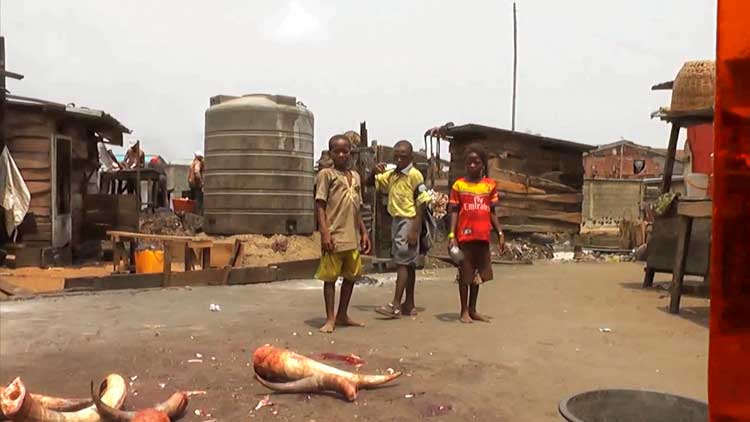
-Installation-view-of-King-of-Boys-(Abattoir-of-Makoko)-(2015).jpg "Karimah Ashadu, King of Boys (Abattoir of Makoko), 2015. HD digital film, colour with sound, 5 mins. Installation view, Camden Art Centre, 2025. Courtesy the artist, Fondazione In Between Art Film, Sadie Coles HQ, London and Camden Art Centre. Photo: Andrea Rossetti.")
Karimah Ashadu, King of Boys (Abattoir of Makoko), 2015. HD digital film, colour with sound, 5 mins. Installation view, Camden Art Centre, 2025. Courtesy the artist, Fondazione In Between Art Film, Sadie Coles HQ, London and Camden Art Centre. Photo: Andrea Rossetti.
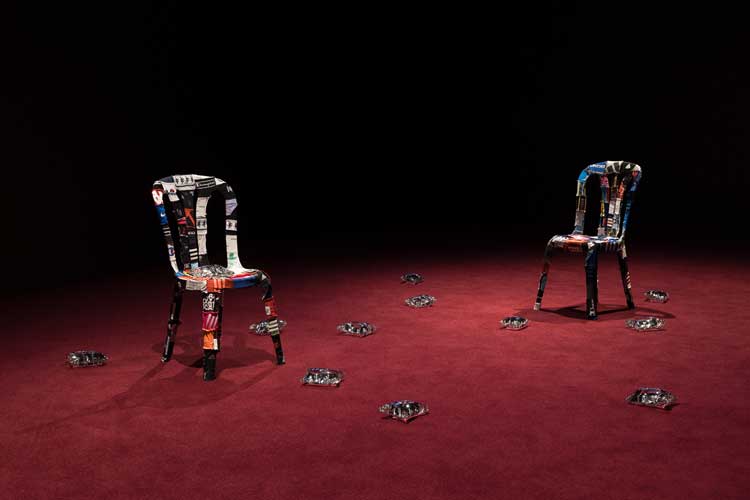
Although less flagrantly, these problems recur in the exhibition’s two other, shorter films. Presented on a concave screen, King of Boys (Abattoir of Makoko) (2015) immerses us in a scene of carnage: men hacking away at animal carcasses, apparently unaware of the camera’s presence. The lens’s robotic swivel and blood-red filter are reminiscent of first-person shooter video games; often there is even an oval at the centre of the screen suggesting, if not a gun’s viewfinder, a pronouncedly targeting gaze. The image of remote-controlled militarism – camped up with a ghoulish soundtrack – establishes a sense of invasion and alterity. In many ways, it is hard not to like Cowboy (2022), a two-screen installation that follows a groom riding to the Nigerian coast as he talks about his love of horses. But Ashadu’s rhetorical mise en scène strikes as being at odds with the subjectivity of the rider – the ocean hints at “the global economic trade central to Nigeria’s past and its future”, for instance, when all we know of the man’s direct experience of internationalism is that he moved to Lagos from Saudi Arabia, in a horse truck, when he was 14. By generalising a Black equestrian’s relationship to the landscape, Ashadu risks imposing her authorial privilege on someone else’s story.
-Installation-view-of-Cowboy-(2022)-in-Karimah-Ashadu.jpg "Karimah Ashadu, Cowboy, 2022. HD digital film, colour with sound, two channel, 10:40 mins. Installation view, Camden Art Centre, 2025. Courtesy the artist, Fondazione In Between Art Film, Sadie Coles HQ, London and Camden Art Centre. Photo: Andrea Rossetti.")
Karimah Ashadu, Cowboy, 2022. HD digital film, colour with sound, two channel, 10:40 mins. Installation view, Camden Art Centre, 2025. Courtesy the artist, Fondazione In Between Art Film, Sadie Coles HQ, London and Camden Art Centre. Photo: Andrea Rossetti.
Such asymmetry is evident in all three films, dilating the gap between author and authored and thereby hampering the artist’s – and the institution’s – anti-colonialist objectives. One thing the exhibition crucially calls for is a more nuanced understanding of subject positionality in the making and curating of art. It may be obtuse of me to comment on the artist’s own subject position. But far more important here is the colonial standpoint versus the Other her work produces through its effects and context – with HD capture, ultrareal sound detection, militarist viewfinders, theatrical staging and cinematic tricks all intended to wow us with a Black and poverty-stricken sublime in the metropole.
Click on the pictures below to enlarge
-Installation-view-of-Cowboy-(2022).jpg)
-courtesy-of-the-artist.jpg)


Copyright © 1893–2026 Studio International Foundation.
The title Studio International is the property of the Studio International Foundation and, together with the content, are bound by copyright. All rights reserved.
 |
 |
 |
|---|

-1000-300.jpg)
 'Destricted': sex as performance art
 The Deformation Man: David Lynch's Chimerical Universe of Metamorphosis
 The Apparitions of a Surrealist Eye: Dalí & Film
 AfterShock: Conflict, Violence and Resolution in Contemporary Art
 Up Against Jeff Wall