


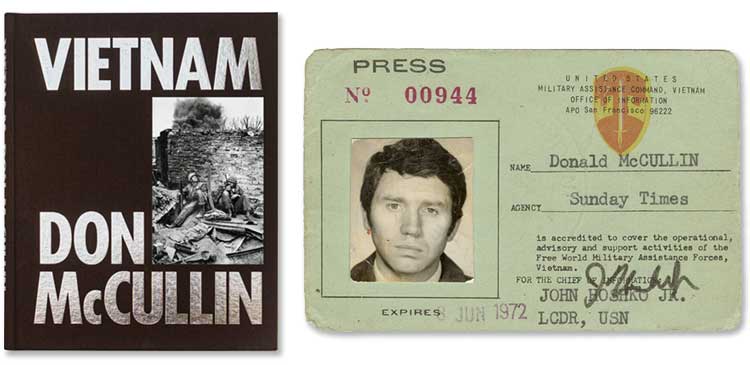
Vietnam by Don McCullin, book cover and Don McCullin's press card. © Don McCullin.
reviewed by BETH WILLIAMSON
The first review I wrote for Studio International, in 2019, covered an exhibition of work at Tate Britain by the British photojournalist Don McCullin (b1935). His work had first been published in 1959 in the Observer newspaper, so that exhibition marked 60 years of his career and covered the full range of his photographic practice, from that first publication, The Guvnors in Their Sunday Suits (1958). Later, there were images of acute poverty in towns in the north of England. There were scenes of homelessness in the East End of London. There were achingly pitiful pictures of those dying in the Aids pandemic in Africa. There were late Somerset landscapes too. But McCullin is best known now, and then, for his photographs of conflict across the world – Bangladesh, Beirut, Biafra, Iraq, Northern Ireland and Vietnam.
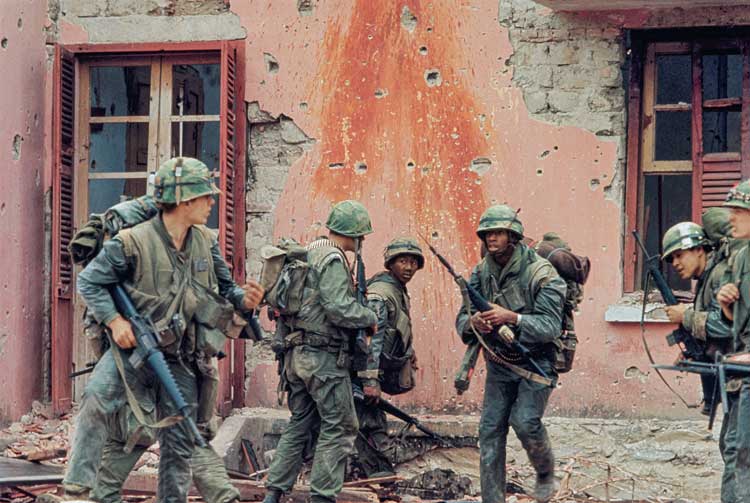
©️ Don McCullin.
This new book marks his long commitment to documenting conflict in Vietnam, a place he visited first in 1955 for the Illustrated London News and many times after, including for the German magazine Quick and the Sunday Times. Now aged 91, McCullin has said this will be his last book, so it is a landmark publication by any measure. It is essentially a retrospective of his work in Vietnam and includes images from three campaigns in the region. Those familiar with McCullin’s work will recognise some of the images. The iconic Shell-Shocked US Marine, The Battle of Hue (1968), was widely published in newspapers of the time while other images, such as The Battle for the City of Hue, South Vietnam, US Marine Inside Civilian House (1968), even featured in photography and art history classes in universities. That said, almost half the images in the book have not previously been published or exhibited but have been retrieved from McCullin’s archive.
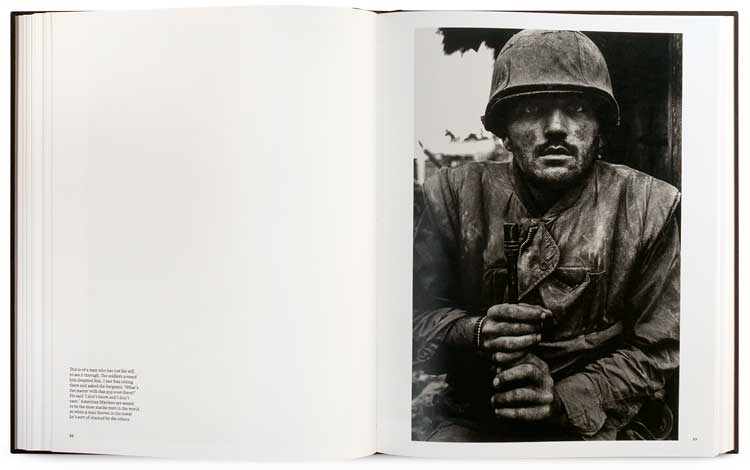
Shell-shocked US Marine, The Battle of Hue (1968). © Don McCullin.
Alongside the photographs, extracts from a conversation between McCullin and the director of Gost Books, Stuart Smith, act as captions of sorts, breathing another dimension of feeling into them in a particularly thoughtful manner. As McCullin has said elsewhere: “Photography for me is not looking, it’s feeling. If you can’t feel what you’re looking at, then you’re never going to get others to feel anything when they look at your pictures.” This aligns well with other statements where he foregrounds his role in Vietnam not as a photographer, but as a human being. Ultimately, he operates from a space of compassion and that is evident in each image.
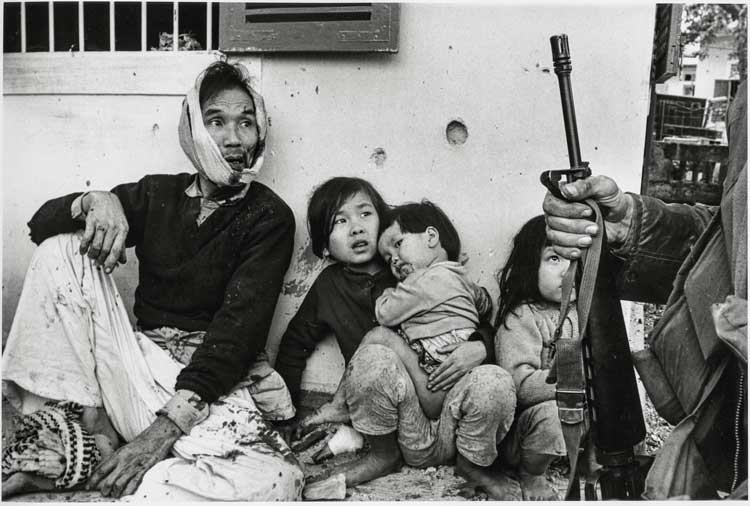
“This family was in a bunker. When the Americans threw a grenade in a bunker, they would shout ‘fire in the hole!’ before there was an enormous explosion. I don’t know how these people got out alive. I was just trying to show how you’d feel if that was your family—so badly shocked and threatened at the end of it all” Don McCullin. © Don McCullin.
This collection of images is bookended by a photograph of McCullin’s boot at the beginning and a photograph of his compass and helmet at the end. He explains how he had to acquire suitable clothing: “I scavenged my uniform from [a] first aid area where casualties were taken … There were mountains for helmets and flak jackets.” Working alongside the US marines, McCullin may have dressed like them, but he did not think like them. Original contact sheets from The Battle of Hue (1968), reproduced at the beginning of the book, give some small sense of how quickly situations develop, as well as an indication of how McCullin selected one image from many.
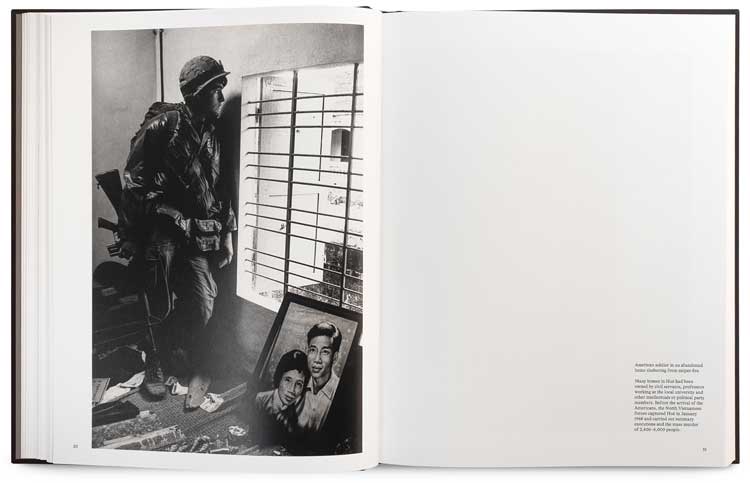
American soldier in an abandoned home sheltering from sniper fire. Many homes in Hué had been
owned by civil servants, professors working at the local university and other intellectuals or political party members. Before the arrival of the Americans, the North Vietnamese forces captured Hué in January 1968 and carried out summary executions and the mass murder of 2,800–6,000 people. © Don McCullin.
What is striking throughout these pages is McCullin’s continued desire not to glorify or glamorise war while, at the same time, knowing that these things were in some way inevitable. Still, his focus was not only on “heroic” US marines. There are newly conscripted recruits to the South Vietnamese army. There is the impact on local people and villages. We see suspected Vietcong recruits being dragged from hiding places and US marines walking past the bodies of Vietnamese civilians.
One photograph shows US soldiers looking for souvenirs or trophies on the body of a North Vietnamese boy, behaviour McCullin found macabre. They dumped his personal items – a medical kit, photographs and letters. These items, McCullin felt, had a story to tell. This was an ethical stance on his part, exercised further a few years later when he stopped South Vietnamese soldiers destroying the possessions of a North Vietnamese soldier. This kind of humanity is seen again in a photograph of US soldiers carrying a young North Vietnamese soldier out of a foxhole and away from battle. In the midst of war, a priest prays over a soldier while a father tries to comfort his family after an explosion. McCullin’s final trip to Vietnam was in 1972.
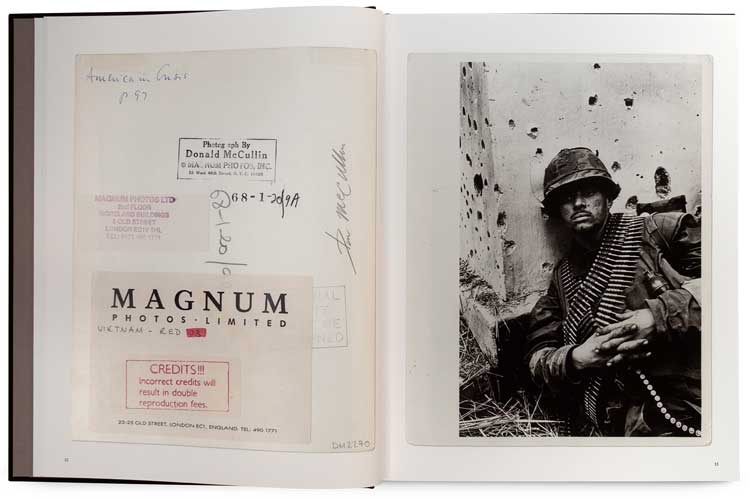
US infantryman with eyes of death and survival. © Don McCullin.
There are some truly horrific images in this book: a Vietnamese baby being treated after being hit by napalm; a dead North Vietnamese soldier with his face blown off. Suffering suffuses every photograph and when McCullin talks about his experience he always reveals a sensitivity that sits alongside his eye for truthful reporting. He may have wanted to take an impactful photograph, but above all he wanted to convey the horrors of war, the eternal suffering and the pointlessness and seeming endlessness of wars across the world. As he explains: “I’d witnessed combat up close. I reviled violence, always, but journalism had also inculcated me with a certain dutiful attraction to conflict.”
McCullin still lives every day with the horror of what he saw and experienced in Vietnam and elsewhere. As a photojournalist, he acted as witness for the world. As a human being, he tried to act with compassion and sensitivity. Look on this book and be reminded of humankind’s violence against itself, its inhumanity, its perpetual suffering. The role of the war photographer is now much more constrained than it was. McCullin had a free hand, and these images may be some the last truly honest images of war we will ever see.
• Vietnam by Don McCullin, is published by Gost Books, 2026, price £80/ €95.
Click on the pictures below to enlarge

Copyright © 1893–2026 Studio International Foundation.
The title Studio International is the property of the Studio International Foundation and, together with the content, are bound by copyright. All rights reserved.
 |
 |
 |
|---|



 Thao Nguyen Phan: Becoming Alluvium
 Martin Parr – Interview: ‘Britain is eternally fascinating … full of contradictions … Photographing it is a form of therapy’
 Nguyen Trinh Thi – interview: ‘I want to unpick the way we look at things’
 Don McCullin
 Jane Irish: ‘There is a critical strain about the anti-war movement that I want to commemorate, so I really think of my work as history painting’