


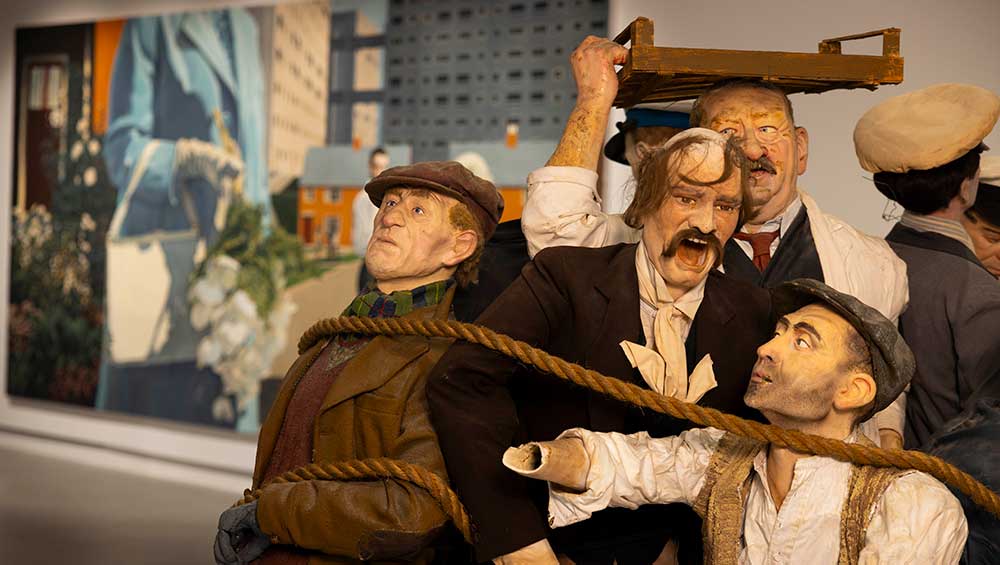
Installation view of Alex Margo Arden, Accounts (2025) in British Art Show 10: A Chorus of Strangers. Image courtesy the artist and Hayward Gallery Touring. Photo: David Parry.
Coventry University and the Herbert and Mead galleries
2 October 2026 – 10 January 2027, then touring
by MARK HUDSON
Close observers of contemporary art will feel a disconcerting sense of deja vu on entering Moments of Being, the first display at the Hayward Gallery Touring’s British Art Show 10 at Coventry’s Mead Gallery. The focus is on painting, with prominence given to artists who broke through in the Hayward Gallery’s 2021 Mixing It Up: Painting Today – a show credited with creating a surge in narrative painting in the aftermath of Covid. While the work of Louise Giovanelli, Mohammed Sami, Kudzanai-Violet Hwami and other Mixing It Up “graduates” still looks strong, it already feels like the product of a different era. The visibility of Emma Talbot’s neo-psychedelic painted silk banners – the first thing we see on entering – takes us straight to another defining exhibition of recent times: The Milk of Dreams, the official exhibition at the 2022 Venice Biennale, which proposed a digital-mystical-posthumanist direction for art (it became, in fact, just one of many strands in today’s polymorphous scene).
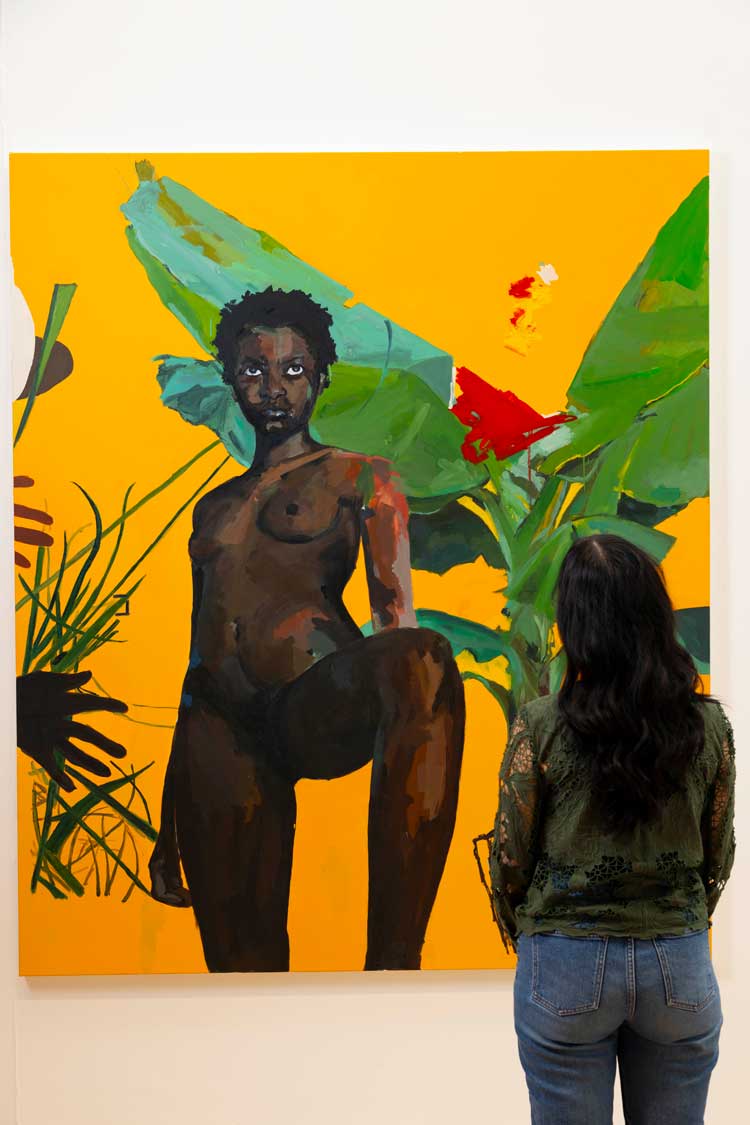
Installation view of Kudzanai-Violet Hwami, Dance of Many Hands, (2017) in British Art Show 10: A Chorus of Strangers. Image courtesy Hayward Gallery Touring. Photo: David Parry.
Having reviewed two previous British Arts Shows (7 and 8), both of which felt bracingly future-driven, I was disappointed to find the feel here so retrospective. But reading into the background of this five-yearly touring “snapshot of British contemporary art”, it is clear that its organisers have been divided on its temporal focus since its inception in 1979. Should it be providing the British provinces with a taste of tomorrow’s art right now, or a digest of all the era-defining exhibitions they didn’t get to see?
While this “landmark” edition, curated by Ekow Eshun, sets out to ask, “what form empathy and shared imagination might take in polarising times” (Eshun’s words), it also has the objective of providing “a vital overview of the most exciting art produced in the UK over the past five years” (the official blurb). In other words, an opportunity to find out what art can contribute to the age of Trump, Gaza and AI, feels hindered at times by an obligation to look backwards.
While British Art Shows regularly pull large numbers of viewers who are first time visitors to the gallery in question, and are in many cases, it’s said, first time consumers of contemporary art, how much are they – or any viewers – expected to read the wall panels, never mind the catalogue, in which BAS curators expound the complex rationales of their shows?
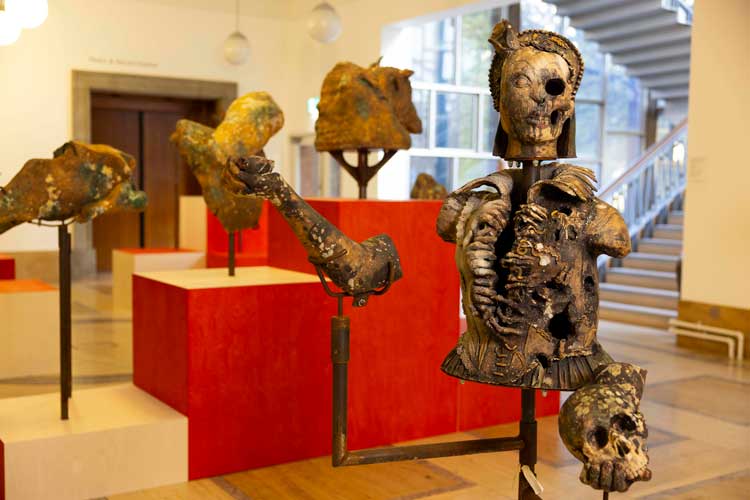
Installation view of Lindsey Mendick, Wicked Game (2025) in British Art Show 10: A Chorus of Strangers. Image courtesy the artist and Hayward Gallery Touring. Photo: David Parry.
This show’s title, A Chorus of Strangers, knowingly invokes Keir Starmer’s notorious “island of strangers” comment. But its point of departure, as defined in Eshun’s catalogue essay, is an early 16th-century London riot against “strangers”, in which thousands sacked the shops and homes of French and Flemish artisans; an event roundly condemned by “metropolitan intellectuals” including Thomas More and William Shakespeare. So, what changes? Paraphrasing More, as paraphrased by Shakespeare, Eshun concludes that the reaction to the presence of the “stranger”, the “outsider”, the “other” should be “not hostility, but empathy”. He has thus assembled a “chorus” of artists “exploring, challenging and reimagining ideas of connection and belonging”. The fact that at least half of these artists have names that many in Britain would still find “other” is barely mentioned by Eshun; the curator likely figuring that a preponderance of non-white artists wouldn’t surprise anyone at this stage in the cultural game.
Fascinating as all this is on paper, and I only had the opportunity to take in the catalogue with its attendant literary texts, after I’d seen the exhibition, I felt I could have been reviewing book and show as entirely independent works.
While the second and third parts of the exhibition, States of Nature, focused on video and technologically driven art at Coventry University, and Ways of Living, comprising historically focused, immersive installations at the Herbert Art Gallery, feel less retro-flective than the first, there isn’t much, at first sight, that will feel radically challenging or wincingly innovative to even the least art-attuned of visitors.
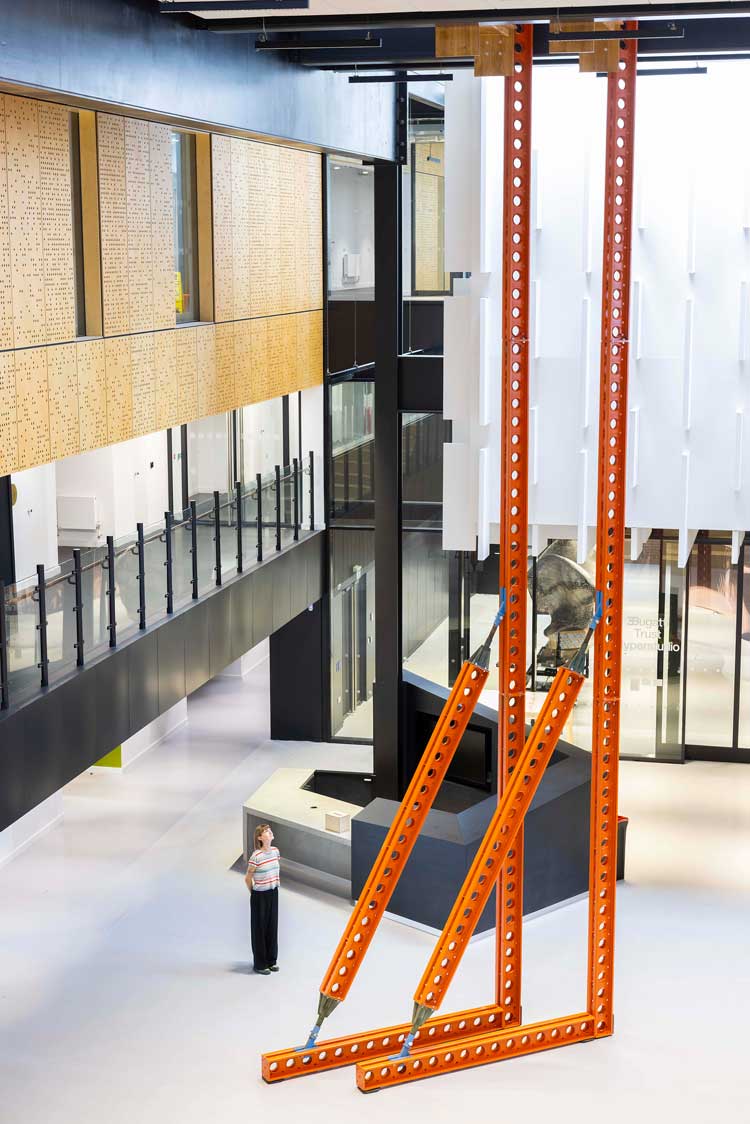
Installation view of Jasleen Kaur, Peace and (2026) in British Art Show 10: A Chorus of Strangers. Image courtesy the artist and Hayward Gallery Touring. Photo: David Parry.
Jasleen Kaur’s Meccano-like architectural intervention in the University’s Delia Derbyshire Building might have had viewers gaping 20 years ago, but most will barely notice it now. Hannah Perry’s Antagonist, a pair of gigantic “dancing” steel and resin pelvic bones – just the kind of wacky modern work newspaper editors love to hear about – were too slow-moving to even start to hold attention.
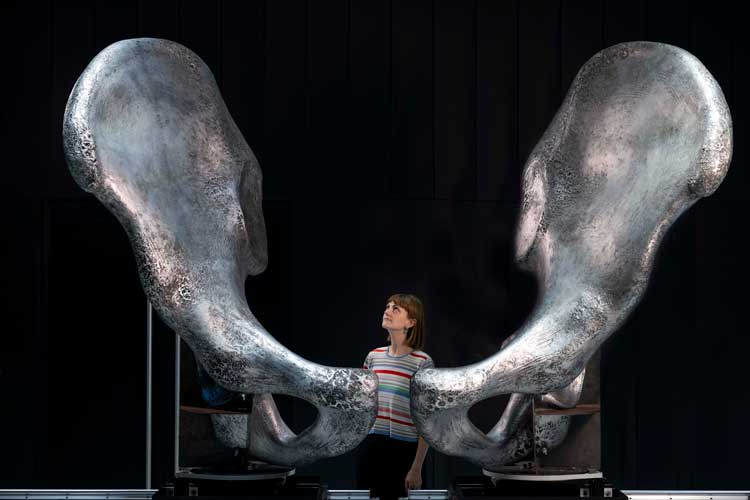
Installation view of Hannah Perry, Antagonist (2024) in British Art Show 10: A Chorus of Strangers. Image courtesy the artist and Hayward Gallery Touring. Photo: David Parry.
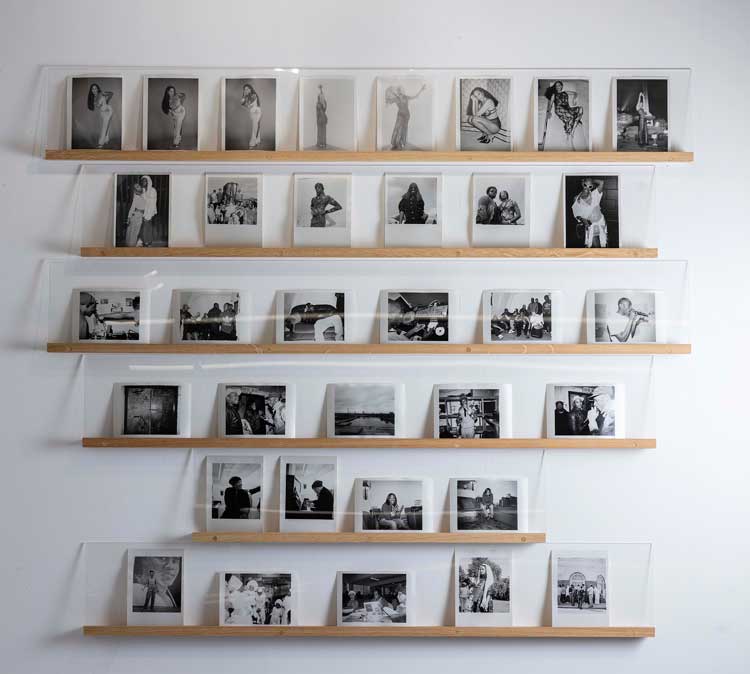
Installation view of Liz Johnson Artur, Where Does Tenderness Come From (1991-ongoing) in British Art Show 10: A Chorus of Strangers. Image courtesy the artist and Hayward Gallery Touring. Photo: David Parry.
Repurposing archives has been a commonplace strategy in recent art, but Liz Johnson Artur’s free play with her own Black Balloon Archive of the British African Diaspora comes close to providing the new forms of subjectivity implicit in Eshun’s call for artists and audience to probe “human connection and the figure of the other”. Who is the “other” in her textile work juxtaposing barbershop images of young Black men with African-themed hairstyles with pieces of classical African sculpture that can be considered portraits?
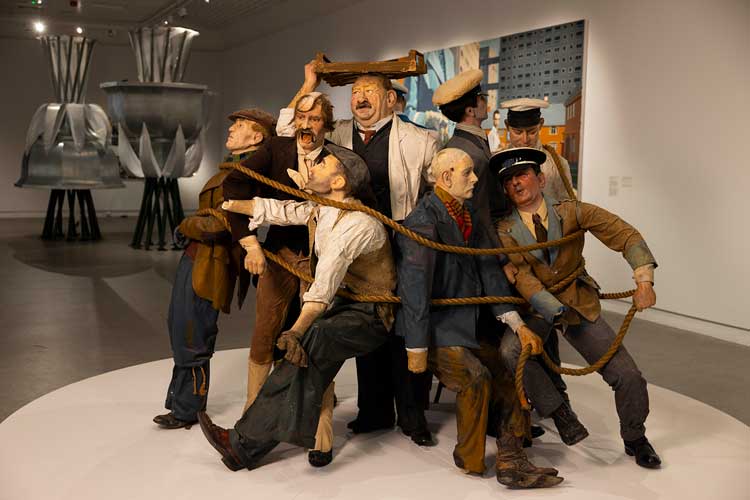
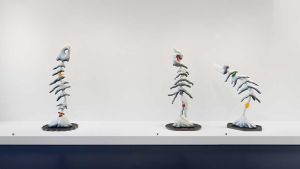
Installation view of Alex Margo Arden, Accounts (2025) in British Art Show 10: A Chorus of Strangers. Image courtesy the artist and Hayward Gallery Touring. Photo: David Parry.
There is a surprisingly similar sense of interpenetrating otherness in Alex Margo Arden’s Accounts, a cluster of nine mannequins illustrating British types, which were discarded by the National Motoring Museum, held together with a tug-of-war rope. While these life-size representations of the milkman, the butcher, the wealthy motorist etc will have been abandoned because they were in poor condition and a touch old-fashioned, it feels as if they could have been purged in a kind of “decolonising” of the museum, but from a white British, class-based perspective.
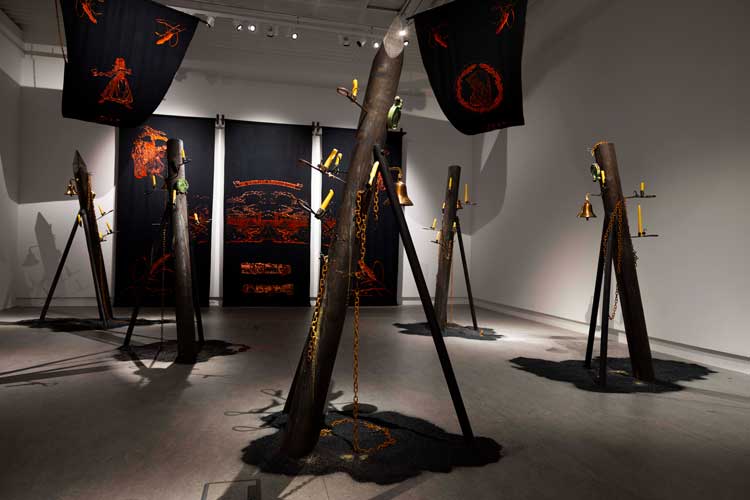
Installation view of Shiraz Bayjoo, Lands of Plenty/ Plains of Plenty (2026) in British Art Show 10: A Chorus of Strangers. Image courtesy the artist and Hayward Gallery Touring. Photo: David Parry.
Shiraz Bayjoo’s striking installation Land of Plenty/Plains a Plenty (2026), exploring the “intertwined histories of colonialism, migration and trade across the Indian ocean”, looks at first like just a very good example of the kind of research-based reconfiguring of materials and objects that has become a familiar staple of this kind of exhibition. Clusters of spike-like pit-props sprout from pools of volcanic dust, beneath festooning drapes of black Indian cloth embroidered in copper wire with scenes of Welsh rioters and Mauritian Sega dancers. What makes it stand out from a myriad other such works is that Bayjoo seems as angry at the poisoning of the rivers north of Swansea (where the work was commissioned) and the brutal exploitation of British workers in the processes of monetising the empire as he is at the plundering of materials from his native Mauritius. There is a fascinating expansion here of the process of identification.
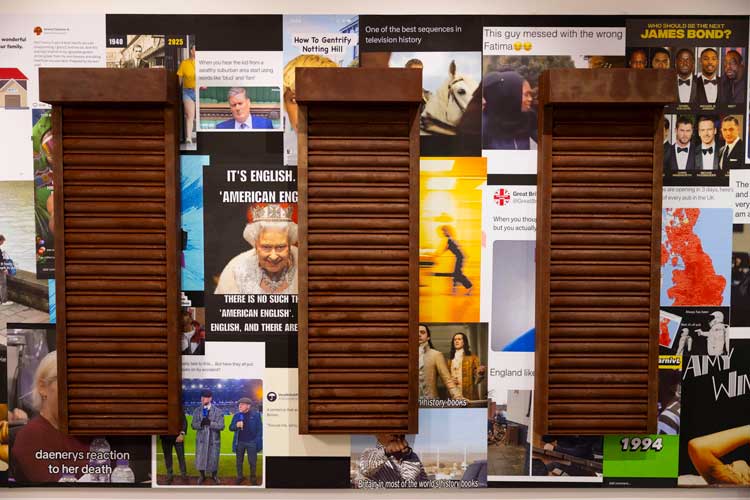
Installation view of Alvaro Barrington’s The City Is Mines/You Belong BAS 2026 (2026) in British Art Show 10: A Chorus of Strangers. Image courtesy the artist and Hayward Gallery Touring. Photo: David Parry.
Alvaro Barrington’s wall-filling installation of social media posts punctuated by steel storefront shutters is the only work to even glance at the online barrage through which most of us are experiencing our divided and polarising times. But quirkier, more affecting and more technically innovative is Precious Okoyomon’s Sky Song, in which the British-born Nigerian-American artist, best known for their garden installations, pilots a light aircraft over the flat landscape of their adoptive Ohio, while declaiming from their own poetry on material and spiritual freedom.
Beyond the hilarious chutzpah of the idea itself, the work opens up genuinely new possibilities in embodying the sublime (imagine if Turner had had his own plane). Alongside Ufuoma Essi’s film Bodies in Dissent, which is composed mostly of archive footage and found text, but is nonetheless strongly autobiographical in feel, it suggests that the possibilities for Eshun’s yearned-for “empathy and shared imagination” are at their most fertile when the perceptions of the artist are at their most personal and intense. If that’s hardly a revelation in itself, after a period of what feels like decades of mega-exhibitions that have barely touched on self-expression or subjective experience, it feels almost radical. That was my main take-away from a nicely put-together exhibition which addresses turbulent times, but ends up feeling rather studious and subdued at its core.
• British Art Show 10: A Chorus of Strangers is at Coventry University, and the Herbert and Mead galleries until 10 January. Then touring to Swansea, Bristol, Sheffield and Newcastle Gateshead until 18 June 2028.
Click on the pictures below to enlarge

Copyright © 1893–2026 Studio International Foundation.
The title Studio International is the property of the Studio International Foundation and, together with the content, are bound by copyright. All rights reserved.
 |
 |
 |
|---|


 British Art Show 9
 Martino Gamper: British Art Show 8
 Rachel Maclean: British Art Show 8
 Ryan Gander: British Art Show 8
 Laure Prouvost: British Art Show 8