


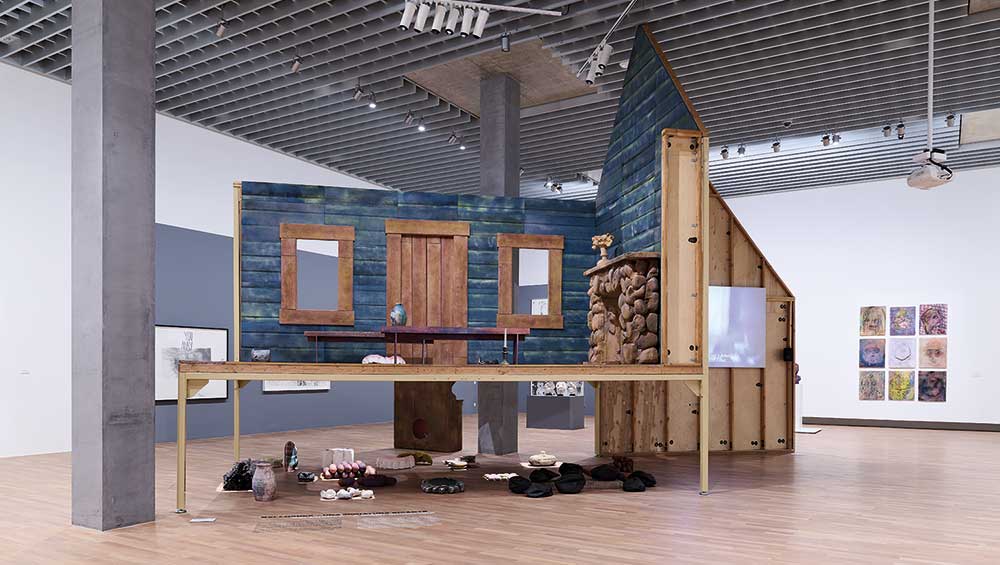
Kaari Upson: Dollhouse – a Retrospective, installation view, MASI Lugano, 6 September 2026 – 10 January 2027. Photo: Gabriele Spalluto.
MASI Lugano
6 September 2026 – 10 January 2027
by SABINE CASPARIE
MASI Lugano’s director, Letizia Ragaglia, has been at the helm only since the spring and, she tells the large press group, she couldn’t be more pleased to inherit the exhibition Kaari Upson: Dollhouse from her predecessor. After all, Upson is one of the most prominent and exciting feminist artists of the 21st century. This is the last leg of the exhibition, which journeyed from Copenhagen’s Louisiana Museum of Modern Art to Kunsthalle Mannheim, before ending here. It is a beautiful temporary resting place for an exhibition, opposite the luminous deep-blue water of Lake Lugano. Upson died from cancer at 51, and today her studio manager, Michael Benevento, is present. He has decided to keep quiet, Ragaglia informs us, to let the artist and her work speak. I can’t help but think that this is possibly the most feminist gesture of all.
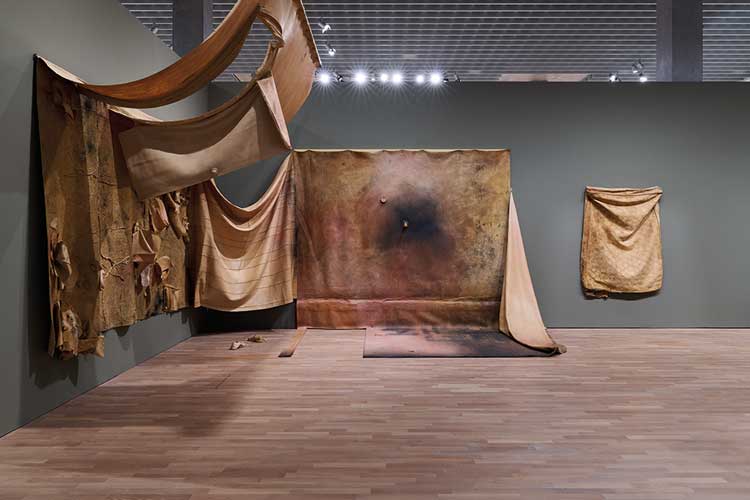
Kaari Upson, Recollection Hysteria, 2012. Latex paint, pigment and metal. Installation view, Kaari Upson: Dollhouse – a Retrospective, MASI Lugano, 6 September 2026 – 10 January 2027. Photo: Gabriele Spalluto.
We are greeted by Recollection Hysteria (2012), a flesh-coloured silicone installation, covering the wall and extending into the first gallery like a stage set, with draped, curtain-like hangings and a silicone scroll suspended over it like the interior of a Moroccan tent. Nipple-like forms protrude from the fabric at regular intervals. The installation has a visceral, bodily effect; an intriguing mix of disgust and seduction. The installation is like a mix of the insides of a body, a sex den and a war zone. A smaller latex work hangs at the side and looks like the labia of a vulva. There are elements of Eva Hesse’s latex sculptures and Louise Bourgeois’s love for the abject – two artists whom Upson greatly admired – but it is as if Upson takes their ideas as a starting point from which to go bolder and naughtier.
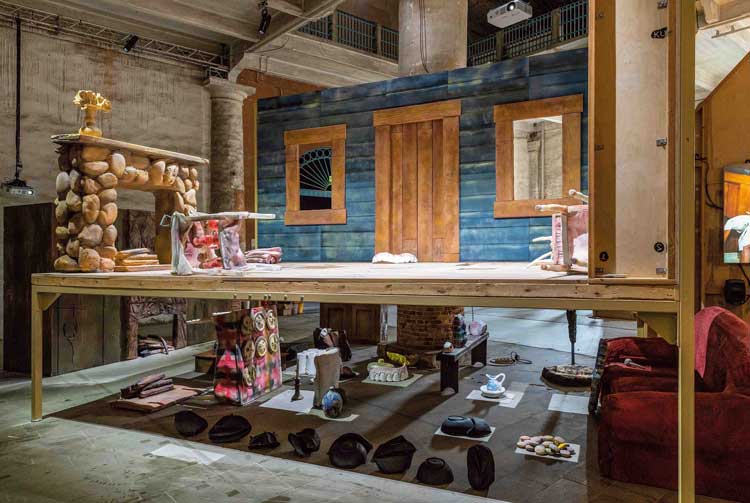
Kaari Upson, There is no such thing as outside, 2017-19. Room installation, mixed media and video. Biennale di Venezia, 2019. Photo: Timo Ohler. © Esme Trust / Kaari Upson Trust. Courtesy Spruth Magers.
In her short life, Upson left an incredible breadth of works, which are primarily concerned with ideas around domestic space, not only as a built structure, but also as the most intimate part of a human life. A space where sex, jokes, rituals and intimacies take place, and sometimes trauma, moulding our psyches in the way that Upson moulds her silicone. The domestic theme takes its most obvious form in There Is No Such Thing As Outside (2017-19). First shown at the 2019 Venice Biennale, which was titled May You Live in Interesting Times, a giant wooden house seems to float in the central gallery, presented like a doll’s house, with its facade taken away so that the interior can be rearranged. Unlike a regular doll’s house, though, Upson’s version is human-sized; so large, in fact, that its roof breaks through the ceiling of the gallery. Inside it, an upturned chair and a candle lie ominously on the floor. This doll’s house suggests danger and violence.
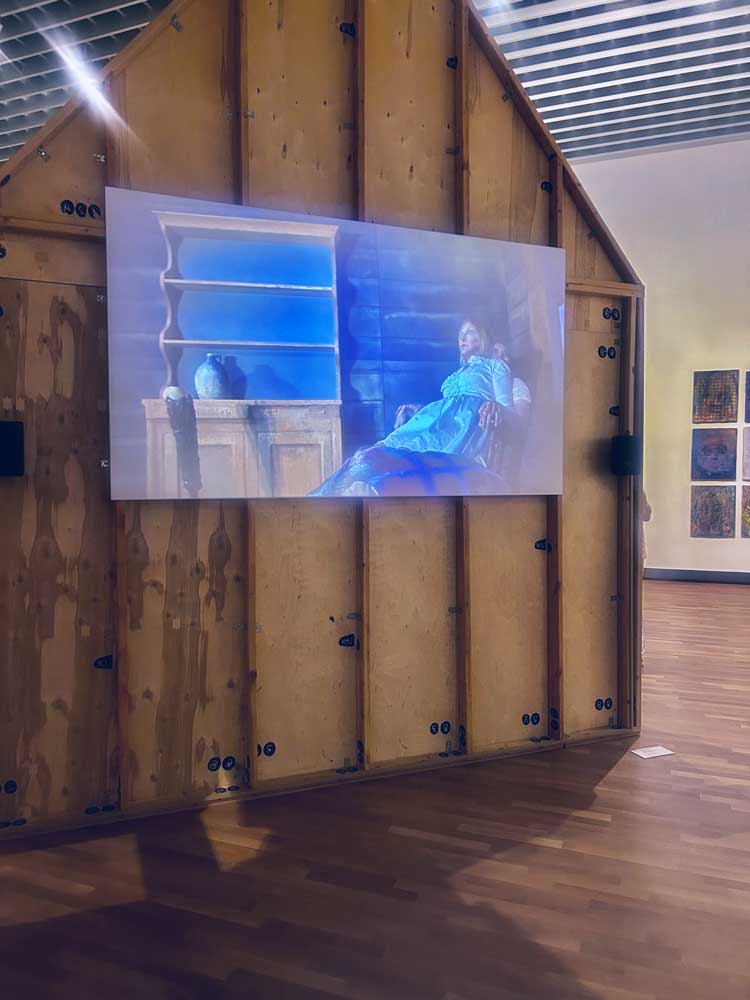
Kaari Upson: Dollhouse – a Retrospective, installation view, MASI Lugano, 6 September 2026 – 10 January 2027. Photo: Sabine Casparie.
Upson’s film House Worry (2019) is playing on a screen inside the stone fireplace. It shows the artist and her childhood friend in a mini version of her doll’s house, like a never-ending house of mirrors. Two grown, masked women sitting on each other’s laps in a rocking chair, and later cavorting over the floor, sends shivers down my spine, even before I find out that the women are each wearing a mask cast from the other’s face. Underneath the giant doll’s house, objects and body parts lie assembled like the remnants of a crime scene waiting to be examined by a forensic team. A giant set of teeth, a pack of kitchen paper, a stone urn, a batch of giant pills. Upson seems confident that her audience’s imagination will finish her horror story for her.
Upson discovered the sweet spot between fact and fiction, and between memory and imagination, while still a student at CalArts. In 2005, she began The Larry Project, after walking into a large abandoned and foreclosed house near her parents’ home one day in 2003. She found letters and legal documents, as well as mattresses in every room, and this set off an obsession with a fictional male character that would last all her life. Most critics agree that Larry is an amalgamation of Playboy owner Hugh Hefner and Hustler owner Larry Flynt, although Upson leaves the precise sources open. In As Long As It Takes – Part I: The Head (2007), Upson is dressed as a nurse, with a gingham face mask and blue gloves. She is crouched over a man-like form made of scraps of white fabric. Are they about to have sex or is she going to murder him? It’s not clear. In a 2016 interview, she recounted how most of the archetypal female characters in her work derive from a film class she took at CalArts, led by Bérénice Reynaud and centred on female protagonists who kill. Caretaker, castrater, mother, wife and whore.
In Untitled (2007), a female bends over the head of a man that she holds in her blue-gloved hands, who we presume to be Larry. But where the film suggested violence, the woman’s painted body suggests pity. It made me think of mother figures and Madonnas: strong female figures carrying the life of men, caring for them and grieving for them when they die.
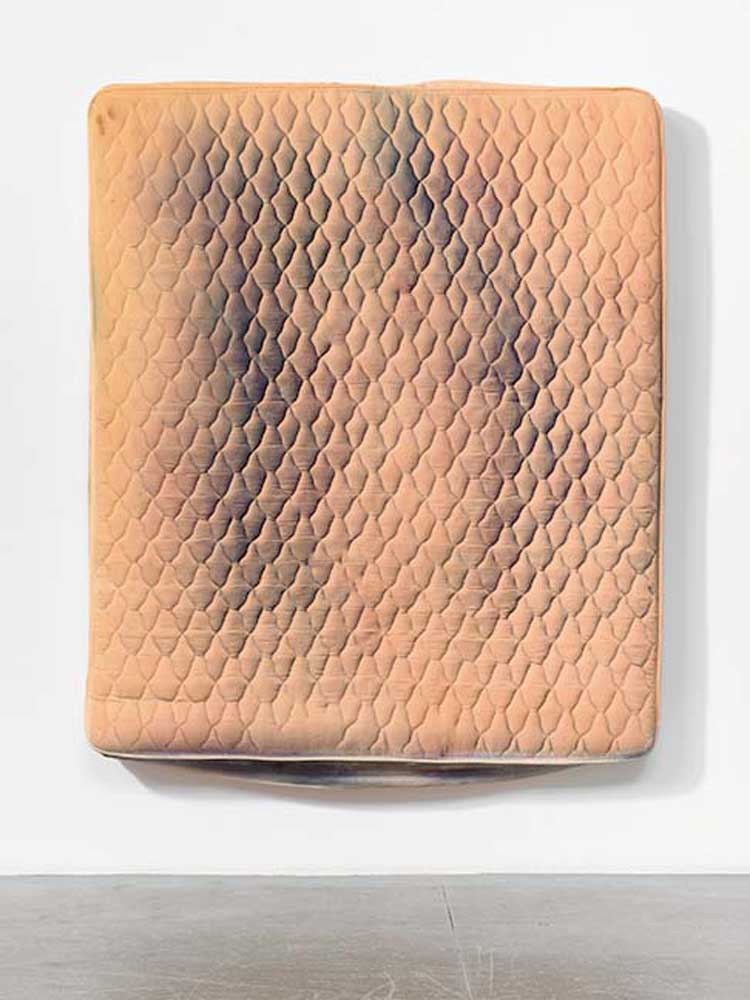
Kaari Upson, 192, 2013. Silicone, pigment, charcoal. Private collection. Photo: Natasha Polymeropoulos. © Esme Trust/ Kaari Upson Trust.
Similarly moving is a series of mattresses with titles including King, Crib and Death Bed. Cast in silicone, then treated with pigment, they mimic the dents and remnants of fluids in the real-life, discarded ones that Kaari Upson picked off the street. These “abstract portraits” keep some of the sensuality and unease of Upson’s other works, but instead of grotesque, they veer on the poetic.
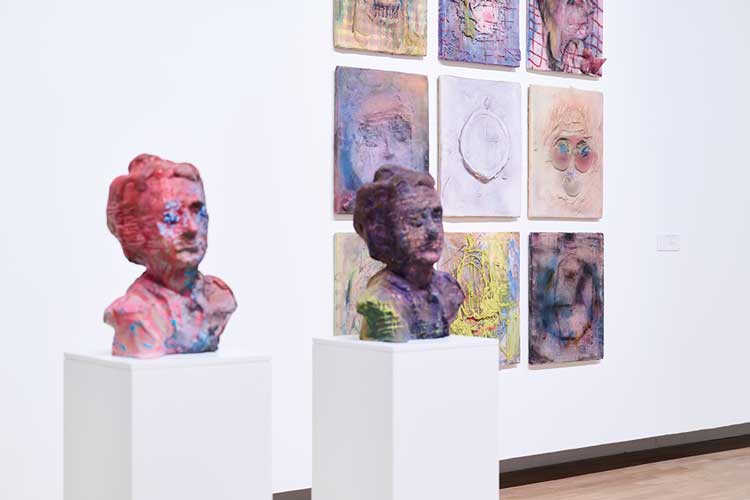
Kaari Upson: Dollhouse – a Retrospective, installation view, MASI Lugano, 6 September 2026 – 10 January 2027. Photo: Gabriele Spalluto.
Among all the greatness, it is easy to forgive a few lesser works. I did not care much for the diptych Untitled (Kiss) (2008), in which Upson combined features of her mother’s face with those from a photograph of Angelina Jolie. The series of painted busts named after her grandmother was unoriginal. These works looked more like something you would pick up from a wacky artist in a car boot sale. Upson’s work is at is strongest when she is either in it herself, or when it is entirely abstract.
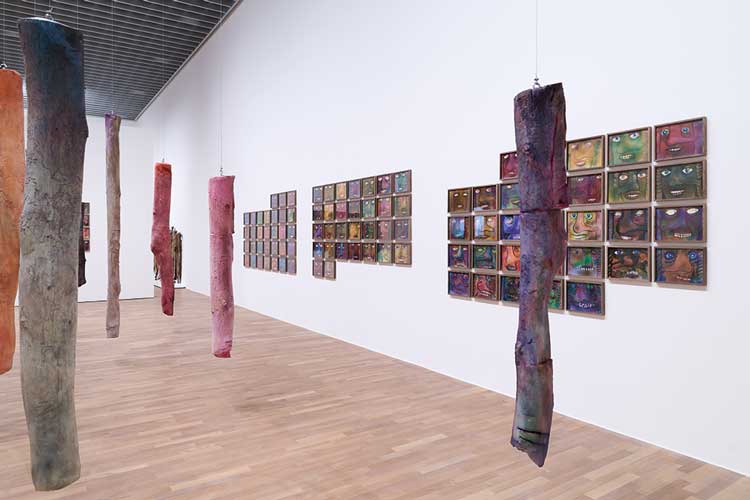
Mother’s Legs, 2018-19 (foreground) and Untitled (Foot Face), 2020-21, installation view, Kaari Upson: Dollhouse – a Retrospective, MASI Lugano, 6 September 2026 – 10 January 2027. Photo: Gabriele Spalluto.
The late works explore illness and the vulnerability of the human body. Mother’s Legs (2018-19), a forest-like installation of tree trunks formed over casts of the artist’s knees, combines eeriness with comfort: the artist’s childhood memories of feeling safe at her mother’s knee height. It is hauntingly beautiful, with its stark forms and its soft pastel hues. Untitled (Foot Face) (2020-21) contains 133 drawings in saturated colours, each combining a foot and a face. Upson made them as a daily ritual when she and her mother were both affected by cancer; her mother died midway through the series. The faces get more anguished as the year progresses, but also more abstract, so that sometimes only a set of glistening teeth and preening eyes remain. Here is Upson, staring death in the face, mischievous and fearless until the end.
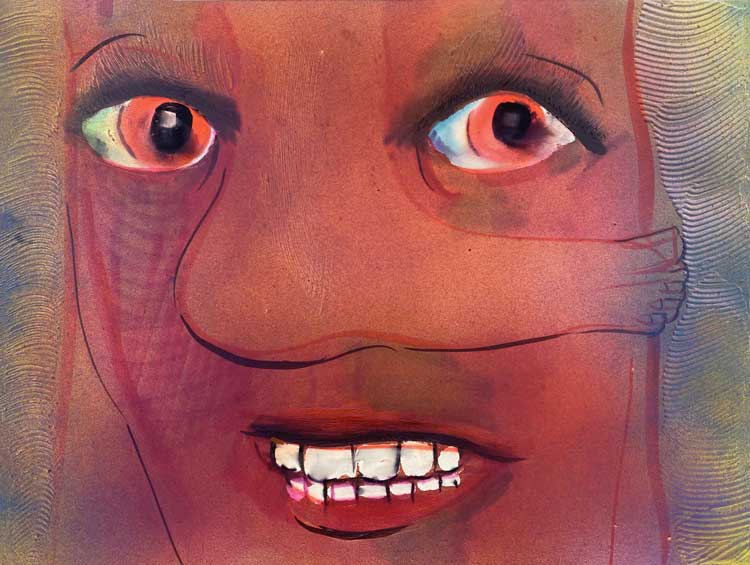
Kaari Upson, Untitled (Foot Face) 2020-21. Coloured pen, pigment and matte medium, 133 elements. © Esme Trust / Kaari Upson Trust. Courtesy Spruth Magers.
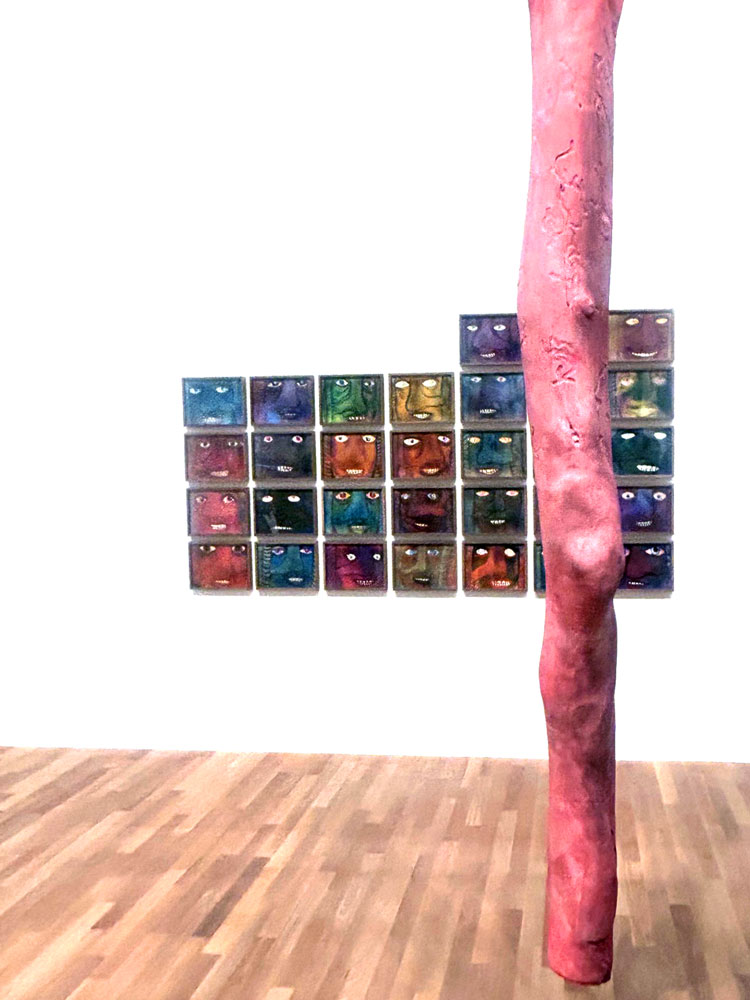
Kaari Upson: Dollhouse – a Retrospective, installation view, MASI Lugano, 6 September 2026 – 10 January 2027. Photo: Sabine Casparie.
Click on the pictures below to enlarge

Copyright © 1893–2026 Studio International Foundation.
The title Studio International is the property of the Studio International Foundation and, together with the content, are bound by copyright. All rights reserved.
 |
 |
 |
|---|

 Whitney Biennial 2017