




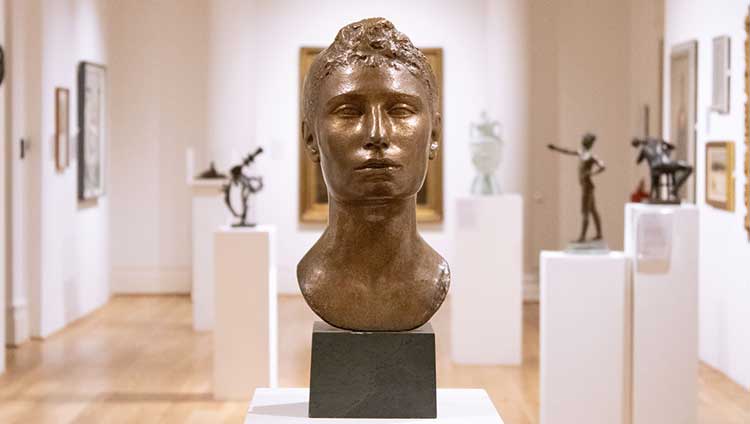
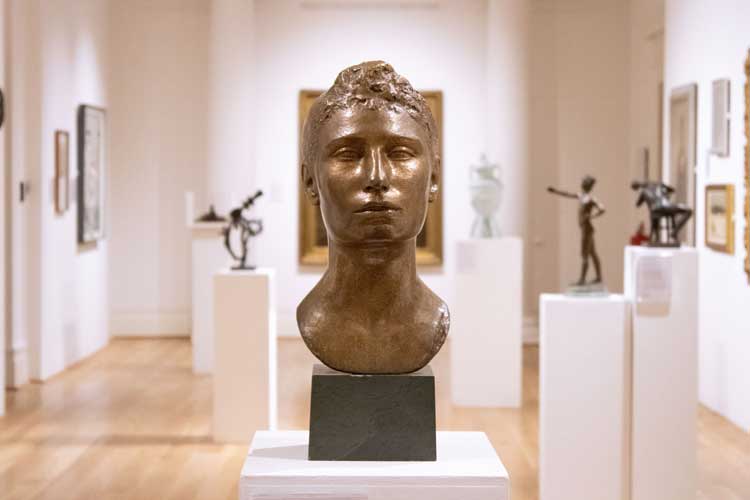
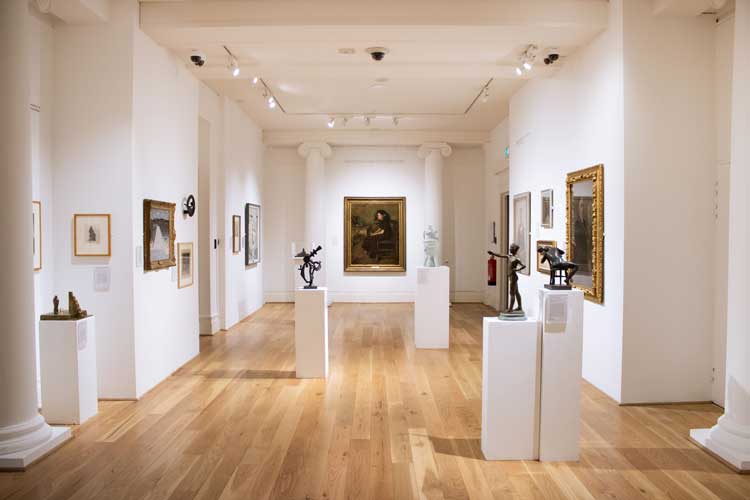
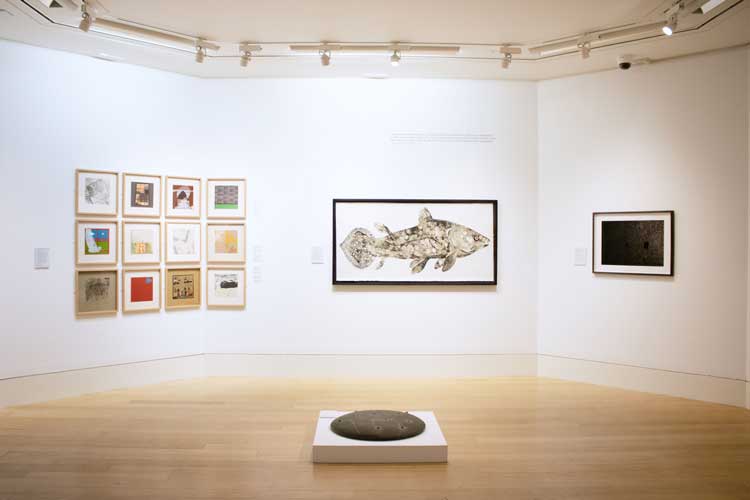
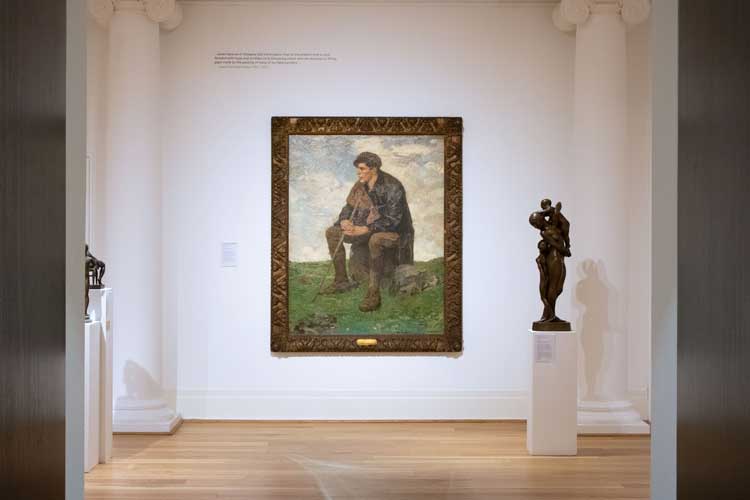
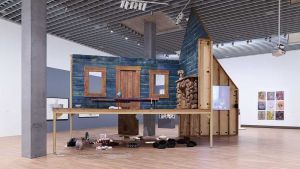
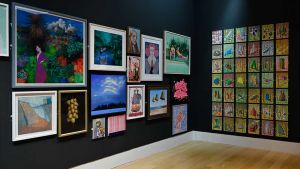
Origin Stories, installation view, Royal Scottish Academy, Edinburgh, 24 January – 8 March 2026.
Royal Scottish Academy, Edinburgh
24 January – 8 March 2026
by BETH WILLIAMSON
Inaugurated in 1826, the Royal Scottish Academy (RSA) in Edinburgh is Scotland’s oldest surviving artist-run institution. Origin Stories is one of two companion exhibitions that delve into the RSA’s illustrious history and it kicks off its year-long bicentennial programme with elan. The scope and extent of this exhibition is considerable as it traces threads of connection and influence from the 19th century to the present day. Distilling the complexities of 200 years of art teaching and making across Scotland, as it relates to the RSA, is a considerable feat of research. Turning that into a clear and engaging exhibition is a phenomenal achievement and it serves as an exceptional grounding for anyone who wants to understand the role of the RSA throughout its existence. It is a masterclass in research-led curating.
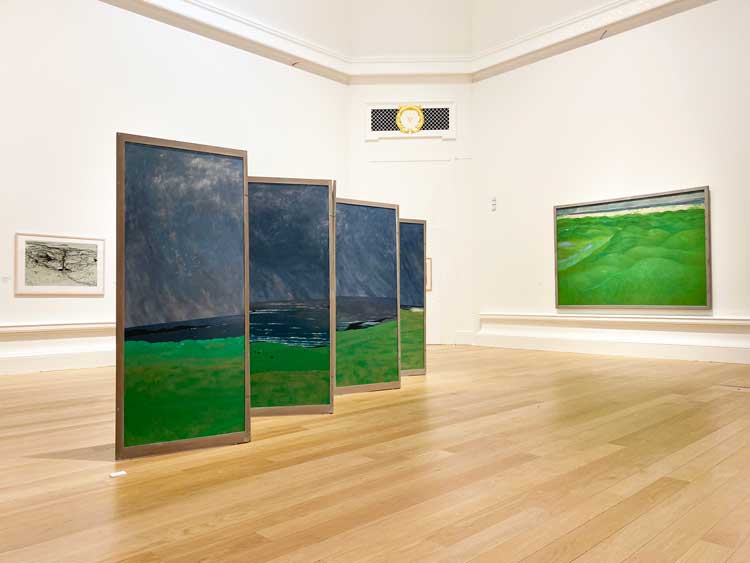
Frances Walker RSA, Atlantic Watch, 1995. Oil on plywood panel with screenprint, eight panel screen, 194 x 648 cm. RSA Collection.
The Art School Family Tree that begins the exhibition is proof of the RSA’s pivotal role in the ecosystem of art education in Scotland. As the diagram’s subtitle clarifies, this is one narrative among many, and Origin Stories is just the beginning of much bigger picture to be explored in a longer-term research project. Art schools across Scotland, in Aberdeen, Dundee, Edinburgh, Glasgow and, later, Moray School of Art, feed into and are fed by the RSA and its Academicians. The connections and networks are many as the influence of Academicians is traced across geographies and generations. Sandy Wood, RSA head of collections, writes: “Travelling through Origin Stories one can begin to appreciate the legacies of teaching and influence that have shaped Scottish art.” While this is undoubtedly true, such legacies are not as straightforward as visitors may at first think, but the exhibition does valuable work in revealing their subtleties. Where else could you see an exhibition that brings together artists from the 1800s to the present day and as wide-ranging as William McTaggart, Penelope Beaton, and Frances Walker, or Elizabeth Blackadder, Michael Agnew and Dalziel and Scullion?
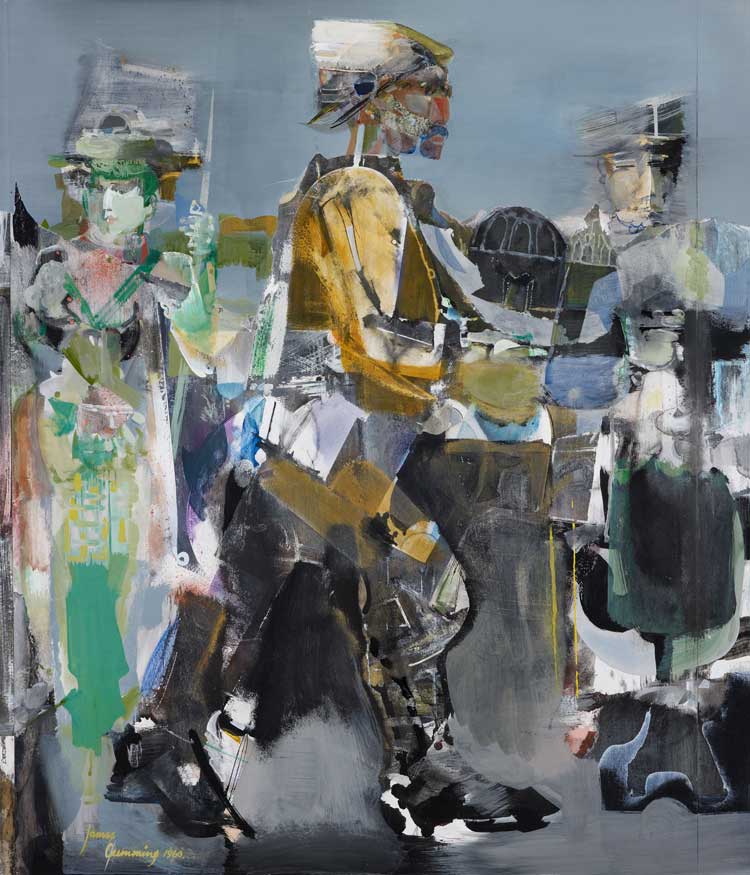
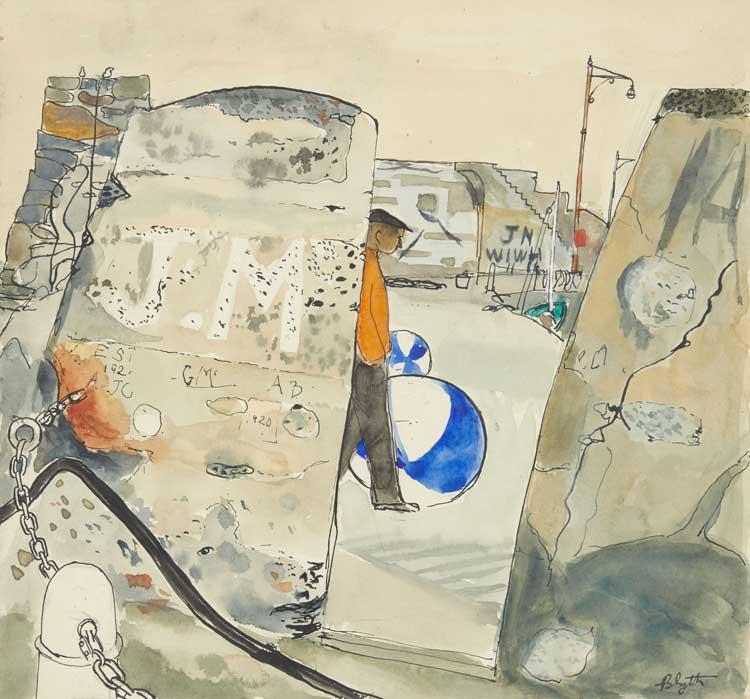
James W Cumming RSA, The Hebrideans, 1960. Watercolour and gouache, 86.1 x 99.3 cm (frame). RSA Collection.
When looking at lines of influence across time, there is always a danger that research slips into a hegemonic narrative, in thrall to history and insufficiently acknowledging the contemporary moment and its conditions and practitioners, but not so here. For rather than marking out firm lines of influence per se, the exhibition instead traces more fluid lines and spaces where relationships flourish and practice is encouraged to develop more freely. Since the exhibition narrative is multidimensional rather than linear, it allows for a richer more nuanced story to be told. What seems to be valued in the relationships between tutors and students is not, necessarily, the passing on of skills and techniques, even in the early part of the period that concerns us here. This is not so much about looking for visual connections in the work of student and tutor. It is, rather, about identifying the time and space where students were held and valued by tutors as being already artists in their own right and encouraged to find their own paths. As Wood explains it: “While visual tradition is inevitably shaped by the flow of ideas through teaching, it is the practical, nurturing role of the tutor, and their dedication to guiding the student on their path to becoming a practising artist that is a more hidden, but just as important aspect of training.”
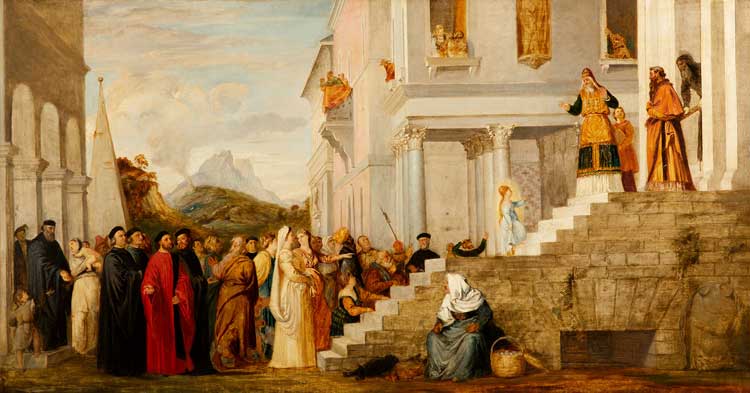
Robert Scott Lauder RSA, Presentation of the Virgin in the Temple after Titian, c1833-38.
This is evident from the very beginning of the exhibition when a sensibility is identified in relation to Robert Scott Lauder (1803-69), an early student (1822-24) then master (1852-61) at the Trustees Academy in Edinburgh. The exhibition plucks out words from Lauder’s obituary to that end: “His love for Art ... was fitted to kindle a corresponding enthusiasm in his students; and not a few of the young aspirants ... will gratefully acknowledge how much they owe to the unfailing kindness and sympathy, as well as able guidance, of Robert Scott Lauder.”
It is good to see sculptor Ann Henderson (1921-76) included here. Henderson was the focus of the Fruitmarket exhibition The Unforgetting (19 October – 17 November 2024), when artist Holly Davey gave life to forgotten parts of the archive and overlooked women in particular. In Origin Stories, Henderson is given her rightful place in the RSA’s history through her making and teaching at Edinburgh College of Art where she modernised the sculpture course, introducing new courses and new material approaches. It was here that she taught a new generation of sculptors, including Bill Scott (1935-2012) and Jake Harvey (b1948), producing work far removed from her own. As Scott later recalled: “Early in her teaching, Ann was directly concerned in establishing new courses which were then experimental.” Harvey recalls that experimental aspect too: “What I remember from Ann Henderson and Bill Scott, is being encouraged to be experimental … With Ann and Bill it was more free composition, and imaginative, looser projects.”
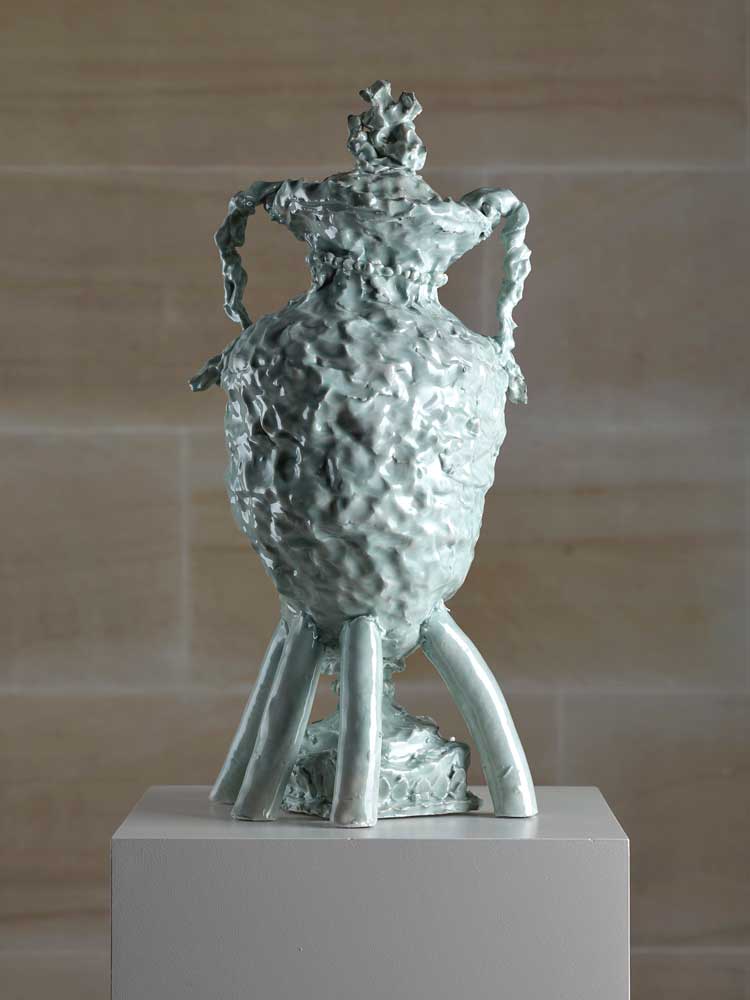
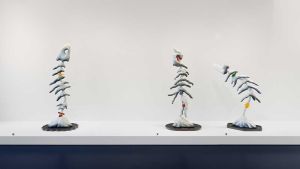
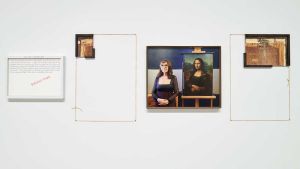
Jessica Harrison RSA, Jasperware vase and cover with Pegasus finial and with reliefs of Apollo and the Muses, made at the factory of Josiah Wedgewood, Etruria, Staffordshire, c1790, 2015.
It is no different really when we turn to Harvey’s former students, such as Mary Bourne and Jessica Harrison. There is mention in the exhibition book of Harvey’s “elemental pedagogy” focused on natural stone and the rural landscape but Harrison turned to other materials, noting: “I couldn’t have anticipated opening up opportunities for working with new materials, techniques and people that I would not have had otherwise.” Still, it was time to spend with tutors learning and talking in a supportive environment that Harrison valued most. Therefore, while skills and techniques remain important, it is sometimes the generosity and passion of teachers that is as important. Stuart Mackenzie (b1959) tells a similar tale when he says: “The really good tutors open doors for you. I think it sparks something in your own thinking … When that happened, it would make me hungry to find out more.” For a teacher to be able to spark that kind of hunger or curiosity is real gift.
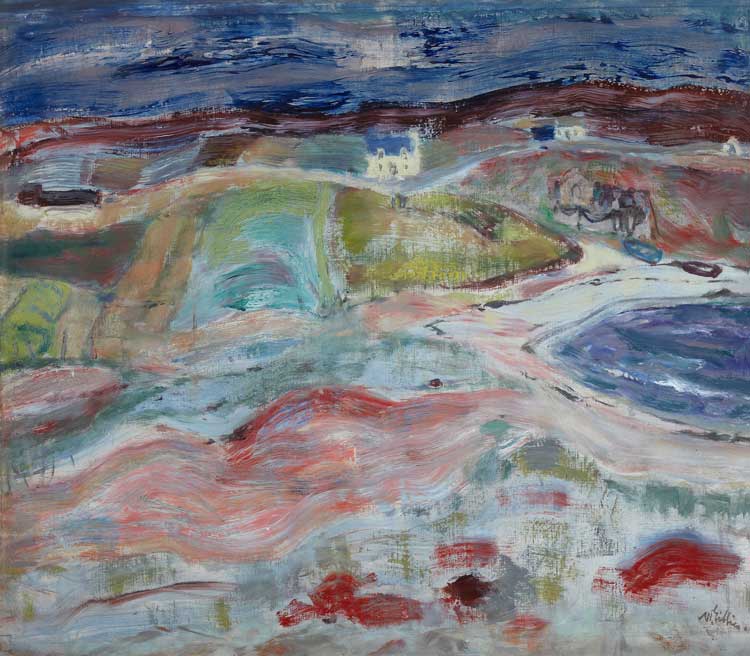
Sir William Gillies RSA, West Coast, 1942. Oil on canvas, 73 x 82.5 cm. RSA Collection.
All of this shows, as I have said from the start, that Origin Stories and the kind of important influence it traces is not direct or linear but something more tenuous and loosely bound in time and space. As well as the richer stories this enables to be told here, it also better allows for the development of further stories, sprouting and branching in different directions, as the project develops in coming years. These are stories of times past that feeds into the present day and look hopefully forward to future generations. Here’s to the future of the RSA.
Click on the pictures below to enlarge

Copyright © 1893–2026 Studio International Foundation.
The title Studio International is the property of the Studio International Foundation and, together with the content, are bound by copyright. All rights reserved.
 |
 |
 |
|---|

-300.jpg)

 RSA 200 Annual Exhibition, Edinburgh