




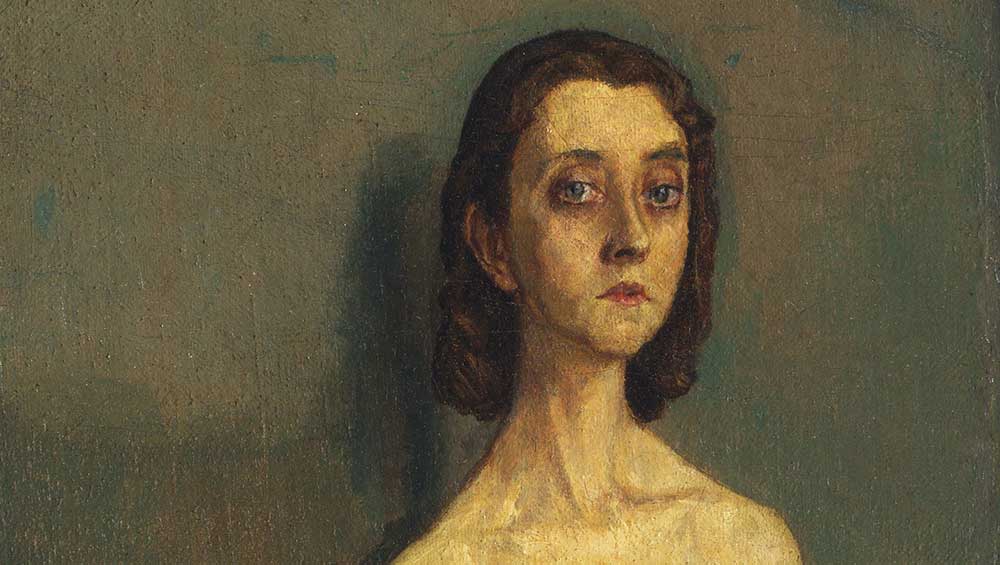
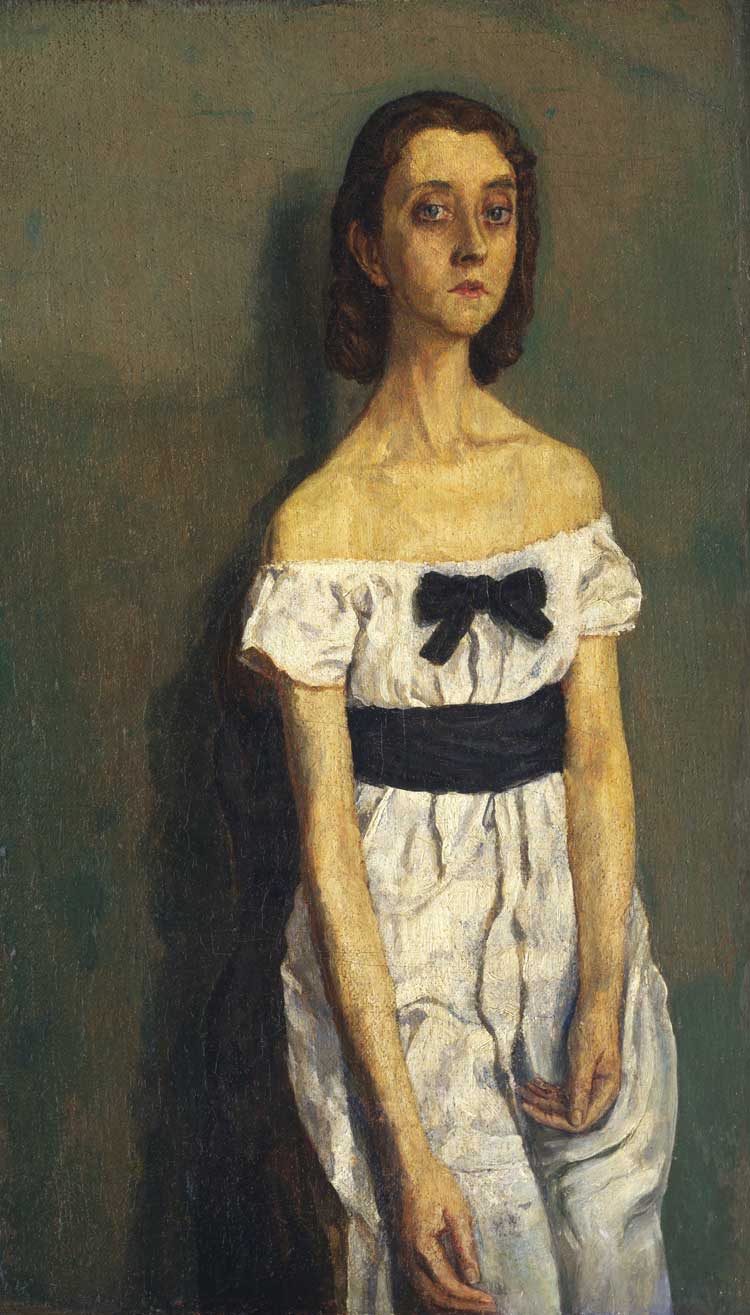
Gwen John, Girl with Bare Shoulders, c1910 (detail). Oil on canvas. 43.4 x 26 cm. A. Conger Goodyear Fund. 2026. © Digital image, The Museum of Modern Art, New York, Scala, Florence.
National Galleries Scotland: Modern Two, Edinburgh
1 August 2026 – 4 January 2027
by ANNA McNAY
What an absolute treat! Following Gwen John: Art and Life in London and Paris (showcased at Pallant House Gallery, Chichester, and the Holburne Museum, Bath, in 2023-24), this exhibition of John’s works was going to take a lot to impress, but impress it does – and how! Not only does it comprise a multitude of paintings by the Welsh artist, but these are complemented throughout by drawings – some paired with similar paintings, others in groups and series of their own – and, as the cherry on top, letters and notebook and journal entries, discussing life, love, painting, process, progress and the future.
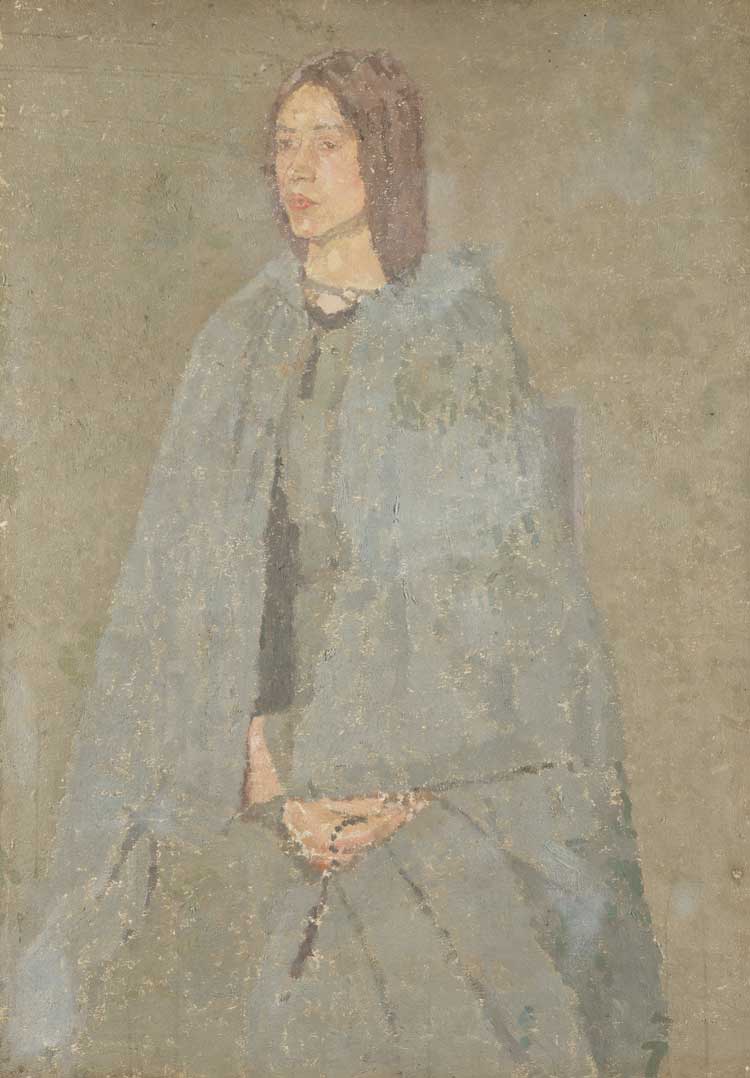
Gwen John, Portrait of a Girl in Grey, about 1918-23. Oil on canvas laid on plywood, 67.3 x 48.3 cm. National Galleries of Scotland. Purchased with assistance from the Henry and Sula Walton Fund and Art Fund (with a contribution from the Wolfson Foundation), 2020.
The exhibition begins with early works by the artist, made when she was a student at the Slade, mainly depicting her family members. An overcast day by the beach in Tenby, a pensive study of her sister Winifred looking down, one of her close friend Grace Westray playing the violin, and, of course, a self-portrait in a vivid red blouse, her direct gaze engaging the viewer. Already, in this latter work, John (1876-1939) is showing signs of her later developments towards plain backgrounds with isolated (literally and metaphorically) figures. A particularly fun piece is Portrait Group (1897-98), a watercolour and pencil sketch, depicting her family and friends in their shared lodgings at 21 Fitzroy Street in central London. Her younger – but already more famous – brother, Augustus, is lording it in his straw hat, while Winifred, who was studying music, sits in white at the piano. It is further thought that the couple outside the window are John and her boyfriend, Ambrose McEvoy. There is also a portrait of Mrs Atkinson (c1898), John’s landlady at the time, set against intimiste-style wallpaper. Presciently, there is then a sketch of the French sculptor Auguste Rodin, John’s later lover, drawn with the tender care and attention only a lover might pay (note, particularly, the absolutely beautiful, crinkled ear and stray strands of hair from his beard).
A couple of nude sketches attest to John’s having attended life classes at the Slade, and other early works include portraits of Grilda and Chloë Boughton-Leigh, friends who shared her love of books and cats, and the exquisite The Student (1903-04), which depicts Dorelia McNeill, the friend with whom John set off on foot for Rome from Bordeaux, ultimately only reaching Toulouse, and then continuing to Paris. Dorelia later became the lover of Augustus, at first in a menage-à-trois with his wife, Ida.
While there is a danger in focusing too much on the biography of an artist, John’s early work speaks, through her choice of sitters, of just that. It is therefore wonderful to next come upon a display of letters to her friend Ursula Tyrwhitt, mostly written from Paris, describing her room and her learnings. One from near the end of her life, dated to c1936, shows how she continued learning, with her English characterfully dotted with numerous Frenchisms. A letter to Véra Oumançoff, a Parisian neighbour with whom she became besotted, describes her practice of drawing in church (John converted to Catholicism in 1913 following the end of her relationship with Rodin), which was frowned on by the priest, and, it seems, also by the letter’s recipient. An exercise book, spanning 1917 to 1925, details various rules and methods John devised for her colour mixing. None of this is misplaced, either, since John wrote in a letter to her friend Michel Salaman in 1902: “To me the writing of a letter is a very important event!”
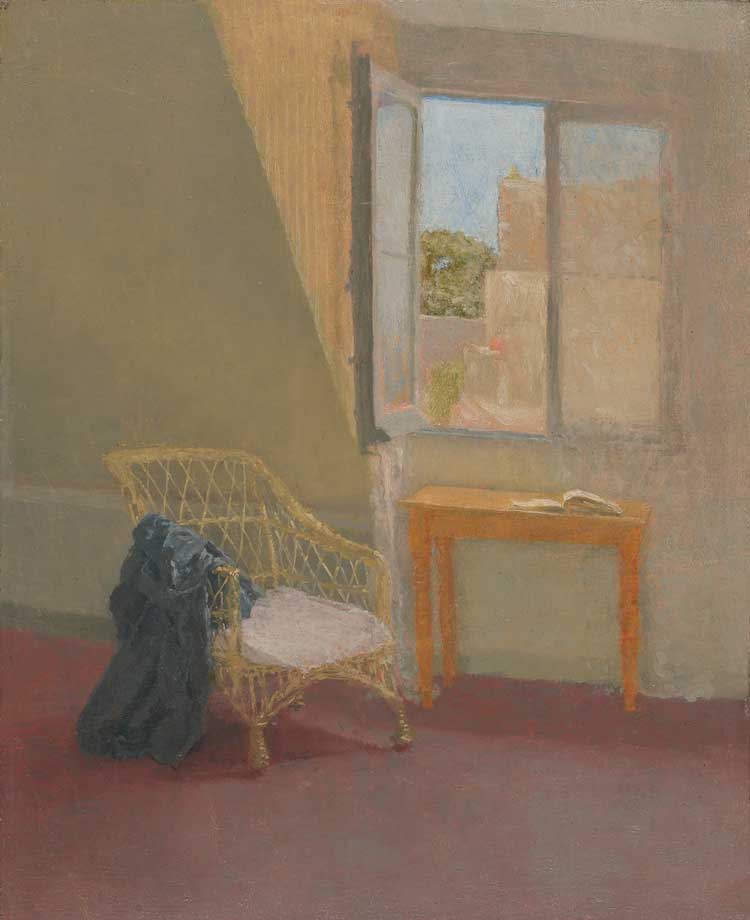
Gwen John, A Corner of the Artist's Room in Paris, 1907-1909. Oil on canvas on board, 31.2 x 24.8 cm. By permission of Amgueddfa Cymru - Museum Wales. Purchased with the assistance of the Derek Williams Trust and the Estate of Mrs J. Green. 1995.
As we move upstairs to a lemon-yellow room, we move in spirit to Paris. Here we see two of John’s best-known pictures, showing her little attic bedroom, also painted in pale lemon, in which her presence is felt, despite her physical absence, through the inclusion of markers such as a posy of flowers or an open book on the table and a jacket and a parasol over the arm of the chair. Also shown as pairs are A Lady Reading (c1910) and Girl Reading at a Window (c1911), in the latter of which John has replaced the Madonna’s head with her own, and Girl with Bare Shoulders (c1910) and Nude Girl (c1910), in which the sitter, Fenella Lovell, holds virtually the same pose minus her garb, engendering thoughts of Goya and his La Maja Desnuda (1797-1800). Fittingly, for a work thus showing her gravitas, this latter piece (along with A Lady Reading) was the first of hers to enter the Tate collection in 1917.
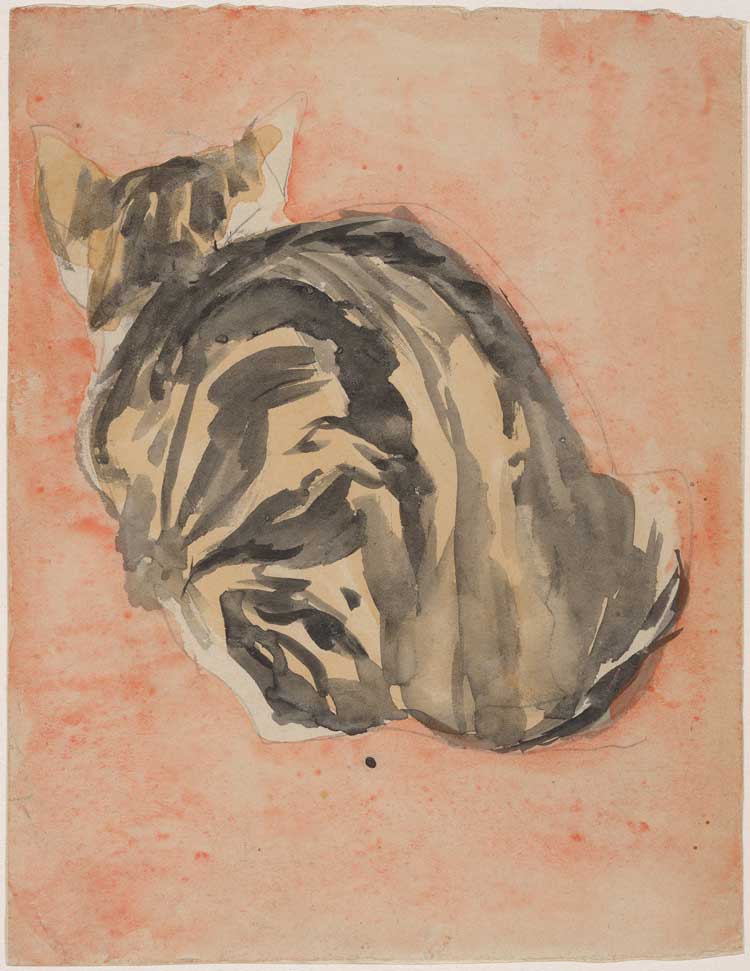
Gwen John, Seated tortoiseshell cat. By permission of Amgueddfa Cymru - Museum Wales.
One wall in this room is dedicated to sketches of John’s cats, including the beloved Edgar Quinet (named after the street in which she lived). This extract from a letter to McNeill shows something of her relationship with her pets: “I wrote to you some time ago but the letter was left on the table and is now covered with Edgar Quinet’s footmarks. I have just been singing Alice Ben Bolt but Edgar Quinet does not like it and bites my chin.” The sketches are certainly loving and intimate.
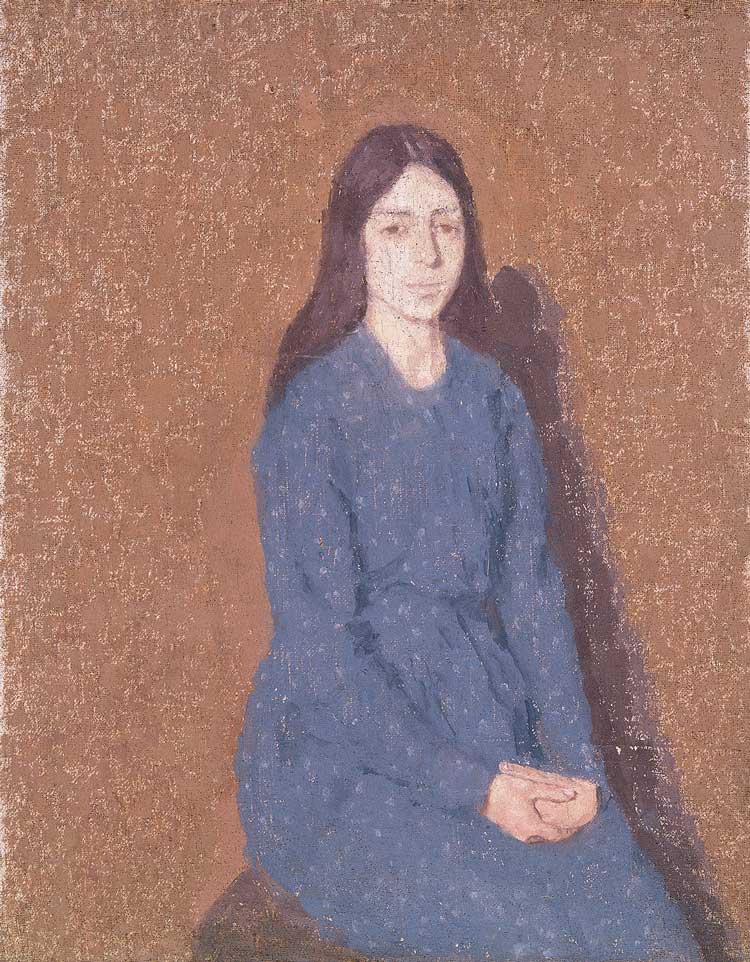
Gwen John, Girl in a Blue Dress, 1914. Oil on canvas, 41.8 x 34.5 cm. © Estate of Gwen John 2002. By permission of Amgueddfa Cymru - Museum Wales.
The facing wall features three of John’s eight paintings of an unknown sitter in a blue dress set against a terracotta background. This is the earliest in her many series of works, where compositions vary incidentally. The next room then contains a wall of nun paintings from a series commissioned by the Dominican convent in Meudon of portraits of the founder, Mère Marie Poussepin. Although the plan was for one painting to hang in each room, only one was installed in the convent for a short period in 1920, before it was purchased by the artist’s patron, the American collector John Quinn. These remarkable paintings also show John’s method of applying the paint, which she termed “blobbing” – thick paint applied in short brushstrokes. Alongside this, she was beginning to mix resin into her paint, which gave it its grainy surface texture. In some of the lesser finished works, her process can be seen most clearly – Young Woman Holding a Cat (c1920) and Study of a Woman in a Mulberry Dress (c1923), on show in later rooms, are a case in point.
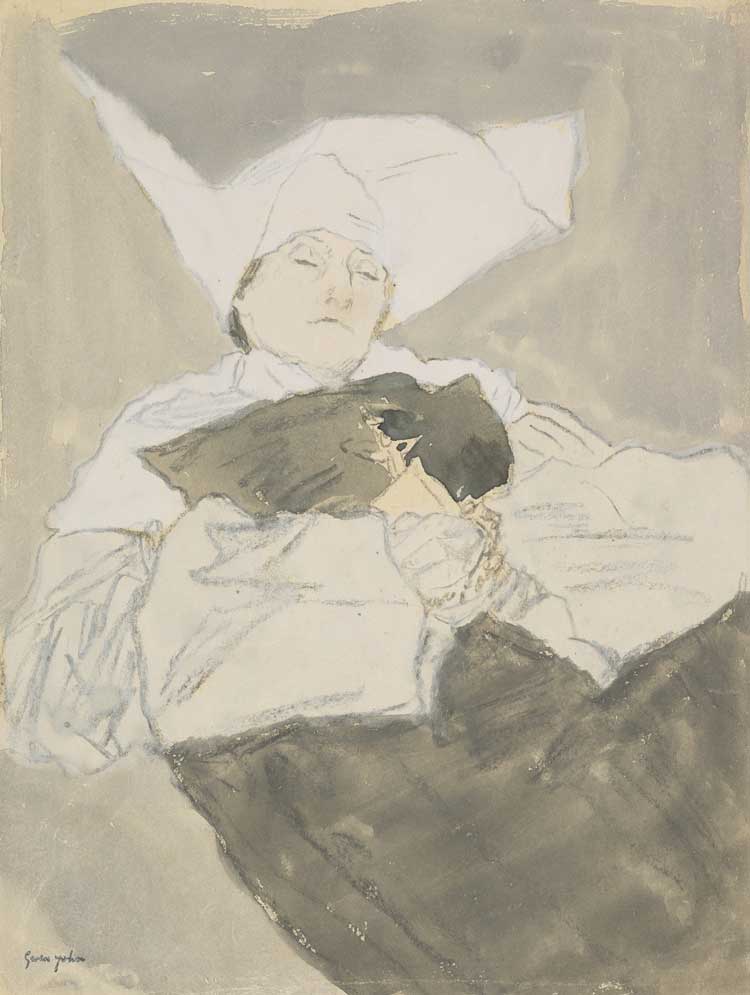
Gwen John, A Nun on her Deathbed, about 1914-1918. Gouache, watercolour and black chalk on paper, 31.5 x 24 cm. Purchased 1976. National Galleries of Scotland.
Visitors next enjoy a wall of the aforementioned controversial church sketches, made during Vespers. It was about this time that John described herself as “God’s little artist: - a seer of strange beauties. A teller of harmonies. A diligent worker,” adding: “Very little they may be but that doesn’t matter – He accepts them.” She went on to make drawings and watercolours of the congregation for more than 20 years, filling sketchbooks and loose papers. Her subjects are almost always depicted from behind or in profile and, as John herself advised: “My drawings are much better seen in sets.” Certainly, there is something very special about being engulfed by the one subject or setting, as visitors are in this exhibition – it gives a sense, perhaps, of John’s dedication to her subjects, and her almost fanatical drawing and redrawing, painting and repainting of the same thing over and over again.
By working in this way, John was able to experiment, and amend her colours and tones as she went. She created rules for herself and worked with colours by connecting each to a specific object in her visual memory. As she wrote to Tyrwhitt: “Rouge Phénicien is the colour of what we called wild geranium. The stems are dark crimson, the leaves seem dipped in pale crimson just now, the rest of the leaves are somewhat Anglais. Earlier in the summer the leaves are emerald green all over.” In 1923, she wrote a note to herself to “paint as you do your drawings”, and, at about the same time, she began to use some brighter colours in her oil paintings. Nevertheless, her watercolours remain her boldest experiments, and it is wonderful to see so many of them, including the cats, the congregation and a series of Breton children, as well as her so-called “little paintings”, which never left her studio, all from Amgueddfa Cymru’s collection, and rarely on display.
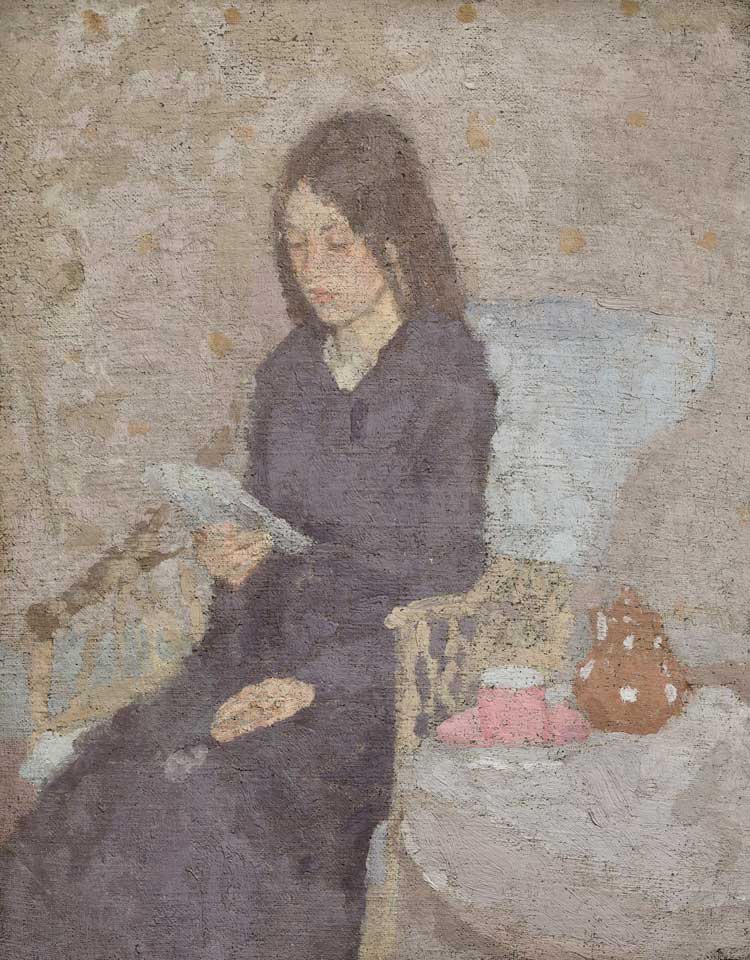
Gwen John, Woman Seated, about 1920. Oil on canvas, Private Collection. © 2026 Christies Images Limited.
Perhaps my favourite series of paintings, however, is The Convalescent, for which John made 11 versions of the girl, dressed in blue, sitting on a wicker chair, with a book or letter and a cup of tea. In The Seated Woman (c1920), a strand of dark hair falls across the girl’s cheek, while in The Letter (c1920), a faint smile caresses the corners of her mouth. This model remains unidentified, despite having sat for more than 60 paintings. Nevertheless, it might be understood that John sought to represent something of herself in each picture, with her patron’s art adviser and friend, Jeanne Foster, stating (after modelling for John a number of times): “She takes down my hair and does it like her own … she has me sit as she does, and I feel the absorption of her personality asI sit.” This intimate sense of person is surely felt across John’s oeuvre.
My overall favourite work, though, was new to me (always a nice surprise): Girl in Profile (c1920). It has about it all that is quintessentially John: a girl in a blue dress and cape, sitting against a pale khaki background, with a beige shawl into which her hair disappears, melding in tone. Her hands are clasped and she looks to the side, a strand of hair loose across her pink cheek. The scumbled blobbing is evident, and the thickness of the paint gives the work an almost sculptural quality. It is simply divine.
The exhibition ends with a short film about John and her work. Here she is poignantly quoted as saying: “I don’t know why my vision will have value, but I know it will.” If only she could see this tour-de-force show and be proud.
Click on the pictures below to enlarge

Copyright © 1893–2026 Studio International Foundation.
The title Studio International is the property of the Studio International Foundation and, together with the content, are bound by copyright. All rights reserved.
 |
 |
 |
|---|



-300.jpg)


 Rubens to Sickert: The Study of Drawing
 Nicole Eisenman: Groupings of Works from Fountain
 Rodin and the Art of Ancient Greece
 Marino Marini: Visual Passions
 Virginia Woolf: An Exhibition Inspired By Her Writings