




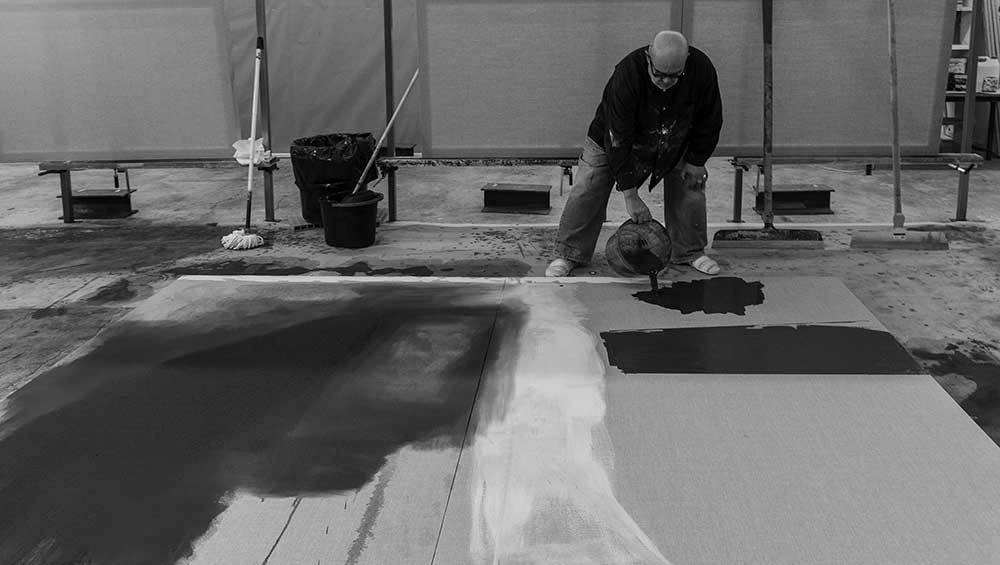
Pedro Cabrita Reis. Photo: Juan Rodriguez © Pedro Cabrita Reis Studio.
by NICOLA HOMER
Pedro Cabrita Reis began his career with exhibitions in the 1980s in Lisbon, Portugal, where he was born in 1956. He achieved international recognition at Documenta IX and Documenta XIV in Kassel in 1992 and 2017 respectively. He has represented Portugal at the Venice Biennale and participated in the São Paulo Biennial. His work features in international museum collections. He has had solo exhibitions in the UK and mainland Europe and Canada. He was one of the first artists to exhibit at the Baltic Centre for Contemporary Art, and his work is held in the Tate collection in London. In 2022, he created The Three Graces, a monumental sculpture for the Tuileries Garden at the Louvre in Paris. That year, too, he presented an exhibition at the Church of San Fantin in Venice.
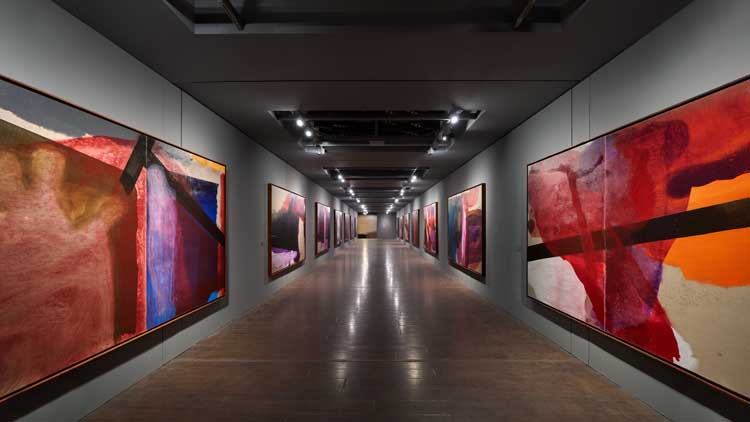
Pedro Cabrita Reis, XIV Steps, exhibition view, Magazzino del Sale 3, Accademia di Belle Arti di Venezia, Venice, Italy. Photo: Cleila Cadamuro.
This year, he has returned to Venice during the city’s 61st biennale, with a show at the Magazzino del Sale 3, the exhibition space of the Accademia di Belle Arti di Venezia, part of a complex of historic buildings that runs along the Fondamenta delle Zattere. In the exhibition, XIV Steps, the artist has created a cycle of 14 diptych paintings, inspired by a significant narrative in western art. The Stations of the Cross depicts events in the Passion of Christ. The exhibition has been curated in collaboration with Luca Berta and Michael Short. The accompanying catalogue offers writings on the form and origin of the sequence, and the relations between painting and poetry, and art and art history, which are themes on which the artist expands. He spoke to Studio International via email about his work.
Nicola Homer: It is a pleasure to speak to you again. I understand that you studied at the University of Lisbon’s Faculty of Fine Arts. When did you start enjoying painting?
Pedro Cabrita Reis: The pleasure is mutual.
For as long as I can remember, I have always thought of myself as an artist and always believed that I would become a painter. It was always what I wanted to be. By the age of 14, I already had a small studio, with a somewhat precarious easel in one of the rooms of the house where I lived in Lisbon with my parents and my sister. I still have that easel today, together with many of my earliest works – small paintings on cardboard and Masonite that I made in 1970 and 1971.
Unlike the biographies of many other well-known artists, my story is one in which my parents never opposed my vocation. That was certainly helpful. Let us now hope that history will prove them right.
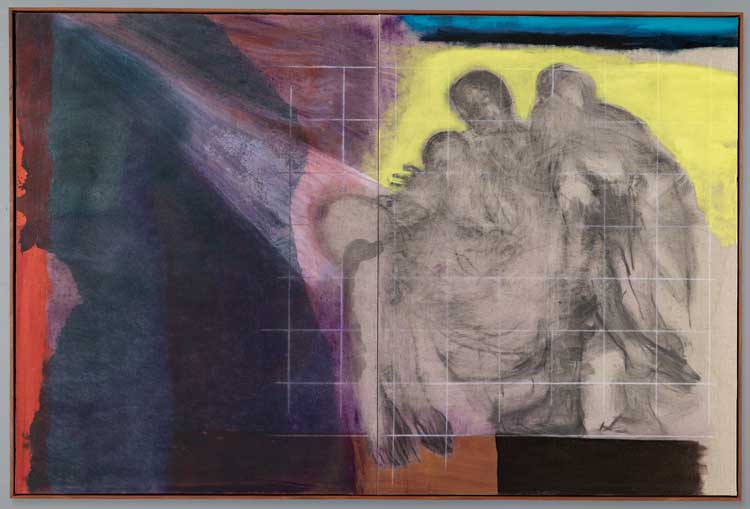
Pedro Cabrita Reis. XIV Passos, 2025. XIV/XIV, Jesus in sepulcro ponitur (entombment). Oil on raw canvas, 200 x 300 cm (diptych: 200 × 150 cm each). Photo: João Ferrand.
NH: You represented Portugal at the 50th Venice Biennale in 2003. How do you feel to have an exhibition of paintings during the 61st Venice Biennale this year?
PCR: I have participated in several other editions of the biennale, in addition to representing Portugal in 2003. My first participation was in 1995, when I represented Portugal alongside two other artists, José Pedro Croft and Rui Chafes. In 1997, I participated at the invitation of Germano Celant. In 2013, I presented A Remote Whisper, a project at Palazzo Falier included in the Collateral Events section. In 2022, at the Chiesa San Fantin, I presented another independent project, Field.
This year, on the occasion of the 61st Venice Biennale, I presented XIV Steps at Magazzino del Sale 3, with the coordination of Luca Berta and Michael Short. The exhibition consists of 14 large diptychs in oil on canvas and proposes a highly personal rereading of the narrative of the Stations of the Cross. Given the importance of the Venice Biennale for any artist – as a moment and a place in which to make one’s work known – there is, without any doubt, an immense pleasure in being able to present these new paintings in Venice.
I should perhaps clarify that I am a painter who has also produced some significant sculptures throughout his career.
NH: Can you tell me about the concept of XIV Steps?
PCR: Like many other artists – whether contemporary, modern or classical – I look to the history of art. Through the study of the works of others, I transform what I learn into a mode of thinking and a practice that ultimately, and in part, gives substance to my own artistic trajectory.
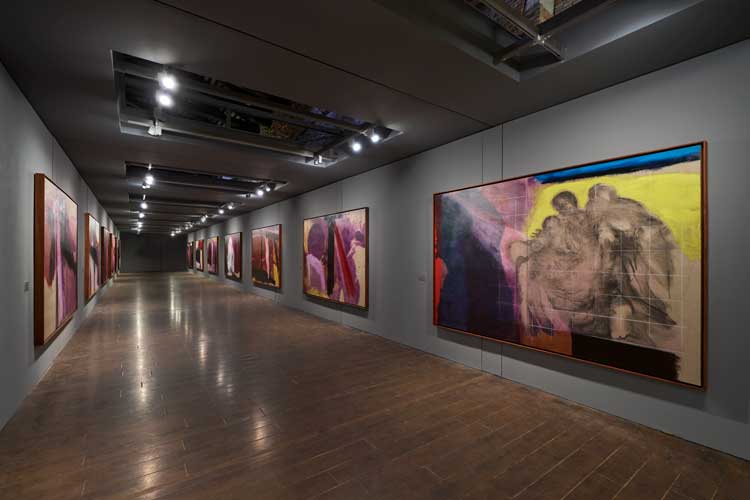
Pedro Cabrita Reis, XIV Steps, exhibition view, Magazzino del Sale 3, Accademia di Belle Arti di Venezia, Venice, Italy. Photo: Cleila Cadamuro.
It could be said that the suite of 14 diptychs that constitutes XIV Steps is informed by my engagement with Caravaggio, Rubens, Tiepolo, Grünewald and even Barnett Newman. These paintings are constructed from the very substance of art history. Although they refer to the familiar narrative of the Passion of Christ, they are not religious paintings, just as I am not a religious person. They are simply paintings about other paintings – works created around a story that has traversed the centuries and that, for better or worse, has helped to shape the history of western civilisation and culture. This is the culture to which I belong, and from which I draw a substantial part of what nourishes my art. These, in a singular sense, are the words I can offer to describe the concept underlying XIV Steps series. They are paintings that are, above all, painting itself. Nothing more.
NH: How did you respond to the historic site at the Magazzino del Sale (Salt Warehouses), where the Republic of Venice once stored one of the most important resources of the Lagoon?
PCR: A work of art must always preserve its conceptual, poetic and semantic autonomy. Under no circumstances should it become hostage to the place in which it is presented for the contemplation of those who experience it emotionally and intellectually. Magazzino del Sale 3 undoubtedly possesses a long and significant history within the city, but this was not the aspect that interested me most when I decided to exhibit XIV Steps there. More than its historiographical or cultural connotations, what fascinated me about the space was its volume and, above all, the manner in which the length of the room creates the possibility of a prolonged trajectory. It establishes a particular way of moving through the space, allowing the viewer to encounter the paintings one after another, at the appropriate rhythm.
I arranged the works precisely with this experience in mind, allowing for a duration of contemplation that demanded an interiorised silence – a singular and individual communion with each of the 14 paintings. Each one in its own time.
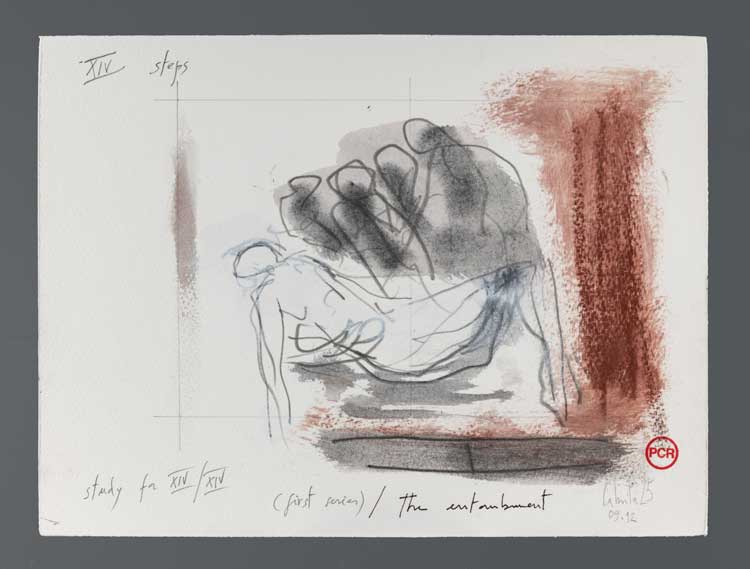
Pedro Cabrita Reis. Studies for XIV Stations, 2025. Study for XIV/XIV (1st series), Jesus in sepulcro ponitur (entombment). Mixed media on watercolour paper, 24 x 32 cm. Photo: João Ferrand.
NH: This exhibition heralds a new chapter as it departs from your industrial-looking sculptures, which explore philosophical concepts, as seen in your work at the Church of San Fantin in 2022. How did you bring your experience of making sculptures into your paintings?
PCR: I do not believe that my work can be divided according to a moment of rupture between a “before” and an “after”. From the perspective of studio practice, the various disciplines – drawing, painting and sculpture – have always coexisted. Perhaps, at certain moments in my trajectory, one has assumed greater prominence than the others. During the 1980s, my work was fundamentally concerned with painting and was seen primarily in Portugal. The 1990s, and the beginning of my international trajectory, coincided with a greater visibility for my sculpture, although, of course, I never ceased to paint or draw.
As in the history of art itself, different periods succeed one another in response to the political, economic and cultural circumstances that ultimately constitute the course of history. There are likewise no irreversible ruptures within the work of an artist. On the contrary, there is a permanent continuity, continually reconstructed through different perspectives, gestures and forms of thought. What emerges is, therefore, a coherent cartography through which the artist’s work reveals itself.
Indeed, I believe that, although Duchamp’s Fountain (1917) was important in its own time, it has become overvalued. The radical rupture that some commentators attribute to it gradually transformed into yet another step, like any other before or after it, within the permanent continuity of the history of art. It is this continuity that traces the connections between the different phases of my work. There is no hiatus, nor any discontinuity, between my sculpture and my painting. There is only the presence of a thought revealed through the creative act: unified, indivisible and permanent. My sculpture is my painting; my painting is my sculpture; I am both.
NH: How has painting helped you to express traditional scenes associated with the narrative of the Stations of the Cross in this latest Venetian exhibition?
PCR: The Stations of the Cross convey the classical narrative of the Passion of Christ. Throughout the history of art, numerous painters have approached this narrative, interpreting it in different ways across the centuries. The absolutely sublime version that Barnett Newman left us is a unique example of how contemporary art can continue to cast light on an ancient subject such as the Passion of Christ. Beyond the sculptural reliefs that adorn hundreds of churches and mark, within them, the path of Christ’s Passion, I believe that these episodes of the Passion have been, above all, the subject of painting.
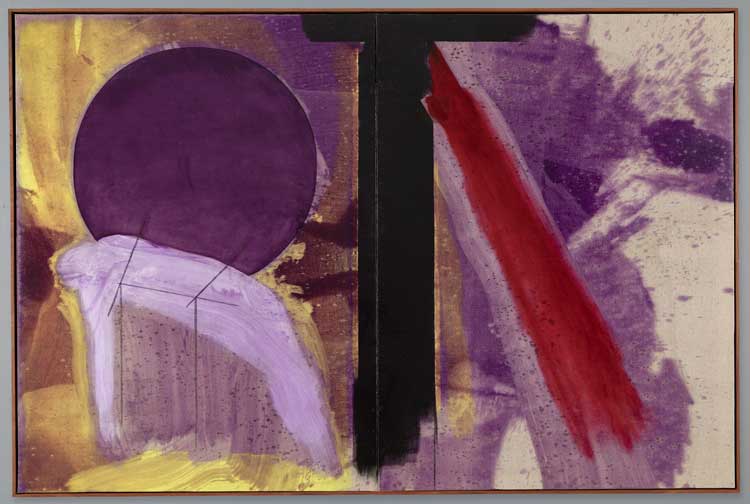
Pedro Cabrita Reis. XIV Passos, 2025. XIII/XIV, Jesus de cruce deponitur (descent from the cross). Oil on raw canvas, 200 x 300 cm (diptych: 200 × 150 cm each). Photo: João Ferrand.
My XIV Steps belong to this territory, but without any intention of following the path of traditional, or indeed canonical, representation. And why should they? If the practice of painting has taught me anything, it is that the absolute freedom to reinvent themes belonging to the history of art is itself a form of freedom that reminds us that art continues to bring light, intelligence, and, above all, beauty into the world. Beauty may perhaps be the only means of resisting the stupidity of violence – the violence that oppresses, discriminates, forgets, silences and kills. It is a horror that persists throughout history, and to which art responds with an unequivocal refusal.
NH: Could you tell me about how your work that is currently on show in Venice is an example of your ongoing investigation into culture, memory and the human condition in your artistic practice?
PCR: Even those who do not identify with the texts, liturgy, history or rituals of Christianity, I believe, can recognise that the episode of the Passion of Christ carries implications and admits readings that extend far beyond a merely religious or theological interpretation of the narrative.
When I painted XIV Steps, I began with a story that has been repeated endlessly, with variations and nuances throughout time. For me, however, its principal significance lies in its potential to function as a kind of parable of the human condition, in which social, political, cultural and religious questions converge: the oppressed and the oppressors; heroes and executioners; horror and suffering, but also love and hope. All this has traversed the centuries and continues to exist today. It existed then and continues to exist now. It is the history of humanity; it is the salt of history.
All of this – whether expressed openly or merely suggested – constitutes the substance from which enduring thoughts and visions are formed, whether in poetry, as in the work of Maya Angelou, Pablo Neruda or Paul Éluard; in painting, as in Picasso’s Guernica, Delacroix’s Liberty Leading the People or Goya’s The Third of May 1808; or in music, as in Beethoven’s Eroica or Britten’s War Requiem. And what are these works, ultimately, if not expressions of the very nature of the human condition? They are ourselves.
Barnett Newman, in his Stations of the Cross, also speaks to us of this restlessness, of this destiny. Within my art, and within the manner in which I think about it, practise it, and derive lessons from it, there persists a murmur and an echo of that which, throughout our shared history, remains indefinable and which we call the human condition.
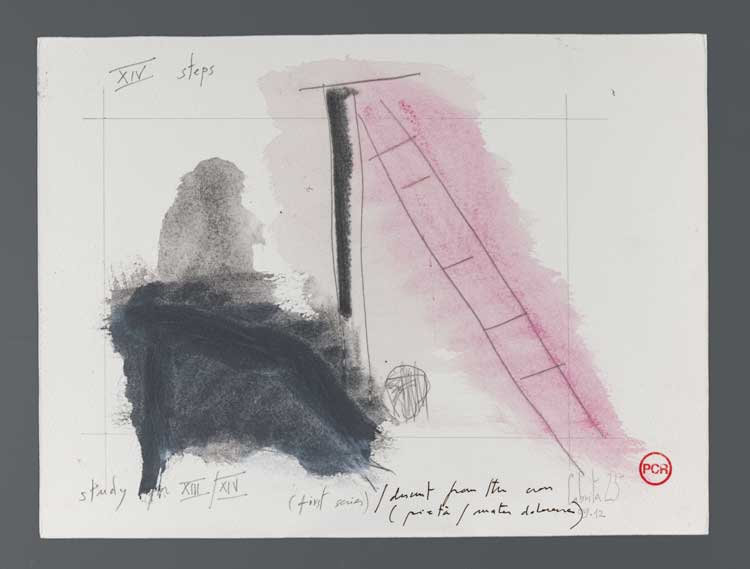
Pedro Cabrita Reis. Studies for XIV Stations, 2025. Study for XIII/XIV (1st series), Jesus de cruce deponitur (descent from the cross). Mixed media on watercolour paper, 24 x 32 cm. Photo: João Ferrand.
NH: I would like to discuss the allegorical content of your work. How do you think that the concept of allegory (a story or a painting in which characters and events offer a symbolic meaning) can provide a framework for people to understand your oeuvre?
PCR: An image is already, in itself, an allegory, and each person understands it differently according to their social, religious, cultural or political context. The way in which works of art are perceived depends on the cultural, political and social environment of those who encounter them, even though the contemporary world has, to some extent, been levelled and normalised by the internet and social media.
Monet’s Water Lilies will never be identical in the eyes of those who encounter them in different parts of the world. I am absolutely convinced that XIV Steps will likewise be seen in as many different ways as there are different people who encounter them. And every person is, of course, different from every other. This multiplicity of perspectives enriches the meaning of the work and expands its existence. Ultimately, the work is always understood. And the wonder of this is that it is always understood in a personal, intimate, subjective and unique manner. Each work of art becomes a different work of art for each different person.
NH: In an interview with Studio International in 2022, you shared your great knowledge of the canon of art history, from the father of European painting, the great innovator Giotto, to the pioneering 20th-century artist Picasso. What are your favourite paintings?
PCR: I do not believe that a conclusive answer can ever be given to a question of this nature. Perhaps it would be more productive to ask which artists interest me, and for what reasons. Even then, however, it is likely that certain areas of uncertainty would remain.
It is possible to establish historiographical, critical and formal connections between the works of one artist and those of another. Yet I do not think it is ever possible to know, with any real precision, why an artist becomes interested in the work of another artist or artists, whether they are contemporaries or belong to other periods in the history of art. I believe these are affinities – not precisely elective affinities, but profound, subjective and, above all, emotional ones: a kind of zone of penumbra.
In any case, I always return, with renewed pleasure, to the painting of the so-called Baroque period, with particular attention to Caravaggio, Velázquez, Zurbarán, Rubens and Ribera, as well as to Bernini’s sculpture. Delacroix, Goya, Picasso and Monet have accompanied me, as have Rodin, Bruce Nauman and Barnett Newman. Yet, despite everything, I continue to prefer my own paintings, which ultimately carry within them fragments, moments, and histories drawn from the paintings of the artists I contemplate.
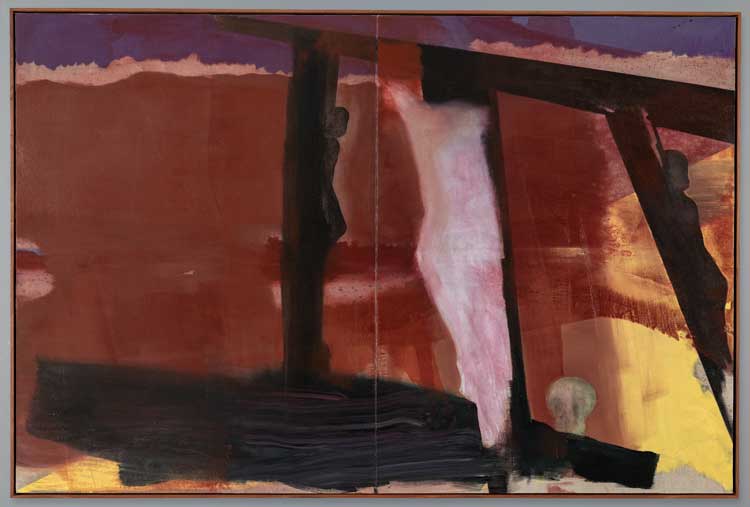
Pedro Cabrita Reis. XIV Passos, 2025. XII/XIV, Jesus in cruce moritur (dies on the cross). Oil on raw canvas, 200 x 300 cm (diptych: 200 × 150 cm each). Photo: João Ferrand.
NH: Although the show is coming to an end, I hope you will be able to continue to exhibit your work. Could you tell me about your next steps on your journey as an artist?
PCR: Well, as we speak – in August 2026 – I am preparing the installation of a major exhibition at the Museum of Art, Architecture and Technology in Lisbon. It is primarily a painting exhibition, but it will also include a large aluminium sculpture entitled 3=1.
Beyond this, I continue to work, principally through writing, as well as through preparatory drawings and watercolours, on an idea that I have been developing for several years: a series of paintings referring to Goya’s Black Paintings. Ultimately, it is always the same gesture: continually going back and forth, departing from and returning to the history of art. I believe that true contemporaneity does not reside in the frenetic pursuit of puerile novelties that serve only the superficiality of fashion and the voracity of the market. All art is, ultimately, contemporary. To understand this is to understand how we may bring into the present, and into our own work, the manner in which the artists who preceded us transformed their own time into the works they created.
Whether one wishes it or not, and regardless of the modes or forms through which this may occur, art is always political and transformative of the world. The work of Goya, and that of many other artists, speaks to us of precisely this.
• Pedro Cabrita Reis: XIV Steps is at the Magazzino del Sale 3, Accademia di Belle Arti di Venezia, Venice, Italy, until 22 November. Pedro Cabrita Reis: ‘Without Sorrow of Heart’ is at the Museum of Art, Architecture and Technology in Lisbon, Portugal, until 15 February 2027.
Click on the pictures below to enlarge

Copyright © 1893–2026 Studio International Foundation.
The title Studio International is the property of the Studio International Foundation and, together with the content, are bound by copyright. All rights reserved.
 |
 |
 |
|---|

-300.jpg)
 Pedro Cabrita Reis – interview: ‘Through all these years, I’ve always done what I wanted. I intend to stay like that’
 José Pedro Croft: Uncertain Measure – Venice Biennale 2017