



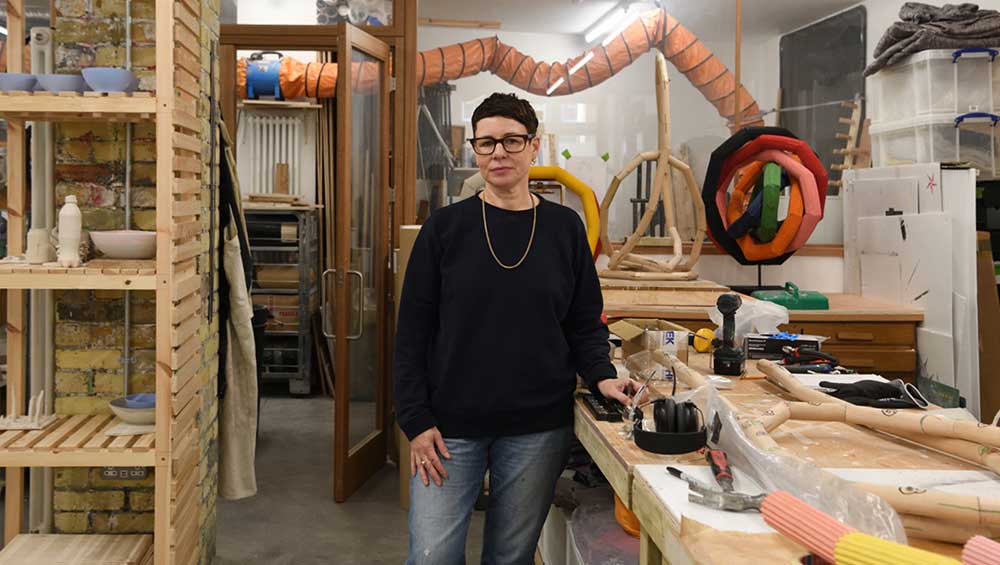
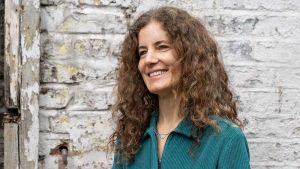
Eva Rothschild RA. Photo: Anne Purkiss/RA.
by SABINE CASPARIE
The culturally rich and vibrant city of Edinburgh isn’t renowned for its weather, but having set off from London in the middle of a July heatwave, it is a delight for me to step off the train in an agreeable 25C. When Eva Rothschild walks me around her show at Fruitmarket before our interview, the first work we encounter is Amphi (2019). It was made for the Irish Pavilion of the 2019 Venice Biennale and shown last year at the Kunstverein Hannover for An Exhibition for Children (And Other People) curated by Jeremy Deller. In Fruitmarket’s bright Upper Gallery with its skylight window, the stacked boxes, with their white surfaces and colourful marks of spray paint, look almost serene. But, as with many of Rothschild’s sculptures, there is an invitation to the audience to climb on them, and so I do. They instantly turn from minimalist, grid-like installation to the amphitheatre alluded to in their title.
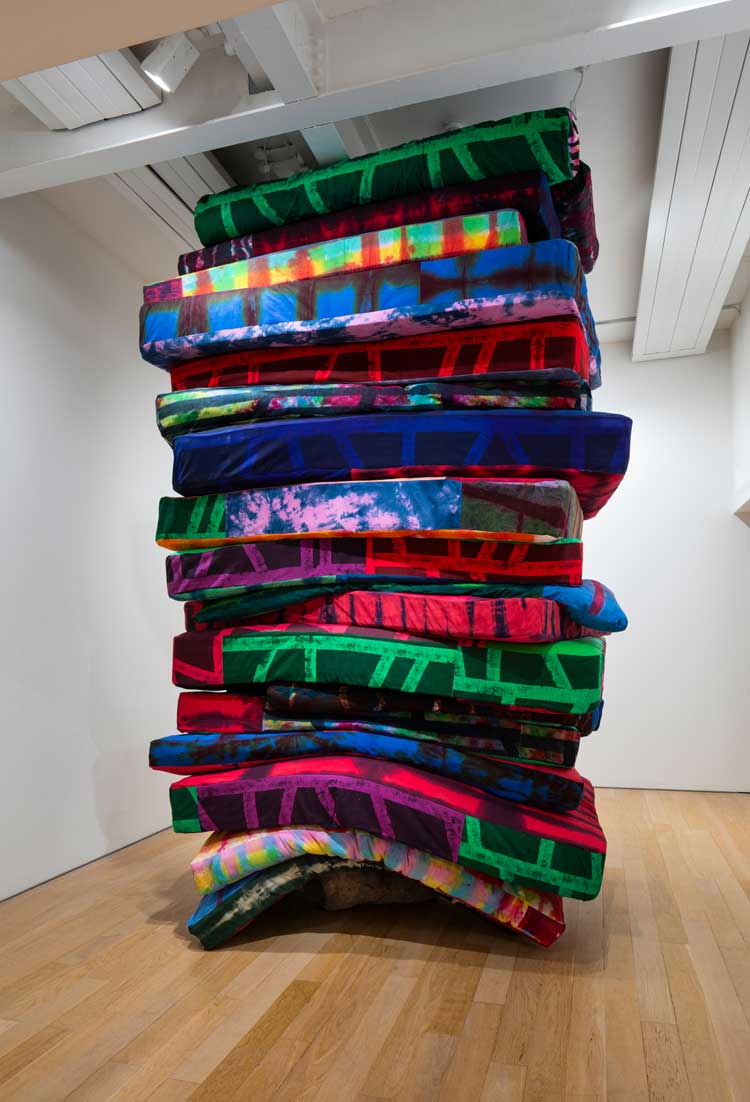
Eva Rothschild, The Grit, 2026. Courtesy the artist, Modern Art and The Modern Institute/Toby Webster Ltd., Glasgow. Photo: Ruth Clark.
Rothschild is interested in titles and the extra layers they add to her works, evoking associations rather than imposing a fixed interpretation. She uses a broad and diverse range of materials for her sculptures, which often reveal themselves only after prolonged looking – something she really values. In Hangouts (2018), hoodies coated in jesmonite are draped over a three-dimensional grid made of steel, inserting associations of the body and the domestic into the geometric forms. In the Lower Gallery, Watcher (2026) is made from cut scraps of clay, which are bisque fired and then glazed in manganese giving the effect of bronze - a multilayered material transformation. In a small room off the main Lower Gallery, The Grit (2026), a monumental pile of stacked mattresses in a hand-dyed fabric with colourful geometric motifs, immediately draws your eyes. “I made the decision to put that gigantic sculpture in that tiny room, where you would normally expect to see something smaller, like the ceramic sculptures,” Rothschild explains. Mats with similar patterns reappear in the Warehouse, a later extension to the Upper and Lower Galleries, and a more industrial space. Here, they are scattered together with soft cones and triangles, functioning as a seating area from which to watch her new film, Safe (2026).
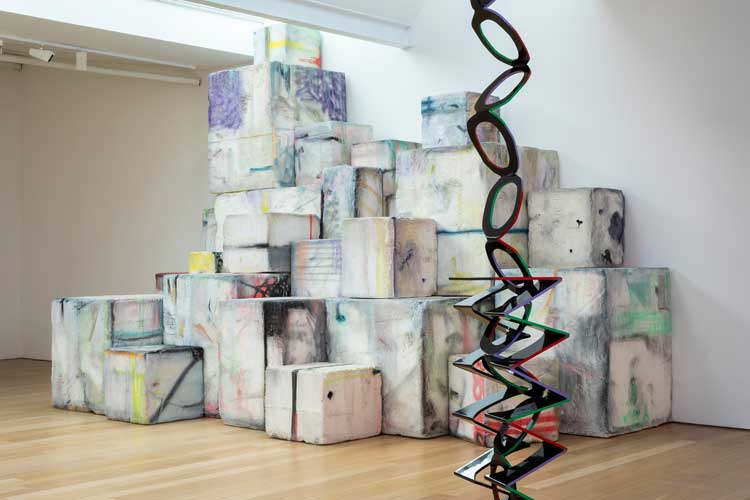
Eva Rothschild, The Void Presses The Wall. Installation view, Fruitmarket, 2026. Courtesy the artist, Modern Art and The Modern Institute / Toby Webster Ltd., Glasgow. Photo: Ruth Clark.
Rothschild often reuses materials and motifs in different contexts, and Safe (2026) features a public commission from 2021: a bright yellow, ziggurat-like playground construction, one of two structures titled Parsloes Memphis and co-commissioned by Create London and the London Borough of Barking and Dagenham for Parsloes Park, Becontree. It’s not just the pulling through of a material narrative thread that Rothschild enjoys; equally important is giving the audience a sense that the encounter with her work is created for the body. The film builds on Boys and Sculpture (2012), in which children from a primary school near Whitechapel Gallery were invited into a room in the gallery containing various of Rothschild’s sculptures: entering the room tentatively, they then completely dismantled the works, ecstatic with joy. The solid playground structure of Safe (2026) invites a different approach. In the first half, a group of young boys from the area is seen climbing on it, hanging from it and kicking a ball around underneath it. In the second half, a group of adolescents takes their place – including students from one of Sadler’s Wells dance programmes (Rothschild was commissioned to make two large tapestries for Sadler’s Wells East in 2025). It is fascinating to watch the different body language of the older boys, their movements slower and lankier, scrolling on their phones and practising short dance routines. At the end of the film, the grey clouds lift to let in the auburn light of the setting winter sun, bathing the scene in a warm glow.
Rothschild talked to Studio International at Fruitmarket on the afternoon before the opening of her exhibition The Void Presses the Wall.
Sabine Casparie: The architecture of the spaces in which you exhibit is an important element of your work. How did the architecture of Fruitmarket influence the selection and placing of the artworks?
Eva Rothschild: There are three galleries, but they aren’t connected; you have to leave one before you enter the next one. The Upper Gallery is really bright and has a clarity to it, whereas the Lower Gallery is more bunker-like. The upstairs space is punctured by the staircase, and I chose Amphi (2019) for the end of that space: you climb the stairs, and then you have the possibility to continue by climbing on the blocks, so it gives the sense of ascension. The space has a clarity to it, and it was important to me to have these clear works: contained and sharp, to maintain that sense of focus and tightness. The downstairs space is more bounded, and the works there are more diverse. Diversity of making and materials is essential to what I do, and given the scope of the show, I felt it was important to include as much as was possible of the ways of making I habitually engage in. The warehouse space is totally different; it has a real physicality to it. I made Safe (2026), the film, especially for that gallery.
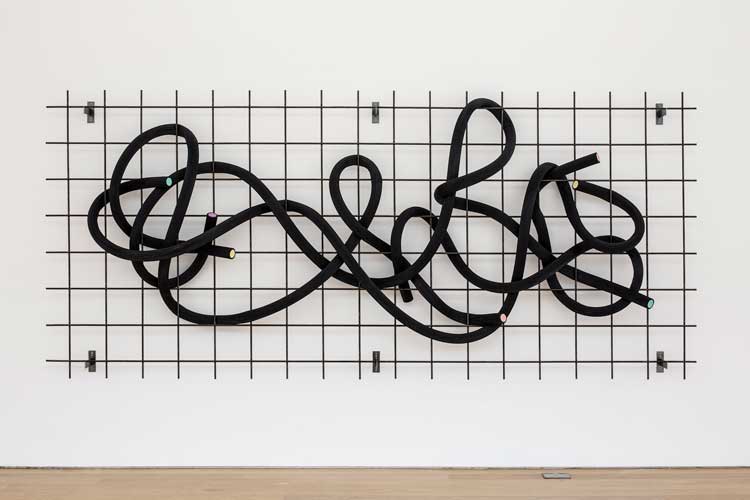
Eva Rothschild, Cursive, 2026. Courtesy the artist, Modern Art and The Modern Institute / Toby Webster Ltd., Glasgow. Photo: Keith Hunter Photography.
SC: Materiality is important for sculptures in general, but for you particularly. In many of your works there is a contrast inside the works: we think we are seeing one material, but we then find out it is a different material. For example, the blocks in Amphi look like polystyrene but are made of resin. Why do you think that is so important?
ER: It’s intrinsic to cast objects, but with an artwork there is also a transformational function. It’s about creating a kind of material confusion: something is alike and not alike. This in turn creates a focus: the viewer is both understanding what they’re seeing and not understanding. That leads to a more searching way of looking, and an intensity of the gaze. And, I hope, an expansion of thinking around the work.
SC: You started your education at a convent school. Did that way of contemplative and meditative looking that we practise with religious objects influence you?
ER: To an extent – going to religious school was absolutely the norm in Ireland then. Catholicism has a very strong visual culture. The idea of the devotional object or image as a stand-in for the spiritual or transformative moment has influenced me greatly.
SC: When you look at a painting, it can open up, whereas with sculpture it feels more like you are closing something down. How do you find ways to make a statement through sculpture beyond the material?
ER: I don’t see sculpture as closing anything down, I just think it is experienced differently from painting. When I am making a work, I don’t ask: “What does this say?”; I think: “What is this? What can this be?” Making sculpture is quite obtuse: physically, it doesn’t fit easily in a house, it is a nightmare to store and, to engage with it, you have to create a separate space. I like that. It’s like a contract you enter into about the space and its rules. Paintings compete with pictures, and pictures are everywhere – in your pockets on your phone! – whereas the obtuse nature of sculpture makes it not really exist in another context. I have made a lot of public sculpture and that responds to the architecture and the buildings, but when I make sculptures for an exhibition, I like the idea that they are held within a kind of stasis in that space.
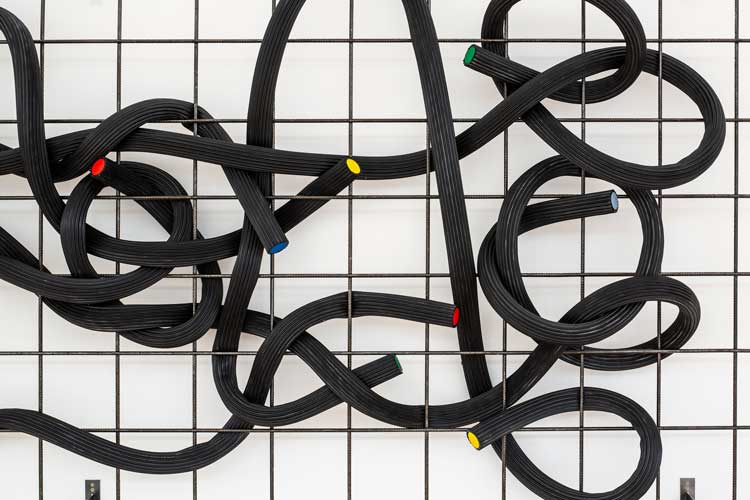
Eva Rothschild, Shorthand, 2026. Courtesy the artist, Modern Art and The Modern Institute/Toby Webster Ltd., Glasgow. Photo: Keith Hunter Photography.
SC: How did you come up with the title of the work, The Void Presses the Wall? It seems contradictory: a void can’t press anything.
ER: I was thinking about bubble gum (mimics the movement of blowing a bubble). A pressure is exerted by the breath, and the bubble gives the idea of a mass, but there is nothing there. But even if there is nothing there, that void is still filling the space; the nothingness is a presence. Most of my work, even though it might be big, is open inside; it is not about the mass. Linear forms can be expansive: even though they reduce the volume, they occupy space. Expressing that kind of negative space in language was something I was interested in doing.
SC: I am thinking of Barbara Hepworth!
ER: Yes, absolutely.
SC: When you are making an artwork, do you think about how someone viewing it will approach it?
EV: No, not at the beginning. Although I collaborate with fabricators sometimes, most of my work is done in the studio. To make an object, I first want to understand what its possibilities are. I make a lot of objects that are accumulated, without a clear sense of where they are going, and often the materials will suggest the iteration. It’s like building a vocabulary, or an alphabet, and the studio is really the site of that. Then when I install my work, I have to consider that it responds to the body. All these objects were made in the studio, but they didn’t fully become sculptures until I installed them, so I am learning about them as they come into being. When we viewed The Grit (2026) earlier, the room with the mattresses, the sound changed when we were talking. The work created a block in the room, and the mattresses absorbed all the ambient sound, and I hadn’t anticipated that – I found it quite overwhelming. I only learned that about the piece today, so there was a sense of discovery for me, as I became the audience for the work. That’s the risk and reward of making the work I do. Audience and location can create the final work.
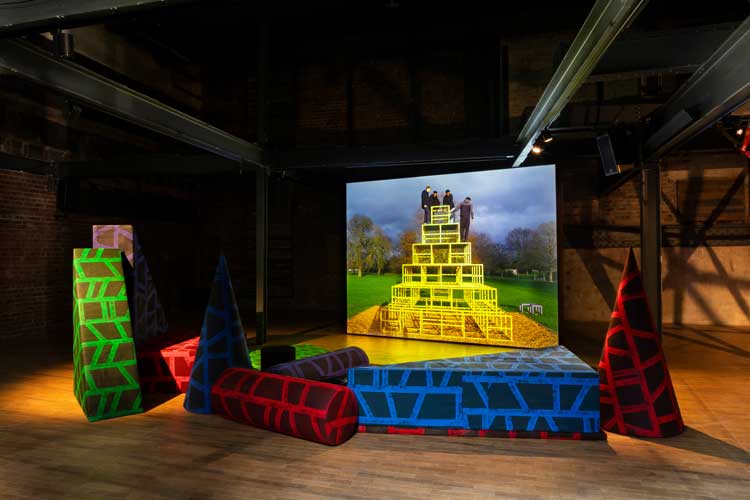
Eva Rothschild, Safe, 2026. Commissioned by Fruitmarket, Edinburgh in collaboration with Sadler’s Wells. Supported by the Herny Moore Foundation, and the generosity of the Eva Rothschild Supporters Circle. With thanks to Barking and Dagenham Council and the Jo Richardson Community School; Soft Play, 2026. Courtesy the artist, Modern Art and The Modern Institute / Toby Webster Ltd., Glasgow. Photo: Ruth Clark.
SC: Your interest in the location of the work and its relationship to the body manifests in your film Safe (2026), shown in the Warehouse. It features one of the two playground structures from Parsloes Memphis (2021), a bright yellow pyramid made up of stacked, transparent steel quadrants. During the film, younger and older boys are seen interacting with the structure. What inspired you to make the film?
ER: When I made the playground, I had wanted to make a film with local boys, but it was impossible due to the pandemic. The film was a way of observing and collaborating with a group who the structure was designed for. A playground is one of the few urban things that is there for you to climb all over, a structure purely for physical engagement. I designed it with older kids in mind; they use playgrounds in different ways from little kids, unsupervised and after hours. It was important to me that the structure was high and could be used to sit on, and that the children could climb to the top and feel a sense of ownership; they could be “king of the castle”. There is something really simple about that – I wanted to make something that had that sense of somewhere you could hang out.
SC: Your earlier film, Boys and Sculpture (2012), shown at Whitechapel Gallery, featured boys from a local primary school. Is there a reason you chose to work with boys in both films?
ER: That film came from the period I spent teaching, and also from having gone to an all-girls school – the differences I felt between boys and girls in terms of taking up space and interacting with the world. With Parsloes Memphis, I was thinking about this but also had the experience of my sons growing up. As well as the local schoolboys, the film features students from Sadler’s Wells’s Academy Breakin’ Convention, an alternative dance and hip-hop programme for 16- to18-year-olds. I am really interested in the movement of the body in relation to objects and, with the age groups represented here, there is that sense of physicality and we can observe the interaction between the older and younger groups. Also, by the time I was making Safe, something had shifted in the conversation around boys and men. There is so much negativity now around young men and the constant sense of “toxicity”, regardless of what they are doing. I wanted to make something positive that countered that.
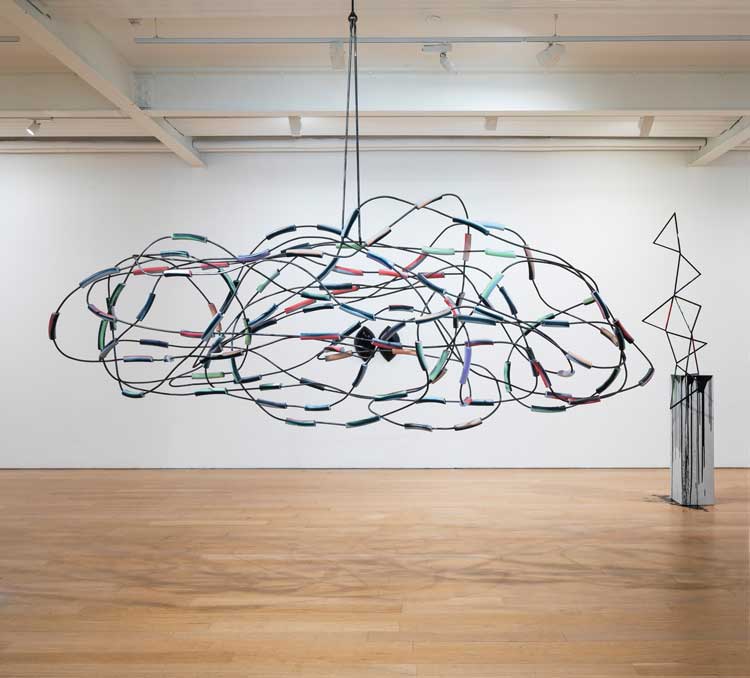
Eva Rothschild, (left to right) The Cloud, 2026; Tranquillity Now (Black), 2020. Courtesy the artist, Modern Art and The Modern Institute / Toby Webster Ltd., Glasgow. Photo: Ruth Clark.
SC: Your art is often placed in the context of minimalism. Your films address masculinity, and what it feels like to live as a man in the world, but stylistically, your sculptures seem to subvert that very masculine sensibility of 1960s minimalist art, by inserting softness and playfulness. You have previously used the term “magic minimalism”. Can you say a bit more about that?
ER: I said this once years ago, and the term has followed me around! But it does describe what interests me. I think of minimalism as so pure, trying to be free of associations, but for me, the more minimal the object is, the more transcendent it is. If you think of the crystal ball, a sphere, there is pure materiality, but also divination. I believe it is a conceit that something could float free of our associative looking. I just think it’s impossible. The associative, kinetic, bodily sense of something, and what happens with that, is what interests me.
SC: Your sculpture Festival (2026) is displayed alongside Safe (2026), mirroring its pyramid-like forms. It made me think about one of Cold Corners (2009), your Duveens commission at Tate Britain. There is that same sense of a geometric shape that angles around the architecture of a space – the neoclassical columns at Tate, and the Warehouse’s industrial pipes at Fruitmarket. Cold Corners was shiny, black and made of steel, whereas Festival (2026) seems much more irreverent; it is colourful and light, made of textiles on an armature of cardboard and bamboo. Is that a matter of being more confident as your career progresses?
ER: Possibly. Getting older, I have a different knowledge of my work. I like the idea of making quite “un-resourced” sculptures, making something grandiose out of something economical. Festival (2026), shown alongside the steel, structured pyramid in the film, is the almost pathetic pyramid. I was also thinking of Glastonbury, and the hippy ideology; the way in which people buy into a romantic or transcendent idea through objects. Like the rubber locks in New Romantix (2026), which are influenced by the locks people put on bridges as a romantic gesture.
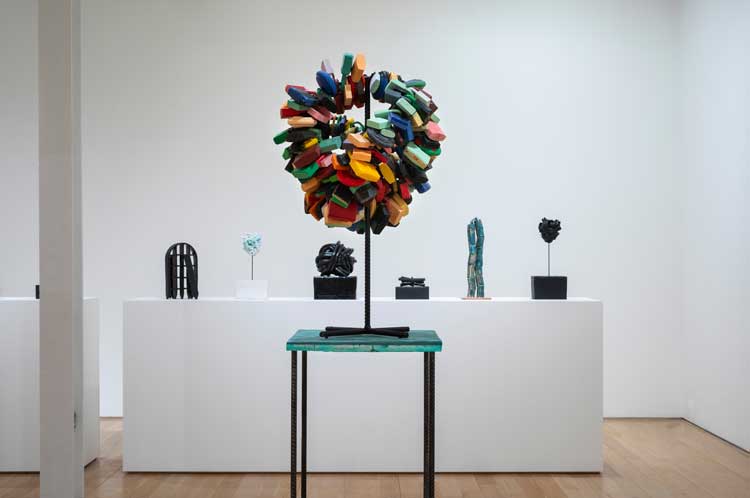
Eva Rothschild, New Romantix, 2026. (Left to right) Gatz, 2026; Watcher, 2026; Medusa, 2026; Stix, 2026; Nymph, 2026; Watcher, 2026. Courtesy the artist, Modern Art and The Modern Institute/Toby Webster Ltd., Glasgow. Photo: Ruth Clark.
SC: Do you see your sculptures as creatures with a life in them?
ER: The thing I really resist is figuration. That doesn’t mean I don’t think about my sculptures as having an aura around them. Sometimes, I may see a sculpture as friendly, hostile or weak. I give attributes, but that is different from narrative figuration.
SC: You recently made two tapestries for Sadler’s Wells East, The In Breath and The Out Breath (2025). A pair of tapestries is currently on view at Goodwood Art Foundation, too. How was it to work in that medium?
ER: I have always been interested in rugs. Like the mattresses, they take on forms you associate with paintings, but they don’t have a surface quality. There is no skin. I began working with West Dean College in West Sussex 12 years ago. They placed an open call as they were looking to work with contemporary artists, and the piece I made with them is now in the Tate collection. For Sadler’s Wells East, I initially thought I would make a sculpture, but when I saw the architecture of the building, there were two large walls, and I immediately thought I would make two tapestries. Working with West Dean College was an amazing process: they dye all the wool for the tapestries, so the specificity of colour is amazing. What’s also incredible is that wool has no reflectivity – none! There’s nothing being lost. When you look, it is completely absorbing.
SC: I like that the tapestries seem to create space, even though they are flat.
ER: Yes! you wouldn’t think that on tapestry you can make this illusionistic space, but the way you can work with the gradients really opens up that three-dimensionality.
SC: In your tapestries, the colours are geometric and controlled, but coming back to Amphi (2019), the work mentioned at the beginning, the colour on the stacked boxes is much more expressive.
ER: With spray paint, I was always interested in what it stands for – the urban environment – and I made quite a lot of work with graffiti artists in the 90s. But I am also really interested in how it moves. It’s paint, but there is no brush; you are making a mark while being removed from it. The paint is travelling and then it hits an obstacle, so it is an arrest rather than a gesture. I find that interesting technically. We use it to express, but it’s a different type of mark: an arrested mark without that sense of touch.
SC: What is the most surprising reaction you had from the public, or the most memorable one?
ER: (Thinks for a moment). I had another artist visit one of my exhibitions, and he told me afterwards that he found it interesting that rather than illusionistic materiality, my works had confused materiality. I really liked that.
• Eva Rothschild: The Void Presses the Wall is atFruitmarket, Edinburgh, until 11 October.
Click on the pictures below to enlarge

Copyright © 1893–2026 Studio International Foundation.
The title Studio International is the property of the Studio International Foundation and, together with the content, are bound by copyright. All rights reserved.
 |
 |
 |
|---|
-300.jpg)
 Eva Rothschild: The Shrinking Universe – Venice Biennale 2019
 31 Women