




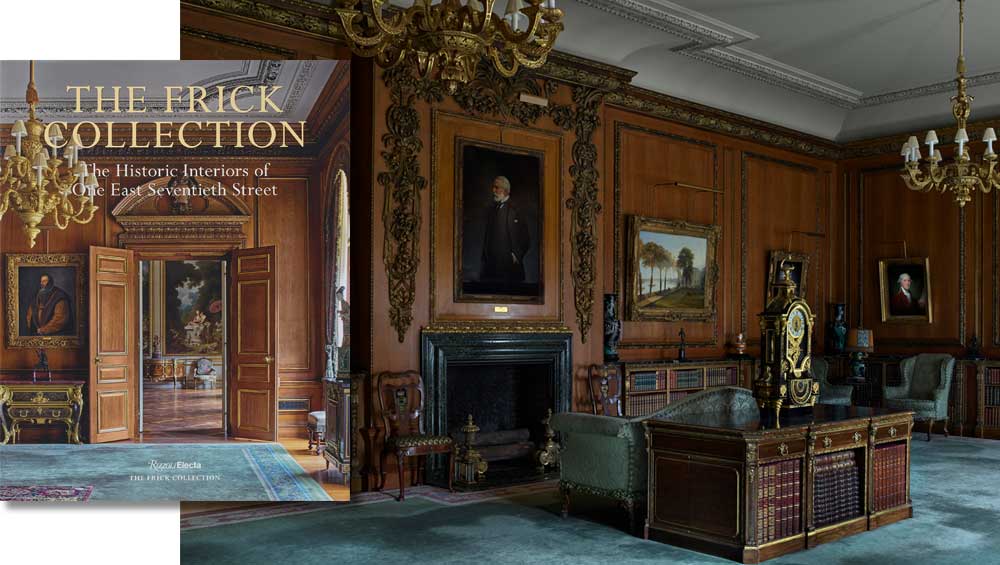
The Frick Collection: The Historic Interiors of One East Seventieth Street, published by Rizzoli Electa in association with the Frick Collection. Right: Library Gallery, The Frick Collection, New York. Photo: Miguel Flores-Vianna.
Review by NICOLA HOMER
This book celebrates the museum housing the Gilded Age collection of the industrialist Henry Clay Frick (1849-1919) in New York City following its renovation and enhancement, an overarching project designed by Selldorf Architects and executed by Beyer Blinder Belle Architects and Planners in 2020-25. During this time, the book’s author, Xavier F Salomon, was the deputy director and chief curator of the Frick Collection and he oversaw the renovation of the mansion itself, collaborating with the institution's curators and conservators as well as an extensive team of specialists and craft firms they selected. A major outcome being that the museum’s second floor, once home to the Frick family, is now open to the public for the first time in its history. The publication does justice to the vision of Frick, who bequeathed his home and art collection to the public.
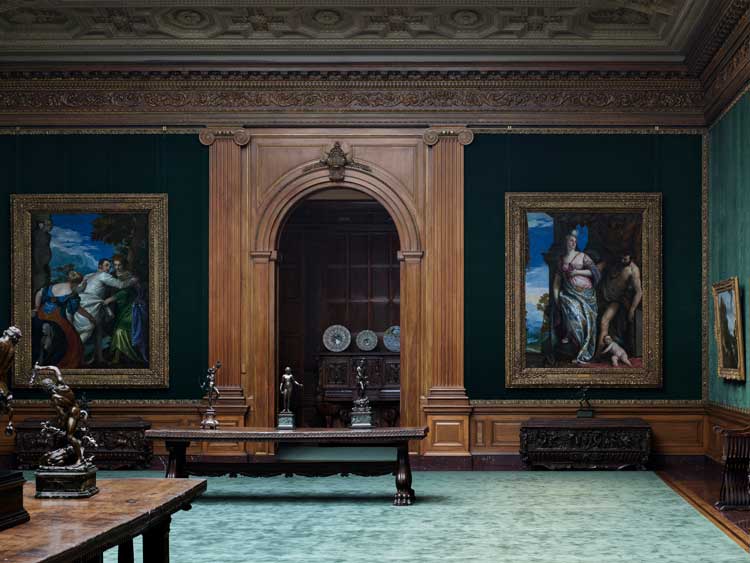
West Gallery, The Frick Collection, New York. Photo: Miguel Flores-Vianna.
Visitors can enjoy masterpieces from the Renaissance to 19th-century paintings, such as John Constable’s White Horse (on display at Tate Britain until 12 April). In the 1890s, Frick started his art collection by pursuing an interest in French naturalism and the Barbizon School, before focusing on European old masters after the turn of the 20th century. In 1911, the industrialist purchased the Fifth Avenue site for his home. In subsequent years, he commissioned an architect to draw up a plan for the mansion and acquired parts of JP Morgan’s collection, including canvases by Jean-Honoré Fragonard, European bronzes and Chinese porcelain, as described in the book’s introduction. The author says succinctly: “In a letter to the architect of his New York City home, Henry Clay Frick wrote, ‘We desire a comfortable, well-arranged house, simple, in good taste, and not ostentatious.’”
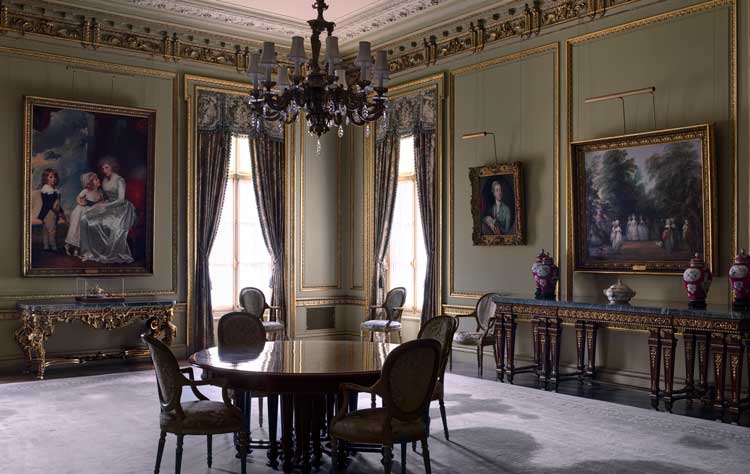
Dining Room, The Frick Collection, New York. Photo: Miguel Flores-Vianna.
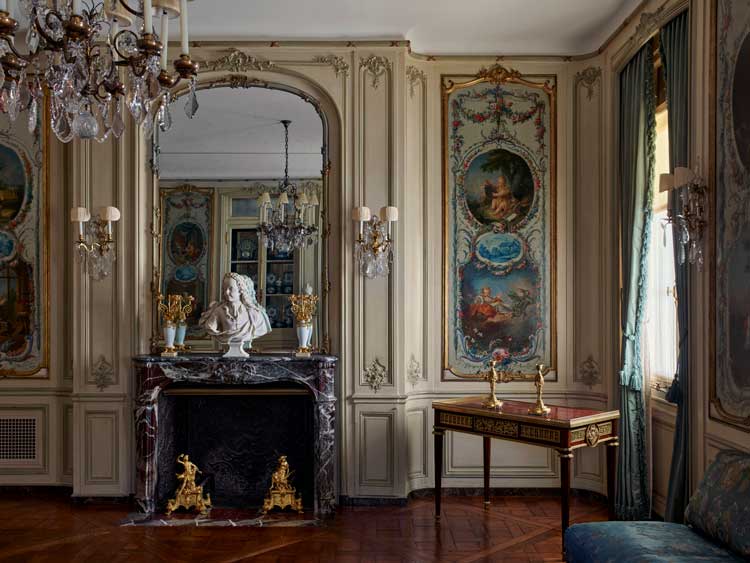
The book focuses on the original mansion of 1 East 70th Street, designed by Thomas Hastings of Carrère and Hastings, architects of New York’s Public Library. The architecture was fashioned on French and English building types. The main facade was modelled partly on the Hôtel du Châtelet in Paris, and the west facade shows the inspiration drawn from the Grand Trianon at the Palace of Versailles. The interiors were designed by Sir Charles Carrick Allom, whose firm had renovated parts of Buckingham Palace in the Edwardian era. The Dining Room was modelled on dining rooms of 18th-century English houses, typically decorated with portraits of aristocratic families. New forms of taxation in the late 19th century led some British nobles to sell portraits: collectors in the US probably acquired such aristocratic portraits to fashion their own legacies. The publication explores additions from the 1930s by the architect John Russell Pope, who held responsibility for the transformation of the grand house into a museum. The architect’s influence can be seen in the Garden Court, at the heart of the main floor, featuring elegant columns and a marble fountain, repaired in the renovation, and pictured in glorious photography.
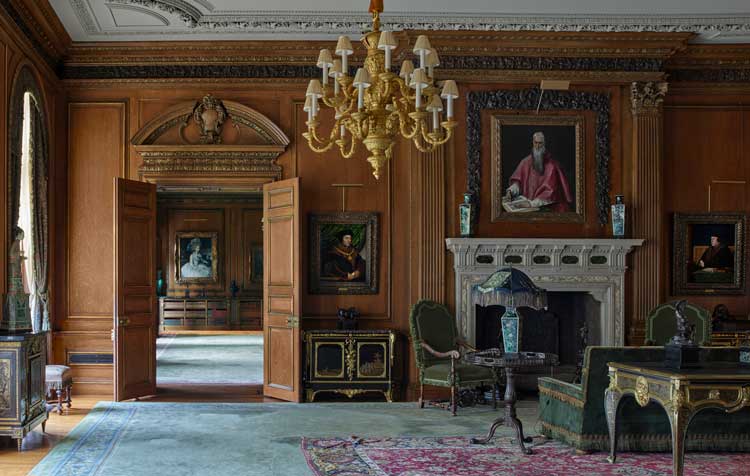
Living Hall, The Frick Collection, New York. Photo: Miguel Flores-Vianna.
This publication transports the reader on a journey through the interiors of this venerable art institution. Consider the Living Hall, which once covered the width of the house, from the front garden on Fifth Avenue to what is now the Garden Court. The Living Hall acts as a synecdoche for the curatorship of the museum. There the installation of six paintings, acquired between 1905 and 1915, has endured since Frick’s time. Portraits of the humanist author Sir Thomas More and the English statesman Thomas Cromwell frame the main fireplace. The author writes: “Frick liked to reunite portraits where he could or juxtapose them to create dialogues; here, he opposed two political rivals from Tudor England.” Above, on a solid oak wall, hangs El Greco’s St Jerome (1609); on the opposite wall, portraits by Titian are positioned on either side of Giovanni Bellini’s St Francis in the Desert (c1475-80), described by the author as “the museum’s most important painting”.
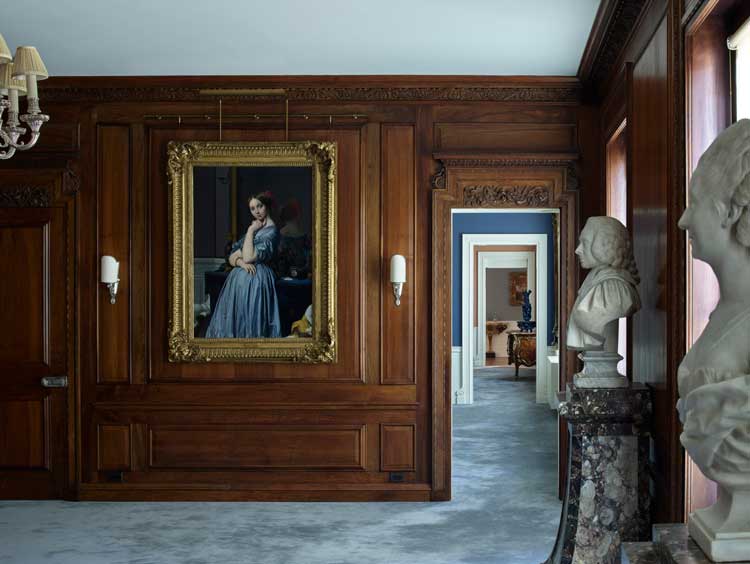
Walnut Room, The Frick Collection, New York. Photo: Miguel Flores-Vianna.
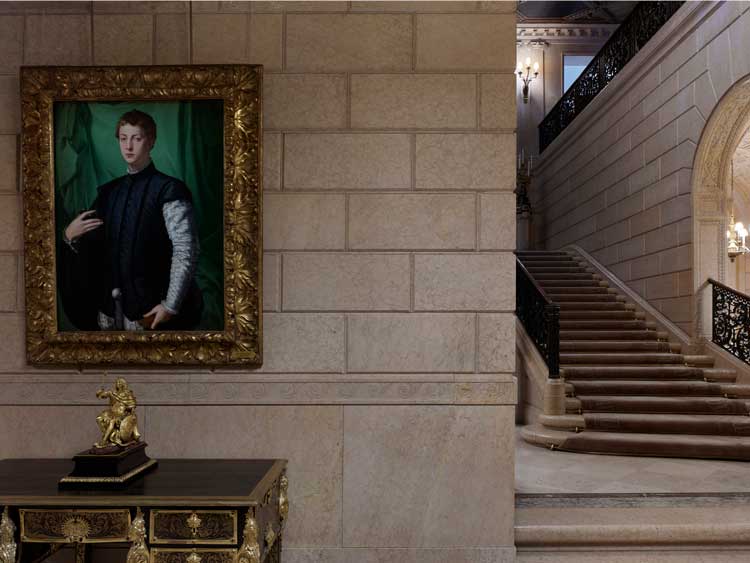
The reader is guided on a room-by-room tour. The decoration of the Library by Allom shares affinities with that of the Living Hall while drawing inspiration from grand English houses. A retrospective portrait of Frick by the Danish American artist John C Johansen, which Frick’s daughter Helen Clay donated after the museum opened to the public, sits above the fireplace. The West Gallery is modelled on galleries of grand English houses, particularly that of the Wallace Collection in London. Between 1912 and 1914, Frick acquired a pair of splendid paintings with moralistic themes by Paolo Veronese, The Choice between Virtue and Vice and Wisdom and Strength (both c1565), which had once belonged to Emperor Rudolf II in Prague. In Frick’s time, the South Hall was home to JMW Turner’s Cologne (1826), now in the West Gallery. Currently, the space displays Agnolo Bronzino’s witty portrait of Lodovico Capponi and two of the museum’s trio of paintings by the Dutch master Johannes Vermeer: Girl Interrupted at Her Music (c1658-59) and Officer and Laughing Girl (c1657).
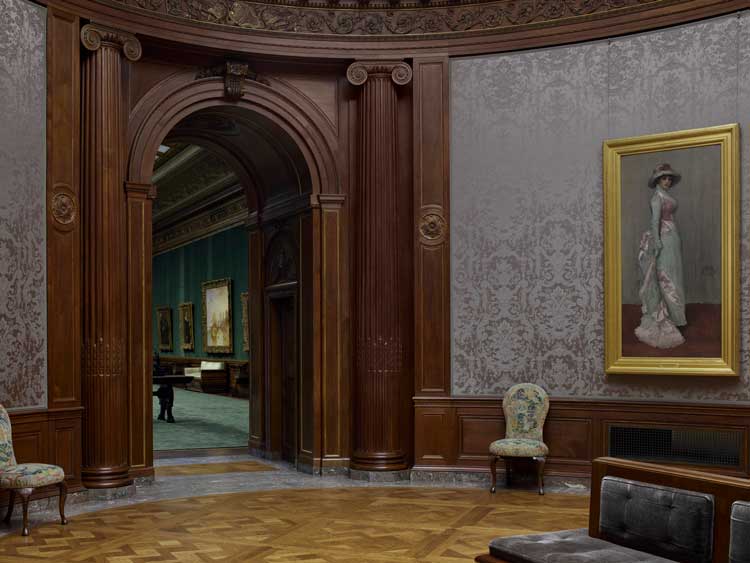
Oval Room, The Frick Collection, New York. Photo: Miguel Flores-Vianna.
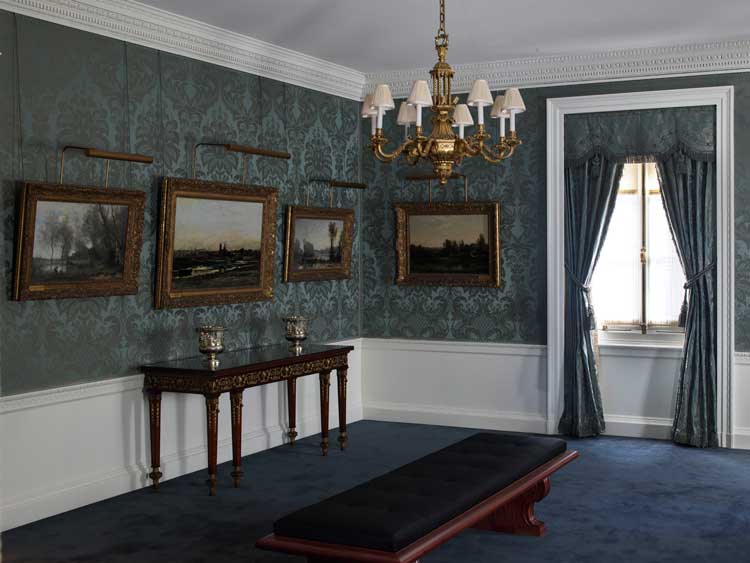
The Oval Room stands in a space that previously held an office for Mr. Frick (torn down in the 1930s and replaced with a gallery by John Russell Pope, reflective somewhat of a 1915 plan by Hastings for a possible future room for the display of sculpture). The outcome was a beautifully designed Oval Room with walls punctuated by arched doors, framed by Ionic columns, which lead to the West Gallery, the East Gallery and the Garden Court. With the renovation, the original patterned wall fabric has been restored. Full-length portraits by James McNeill Whistler can now be seen to full effect in the Oval Room. Following the renovation, the second-floor Breakfast Room once decorated by Allom was restored and the Barbizon School paintings that Frick had purchased as a young man were installed in the room where he had displayed them; and the Walnut Room, which later held special significance as his private residence, was transformed into a gallery, featuring a portrait by Jean-Auguste-Dominique Ingres that has a captivating gaze. Elsie de Wolfe, actor turned decorator, also contributed many second-floor interiors, elements of which the public are enjoying today. With polished writings on this wonderful museum, this book offers insights into the gold-standard interiors of The Frick. This is a book to treasure.
• The Frick Collection: The Historic Interiors of One East Seventieth Street by Xavier F Salomon with photography by Miguel Flores-Vianna is published by Rizzoli Electa in association with the Frick Collection, price $65/£50.
Click on the pictures below to enlarge

Copyright © 1893–2026 Studio International Foundation.
The title Studio International is the property of the Studio International Foundation and, together with the content, are bound by copyright. All rights reserved.
 |
 |
 |
|---|
-300.jpg)


-300.jpg)
 Gainsborough: The Fashion of Portraiture
 Frick Madison provides temporary home for the Frick Collection