




.jpg)
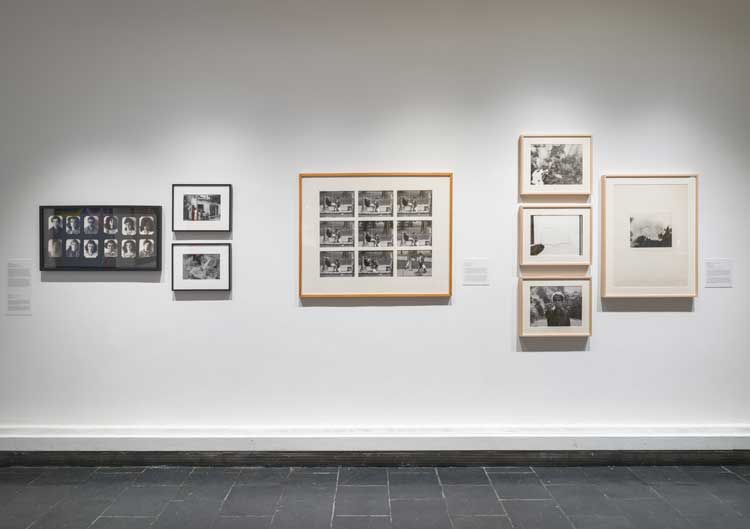
Artes Visuales, The Latin American Avant-Garde in Print, installation view, Bertha and Karl Leubsdorf Gallery, Hunter College Art Galleries, 2025. Photo: JSP Art Photography.
Bertha and Karl Leubsdorf Gallery, Hunter College, New York
16 October – 13 December 2025
by LILLY WEI
For a multitude of reasons, the Americas south of the United States has been a topic of much current interest, the news both positive and deeply troubling. While the border between the two countries has been particularly fraught, Mexico City itself has become a cultural boomtown in recent years – the art scene there thriving. But long before that, there was an outspoken activist avant garde in the region, many of the artists associated with it appearing in Artes Visuales (AV), an influential quarterly published by the Museo de Arte Moderno in Mexico City, then under the directorship of Fernando Gamboa. It was state sponsored, which at times required some fancy footwork to avoid official intervention when discussing controversial subjects that took aim at the repressive policies of Latin America’s increasingly numerous authoritarian regimes, including that of Augusto Pinochet in Chile, whose 1973 coup overthrew the democratically elected president, Salvador Allende, and his socialist government.
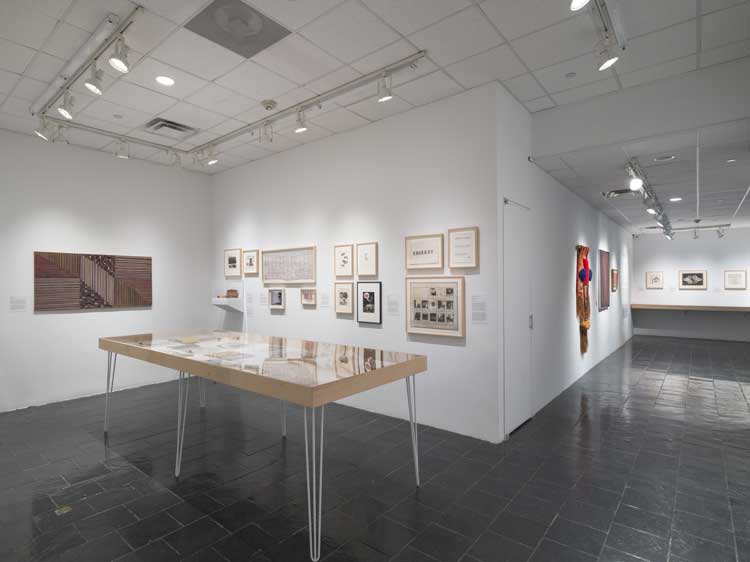
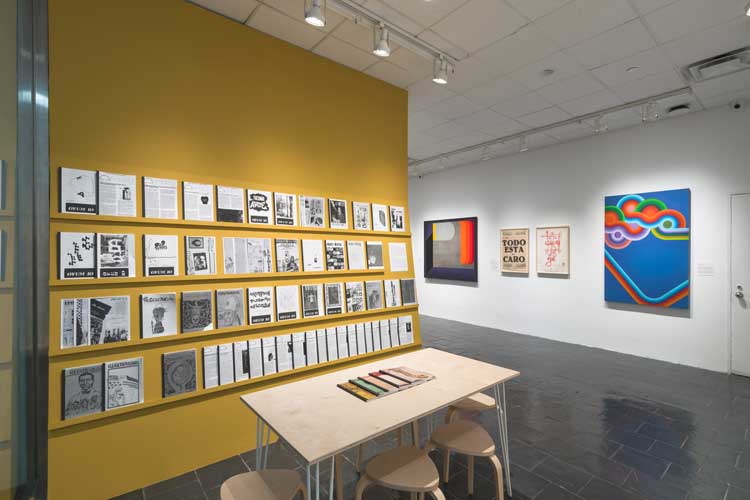
Artes Visuales, The Latin American Avant-Garde in Print, installation view, Bertha and Karl Leubsdorf Gallery, Hunter College Art Galleries, 2025. Photo: JSP Art Photography.
The magazine was co-founded that same year by Gamboa and curator and writer Carla Stellweg, a pioneering lifelong champion of Latin American contemporary art as well as Latine artists from the US and the Caribbean. As its editor between 1973-1981, Stellweg collected a transnational cohort of extraordinary experimental artists within its pages, as well as critics, theorists, writers, academics and curators. It might be called an activist space of resistance, a vanguard thinktank that focused on modern and contemporary art as a means of shaping a Latin American vernacular and identity. It also highlighted feminist, performance, video and conceptual art, then in their incipient stages. Stellweg thought of it as an exhibition venue of sorts, often soliciting texts, projects, documents, manifestos of a non-traditional kind. Artes Visuales was bilingual, published in Spanish and English, which made it more widely accessible, as Stellweg knew it needed to be, in a period when such ventures were one of the few ways to have serious debates about culture, acting as a rare platform for Latin American art, a topic that attracted little interest at the time. Stellweg also knew – what now seems abundantly obvious – that if the region didn’t define itself, it would be defined by outsiders.
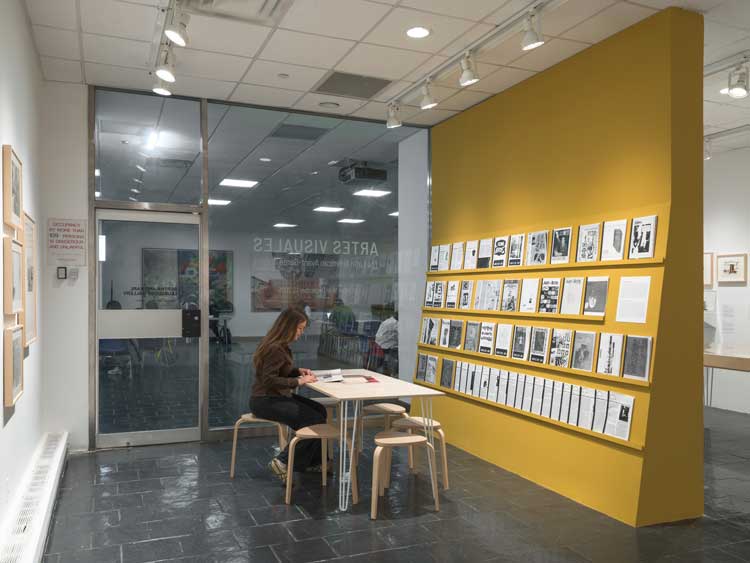
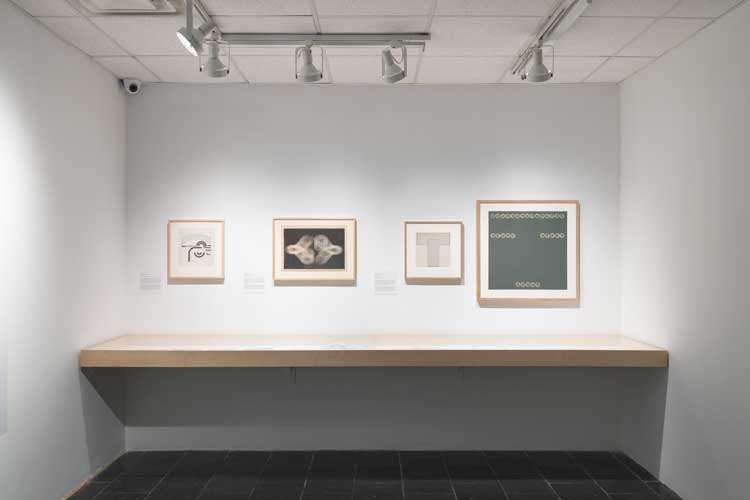
Artes Visuales, The Latin American Avant-Garde in Print, installation view, Bertha and Karl Leubsdorf Gallery, Hunter College Art Galleries, 2025. Photo: JSP Art Photography.
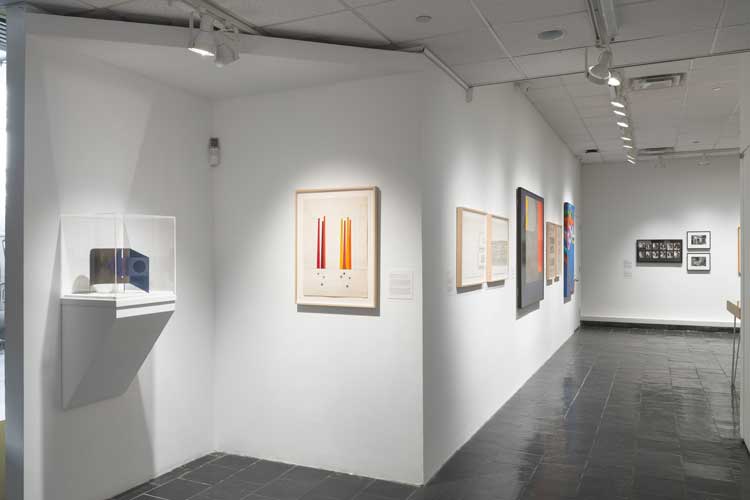
The exhibition Artes Visuales: The Latin American Avant-Garde in Print is curated by Harper Montgomery, director of the Hunter College Art Galleries, in collaboration with the students in the Hunter MA and MFA curatorial programme, and the Institute for Studies on Latin American Art (much of the material comes from the institute’s archives). It is a timely and informative tribute to an essential publication that merits renewed attention, as well as a tribute to Stellweg, who died unexpectedly in October, arguably the soul of the project, her presence illuminating it. It features issues of the magazine and includes other ephemera associated with it in an installation that does not overwhelm, not always easy in exhibitions like this which depend on reading as much as looking. A reading room of sorts was created within the show and viewers are invited to leaf through the materials arranged on a wall of shelving. The artworks that form the other component of the show – paintings and photographs, some textiles, collages, page art and other works on paper – appeared in Artes Visuales. Among the 22 artists shown is Vicente Rojo, a Spanish Mexican graphic designer, painter and typographer who was instrumental in the publication’s design, responsible for 25 of its 29 issues, including its distinctive, dynamic geometric logo, which recalls a kind of modernist ourobouros.
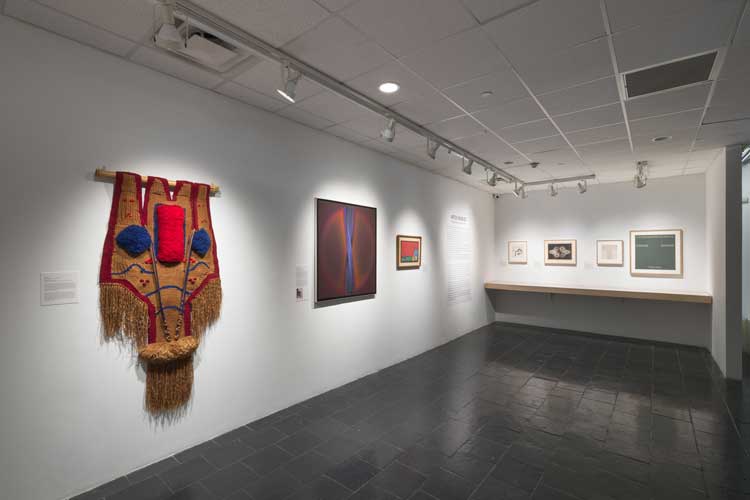
Artes Visuales, The Latin American Avant-Garde in Print, installation view, Bertha and Karl Leubsdorf Gallery, Hunter College Art Galleries, 2025. Photo: JSP Art Photography.
Other artists include the Buenos Aires-born Kazuya Sakai, whose high intensity, boldly coloured geometric paintings stand out as one of the few larger scale paintings present; the Spanish Mexican Marta Palau, a much admired textile artist, who challenged the notion that traditional crafts, usually practised by women, were of lesser value, and whose rough but commanding homespun work with its knotted hangings suggesting a female face, a body, is riveting in its forceful materiality; the Brazilian Regina Vater, represented by black-and-white photographs of a performance from 1976 in which she assumed the different roles traditionally assigned to Latin American women as a critique of patriarchal norms; and the Argentinian Victor Grippo, whose sculpture Síntesis (1973) pairs a lump of coal with a potato of equal size, a striking comparison of contrasting sources of energy and extractive economies, and a topic of continuing debate, more vehement and acrimonious than ever.
One of the best known of these artists is Luis Camnitzer, a Uruguayan born in Germany who came to the US in 1964. A conceptualist who has always questioned systems of power, the visible and unseen, he is represented here by images from his photographic series The Book of Holes (1978), printed in AV (Summer, 1978), an issue dedicated to imprisoned fellow Uruguayan artists Jorge Caraballo and Clemente Padín, also in the show. In Camnitzer’s images, the surface is interrupted by an outline of a form that is left incomplete. We question the rather ordinary photo before us, etched with an open shape that is “inexplicable”, a word he once offered as one way to view his work but later retracted.
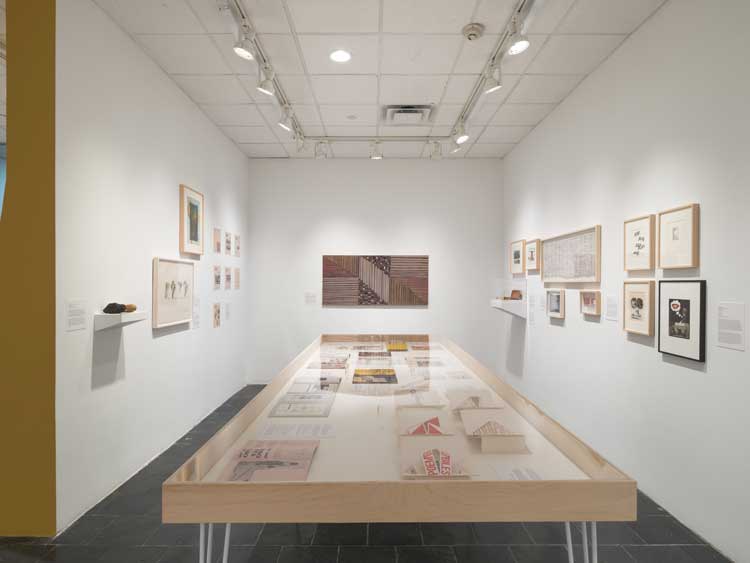
Artes Visuales, The Latin American Avant-Garde in Print, installation view, Bertha and Karl Leubsdorf Gallery, Hunter College Art Galleries, 2025. Photo: JSP Art Photography.
And don’t forget to read the labels – they offer viewers who are not familiar with the history of these works the groundwork from which to explore the show. Although concentrating on a single publication, it nonetheless opens a surprisingly large window into a complicated past which, unfortunately, only too closely resembles the present, with, however, a greater sense of audacity, purpose and hope for the future. It also offers the pleasure of touching (some of the) actual objects, turning pages, and looking at the subtleties of light and depth in silver gelatin prints. You leave this show with the feeling that there is something to take away with you, that you have learned something – which is always rewarding.
Click on the pictures below to enlarge
-750.jpg)

Copyright © 1893–2026 Studio International Foundation.
The title Studio International is the property of the Studio International Foundation and, together with the content, are bound by copyright. All rights reserved.

 |
 |
 |
|---|


-300.jpg)




 Xavier Mascaró interview: ‘I’m a sculptor, because I want to leave something behind, some trace of what I have been’
 Radical Geometry: Modern Art of South America from the Patricia Phelps de Cisneros Collection
 A Choice Collection of Latin American Art Comes Home
 Touring obsession
 Face to Face - The Daros Collections