




-Installed-in-Proximities-at-SeMA-Seoul-Photo-courtesy-of-ADMAF.jpg)
Mohammed Kazem, The Window 2003-2005 (2005). Installed in Proximities at SeMA Seoul. Photo courtesy of ADMAF.
Seoul Museum of Art, South Korea
16 December 2025 – 29 March 2026
by ALLIE BISWAS
Institutional collaboration is the starting point for this exhibition at Seoul Museum of Art (SeMA), which includes more than 100 works by 47 artists based in the United Arab Emirates (UAE), the majority of whom are Emirati. Last year, the museum’s partnership with Abu Dhabi Music & Arts Foundation, one of the first cultural organisations to be founded in the Arabian Gulf, in 1996, resulted in an exhibition tracing the evolution of new media art in Korea, held at Manarat Al Saadiyat in Abu Dhabi. That show was presented as the most extensive display of Korean contemporary art to be shown in the Gulf to date. Similarly, this exhibition at SeMA is put forward as the most comprehensive show of contemporary art from the UAE to ever be seen in Korea.
Proximities, though, doesn’t set out to explore the potential similarities between the two regions, even though its title may suggest this. Instead, it considers how artists in the UAE have been responding to what the curatorial statement for the exhibition calls “the dynamic and ever-transforming cultural landscape of the United Arab Emirates” – a transformation led by migration and rapid urban renewal, since its establishment as a country only 50 or so years ago. Taken as a whole, the works in the show offer various approaches to navigating a culture that is burgeoning yet still responsive to age-old traditions.
.-Courtesy-of-the-artist-and-The-Third-Line,-Dubai.jpg "Farah Al Qasimi, Conversation, 2023. Courtesy of the artist and The Third Line, Dubai.")
Farah Al Qasimi, Conversation, 2023. Courtesy of the artist and The Third Line, Dubai.
Each of the exhibition’s three sections has been devised by an artist in collaboration with the main curators Maya El Khalil and Eunju Kim. The first section, A Place for Turning, organised by photographer Farah Al Qasimi, is the most rewarding and coherent, using several works to consider how familiar, domestic spaces can be viewed differently. Al Qasimi’s own sleek, compelling pictures relate this best. In one image (Conversation, 2023), two girls who wear floral dresses and sit on a sofa covered in floral fabric become mysterious figures whose relationship is unclear; the head of one figure has not been included in the frame, while the face of the other isn’t shown, which creates a disorienting effect, even though the context initially appears benign.
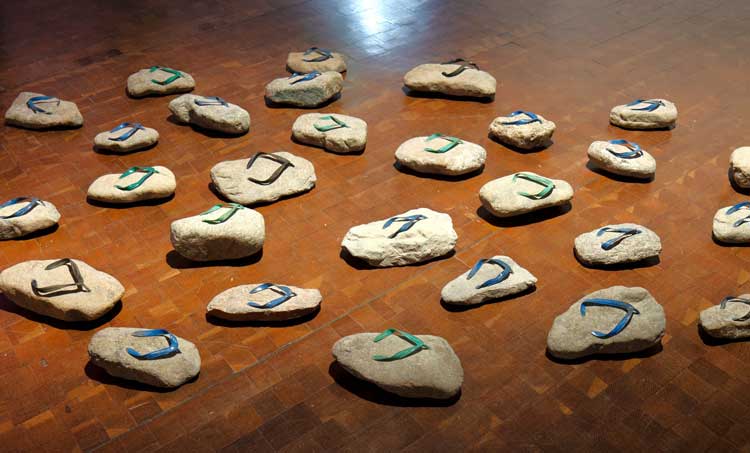
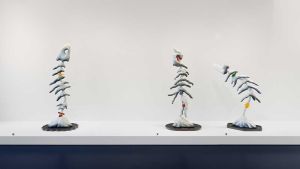
Abdulla Al Saadi, Stone Slippers, 2013. Installed in Proximities at SeMA Seoul. Photo courtesy of ADMAF.
Stone Slippers (2013) by Abdullah Al Saadi, a founding member of the Emirati avant garde of the 1980s and 90s, combines worn flip-flop straps with heavy stones, creating a type of novel shoe in itself – a comment on the historically peripatetic culture within the Emirates, grounded by its rich natural landscape despite ongoing technological advances (Al Saadi has spoken of the daily walks he takes through the mountainous coastal city of Khor Fakkan in the eastern emirate of Sharjah). Similarly, Ammar Al Attar’s Door photographs (2011) reflect on the country’s geographical history, revealing the entrances from houses situated in different Emirati neighbourhoods, many of which no longer exist. Functioning as historical documents, each image is reflective of a previous era, specifically houses and communities, from the 1970s and 80s, which were occupied by Emirati and South Asian families and adorned with specific symbols such as falcons and palm trees.
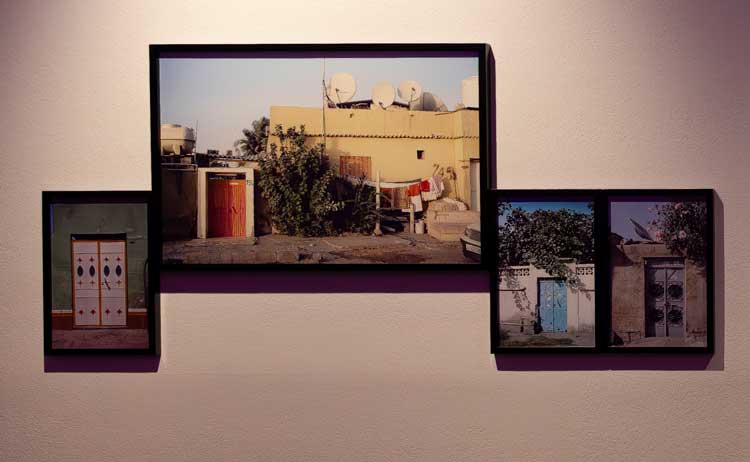
Ammar Al Attar, Door Series, 2011. Photo: Cocoapictures, courtesy of SeMA Seoul.
Related to these works is a separate gallery where Mohammed Kazem’s Window (2003-05) has been installed. The multipart installation comprising a film and photographs documents the construction of a building, captured from the window of the artist’s apartment over the course of two years, as it slowly began to block his view and even the sky – a discreet yet persuasive comment on high-rise development.
The second section, Recording Distance, Not Topography, considers the loaded status of space and territory, acknowledging the emotional and political components of land, organised by artists Mohammed Kazem and Cristiana de Marchi, who were central figures in the art scene that developed in the 1990s as the country rapidly urbanised. De Marchi’s two-channel video work (The Atlas of the Impossible, 2025) revolves around a former market, a public garden and a space within a house, where distance is recorded through the emotional tenor of each location. In another two-channel video, Passage (2019), Nujoom Alghanem takes one of her poems as a point of departure to explore notions of belonging and displacement through three female characters on different journeys.
In the final section, titled That Thing, Amphibian, organised by the artist trio Ramin, Rokni and Hesam, the opening room of the gallery has been transformed into a multicoloured, dizzying space that reflects what the artists describe as “the post-50th National Day condition”. Their installation (O, You People, 2019-22) operates as a huge floor painting that makes reference to issues of oil extraction and desert ecology while more widely creating a “terrain” that appears to be in flux. For them, the current climate, “post-50th”, reflects the prevalence of contemporary art within institutional contexts in the UAE – a development that places artists within civic life. Like the rest of the exhibition, such an intervention is a reminder of the essential interplay between artists and their surroundings.
Click on the pictures below to enlarge
-Installed-in-Proximities-at-SeMA-Seoul-Photo-courtesy-of-ADMAF.jpg)

Copyright © 1893–2026 Studio International Foundation.
The title Studio International is the property of the Studio International Foundation and, together with the content, are bound by copyright. All rights reserved.
 |
 |
 |
|---|
-300.jpg)


-300.jpg)
 Farah Al Qasimi: Abort, Retry, Fail