





by JOE LLOYD
It is very dark indeed. A man sits half-visible on a tall-backed chair. The view in the window behind him reveals a blurred cosmos of lights. But one’s focus is drawn to a single smaller glow in the man’s hands. It comes from something mundane: the end of a lit cigarette. Yet it glows with an intensity that belies its humble origin. The man is Hart Leroy Bibbs, a poet, photographer and one-time actor, in the Herbie Hancock-scored jazz film Round Midnight. And his photographer was Ming Smith (b1950). “There was no light,” recounts Smith, “and I was holding my breath. And he said: ‘Do you know what you’re doing? You’re doing circular breathing.’”
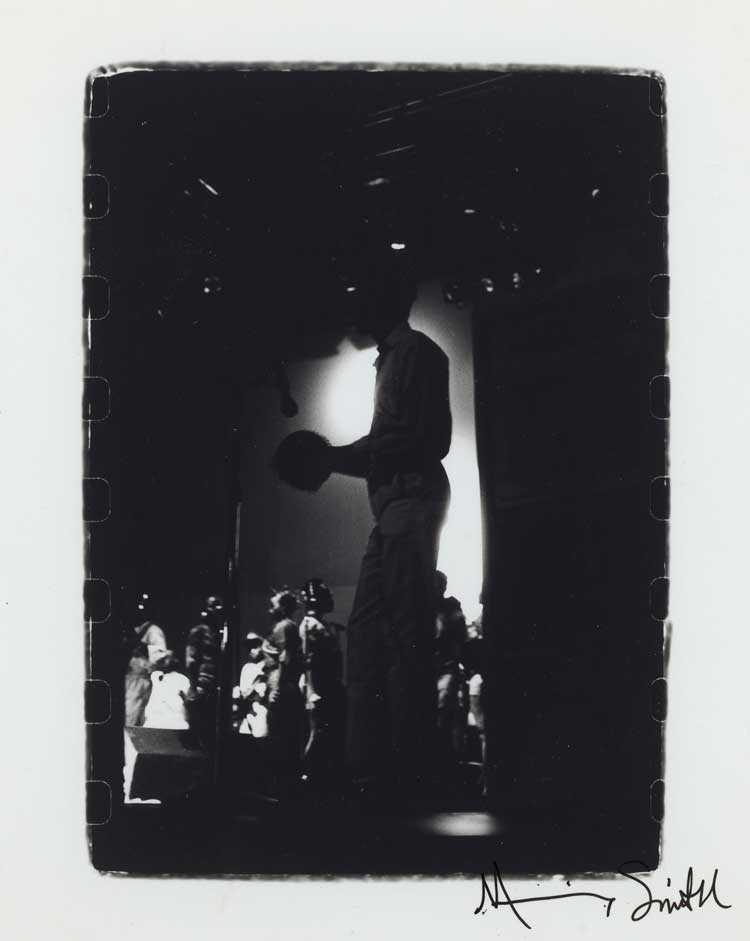
Ming Smith, Untitled (Invisible Man series), 1988-91. Vintage silver gelatin print, unique 20.3 x 25.4 (8 x 10 in) (paper), 11.3 x 15.7 cm (4.5 x 6.25 in) (image). Image courtesy the artist and Pippy Houldsworth Gallery, London. © Ming Smith 2022.
Circular breathing is a technique used by wind musicians that involves simultaneously breathing in through the nose and out through the mouth, allowing for a single continuous note. It can require an enormous amount of training and focus. This makes it an apt comparison for Smith’s practice. “Photography’s really the only thing I know,” she says, “I don’t know a lot about politics. I’m completely confused about everything.” Smith is being modest: over an hour of conversation, she reveals a knowledge of much more than her chosen medium. But it becomes quickly apparent that her art and life are enormously intertwined.
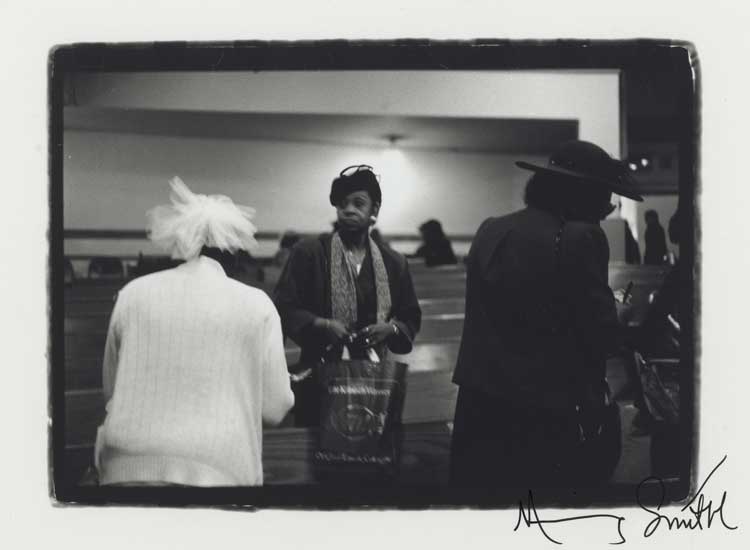
Ming Smith, Untitled (Invisible Man series), 1988-91. Vintage silver gelatin print, unique 20.3 x 25.4 cm (8 x 10 in) (paper), 11.4 x 15.8 cm (4.5 x 6.25 in) (image). Image courtesy the artist and Pippy Houldsworth Gallery, London. © Ming Smith 2022.
Smith was in London for the opening of A Dream Deferred at Pippy Houldsworth Gallery in London, her first exhibition in the UK. It includes silver gelatin prints of 36 works spanning much of her career, but with a particular focus on the Invisible Man (1988-91) series. Smith was born in Detroit and raised in Columbus, Ohio. Her father was a pharmacist who had once harboured artistic ambitions of his own. Smith followed in his footsteps: after medical studies at Howard University, she moved to New York to become a photographer, working as a model to support herself. It was a meagre existence. But Smith kept on shooting. “I remember one lady came to my house,” recalls Smith. “I just had a room in the West Village. All my money went into photography. And I just had photographs on the walls and on the ceiling, because I had run out of room.”
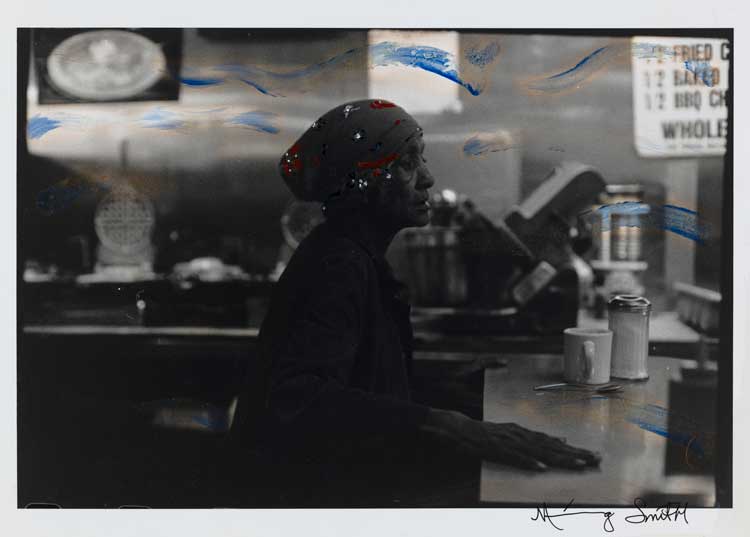
Ming Smith, Untitled (painted). Oil paint on vintage silver gelatin print, unique, 27.8 x 35.3 cm, 11 x 14 in. Image courtesy the artist and Pippy Houldsworth Gallery, London. © Ming Smith 2022.
In 1975, Smith became the first woman invited to join the Kamoinge Workshop – a collective of African American photographers that emerged from the civil rights movement – where she was mentored by the late Louis Draper. “Once we were in a studio,” says Smith. “We waited almost three weekends to use it. I brought all my money, all my materials, everything I had. And then he said: ‘Oh my goodness, you didn’t bring the lens holder.’ It would have taken me months and months to get in again. And he laughed and chuckled, sort of like how Santa Claus would chuckle – he was missing teeth – and said: ‘I have an idea.’ And he took pieces of cardboard and cut them. And we used them.” Photos from this session have rough, uneven edges reflecting their improvised creation.
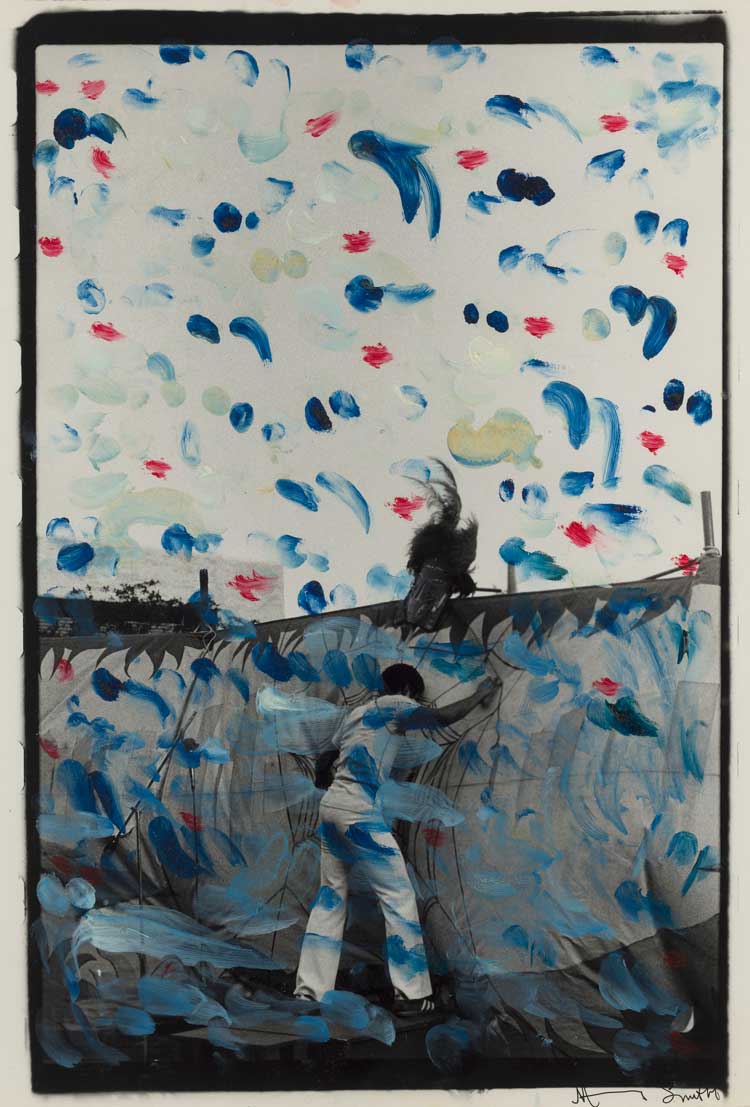
Ming Smith, Setting the Stage, Harlem, New York (painted). Oil paint on vintage silver gelatin print, unique, 50.5 x 40.7 cm (20 x 16 in). Image courtesy the artist and Pippy Houldsworth Gallery, London. © Ming Smith 2022.
Smith gradually established herself as an artist concerned with African American life, though her range is far broader. Her subjects include a dazzling array of cultural luminaries. Many are black musicians, among them Nina Simone, Sun Ra, Grace Jones, Tina Turner and Pharoah Sanders. But she has also captured wider cultural figures: dance pioneer Alvin Ailey, writer and activist James Baldwin and the pioneering photographers André Kertész and Brassaï. Her portraits are seldom straightforward. She caught Brassaï, a longtime hero, at an exhibition opening in 1979. The aged artist looks straight into the lens. But the composition – Brassaï’s left arm out of shot, a framed print half-visible on the wall behind him, an umbrella on the table next to him – is beguilingly off-kilter. “He put that umbrella there,” says Smith, “to help me make a better photograph. It was a communication that he was giving me.”
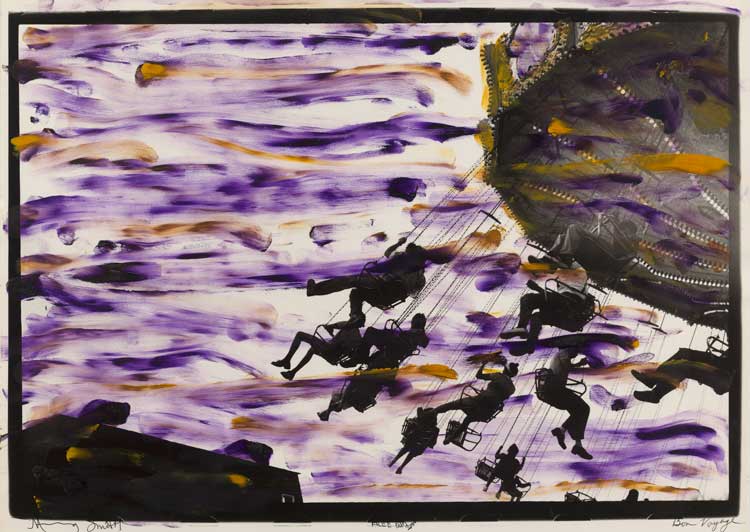
Ming Smith, Freedom (painted), oil paint on vintage silver gelatin print, unique 27.8 x 35.3 cm (11 x 14 in). Image courtesy the artist and Pippy Houldsworth Gallery, London. © Ming Smith 2022.
Despite depicting figures from life, Smith’s work is seldom documentation. But it is stranger and more personal. It presents an America of fleeting impressions, subjective rather than definite. “I have a body of work,” she explains, “but it comes out of my life.” Many of her images feature oblique angles, minimal light sources and blurred elements created by using a slow shutter speed. Some – such as Nuns on the Square (August Moon Series) (1991), showing a Pittsburgh cemetery where a real or stone nun prays before a statue of the Virgin – have an element of surrealism.
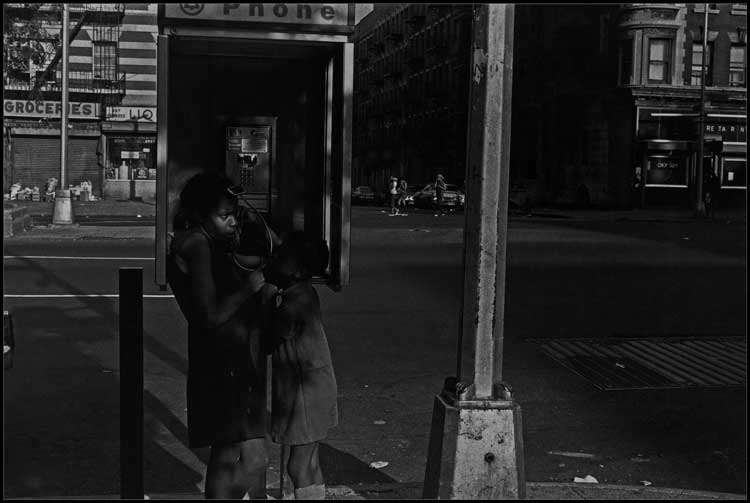
Ming Smith, Mother and Child, Harlem, NY, c1977. Vintage silver gelatin print. 40.6 x 50.8 cm (16 x 20 in). Image courtesy the artist and Pippy Houldsworth Gallery, London. © Ming Smith 2022.
There are curious distortions and absences. Fela Kuti and his band seem to melt into each other, their features obscured, as if they have become music itself. One 1978 work purports to depict the jazz singer Betty Carter playing an end-of-year gig. But Carter herself is not visible across the balloon-filled room. “She wasn’t in this picture,” explains Smith, “I wasn’t close enough. But the feeling of New Year’s Eve at The Bottom Line …” Smith coated the photograph in brownish-pink paint, to enhance the mood. “I did my pink period,” she recalls, “like Picasso’s blue period. So, I did a lot of different things in this colour.” Feeling and ambience can matter as much as the subjects shown.
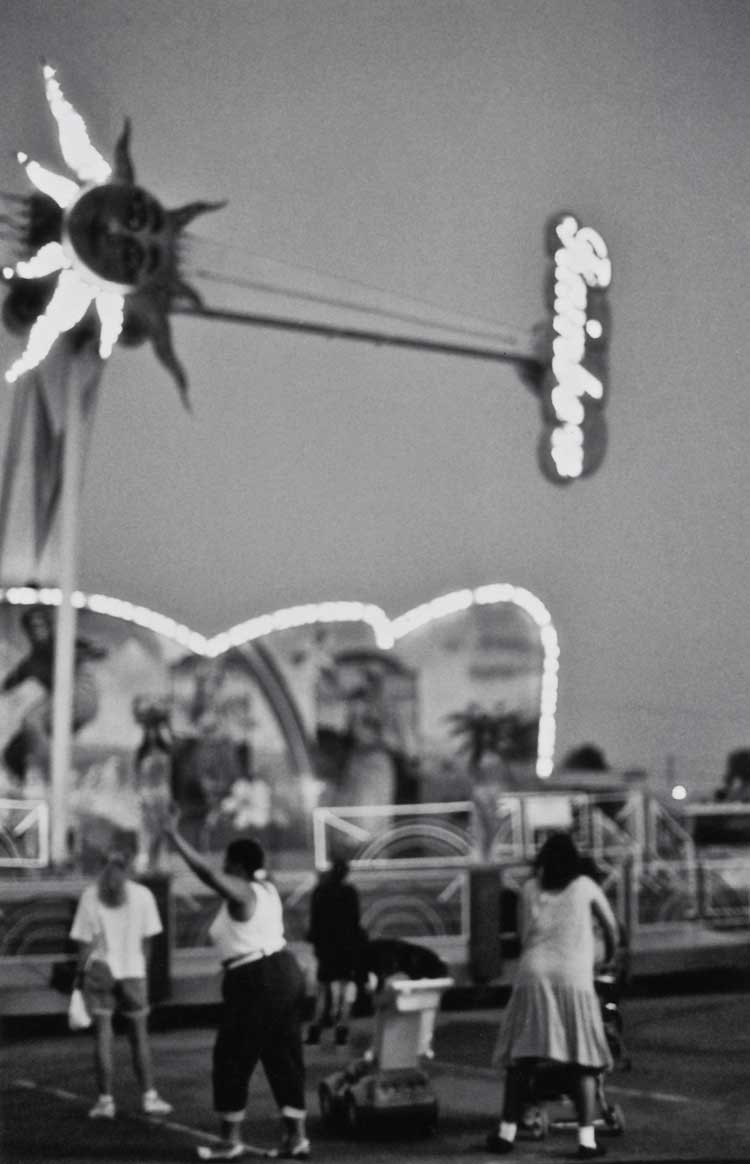
Ming Smith, Reach (Transcendence Series), c1988. Archival pigment print, 101.6 x 76.2 cm (40 x 30 in). Edition of 5. Image courtesy the artist and Pippy Houldsworth Gallery, London. © Ming Smith 2022.
They often have a story attached, tying them to a moment in Smith’s life. Sun Ra Space II, New York (1978), which shows the jazz composer, poet and mystic as almost an apparition, clad in turban and diaphanous cloak, came about by happenstance. Smith says: “One of my friends was going to a dance with Sun Ra, and I went because he was going. I think it was free, or it wasn’t that much. But I went. And that’s how I took a photo, because of a friend. And my whole life has been like that really.” Smith sold the photo to the Museum of Modern Art (MoMA), making her the first female African American photographer in its collection.
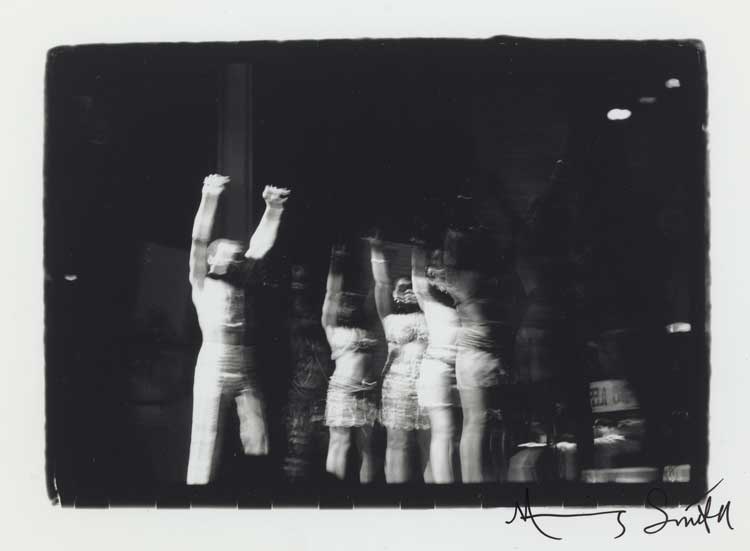
Ming Smith, Untitled (Invisible Man series), 1988-91. Vintage silver gelatin print, unique 20.3 x 25.4 cm (8 x 10 in) (paper), 11.4 x 15.7 cm (4.5 x 6.25 in) (image). Image courtesy the artist and Pippy Houldsworth Gallery, London. © Ming Smith 2022.
For the Invisible Man series, named after Ralph Ellison’s extraordinary 1952 novel, Smith roamed at night, creating a nocturnal guide to Harlem. She captured both empty basketball courts and bustling streets. There are residents of all shapes and sizes: young bucks in exuberant patterned jackets, grannies heading to church. People gather beneath the Apollo Theatre’s beacon-like billboard, while light glows from a West African restaurant. One of the most striking images has a stoop in almost pitch darkness, with the outlines of two figures barely visible on the steps.
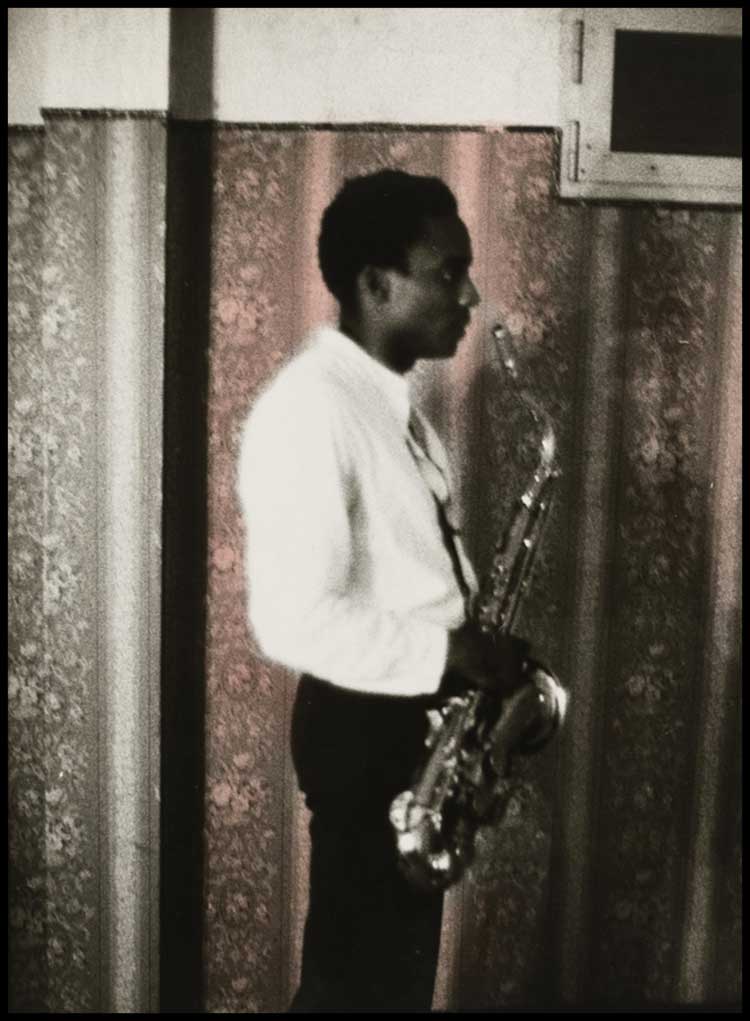
Ming Smith, David Murray in the Wings, Padova, Italy, 1978. Archival pigment print, framed,
101.6 x 76.2 cm (40 x 30 in), edition of 5. Image courtesy the artist and Pippy Houldsworth Gallery, London. © Ming Smith 2022.
There was a point when Smith was in danger of becoming invisible herself. But recent years have seen interest in her work grow and grow. In 2017, she featured in the Tate’s revelatory Soul of a Nation: Art in the Age of Black Power. She has embarked on a series of collaborations with video artist Arthur Jafa, including a recent shoot in a plantation near New Orleans. Her practice has grown too: since the turn of the millennium, Smith has returned to using paint, applying oil directly to prints in expressive daubs. “I follow my impulses, I follow my spirit,” she says, “And I also feel that God leads me, and so I kind of go with that.” Perhaps we, in turn, should follow where Smith leads.
• Ming Smith: A Dream Deferred is at Pippy Houldsworth Gallery, London, until 30 April 2022.


Click on the pictures below to enlarge
The 61st international art exhibition is a vast, volatile project that this year, more than most has...
25th Biennale of Sydney – Rememory
Central to this biennale are First Nations voices and the diverse diasporas that shape contemporary ...

This year is the 250th anniversary of the birth of John Constable and to celebrate, his native Suffo...

MoonSunStarEarthSkyWater, the first UK presentation of the late artist Nancy Holt’s work to includ...
The first UK retrospective of the great Spanish baroque painter Francisco de Zurbarán trades the mo...
Several Eternities in a Day: Form in the Age of Living Materials
Opened within weeks of each other, the Hammer Museum presents a mind-bending show of Brown Art and L...
André Leon Talley – interview with curator Rafael Brauer Gomes
Rafael Brauer Gomes, the director of fashion exhibitions at Savannah College of Art and Design (SCAD...
To coincide with his first UK exhibition, Agua Salada at Hauser & Wirth Somerset, Angel Otero talked...
Paula Rego: Dance Among Thorns
With more than 140 works on show, this exhibition encompasses the breadth of Rego’s art, from her ...
Handpicked: Painting Flowers from 1900 to Today
A smorgasbord of flower paintings from the last 125 years, exploring meaning, metaphor, accuracy and...

Klima Biennale Wien 2026: Unspeakable Worlds
Vienna’s climate biennale takes place across the city with institutional exhibitions and public pr...
Troublemakers and Prophets: Elizabeth Allen and Other Visionary Artists
The amazing story of an artist, who saw herself as a contemporary prophet, and made patchwork artwor...
Bellmer Nauman Pondick: Material Desire
Focusing on the work of Rona Pondick, Hans Bellmer and Bruce Nauman, this exhibition considers how b...
-300.jpg)
Spanish artist Angela de la Cruz’s twisted canvases and collapsed objects are a reflection of the ...
,-Red-Devil-(soul-2),-Drifting-Leaves,-1972-300.jpg)
Senga Nengudi: Performance Works 1972-1982
Featuring photographic works, archival materials and films of key performance pieces, this exhibitio...
-Cecily-Brown-Photo-(c)-Jo-Underhill-300.jpg)
A painter’s painter, whose dynamic landscapes take viewers on a walk, Cecily Brown returns to Lond...
Frank Bowling: Seeking the Sublime
Though containing just 10 works, this exhibition demonstrates the breadth of the British-Guyanese ar...
This exhibition explores ageing from the 1500s on, but it was the contemporary works here that reson...
This show focuses on honouring ancient relationships between people, land and water, with new work f...

Gainsborough: The Fashion of Portraiture
Despite once saying he was sick of portraits, Gainsborough was one of the most sought-after portrait...
Histories of erasure, displacement, annihilation and colonisation are told with power, subtlety, cla...
-(8)-300.jpg)
Hurvin Anderson’s paintings, which here stretch across his career, blend his British and Caribbean...
-(c)-DACS,-London,-2026-and-Chiharu-Shiota.-300.jpg)
Chiharu Shiota: Threads of Life
Chiharu Shiota’s immersive web-like installations, fashioned from coloured thread and found object...
-(c)Rob-Battersby-6-1000-300.jpg)
Paul Eastwood, who is dyslexic, attempts to explore neurodiversity and the complexities of language,...
The artist and writer Morgan Quaintance, winner of the 2025 Film London Jarman Award among other acc...
Maggie’s: Architecture That Cares
Celebrating 30 years of the distinctive Maggie’s Centres for cancer care, this exhibition highligh...
Euan Uglow: An Arc from the Eye
His almost scientific methods of observation led Euan Uglow to take months, even years to finish a p...
A look behind the scenes of the travelling exhibition on Berthe Weill
The show celebrating the pioneering Parisian avant-garde gallerist opened in New York before travell...

Hammershøi: The Eye That Listens
A substantial retrospective reveals the mysteries and anomalies of magnetic Danish master Vilhelm Ha...
Barbados Museum & Historical Society challenges narrative around slavery
These two fascinating, interrelated exhibitions – one of a 19th-century Black Barbadian, the other...

Copyright © 1893–2026 Studio International Foundation.
The title Studio International is the property of the Studio International Foundation and, together with the content, are bound by copyright. All rights reserved.
 |
 |
 |
|---|
 Guy Bourdin at the V&A. Fashion photography as art
 Keith Arnatt: I'm a Real Photographer
 Diane Arbus: Revelations
 Nobuyoshi Araki: Araki: Self, Life, Death