



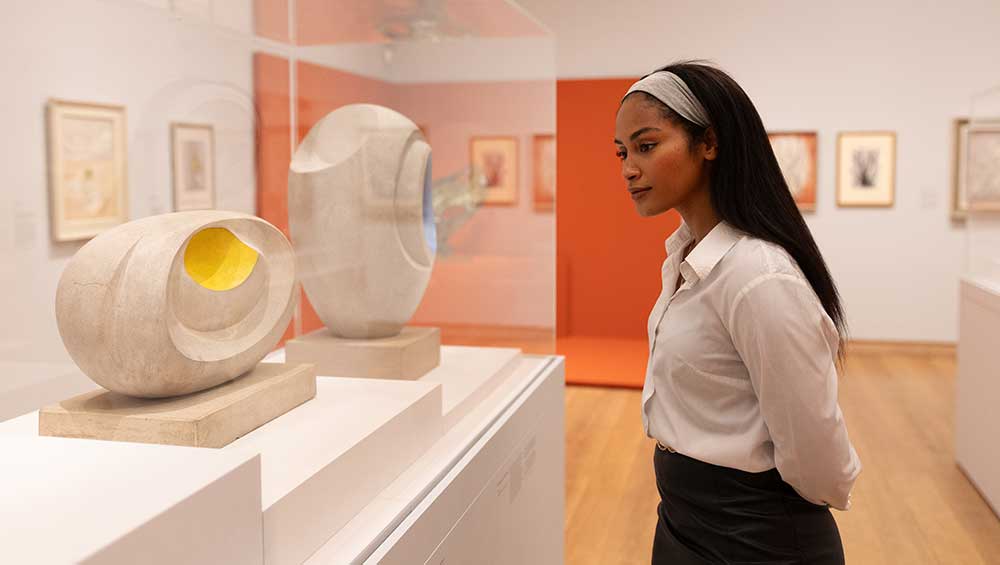
Installation view, The Joseph Hage Aaronson & Bremen Exhibition, Hepworth in Colour, Courtauld Gallery. Photo © Fergus Carmichael.
Courtauld Gallery, London
12 June – 6 September 2026
by BETH WILLIAMSON
While the work of Barbara Hepworth (1903-75) is well known, little attention has been paid to the significance of colour in that work. This utterly fascinating exhibition changes that entirely, revealing, for the first time, the innovative interplay of colour in her drawing, painting and sculpture. As late as 1970, she said: “My colour has been accepted, but never understood.” There is a sense of her disappointment in this statement that this exhibition seems to address and resolve. The curators have expertly judged its balance, pitch and tone, and brought together about 20 sculptures and 30 drawings that perfectly show Hepworth’s commitment to colour and how it relates to landscape though expressive means.
-Bowness.jpg "Barbara Hepworth, Eidos, 1947. National Gallery of Victoria, Melbourne. © Bowness. Photo: Predrag Cancar / NGV. Image courtesy National Gallery of Victoria, Melbourne.")
Barbara Hepworth, Eidos, 1947. National Gallery of Victoria, Melbourne. © Bowness. Photo: Predrag Cancar / NGV. Image courtesy National Gallery of Victoria, Melbourne.
An interest in painting colour on to stone, wood and plaster began for Hepworth in the mid-30s at a time when she and her future husband, Ben Nicholson, were part of European modernism. A move to Cornwall in 1939, immediately before the outbreak of the second world war, found her able to take just one sculpture – her first study for sculpture with colour. The Cornish landscape captured her imagination and, over the course of the following decade, she developed from this initial colour experiment, creating a body of work using colour and strings, particularly in the 40s, that she said revealed “the tension I felt between myself and the sea, the wind or the hill”. As she explained: “I used colour and strings in many of the carvings of this time. The colour in the concavities plunged me into the depths of water, caves or shallows.” The sheer sense of vitality inherent in such statements is what grabs our attention because what we have is a sculptor working in heavy static materials but somehow imbuing their very fabric with life and movement and part of that coming through her considered use of colour. There are some especially bold examples in the exhibition. The brightly painted stone carvings Eidos (1947-48) – Portland stone with yellow paint – and Sculpture with Colour (Eos) (1946) – Hoptonwood stone with grey and blue paint – are seen here together in the UK for the first time since 1954.
-Pale-Blue-and-Red-1943-(c)-Bowness.jpg "Barbara Hepworth, Sculpture with Colour (Oval Form) Pale Blue and Red, 1943. Painted wood and strings. Wakefield Permanent Art Collection (The Hepworth Wakefield). Image © The Hepworth Wakefield. Photo: Mark Heathcote.")
Barbara Hepworth, Sculpture with Colour (Oval Form) Pale Blue and Red, 1943. Painted wood and strings. Wakefield Permanent Art Collection (The Hepworth Wakefield). Image © The Hepworth Wakefield. Photo: Mark Heathcote.
Sculpture with Colour (Oval Form), Pale Blue and Red (1943) is perhaps the most enchanting work presented in the show. This painted wood carving marked a step change in the development of Hepworth’s work. Not only is it the first to combine the use of strings and colour, but it is also the first time she used this beautiful pale blue, so redolent of the Cornish coast and skies. It will be familiar and evocative to anyone who has ever walked along the coastline in Cornwall. Homing in on St Ives, other painted stringed sculptures in the exhibition include Wave (1943-44) and Pelagos (1946). For the latter, Hepworth took direct inspiration from studio view across the bay into St Ives.
It is worth noting that the exhibition brings together six iterations of Sculpture with Colour (Deep Blue and Red), all made between 1940 and 1943. The variations in size, curvature and even materials show how Hepworth experimented over the course of three years to develop a series of closely related sculptures that demonstrate how necessary it was for her to explore her relationship with the landscape in its infinite variety. At the same time as making these carved sculptures, Hepworth was exploring similar themes in two dimensions. Using the same iridescent blue, curved forms and string formations, she created multiple versions of Drawing for Sculpture across a similar period. Together they show the geometrical investigations needed for her to bring the ideas into three-dimensional sculptural forms. These “drawings for sculpture” had allowed Hepworth to explore her ideas during the early years of the war when materials, studio space and time where at a premium. She also had young children to care for at this time and recalled: “In the late evenings, and during the night I did innumerable drawings … exploring the particular tensions and relationships of form and colour which were to occupy me in sculpture during the later years of the war.” We can see this in other drawings such as Curved Forms with Green (1943) and Crystal (1942). The latter was made as an illustration for Stone and Flower, a collection of poems by Kathleen Raine published in 1943.
-Bowness.jpg "Barbara Hepworth, Curved Forms with Green, 1943, Pier Arts Centre, Barbara Hepworth © Bowness, Photo: Alistair Peebles, Courtesy of \the Pier Arts Centre, Stromness.")
Barbara Hepworth, Curved Forms with Green, 1943, Pier Arts Centre, Barbara Hepworth © Bowness, Photo: Alistair Peebles, Courtesy of \the Pier Arts Centre, Stromness.
In the later 40s and on into the 50s and 60s, Hepworth’s experiments with material, form and colour developed further. This included new expressive paintings and work with patinated bronze and coloured marble. The expressive paintings began from two points of reference. First, American abstract expressionism and second, European tachisme. Aspects of these differing techniques can be observed in a range of paintings including Spring, 1957 (Project for Sculpture), Summer – Project for Sculpture and Project for Sculpture (Group), all made by Hepworth in 1957. The freedom and looseness in these works are mesmerising to see in close proximity to the geometric precision of others such as Counterpoise, Forms in Space, and Spiral with Red, all from 1946.
,-1958-(c)-Bowness.jpg "Barbara Hepworth, Sea Form (Porthmeor), 1958. Bronze, Tate: Presented by the artist 1967. The Hepworth Estate. Barbara Hepworth © Bowness.")
Barbara Hepworth, Sea Form (Porthmeor), 1958. Bronze, Tate: Presented by the artist 1967. The Hepworth Estate. Barbara Hepworth © Bowness.
Hepworth’s interrogation of material, form and colour continues in her sculpture. Sea Form (Porthmeor) (1958) marks another step change in her sculptural practice as she works in bronze and finds a new way to delve into colour. The mottled green patina with white flecks came from close collaboration with the Morris Singer Foundry. Here, she worked with technicians to develop a range of patinas and colours, especially greens and the blue-greens. In 1967, and aligned with her interest in space exploration, Hepworth made the aluminium structure Sphere with Inside and Outside Colour. She used industrial paints in recently developed British Standard colours. Despite these very contemporary references, there are others to European modernism and especially to Mondrian.
One fascinating corner pairing in this show is Single Form (1937-38) and Oval with Black and White (1965). The former began life as a white carved plaster, exhibited in Paris in 1939 and remained in France for many years. In 1961, it was returned to Hepworth who soon decided to cast it in bronze, then paint it in dappled tones of blue. Transforming this white plaster into a painted bronze demonstrates her much freer approach in the 60s. Next to it, Oval with Black and White displays this freedom, too, but in different ways. She said: “It was a new material that I hadn’t carved before. I don’t usually like a patterned marble, and I didn’t know how intense the markings would be until we began polishing the stone. They needed taming.” Perhaps just as Hepworth tames the materials of nature by carving them, she tamed the colours, too, by embedding them in her work. In this way, she used colour, material and form to create two- and three-dimensional works that tempered nature, including colour, and brought it into her work and the gallery in unique ways. It is a fabulously expressive tool in her aesthetic landscape.
Click on the pictures below to enlarge

Copyright © 1893–2026 Studio International Foundation.
The title Studio International is the property of the Studio International Foundation and, together with the content, are bound by copyright. All rights reserved.
 |
 |
 |
|---|
-1000-300.jpg)
 Barbara Hepworth: Sculpture for a Modern World
 Reflections on the Self: From Dürer to Struth
 Kenneth Clark: Looking for Civilisation
 Wilhelmina Barns-Graham: In Perspective – The Late Works
 Uproar! The First 50 Years of the London Group 1913-1963