




Installation view, Lucie Rie / Hans Coper: Life at the Wheel, Offer Waterman. Courtesy of Offer Waterman. Photo: David Gerrans.
Offer Waterman, London
18 September – 30 October 2026
by BETH WILLIAMSON
The four-room exhibition of work by Lucie Rie (1902-95) and Hans Coper (1920-81) is pitch perfect. The refinement of Offer Waterman’s historic building (the former showroom to William Morris and Co) and the elegance of the work by Rie and Coper make for an air of serenity and grace that is rarely encountered anywhere. There is little in the way of text, so the works speak for themselves. Even the exhibition leaflet is essentially a list of the more than 200 works, exclusively drawn from private collections and therefore not generally accessible. The photographs of Rie and Coper on the front of the leaflet alongside an embossing of their respective maker’s marks is a nice touch. The exhibition is also the first time that works by the two artists have been shown side by side in London in almost 30 years. The last occasion was at the Barbican in 1997.
Rie and Coper each had their own distinct style, but they were inextricably linked by a shared history. Both were born outside the UK (Rie in Vienna and Coper in Chemnitz, Germany) and came to Britain as émigrés, challenging the dominant aesthetic of Bernard Leach. They also spent 12 years working together at 18 Albion Mews in London and their friendship endured when Coper left to establish his own studio. The title of the show reflects the fact that both artists spent their life at the wheel with little interest in writing or talking about their practice.
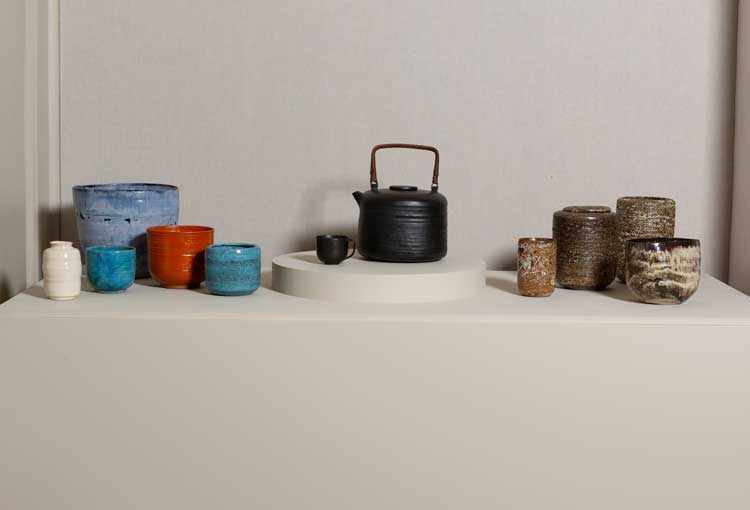
Centre: Lucie Rie, Teapot Designed and Made for Ernst Plischke, 1928. Installation view, Lucie Rie / Hans Coper: Life at the Wheel, Offer Waterman. Courtesy of Offer Waterman. Photo: David Gerrans.
The first room contains the earliest work, up until c1959. Inevitably, there is more of Rie’s work here as she was the older of the two artists, including a number of pieces packed in her suitcase when she left Vienna in 1938. These early works include an earthenware teapot made in 1928 for the architect and designer Ernst Plischke. A number of pots, jars and bowls show the variety of her work in the early 40s in London. This is extended further by the displays of buttons, buckles, brooches and other accessories from that period displayed in the stairwell and hallway. Rie first met Coper in 1946 when she employed him as a studio assistant. They became close friends and collaborators, evidenced by a number of objects they made together in the period c1947 to the 50s. Individual works, largely from the 50s, include three bold black-and white-dishes by Coper from c1952 and Rie’s exquisite tea set of c1950.
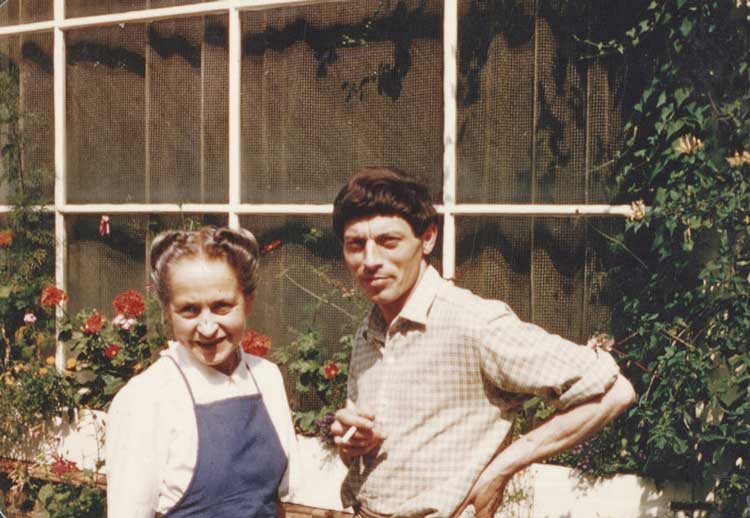
Lucie Rie and Hans Coper in front of Albion Mews, 1950s Photograph by Jane Coper © Estate of Jane Coper / The Lucie Rie and Hans Coper Foundation Image Courtesy of the Crafts Study Centre, University for the Creative Arts, Farnham.
The second room considers work by both artists generally from the late 50s and throughout the 60s. Rie’s bowls and tapered vases stand out. A small yellow bowl (c1960) competes for the eye with a Squeezed Yellow Beaker (c1955). There is a remarkable consistency across Coper’s footed cups while, at the same time, he plays with scale, shape, texture and pattern. It is as if this recognisable form becomes a scaffold within which to experiment with other attributes. One interesting pairing is Rie’s Conical Vase (c1966) and Coper’s “Trumpet” Form (c1962). While close in size and form, the pairing nonetheless serves to pull out the differences and the similarities between them. Here, too, the ingenuity of Coper’s Poppy Head pots and Spade forms is met by that of Rie’s Swan-necked Vase (c1960).
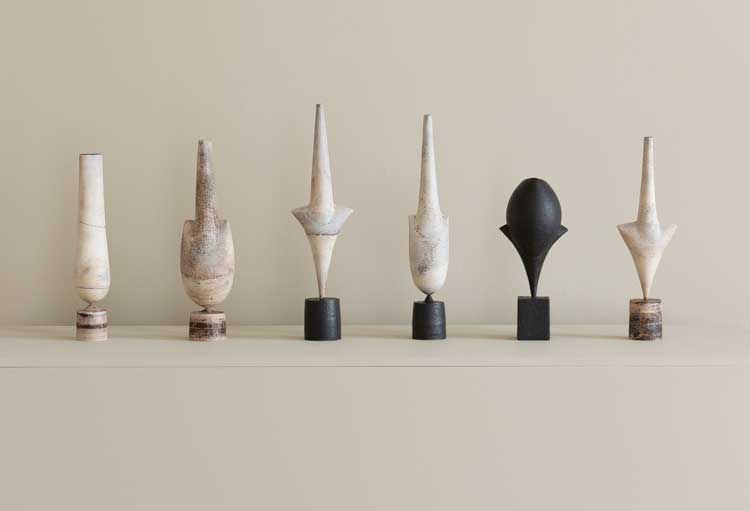
Hans Coper, A group of Cycladic forms, late-1970s – early-1970s. Installation view, Lucie Rie / Hans Coper: Life at the Wheel, Offer Waterman. Courtesy of Offer Waterman. Photo: David Gerrans.
The third room takes us into the 70s where Coper’s Hourglass and Cycladic forms really make their presence felt. His interest in Cycladic art probably began when he visited the British Museum in the postwar years. Coper’s essentially sculptural forms show his interest in the Neolithic, Ancient Egyptian and Mycenaean art collections at the British Museum, as well as discovering the contemporary sculpture of Jean (Hans) Arp, Constantin Brâncuși and Alberto Giacometti. Coper’s anthropomorphic forms give a nod to the human figure with the slightest of gestures. Rie’s explorations in this room are black and white. There is the White Vase with Raised Dots (c1974), White Open Bowl (c1970) and Black Bowl (c1965). There is also a Vase from the Black Firing (1981), when Rie opened her kiln to notice that her pots were mysteriously black and knew instinctively that Coper was ill. She immediately went to his bedside where she remained until a few days before his death.
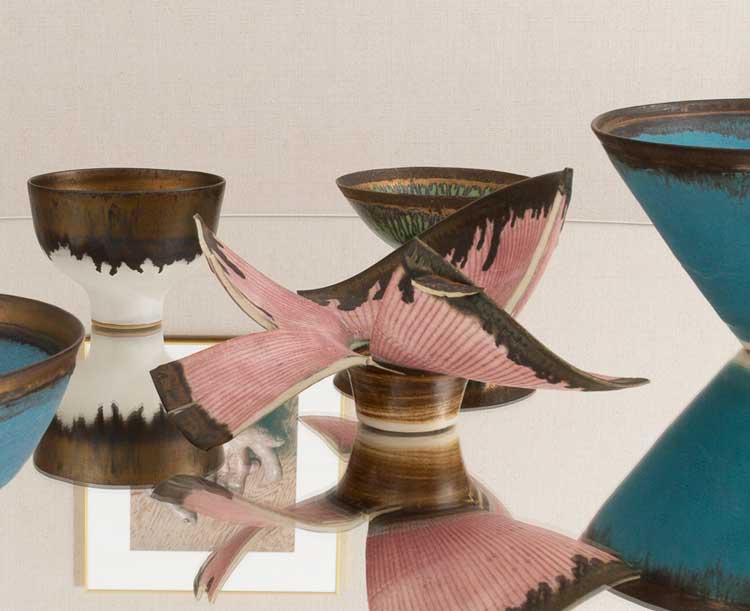
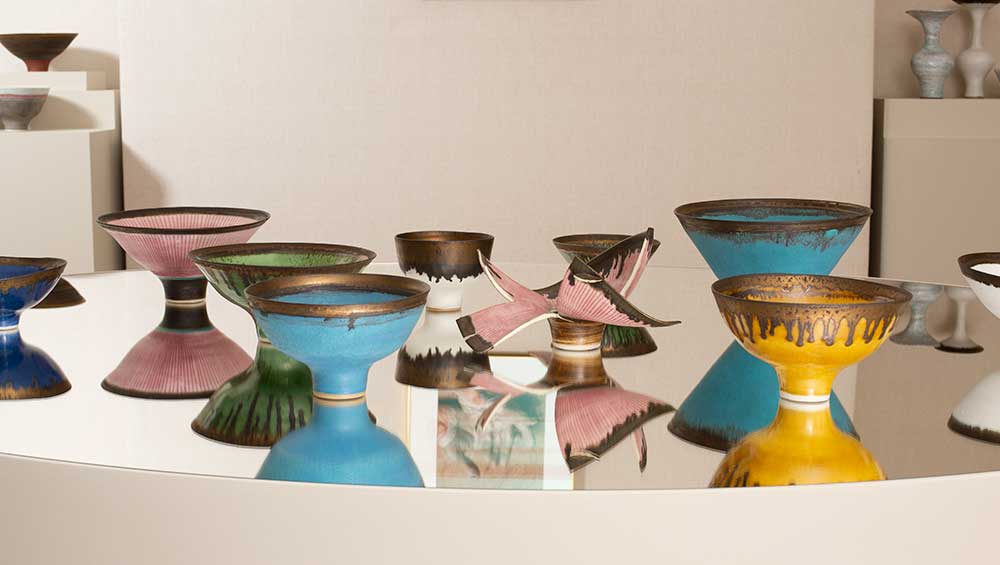
Centre: Lucie Rie, Pink Footed Bowl, Split During Firing, c1980. Installation view, Lucie Rie / Hans Coper: Life at the Wheel, Offer Waterman. Courtesy of Offer Waterman. Photo: David Gerrans.
The fourth and final room is devoted to Rie’s late work of the 80s. A waist-high mirrored surface is used to great effect to display a selection of coloured footed bowls in blue, pink, white and green. In the middle of this dramatic display is a Pink Footed Bowl, Split During Firing (c1980). Like a flower in full bloom, this damaged object takes centre stage and focuses our attention on ideas of construction and deconstruction. On the wall, two late photographs of Rie by Lord Snowdon show the elderly potter in her elements. Dame Lucie Rie’s Hands Covered in Clay (1988) shows her at one with the material at the heart of this show. In another photograph, Dame Lucie Rie, Sitting Beside the Korean Moon Jar, Gifted to Her by Bernard Leach (1988), many aspects of her career seem to come together. Here, the elderly diminutive potter sits next to the Korean Moon Jar, aligning her with the stature and quality of the object. That it was also gifted to her by Leach tells another story, of her acceptance into the fold of British studio pottery. Do not miss the opportunity to see this beautifully curated show of rarely accessible works. It may just be a once in a lifetime opportunity.
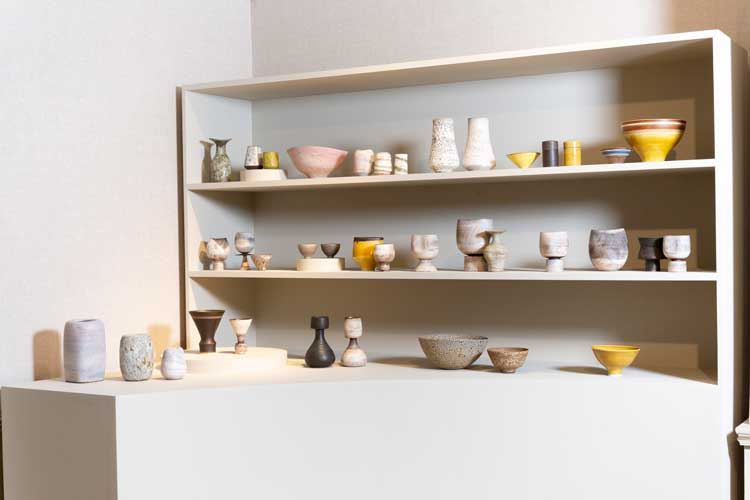
Installation view, Lucie Rie / Hans Coper: Life at the Wheel, Offer Waterman. Courtesy of Offer Waterman. Photo: David Gerrans.
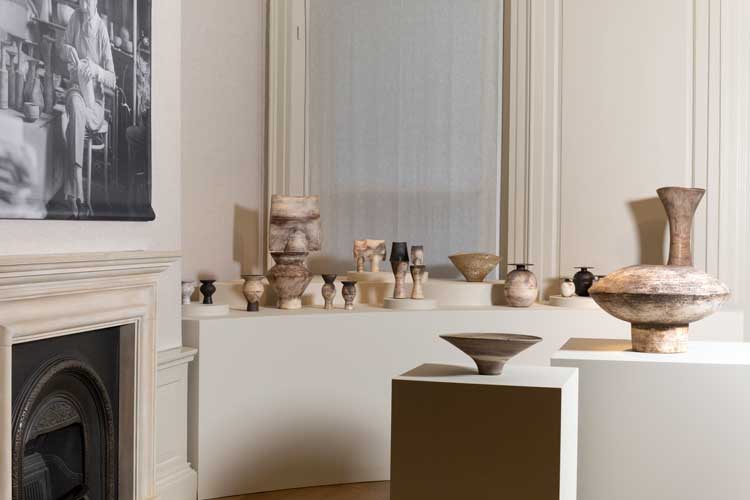
Installation view, Lucie Rie / Hans Coper: Life at the Wheel, Offer Waterman. Courtesy of Offer Waterman. Photo: David Gerrans.
Click on the pictures below to enlarge

Copyright © 1893–2026 Studio International Foundation.
The title Studio International is the property of the Studio International Foundation and, together with the content, are bound by copyright. All rights reserved.
 |
 |
 |
|---|
-300.jpg)
-300.jpg)

 The Pattern of Life: Enid Marx and Modern British Design
 Shōji Hamada: A Japanese Potter in Ditchling
 Lucie Rie: The Adventure of Pottery
 British Ceramics Biennial 2021
 Kai Althoff Goes With Bernard Leach