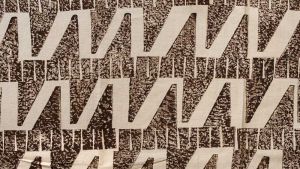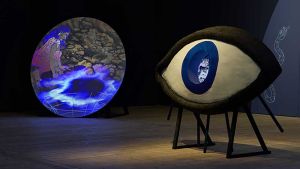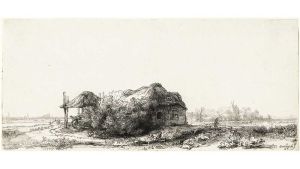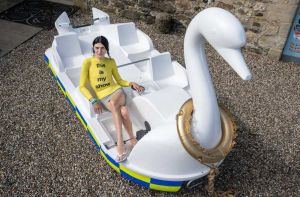

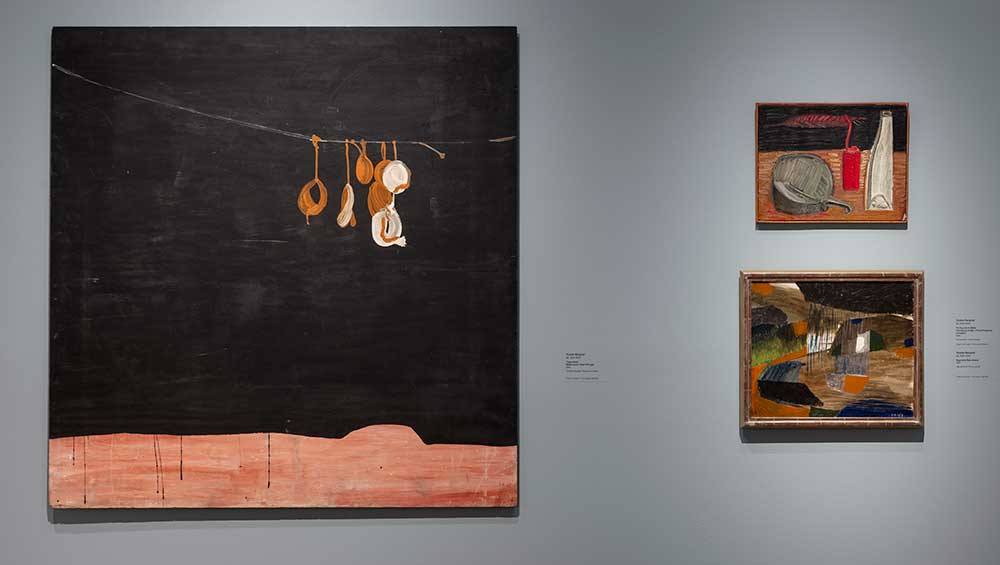
Between Dreams and Reality, installation view, Kunstsilo, Kristiansand, Norway, 2026 © Tor Simen Ulstein / Kunstsilo.
Kunstsilo, Kristiansand, Norway
11 June 2026 – 3 January 2027
by VERONICA SIMPSON
I had been hoping to visit Norway’s newest art museum, Kunstsilo, since reading about it before its opening in 2024. There is something deeply totemic about retaining monumental post-industrial buildings in a landscape that was once all about trade and shipping but is now being reclaimed as civic space. And, when adapted for cultural pursuits with a real sensitivity to history, materiality and its full potential for inhabitability, the effects can be profound. Since its opening in 2000, Tate Modern in London has transformed my home city’s cultural and riverfront ecology (and economy). But where the Tate’s power-station typology – with its towering chimneys, turbine hall and walkways - carries the echoes of belching smoke, intense heat and hard, human labour, Kristiansand’s Kunstsilo is an altogether calmer, quieter prospect.
This 1930s building once housed 15,000 tonnes of grain – a bulwark against the risk of famine or war. Designed by the architects Arne Korsmo and Sverre Aasland, the groundbreaking structure consists of 15 cylindrical cells, an elevator tower and a storage building and was inspired by the new wave of modernism and functionalism. Its slim, 38-metre high cylindrical concrete cells give it its distinctive profile. And inside, that cellular structure remains, albeit sliced out from the ground floor to the fourth; it hovers above you in the central hall, conjuring images of beehives, not blast furnaces. Those cellular elements remaining on the lower levels – corner spots adapted as shapely, curving seating alcoves – maintain their previous incarnation with a compelling combination of sculptural, concrete rawness and intimacy.
-Alan-Williams-412.jpg "Kunstsilo, Kristiansand, Norway. Photo © Alan Williams.")
Kunstsilo, Kristiansand, Norway. Photo © Alan Williams.
Walk a few steps beyond the main harbourfront entrance – via a slim, airy cafe to the left and a shop to the right – and you are immediately inside this huge hall. Light filters down from artificial and natural sources through the honeycomb above. The legibility and transparency of routes up and around the building and the clear glazing at ground level making exits and entrances visible mean the height and heft of the surrounding concrete is intriguing rather than oppressive. Spiralling timber staircases ascend to the fourth floor, their smooth wooden handrails and pale timber walls illuminated to describe a continuous curve of light. Glazed balustrades along every interior walkway create a kind of theatre as visitors promenade around the building. When empty, as for our press preview, the place is calm, uplifting but contained. On a busy, opening night, the sense of movement and flow is captivating.
It is a spectacular conversion and a worthy winner of its multiple awards. Architects Mestres Wåge (based in Oslo and Barcelona), BAX Studio and Mendoza Partida, who beat 100 architectural firms from around the world (including Zaha Hadid Architects and Snøhetta) to win the international competition, have done a wonderful job. On the day of our visit in June, it had just been announced as a winner of one of the Royal Institute of British Architects’ International Award for Excellence.
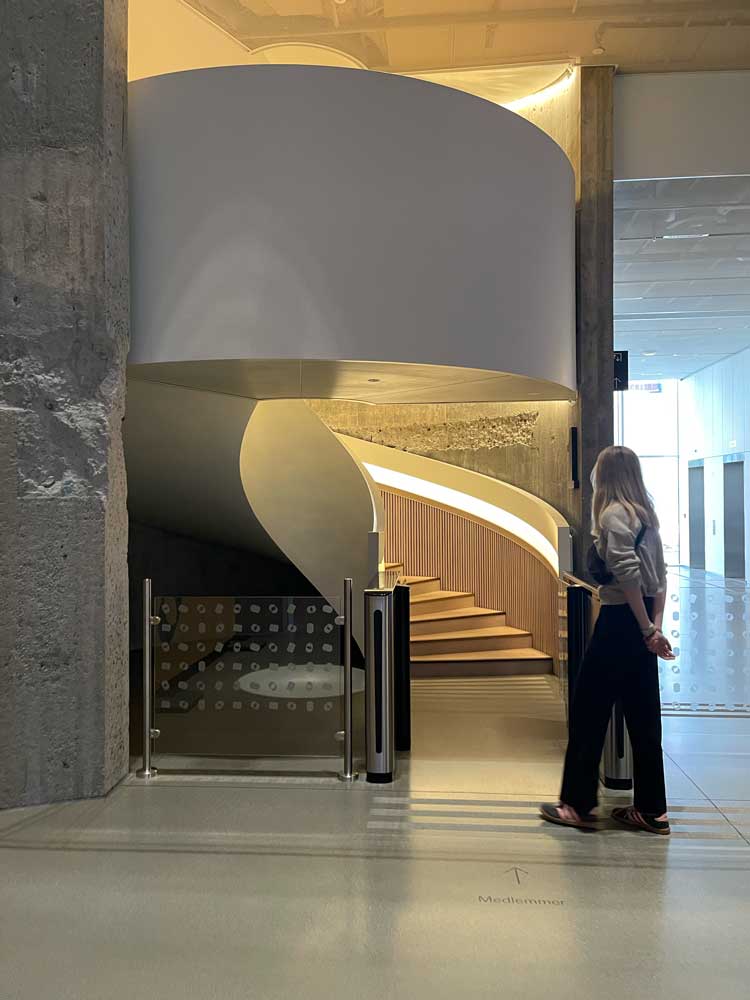
Kunstsilo, Kristiansand, Norway, interior. Photo: Veronica Simpson..
But a great building doesn’t amount to much without a good reason for visiting. And, as Tom Denman wrote in Studio International on his visit to the opening exhibition in May 2024, the Kunstsilo houses “one of Scandinavia’s most comprehensive collections of Nordic modern art”.
Most of this art comes from one donor – Nicolai Tangen. Born and raised in Kristiansand, Tangen made his money from banking, and while working in London he enriched his interest in art with two years of study at the Courtauld Institute. Over the last three decades, he has amassed an outstanding collection of Danish, Norwegian, Finnish and Swedish art, from the 1910s to the 1990s. It was his proposal in 2015, to hand over that collection of about 5,000 works to his home town, which made the Kunstsilo’s transformation into a cultural hub desirable and viable. He also helped to fund the construction.
Two years ago, his collection was joined by 400 works from fellow Norwegian Stein Erik Hagen’s Canica Art collection, covering a similar period of Nordic art. The unifying element between these two is art historian Steinar Gjessing, who had spotted, while working as assistant, then curator and collection adviser at Oslo’s National Gallery, and then at Kunstnernes Hus before becoming senior curator at Norway’s National Museum of Contemporary Art, that there were huge gaps in national collections of work from this era, as well as an abundance of overlooked (and therefore highly affordable) artists of real calibre. With his help, these two collectors set about making sure those artists did not vanish into obscurity – although some, especially Danish artists Asger Jorn and Per Kirkeby, were already established names.
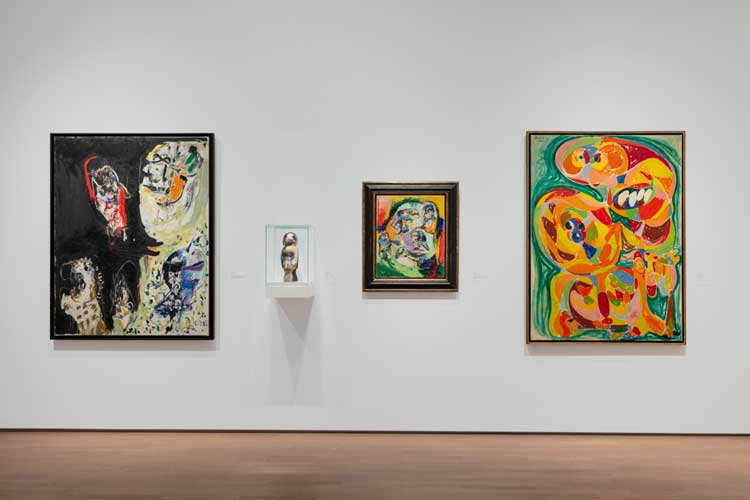
Between Dreams and Reality, installation view, Kunstsilo, Kristiansand, Norway, 2026 © Tor Simen Ulstein / Kunstsilo.
But does the term “Nordic” mean more than just geographic adjacency? Very much so, according to the Kunstsilo CEO, Maria Mediaas Jørstad, who says in her introduction to the Kunstsilo’s new monograph (Stories from the Tangen Collection): “The 20th century was a critically formative era in the Nordic region, due to the impact of two world wars and the establishment of a formal Nordic collaboration. There was a great belief in the importance of a Nordic community as a means of promoting stability during a turbulent time.” Artists from these countries collaborated and communicated with each other. They were also hugely inspired by movements going on around them, visiting and studying in Paris and Berlin in particular, bringing these avant garde ideas back home, and participating in and arranging exhibitions with the artists they met there.
There are many revelations and delights in these two collections, which are arranged thematically around the building. The latest exhibition for Kunstsilo, and the focus of this review, is one on expressionism and surrealism: Between Dreams and Reality: Stories from the Tangen Collection.
At the start of this show, the narrative centres around Edvard Munch. But there is a reason why Norway’s premiere art export is always foregrounded, according to this show’s curator, Frank Falch: Munch was the only Nordic artist included in HW Janson’s seminal History of Art, published in 1962. So, for the last few decades of the 20th century, Munch was the sole reference point for this region. In the first room of this exhibition, three artists (all Danish, as it happens) are selected as inheritors of Munch’s “legacy”: Asger Jorn, Per Kirkeby and Jens Adolf Jerichau. While there are clearly shared influences and overlaps, with ample use of “bold colours and brushwork” and “expressivity”, as the wall caption testifies, most importantly, the work is intriguing and arresting in its own right.
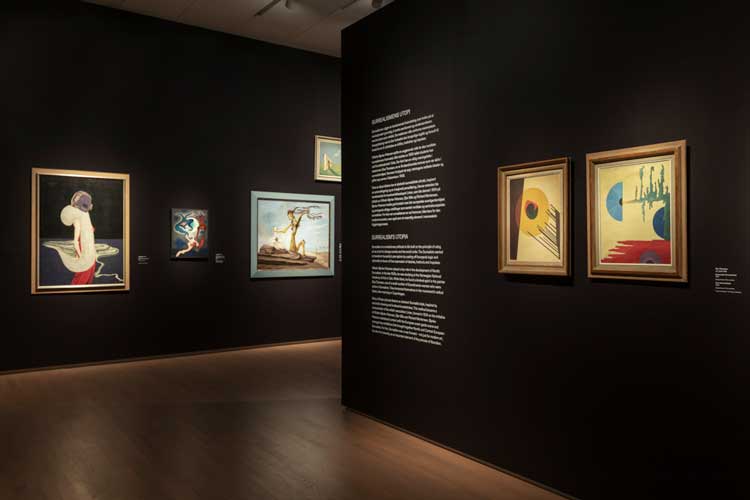
Between Dreams and Reality, installation view, Kunstsilo, Kristiansand, Norway, 2026 © Tor Simen Ulstein / Kunstsilo.
Jorn’s pieces are glorious: there are strong Munch-like elements in his small oil painting Top of the World or Gay Day (Pa Topped av Verde elder Glad Dag) (1960) above the larger, quasi-pointillist, mask-like Danno the Dane (Danno Dansken) (1961), together with a small, painted terracotta figure with black paint shadowing its eyes and dribbling down its torso (Untitled, 1959). The riotous colours and tumbling movement in Tolitikuja (1945) may well have been inspired by his visit in 1945 to the National Gallery Oslo, where he was apparently much taken by Munch. He told the newspaper Dagbladet that “his colouristic mindset was a prerequisite for a new visual idiom”, as Falch writes in his monograph essay. But does that matter when these paintings are so complex, arresting and satisfying to study? En Place pour le Rite (Et Sted for Ritualiet/A Place for the Ritual) (1957) groups four mysterious, spectral figures in a luminous bubble, outlined in shadow and surrounded by the fierce colours of a forest sunset. L’Abominable Homme des Neiges (Den avskyelige snømann/The Abominable Snowman) (1959) offers an intense encounter between the dark and the light. The Kunstsilo apparently has one of the best representations of Jorn’s work, outside of Denmark.
-Rita-Kernn-Larsen_BONO.jpg "Rita Kernn-Larsen, Valmue, 1935. Tangen-samlingen. © Rita Kernn-Larsen.")
Rita Kernn-Larsen, Valmue, 1935. Tangen-samlingen. © Rita Kernn-Larsen.
The selection of Kirkeby’s work is equally strong, revealing his earlier incarnation as an Arctic geologist to compelling effect in expressive, elemental landscapes. Here we have Tavle: Palaeozoikum (Board: Paleozoic) (1976), one of Kirkeby’s famous blackboard paintings, from a series exhibited at the 1976 Venice Biennale, where he represented Denmark. Also wonderful is a dense and gnarly sculpture of a head, in blackened bronze (Head at Home I, 1991-92), and two of his jaggedly exuberant mountain paintings, in which it’s hard to tell the strata within the mountain from the vegetation on its surface: both appear to be fizzing with life and pulsing with colour.
I am less familiar with Jerichau’s work but his seminal The Sacrificial Feast, People Seek Omens, Opus II from 1915 offers a potent blend of the mythological and figurative paintings of the past, with the rising forces of expressionism and modernism. With all this going on, this first room positively vibrates with fierce and spirited energies; a sense of art forms and artists wrestling themselves into new kinds of ways of seeing - and being.
From here, we move into a room exploring the work and influence of the German-born artist Rolf Nesch, who, in 1933, fled Nazi Germany for Norway’s then safer shores, declaring that “a country that has a Munch must be a good place to live”. An artist already linked with the German expressionist Brücke group, formed in 1905, Nesch experimented with new materials and ways of creating pictures, and apparently inspired a new generation of young Norwegian artists, including Erling Enger and Sigurd Winge.
You can see that experimental spirit expressed here in three of Winge’s works, collages of coloured glass on slate, which glow against this gallery’s black painted walls –including To Mennesker (Demring)/(Two Figures (Dawn) (1946) and The Expulsion from Paradise (1945). Enger’s pieces also practically levitate off this dark backdrop, with his haunting figures rendered more otherworldly by the use of powdered paint on canvas – a fresco-like technique that Nesch pioneered, and which Winge also uses in Mor og Datter (Mother and Daughter) (1935).
Nesch achieved considerable success as an artist with his print work, and a handful of his extended prints are grouped on one wall, including one from his San Marco series (1961-62), which was exhibited at the 1962 Venice Biennale, when Nesch represented Norway in the Nordic pavilion.
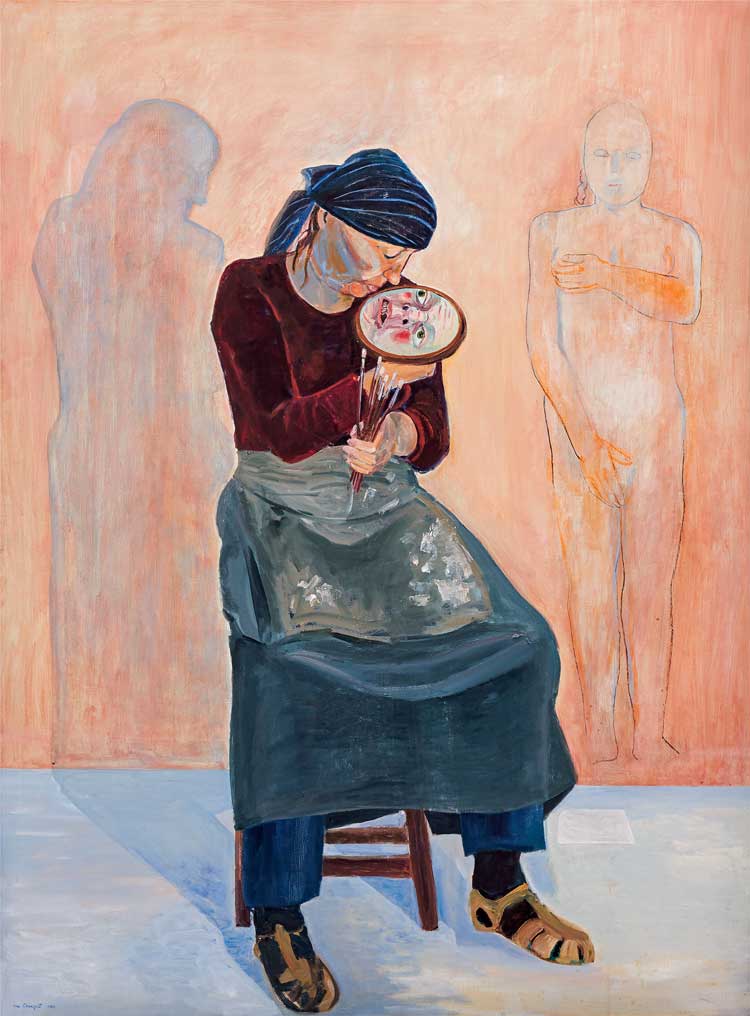
Lena Cronqvist, Mirroring, 1982. The Tangen Collection.
The next room, the wall text of which is captioned Expressive Approaches, groups together several artists to reveal their explorations of a more personal, subjective kind. Three small, beautifully observed oil portraits by the Swedish artist Birgitta Liljebladh demonstrate the collections’ commitment to registering the many female artists of the era. Painted between 1962 and 65, they have a fluent and spontaneous quality that feels utterly modern. The Swedish Lena Cronqvist’s large scale Spegling (Spelling/Mirroring, 1982) is also a fine, full-length self-portrait showing a woman absorbed in her own reflection, her figure the only clearly rendered image on a pale canvas, but with her own shadow looming on the left, and a half-seen, more sinister figure on the right. Other highlights include works by Torsten Renqvist, Evert Lundquist Stolen (The Chair) (1951), which also pulsates with intensity thanks to its thick layers of vigorously applied paint), Staffan Hallström’s Ingens Hundar (Nobody’s Dogs) (1964) oozes a sickly yellow aura of anxiety around these lost or abandoned canines.
The next section, themed Reality and the Visionary, showcases artists who lead the movement for “social commentary painting”, Arne Ekeland, Reidar Aulie and Willi Midelfart. But here, too, is Hannah Ryggen, a pioneering textile artist who was rightly celebrated in her day, with a large wall tapestry, titled Frihet (Freedom, 1941). Finland’s Tove Jansson – more famous for her Moomin writings and illustrations – is represented here with a gentle painting of a solitary figure in a cafe Kaféinteriör (Café Interior) (1939); quite Hopper-esque in its skill at conjuring the poetry in the everyday, albeit with a uniquely bleak Nordic light and colouring.
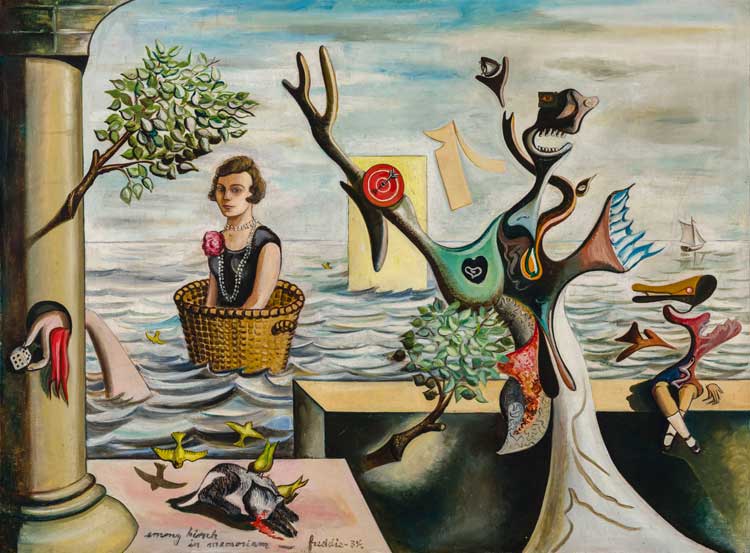
Freddie Wilhelm, Emma Hirsch in memoriam, 1934 .The Tangen Collection.
From here we move decisively into the influence of surrealism – the gallery walls taking a darker turn again for a section titled Unrest and Desire. Wilhelm Freddie is regarded as the foremost Danish surrealist, along with Harry Carlsson. But given the enduring, conformist power of the Nordic region’s Lutheran tendencies, it is perhaps not surprising that more rebellious artists were inspired by Freudian theories of the harms imposed by repressive morality and the necessity of liberating the libido and the unconscious through dreams and social/sexual experimentation. Freddie’s works here include Satanisk Elskov (Satanic Love) (1934-35), one of several that appeared in an exhibition he staged in 1937 called Sex-Surreal, which caused such outrage it was shut down by the authorities. Undeterred, he continued on this course and in 1947 was invited by surrealism’s founder, André Breton, to participate in his Paris exhibition. He was not alone in his enthusiasms, as evidenced by the diverse and fascinating work also shown here, with a captivating Valmue (Poppy) (1935) by pioneering avant garde Danish artist Rita Kernn-Larsen, several vivid works from Elsa Thoresen, including Burning Earth (Terre Brûlée) (1946), plus striking pieces from Vilhelm Bjerke-Petersen and Richard Mortensen. All combine a clear awareness of the evolutions in the mainstream European avant garde, but with their own distinctive expositions.
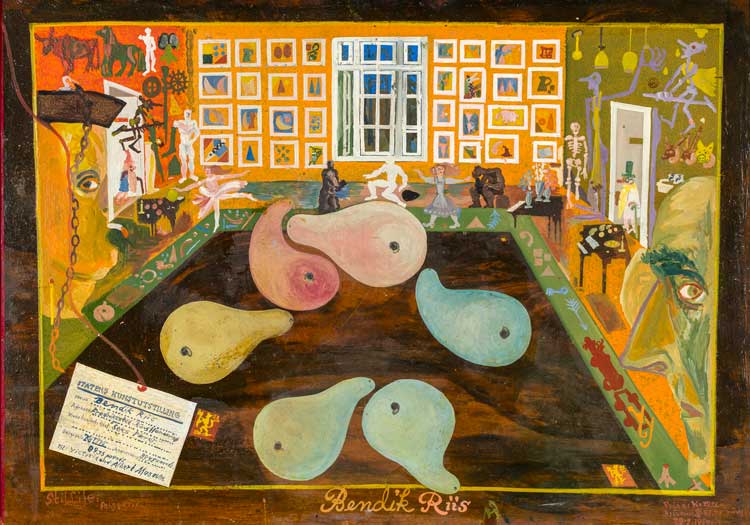
Bendik Riis, Six Pears, 1950. The Tangen Collection.
There is a fascinating room exploring “outsider” artists, such as Bendik Riis, who spent some time in psychiatric care, undergoing the horrors of electroconvulsive therapy (ECT). His Six Pears (1950) is a hallucinatory scene of dancing fruit, skeletons and witches. His Wiwisextion portrait above it a haunting representation of mental anguish, possibly in response to that gruelling ECT treatment. Nearby, works on paper nearby by Terje Bergstad and Olivia Holm-Møller – Sankthansbål (St John’s Eve Bonfire) (1947) – are compelling depictions of visceral experience, interior and exterior. In the same room are two seductive bronzes by Sonja Ferlov Mancoba, Fugl med Urge (Bird with Young) (1935) and Mask (1939).
I almost missed the final works, situated along a corridor facing into the main atrium, but here were three works by one of, for me, the most exciting discoveries, surrealist artist Max Walter Svanberg. There was also a vivid, sprawling nude on a blood-red and splattered-paint background. It had shades of Tracey Emin (though, painted in 1990-91, it predates Emin’s tortured nudes), albeit by a male artist, Ryszard Warsinski, so coming from quite a different place. There are many marvels in this show – as there are in the other floors of works. It is a salutary lesson in following your collecting instincts, against the fickle fads of the mainstream art world.
But one question remains: why were these painters and their works so sidelined? Gjessing lays out his view, in a conversation between himself and gallery director Else-Brit Kroneberg, printed in the aformentioned monograph. He traces the key moment back to 1935, when the Oslo gallery Kunstnernes Hus showed Swedish and Danish modernist and surrealist artists. There was a strong reaction against these works, he says. The artists were labelled “irresponsible formalists”, in a “period of instability that above all demanded social involvement”. Their experiments were seen as “aesthetic dilettantism”. Rediscovering these artists in the 80s, was for him a fascinating process of trusting his own judgment against the prevailing orthodoxy. “It was exciting to experience this period in a completely new way,” he says. And it was a privilege, as a visitor, to be allowed to do the same.
Click on the pictures below to enlarge

Copyright © 1893–2026 Studio International Foundation.
The title Studio International is the property of the Studio International Foundation and, together with the content, are bound by copyright. All rights reserved.
 |
 |
 |
|---|


-1000-300.jpg)