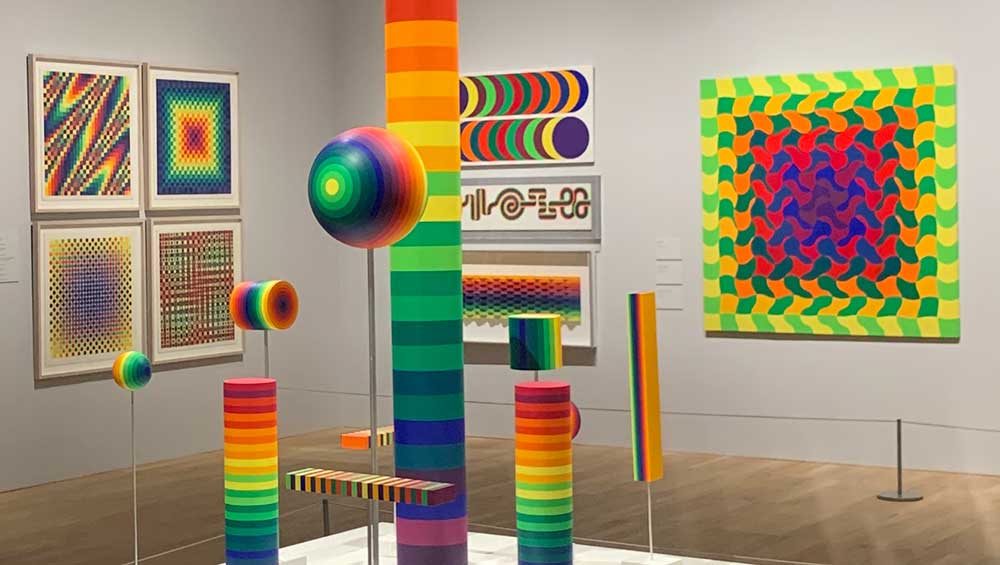
Julio Le Parc: Light. Colour. Action. Installation view, Tate Modern, London, 8 June 2026 – 3 May 2027. Photo: Bronac Ferran.
Tate Modern, London
8 June 2026 – 3 May 2027
by BRONAĊ FERRAN
The death of Julio Le Parc, at 97, eight days before the opening of his first solo exhibition at Tate Modern, marks the passing of a modern master. At the exhibition preview, Yamil Le Parc, one of his three sons who jointly run his foundation, tells us that his father would have loved to attend. Tate’s lead curator for this exhibition, Valentina Ravaglia, refers also to the dialogic process evolved with Le Parc around the exhibition details and layout. The exhibition duly carries a sense of his ghostly presence, manifest for example in installations that seem to spring to life in a multiplicity of surprise mirrorings or shimmering distortions, where the pliable ethereality of light meets darkness and shadows.
Le Parc’s contribution to a lineage of using light as a primary medium, adding enhanced time-based elements to the modernist breakthroughs of László Moholy-Nagy, in anticipation of the electronic revolution that soon followed, marks his greatness as an artist. Twelve years ago, during a major exhibition in Rio de Janeiro, Le Parc explained to Caroline Menezes for this magazine how he began working with light, so as to “multiply images, visualise them and place them in my presence in a simultaneous or progressive manner … I started putting some elements in motion and became aware that I could take these moving elements out of the little boxes and started exploring with them. Then I realised that, depending on how these elements were made, they would provoke images and reflections on the wall, and I tried to see how I could exploit this and give it form and make them reflect and refract.”
In 1963, Le Parc began to use small electric motors to cascade light into various affective configurations, making light move in innovative ways, scattering rays across walls and ceilings and floors, creating environmental interventions. The tantalising visual effects that he created using light as a primary medium from 1959 remain spellbinding for the contemporary viewer. Indeed, we see this happen at numerous points within the Light in Motion 1 area of the exhibition, where a piece from 1960 (remade in 2007) entitled Continual Light Mobile Dented Squares spills in multiple directions, responding also to the airflows caused by the presence of people delightedly moving through the space.
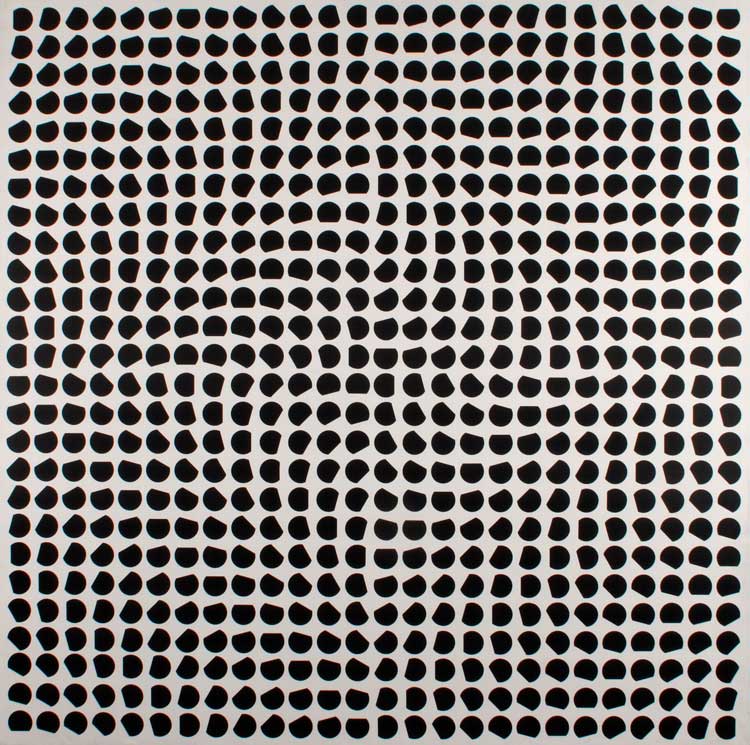
Julio Le Parc, Instability, 1959–1991 Lent by the Atelier Le Parc 2026 © ADAGP, Paris and DACS, London 2025
Atmospheric effects are also at play in the newly commissioned, Continual Light Mobile (Tate) 2026. It is situated on the ground floor of the Blavatnik extension, above a curving staircase, as if seamlessly part of the fabric of the building. Its location here, in a relatively public space, seems also ideal for Le Parc’s sensibility, outside the ticketed galleries and placed to seem resonant with the flows of the nearby river, its serialist multiplicity of surfaces glinting in reflecting artificial and natural light sources as well as the contingency again of air and people passing.. One must trust that Tate will hold on to this work after the exhibition is over.
The work forms part of a series entitled Continual Mobiles and Continual Light Mobiles that Le Parc first made in the early 60s, and continued to evolve throughout his life, all of which communicate through lateralised structural organisation a notion of decentring of power and freedom of control from vertical hierarchies. In an excellent film produced by Tate to accompany this exhibition, the series is cited as making manifest Le Parc’s activist socialist principles during a period of co-founding the GRAV, or Groupe de Recherche d’Art Visuel with 10 other Paris-based artists, including François Molnar, François Morellet, Francisco Sobrino and Jean-Pierre Yvaral, in 1960.
Le Parc, who was the recognised primary theorist of GRAV, has written of its collective aim to “remove the word art from their vocabulary”, focusing instead on research into the nature of visual perception. “We prefer to consider artistic phenomenon in terms of a strictly visual, non-emotional experience located in the plane of physiological perception” – and in the connection between the human eye and the “plastic” object (by which was being implied degrees of intrinsic or potential movement).
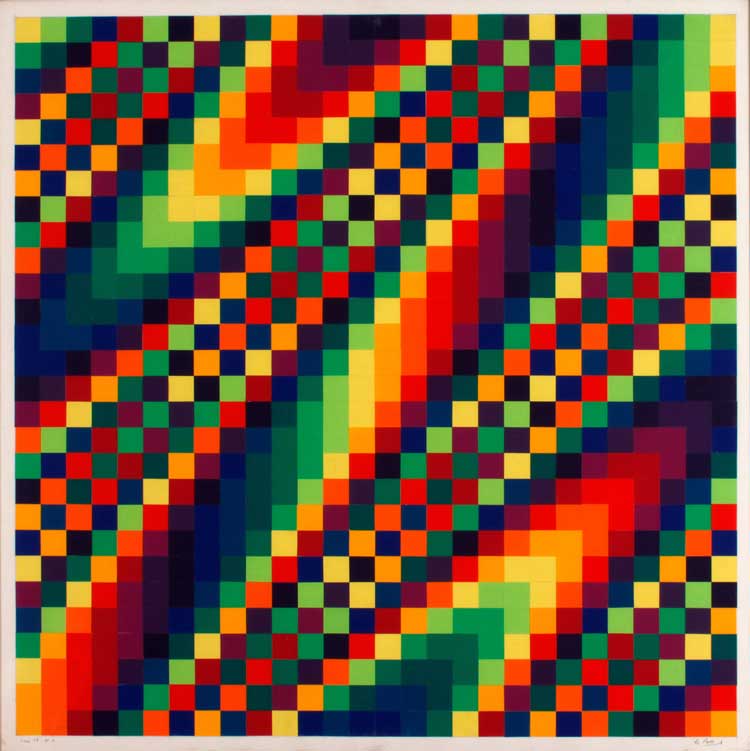
Julio Le Parc, Series 37 n°1, 1970. Lent by the Atelier Le Parc 2026 © ADAGP, Paris and DACS, London 2025.
The group’s aspiration was also to “distort the normal perception of reality, by fragmenting it, overlapping, duplicating, inverting, colouring, deforming, and so on”. In what might be perceived as a transitional moment towards the deformations made possible by artificial intelligence today, where agency of the human is in turn being displaced by machine processes, GRAV sought to transform the exhibition visitor into an active agent, to “put the spectator in a situation that he triggers and transforms. We want him to be aware of his particulation. We want him to head in the direction of interaction with other onlookers … Any spectator who is aware of his power to act and tired by so much abuse and mystification will be able to make the true ‘art revolution’ himself.”1
Le Parc was born in Argentina to a working-class family in 1928. As Ravaglia’s essay in the exhibition catalogue tells us, in the mid-1940s he dropped out of art school for a while to live and travel for a while among dispossessed peoples.2 His shift to Paris in 1958 was facilitated by a travel scholarship; soon he settled into forming GRAV and development of a series of works on paper and, from 1959 onwards, using light as primary medium. In 1966, Le Parc was awarded the Grand Prize for Painting for his first solo exhibition, representing Argentina, at the Venice Biennale. This led to significantly enhanced international recognition, including a solo exhibition in New York soon after and in November 1966 at the Galerie Denise René in Paris.
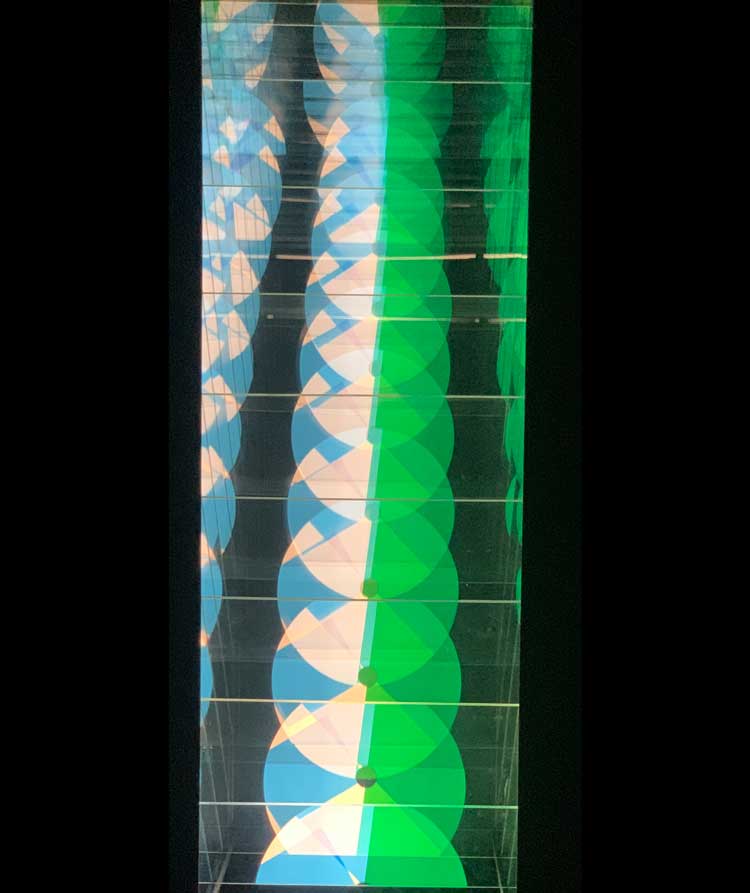
Julio Le Parc: Light. Colour. Action. Installation view, Tate Modern, London, 8 June 2026 – 3 May 2027. Photo: Bronac Ferran.
The largest kinetic light-based work on display at Tate by Le Parc is Vibrating Light – Tulles (1968/1981). It is one of a series he made that become like environmental structures, that people might sometimes walk through and into, losing their sense of individual boundaries in the process. In the version now on display, Le Parc used a combination of revolving shutters, generated by an electrical motor and a gear system, along with lengths of net curtains of various sizes through which light is being transmitted. A crossplay of simultaneous reflections is also facilitated by full-length mirrors running along the sides. The effect is one of a simultaneous disequilibrium. At the stunning Dynamo: A Century of Light and Motion in Art exhibition of related works in the Grand Palais in Paris in 2013, the term “sensitive apparitions” was introduced; I find this still highly resonant with the effects that Le Parc was conjuring, instilling levels of dynamic and hallucinatory distortion that attract and unsettle in equal measure.
In building in such elaborate tensions, using what might be now viewed as very simple components, Le Parc was also drawing on levels of detailed research that preoccupied him for years (and continued to do so after the 60s) into the nature of human perception and in particular the eye and its purity of impulse, being a grounding site through and within which all class divides and other divides might be cast off and transformed into something more levelling. In this sense, as manifest in the direction of liberation towards an egalitarian approach to art-making that might in turn free the person to continue to exercise their own agency, Le Parc was a politically engaged artist, reacting in often polemical fashion, against what he perceived to be dominant forces of oppression, misrepresentation and mystification within cultural practices and society more widely.
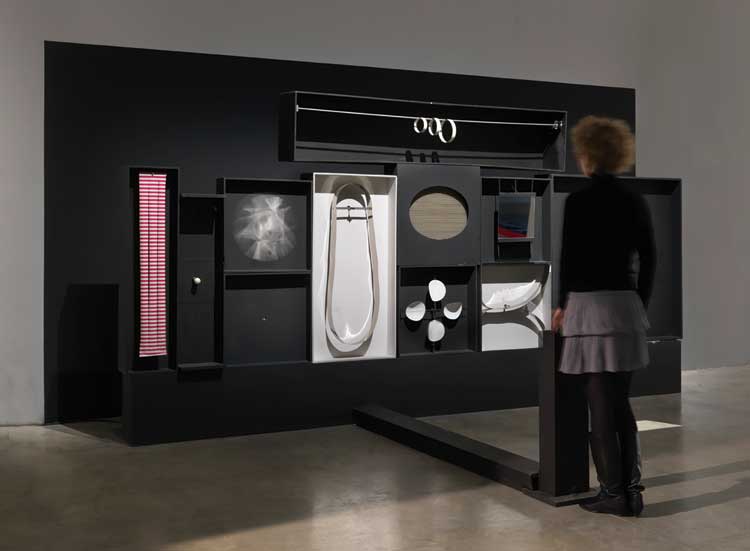
Julio Le Parc, Ensemble of Eleven Surprise Movements, 1967. © Atelier Le Parc.
While in his only earlier substantial solo exhibition in the UK, at the Serpentine Gallery in 2014-15, previously unseen political drawings and political manifestos were included, along with light-based works and geometrical drawings, here, a greater focus has been placed more on showing the dynamic effect of breaking down perceptual barriers and lowering the threshold of interaction. This comes into clearest view in the “Games-Room” assemblage that is in many ways the centrepiece of the exhibition. We see a range of interactive and participatory installations, creating an atmosphere like a a vintage hall of mirrors or a 60s-themed art antiques roadshow, where part of the joy of being there is seeing how other people are engaging. Among the “push-button” pieces are Ensemble of Games with Ping Pong Balls (1965) and Ensemble of Eleven Surprise Movements (1967/remade in 2016) – which looks vaguely medical and scary when not being played, while Transformable Face (1985/remade in 2025) draws everybody in the room towards it while I am there, being simple to take part in and based on magnetism rather than mechanics.
-Atelier-Le-Parc.jpg "Julio Le Parc with Reflective Blades. © Atelier Le Parc")
Julio Le Parc with Reflective Blades. © Atelier Le Parc
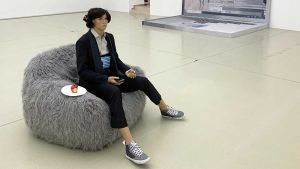
More paradigmatic of the concept of “Spectator Displacement”, highlighted in this section, is a piece entitled Screen with Reflective Blades (1966/2005) that looks like a 60s Perspex sculpture – all red and diagonally aligned – when it is not in use. But when people approach it and look behind, they see a notice relating to where they can place their feet, in so doing, and in walking along to reach it, their silhouette becomes broken into multiple fragments. I have a flashback on seeing this to watching a 1968 film by Henri-Georges Clouzot, entitled Woman in Chains, which opens by showing an art gallery in Paris (modelled on the aforementioned Denise René space) in which 60s kinetic works are installed with related artists walking around. The film itself shifts from a psychedelic opening sequence to becoming darker, mirroring once again the dialectical tension between constraint and openness that is also at the core of Le Parc’s artistic process.
While GRAV sought to bring such approaches out into public spaces, as a turn away from the constraints and limitations of museums and national galleries, it may be viewed as somewhat paradoxical that the same projects are now firmly on the inside of the walls and drawing in wider audiences. Though it may seem that the challenge now lies only in suspending degrees of cynicism sufficiently to enjoy the effect of pushing a simple button and having blown rolls of paper unfurl erratically in one’s direction (Ribbons in the Wind, 1988), the reality of what is happening, with respect to people watching other people to work out how to interact (there are no instructions given) is in many ways the point of the exercise. Many of those spectating also take the opportunity to photograph what is happening, which adds further to a sense of historical distortion that the early sections of this exhibition produced in this observer.
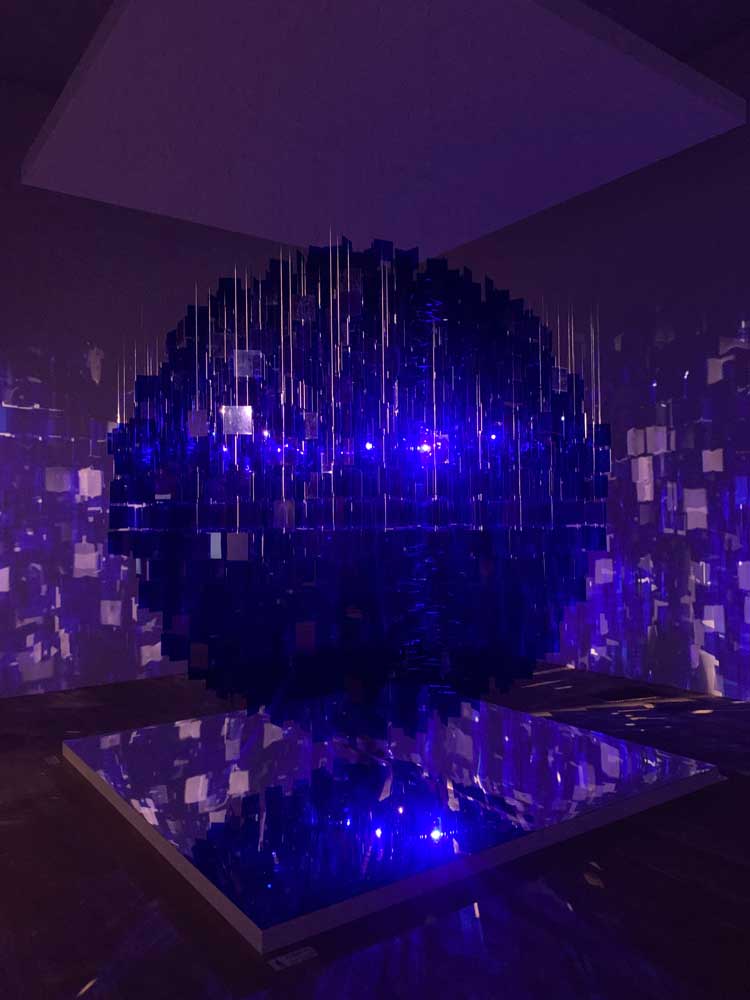
Julio Le Parc, Blue Sphere, 2001; remade 2024. Installation view, Tate Modern, London, 8 June 2026 – 3 May 2027. Photo: Bronac Ferran.
A square room is, meanwhile, dedicated to Le Parc’s numinous Blue Sphere (2001; remade 2024) which was acquired by Tate in 2024. The work takes effect by its rippling of lines of light on to nearby surfaces, in this instance covering the walls and penetrating the bodies of those watching. Like various other pieces in this exhibition, it encourages forms of collective response among those who find themselves experiencing it together. I was filled with anticipation at the prospect of experiencing this in person. Yet, it seemed to me on first sight (and on a later visit) to be a work pushing too hard against its spatial limits. The scale is such that there is little room left for those who like to walk around works so as to experience a full sense of their dimensions, waiting for the intuitive moment to co-evolve, when the radiance of the structure, as with Le Parc’s light-kinetic works generally, will settle into a sort of gestalt or wholeness.
In his writings of 1962, he referred to how “spectators” would “fully immerse themselves in these indeterminate manifestations” and “it is their perception that will provide a particular image of the work”. He referred also to a desirable point when the spectators have been “activated” and to how “their activation is fundamental to the reality of the artwork”. This is all also highly timely with respect to our contemporary moment, though as noted earlier, the active spectator now is most likely to be grabbing the most effective image with their camera, shifting the focus of the reality from real-time experience to a mediated impression.
In the curatorial handout, we find a reference to “the retinal afterimage”, where high-contrast motifs leave an impression on the retina for long enough to be visible against a blank background and prompt the viewer to “complete” the artwork with their eye movements. This was a theory of strong influence on artists in the postwar era, from whose experiments in visual perception as a form of negative/positive duality what we now know as kinetic art first became a reality. One of my favourite parts of the exhibition is right at the opening, where a series of works, using only black, white and grey, dating from the transitional phase before and after Le Parc left Buenos Aires for Paris are hung dramatically against a black background.
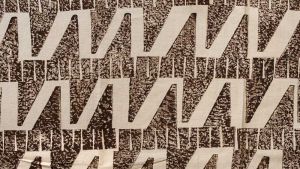
In works with titles such as Ambivalence, Ambivalent Sequences, Progressive Sequences, Circular Translation, Translational Sequence of Nine and Collective Translation (all 1959), we see Le Parc developing a visual notation or semiotic language based on shapes, forms and negative spaces. We also start to see how he was beginning to form animated sequences, testing out possibilities of time-based shifts within highly constrained 2D surfaces. He was in this way a clear inheritor of concrete and constructivist tendencies from earlier in the century that were being reworked into neo-concrete and kinetic fields of movement from the middle to the late 50s onwards. Indeed, Le Parc saw his 1958-59 works, both those without colour and concurrent sets, as his first kinetic pieces.
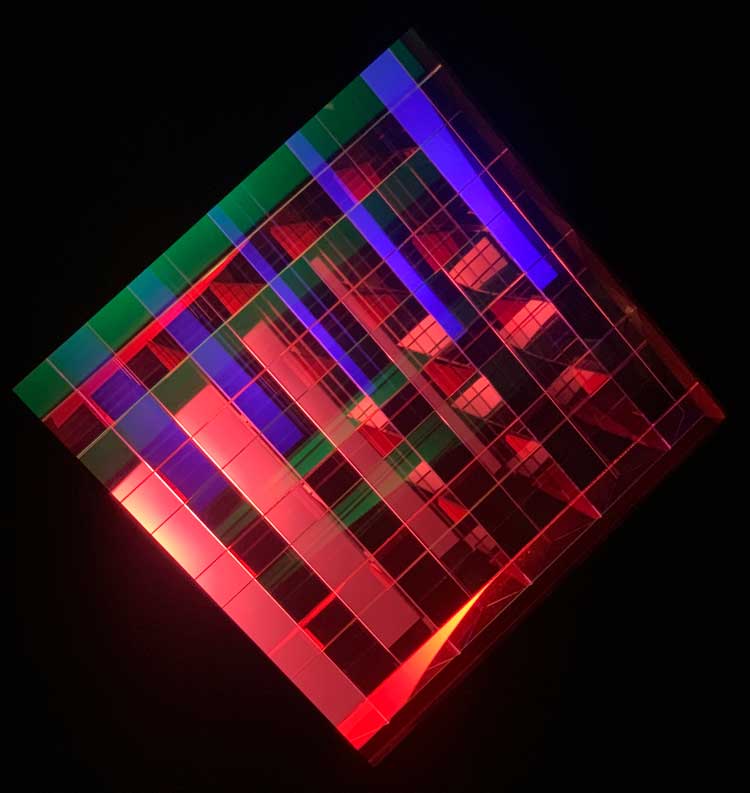
Julio Le Parc, Continual Light Box, 1963–2013. Installation view, Tate Modern, London, 8 June 2026 – 3 May 2027. Photo: Bronac Ferran.
Those who look closely, or have time to go back and forward through the exhibition, will notice some illuminating connections, where in the final room of the exhibition we get access to numerous multicoloured drawings he was doing in 1959, with their sequential titles, Colour Projects 1-16, which map well on to how he approached the use of colour within mobile light boxes shown earlier in the exhibition. The most clearly related of these is Continual Light Box, (1959/remade in 1965 and 2013), which Le Parc made using coloured acrylic sheets and prisms; the correspondence between colours appearing in multilinear sequences in this mobile light work and other colour sequence drawings later in the exhibition allows us to recognise how he was exploring ideas of depth and transparency, in both domains, simultaneously, during his first and crucial phase of artistic emergence in Paris.
In the last room, we also see a series of multicoloured notational titles from the early 70s that reveal how intensively he was then applying his system based on the constraint of only 14 colours in various evolving patterns. The texture of these post-60s titles manifest the aforementioned GRAV manifesto concern for depersonalised expression, reducing everything down to what seem to me to be sequential patterns of colour relations in time and space, that vary consistently but remain somehow similar. However, in watching how members of the public are interacting with these pieces, one recalls that, as the art historian Alexander Alberro has observed in an analysis of the works of the GRAV, there was still a place for emotion with respect to encouraging “the public to enjoy itself, to respond with sensuous humour”.3 I also see gallery visitors spend time closely examining the detail of the sequence of his multicoloured, multilinear squares. While I find these works too garish and stylistically corporate, others are clearly entranced, studying the rigorous textures closely in the hope of deciphering their underlying numerical systems.
Watching his multilinear grids, such as Four Juxtaposed Patterns in Fourteen Colours (1959), being captured on mobile screens, for potential circulation onwards into wider network systems, by visitors of various ages, I sense that had Le Parc been well enough to engage with the implications of how his works are now being received, he would have enjoyed the spectacle. For all his protestations against artworld ideologies in the 60s, he was consistent, as Ravalgia observed at the press preview, in creating a “machinery of joy” that this rather ludic exhibition brings into clearer focus. Spilling over also into the foyer outside the gallery as well in the downstairs installation, this exhibition is an impressive parting gesture, as well as a fitting tribute to Le Parc’s entraining prescience.
References
1. Alessandro Alberro, Julio Le Parc, the Groupe de Recherche d’Art Visuel, and Instability in the 1960s. In: catalogue for Julio Le Parc, Kinetic Works, Works by Julio Le Parc in the Daros Latin America Collection, Rio de Janeiro, 2013-14; 37-83, 63.
2. Valentina Ravaglia, Perpetual Research: Seven Decades of Julio Le Parc, Julio Le Parc, catalogue of exhibition, Tate Publishing, 2026.
3. Alberro, Julio Le Parc, the Groupe de Recherche d’Art Visuel, and Instability in the 1960s; 71.
Click on the pictures below to enlarge

Copyright © 1893–2026 Studio International Foundation.
The title Studio International is the property of the Studio International Foundation and, together with the content, are bound by copyright. All rights reserved.
 |
 |
 |
|---|
-1000-300.jpg)