Ikon Gallery, Birmingham
30 September 2026 – 21 February 2027
by DAVID TRIGG
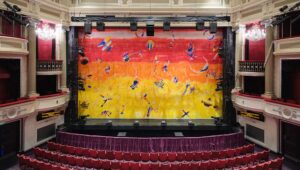
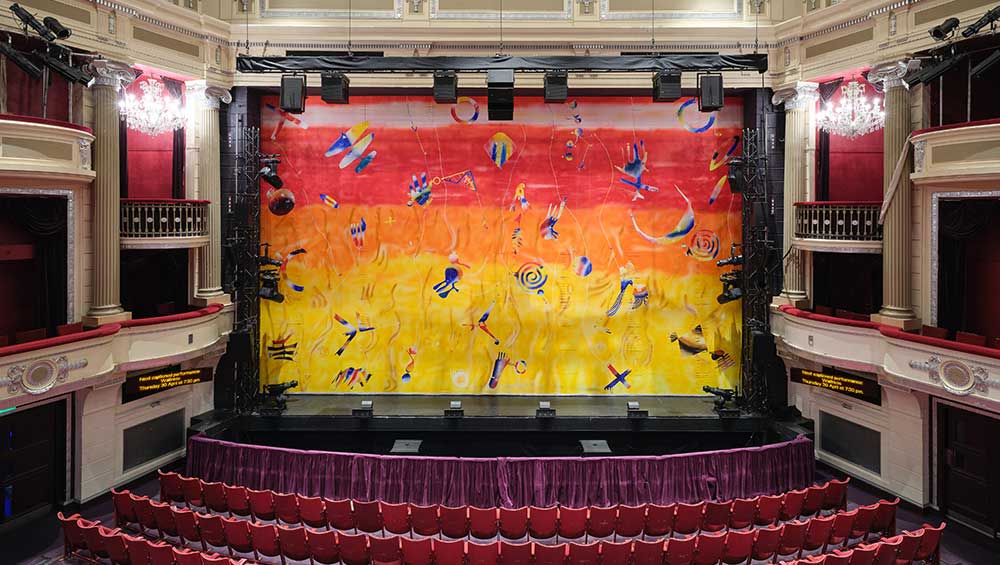
Visitors to Birmingham Hippodrome will already be acquainted with the work of Balraj Khanna (1939-2004), even if they do not know his name. His monumental painting Astral Dance has adorned the theatre’s safety curtain since 2001, greeting more than a million theatregoers with its lively cast of organic and geometric forms scattered across a shimmering backdrop of fiery hues. Evoking microscopic lifeforms and cosmic phenomena, the dynamic composition invites pre-show reverie and wonderment. Measuring almost 13 metres (43ft) wide and eight metres high, it is the British Indian artist’s largest and most visible work, exemplifying his creative determination and enduring ambition.
Informed by his love for the natural world, Khanna’s distinctive visual language was shaped by his upbringing in Jhang, in the Punjab region of India (now Pakistan), but it found full expression in postwar Britain after he moved to London in 1962. Although he was a notable figure in the British South Asian diaspora, his wider contribution has been largely overlooked, not least because his art resisted neat categorisation in an art world dominated by pop, minimal and conceptual tendencies. This exhibition, the most comprehensive overview of his six-decade-long career to date, traces the evolution of his singular painting practice, which was driven by experimentation, invention and an insatiable curiosity about the world.
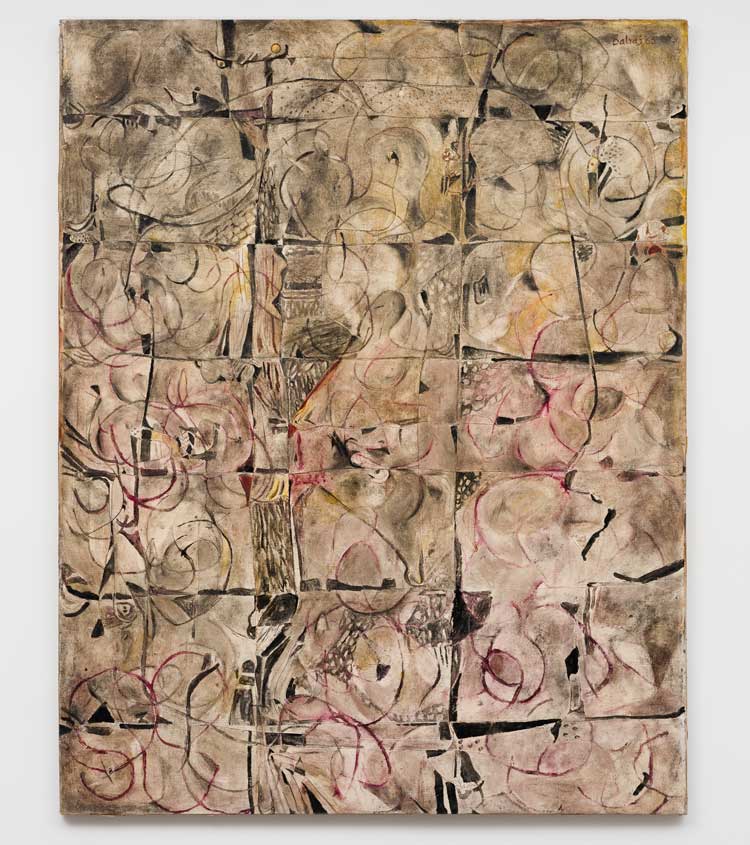
Khanna, who never studied art formally, began painting before leaving India. However, the earliest works in the show date from 1965 and were made in France while he was recuperating from a motor scooter accident. Immersed in the forests surrounding the city of Metz, he began making abstract canvases characterised by layered surfaces and a deeply personal lexicon of organic and geometric forms inspired by his experiences of nature. Remote Region (1965) is a work that typifies his approach, its grid-like structure containing a careful balance of tightly controlled shapes and areas of looser mark-making. Time spent in the French forests unlocked something for Khanna, a deep connection to nature that would inform much of his subsequent abstract work.
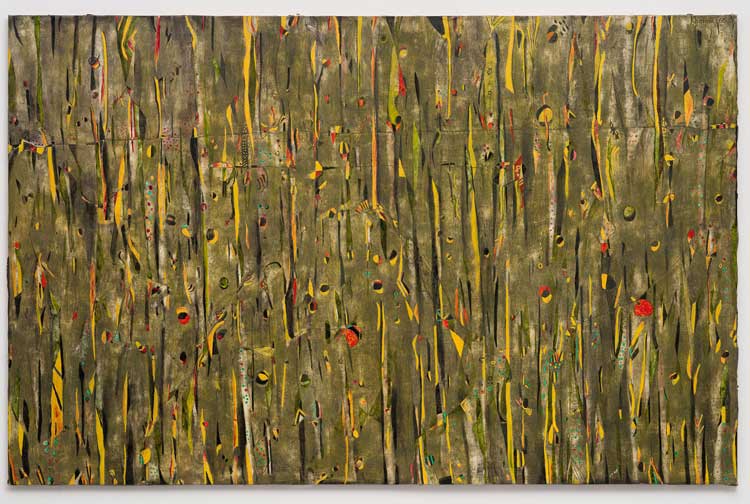
Landscape is repeatedly evoked by titles such as Marshland (1965), A Walk in the Lake District (1965) and Forest Walk (1969), which link the paintings to specific experiences of place. Even in these early works there is already a striking sense of rhythm and bustling movement. Many are suggestive of life at the micro level while others, though abstract, evoke the visible world. In one dense composition, small and colourful globular forms punctuate a greenish-grey ground covered with vertical yellow and black streaks. When Khanna’s friend and fellow Indian artist Francis Newton Souza remarked to him that it appeared like something a grasshopper might encounter, he welcomed the suggestion, titling it A Grasshopper’s Eye View (1966).
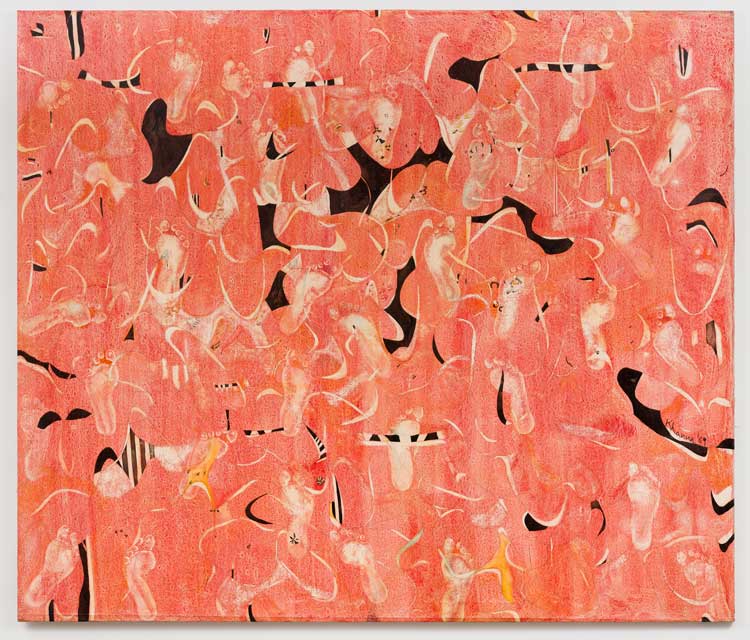
Experimentation was central to Khanna’s work and he trialled numerous techniques as he advanced his own style of abstraction. Collage became increasingly important; thread, string, sand and cut-out shapes were added to layers of paint to create subtle textures and reliefs that give his paintings an added physicality. In works such as Unravelled (1967) and Rain Raga (1967), string was embedded into the primer, painted over and removed, leaving their surfaces inscribed with sinuous lines running playfully across the canvases. An interest in pattern comes to the fore in Nairobi Nights (1970) and African Queen (1969-70): covered with spots, stripes and overlapping amorphous shapes, their decorative qualities recall African textile designs. Nearby, Khanna’s footprints litter the pink surface of A Walk in the Rose Garden (1969), while the anomalous Love at First Sight (1968) sees him veering into hard-edge minimalism.
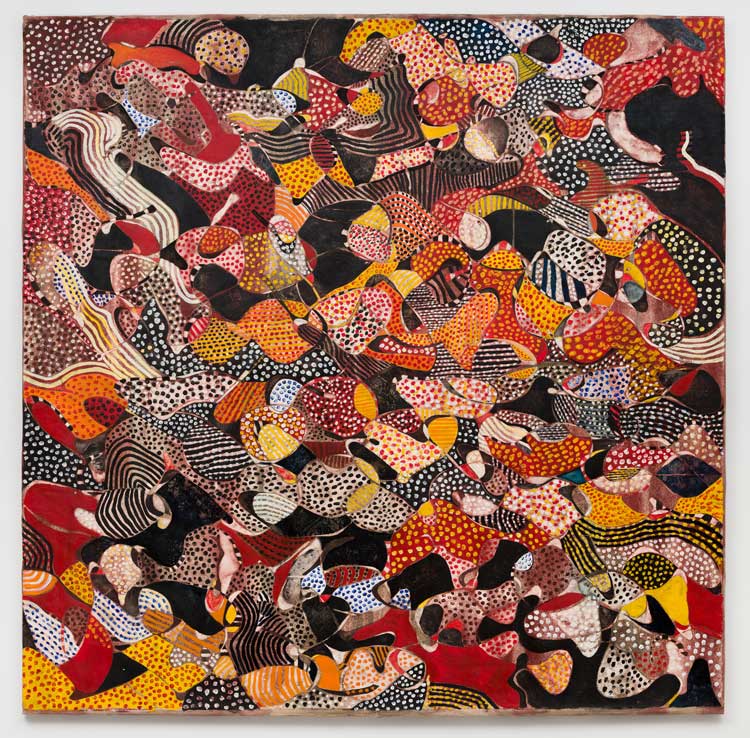
One of Khanna’s strongest childhood memories was of visiting the Basant kite festival in Lahore, which he described as “a sensational tournament of flying colours”. His imagination was similarly sparked by the street performers he saw in the city. These recollections ostensibly inform the shapes that dance across many of his compositions from the 1980s, such as the dynamic New Play (1984), and Flying Kites – Patang Bazi (1988-89). But these are not figurative depictions, rather they are abstract evocations of memory, and though Khanna’s forms could certainly be read as kites, they are, in his words, “symbols from the submerged layers of our unconsciousness – all floating or flying around in one unified field”. Sand and pieces of cut canvas physically embedded into these works create a tension, a push and pull between surface and the suggestion of spatial depth.
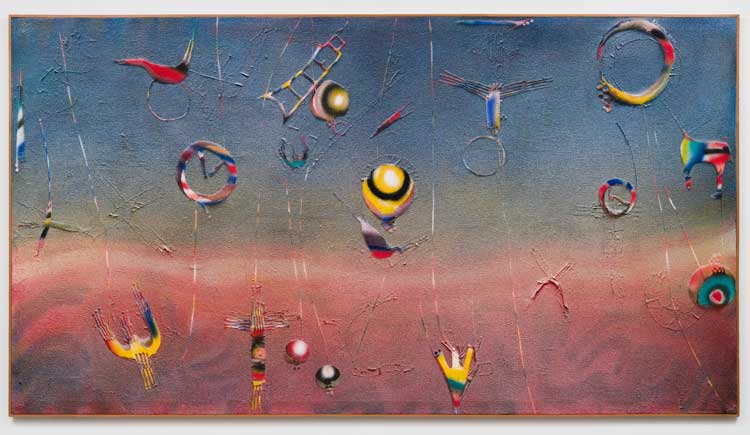
These works see Khanna settling into a signature style. He also began employing an airbrush, initially using his own breath in lieu of compressed air, applying paint by blowing through a nozzle or straw. Later, he employed spray guns to apply multiple layers of misty pigment, often over handmade paper cut-outs and stencils that were subsequently removed to reveal crisp configurations of abstract forms floating over finely gradated backgrounds. Evoking celestial expanses or astral planes, each painting is its own microcosm with its own inner logic, and although Khanna’s biomorphic and amorphous forms vary from one piece to the next, they remain recognisably his. Indeed, while artists such as Paul Klee and Joan Miró were clearly an influence, nothing here can be described as derivative.
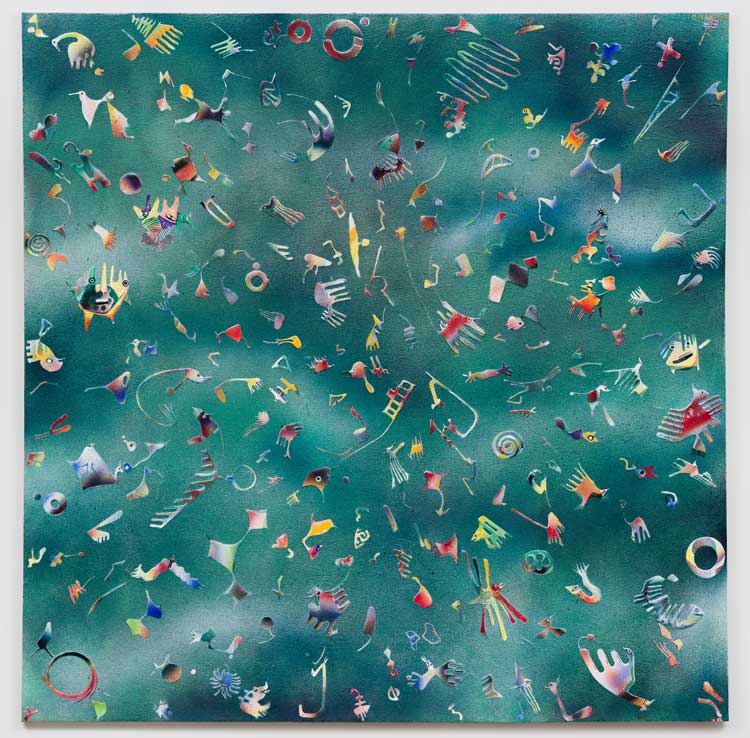
Khanna continued in this vein for the rest of his career with works such as the mesmerising Coming from Edinburgh (1986) forming a high point in his practice. This large-scale painting looks as if a cosmic party popper has exploded, blasting swirling and spiralling forms deep into space. In the overtly playful composition Big Bang (2004-07), abstraction gives way to surreal figuration. A mass of brightly coloured forms resembling amoebas, marine creatures and plastic toys with cartoonish eyes float in a nebulous, primordial space. It is an enjoyably quirky work in which the mysteries of the cosmos become whimsical spectacle.
As a young boy, Khanna witnessed the 1947 partition of India, experiencing first-hand the chaos, violence and mass displacement that followed in its wake. In Britain, he experienced racism and exclusion, but none of these experiences are addressed in his work. If anything, art for him became a form of escape. He evidently believed that the woes of the world need not preclude the pursuit of that which is uplifting, joyous and life-affirming. As curator Elena Crippa writes in the exhibition catalogue: “That in most of his works from the mid-1960s, Khanna chose to draw from and bring into the world the fantasy or possibility of joy and awe […] was most certainly the expression of a hard-won hopefulness and an unwavering sense of possibility.” While the blending, overlapping and dialoguing of multiple cultural traditions shaped his innovative approach, it was his enduring optimism that became the guiding principle of his life and work.