Kode Bergen
30 October 2026 – 28 February 2027
By JOE LLOYD
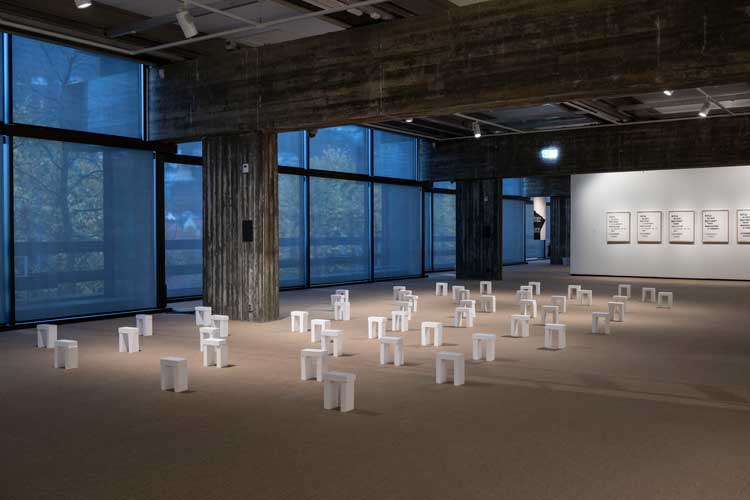
Since Ancient Rome, leaders across the globe have attempted to immortalise victories with vast ceremonial arches. Gardar Eide Einarsson’s Our Arcs of Triumph (2025) might cock a snook at this megalomaniacal drive, diminishing and schematising them. It consists of dozens of miniature portals sprawling across the floor like kubb blocks. Each comprises three plastercasts of bricks arranged like a Stonehenge trilithon. The brick is the ad hoc weapon of the revolutionary rather than the state. In Hong Kong in 2019, those protesting against Chinese rule blocked police vehicles using similar miniature arches. Will these makeshift barriers come to commemorate the individuals and groups that stood up? Unlike their state-sanctioned equivalents, they are anonymous and easy to kick over, a fragile memorial.
Einarsson’s multimedia practice examines the signs, symbols and structures through which power is exerted. The Purpose of a System Is What It Does at Kode Bergen is his largest exhibition to date. It is something of a homecoming. Born in Oslo in 1976, the artist studied at the National Academy of Fine Arts in Bergen in the late 1990s, before moving to New York for the Whitney Museum’s independent study programme. He arrived in the city the night before 9/11. Much of his work since has been immersed in the world that followed: the increase in surveillance, the growth of nationalism, the alienations of late capitalism. Rather than approach these issues through agit-prop or advocacy – although it seems clear where Einarsson’s sympathies lie – they are presented through objects, paintings, prints and sculptures gathered like confiscated goods or criminal evidence.
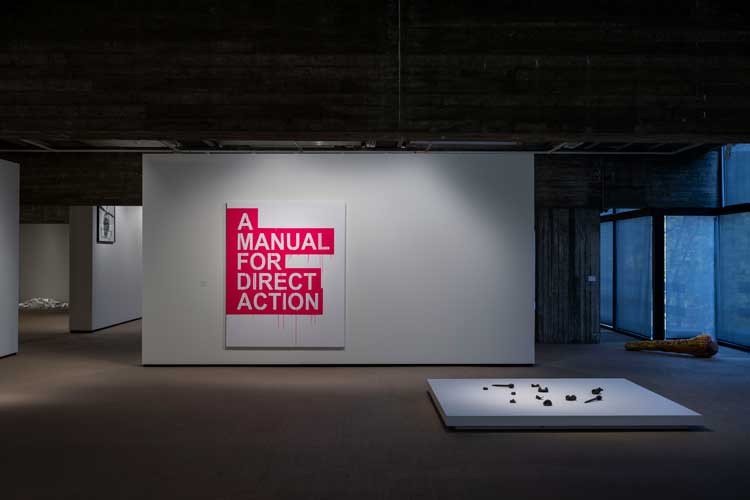
The threat of violence is everywhere, spread across formats and mediums. A sample: a textile work, one of many that evoke protest banners, reads “Brute force”, another “Demand destruction”. There are bronze casts of claymore anti-personnel mines, photos of gunmen – gangsters or special services? – hiding behind lamp-posts and postboxes, and an oversized cudgel engraved with the word “Kultur”, an overt reference to the way culture and thought can be used to promote violence. Untitled (Bleach) (2011) is a set of resin bottles tied together and dangled from the ceiling. They appear innocuous, but their shadow resembles a hanging corpse. Gag (2009) is a cotton mouthpiece used to silence prisoners. A set of 2021 prints replicates pages from a manual for protest suppression, a publication that makes the mechanisms of state control the subject of a mundane how-to guide. For me, however, the most discomfiting of all is a cluster of duffel bags (2014) placed side by side. Einarsson has filled them with blocks of concrete, but without that information one is left to speculate about what these zipped-up sacks contain.
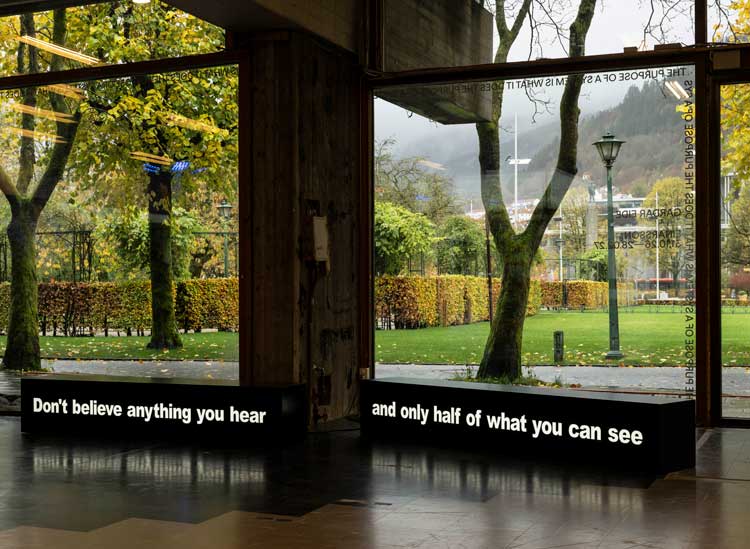
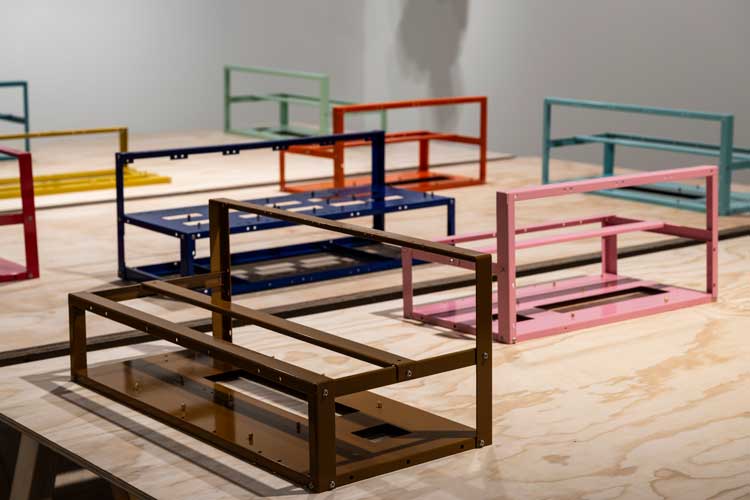
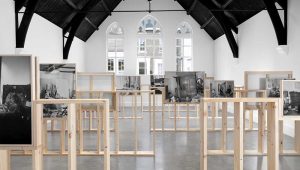
The exhibition is held in Kode’s Stenersen, a brutalist building with straight lines, vast windows and white walls. Einarsson’s work is perfectly suited to this venue. Remove the art and the upstairs space could be an antiseptic corporate office. The smaller downstairs, recently opened up for Kode after being used by another tenant, has the exposed ceiling beams and strip lighting of a warehouse, the architectural expression of the silent motions of international trade. These settings combine with the predominantly black, grey and white palette of Einarsson’s work – reminiscent of that of Cady Noland, whom Einarsson has cited as a favoured artist, or Glenn Ligon – to create the sensation of wandering through a place where secret decisions and transactions are made, a sort of security infrastructure backrooms. There are occasional jolts of colour. Untitled (FT) (2017) replicates a phrase (“The good old days are gone and they won’t return”) from a Financial Times article on a banner of the same soft-pink as the newspaper; Mining Rigs (2022), steel sculptures of household cryptocurrency-mining rigs adopt the same RAL colour system used by Donald Judd. Yet the overall display has the greyness of a world seen in Xerox.
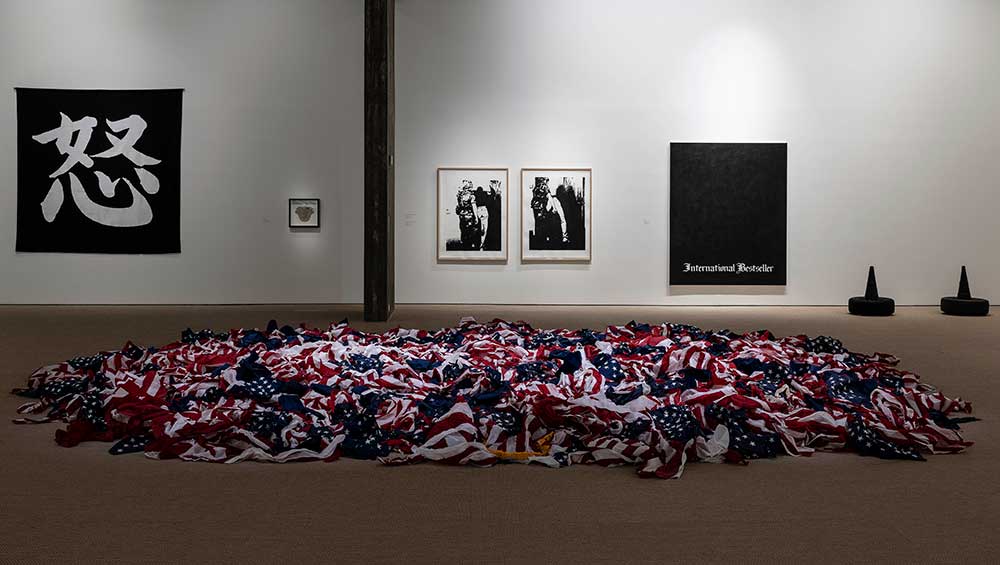
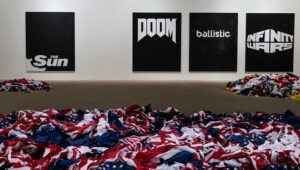
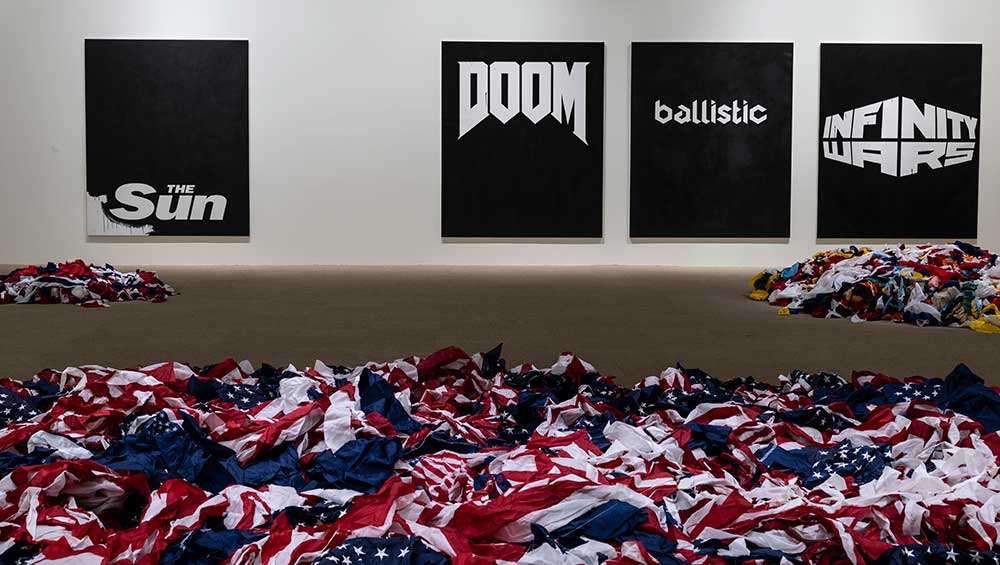
Violence is not the only method of control that Einarsson captures. Flagwaste (US) (2014) looks at first glance like a pile of American flags, symbols both of state power and national cohesion. Heaped up on the floor, they almost look like a desecration, reducing the mighty flag to litter. Yet the tattered textiles are already waste, imperfect offcuts from among the last remaining flag manufacturer in the US. An imperfect banner becomes inert fabric, a byproduct of an industrial process rather than a site of independent meaning. Einarsson lived in New York until moving to Tokyo in 2014, and the decline of the supposed international order led by the US recurs throughout the exhibition. Facing the flags is a vast painting showing the logo of the American chemical company Union Carbide (2015). In 1984, a gas leak at its pesticide manufacturing plant in Bhopal, India, led to thousands of deaths and hundreds of thousands of injuries. The region still has birth defects and polluted water today. No US executive faced legal consequences for this travesty. Corporate responsibility, and the supposed social relationship between employers and employees across the globalised world, was revealed to be fractured. Einarsson’s painting is split over two canvases displayed separately, suggesting that any such relationship is, or always was, sundered.
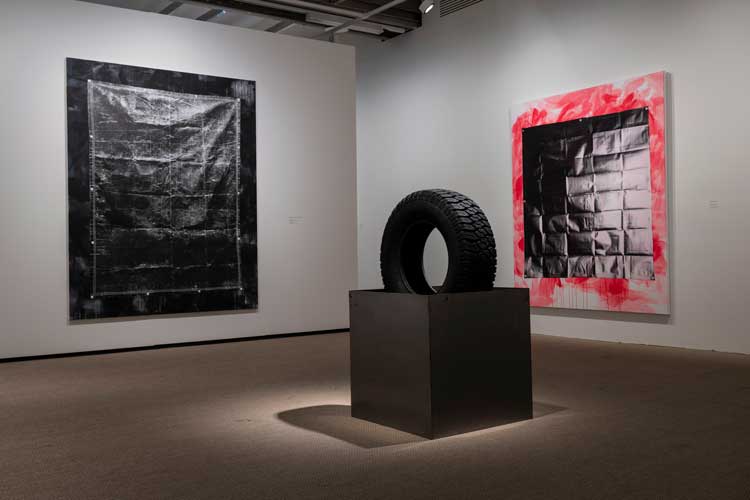
In a nearby antechamber, Einarsson has installed a video of Donald Trump shuffling his body as a crowd of jeans-clad dancers perform for him, a tawdry sight that evokes and burlesques dictatorial military parades and displays of gymnastic prowess. As the curator Dieter Roelstraete wrote in a 2007 catalogue essay, Einarsson refutes the idea of “the art gallery as a place of revelation or change or quasi-religious experience”; instead, it becomes “where the wretched contemporary global condition is sold back to us as spectacle”. Einarsson sometimes makes the interweaving of art and capital visible. A series of paintings of tarpaulin sheets silkscreened over abstract monochrome paintings reference the US government’s Troubled Asset Relief Program (TARP) scheme, used to protect the financial sector during the 2008 crash. Here, a plastic sheet seems to protect and reinforce the sort of art favoured by the capitalist collector, shielding these assets from fallout.
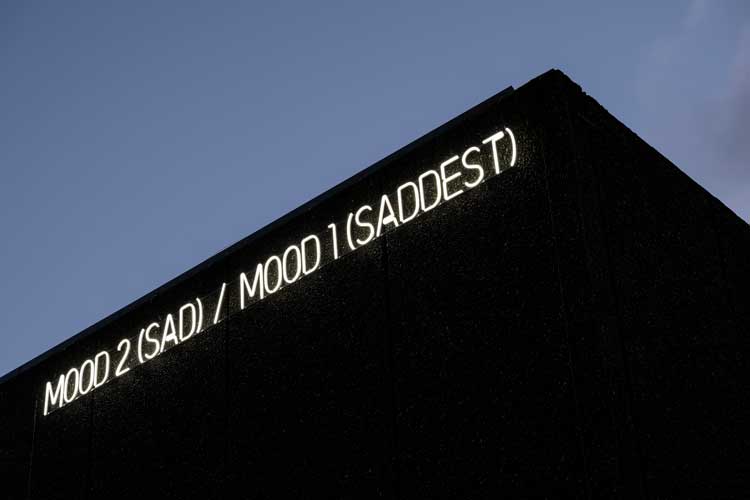
State control is not always aggressive. Mood 2 Sad/Mood 1 Saddest (2026), a neon light installed on the Stenersen’s concrete facade, references the BBC’s pre-prepared playlists for moments of national crisis. Mood 2 was played during Queen Elizabeth’s II illness, followed by Mood 1 after she died. Is the media showing concern for the feelings of distraught royalists, or is it just promoting stability through moderating moods? Similar questions are asked by Distinct Functional Layers Help Establish Hierarchy and Order (2016), which consists of aluminium ultraviolet poles like those made to calm down passengers on the Tokyo Metro. Apparently, these poles have succeeded in reducing suicide attempts on platforms. It is a subtle method of control, but one that ostensibly cares for those it affects – as well as making life easier for train staff and fellow travellers. That they temporarily muffle suicidal thoughts rather address them (or their causes) head-on suggests that there are limits to society’s munificence.
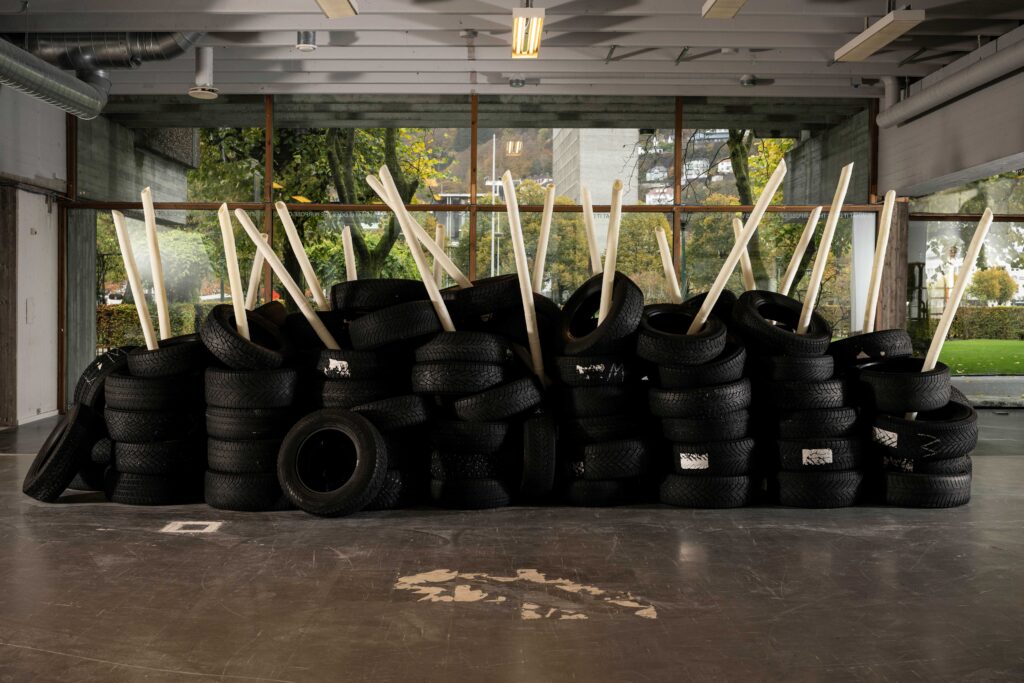
Throughout this concentration of state activity, Einarsson allows for signs of resistance. There are the arches and the protest banners. Barricade (Bergen), a new arrangement of a 2011 work, is a pile of tyres and resin casts of bamboo poles, a reference to the 2010 pro-democracy protests in Bangkok. While this revolution failed, the toolkit remains. Nearby are several works from the How to Hide Things in Public Places series (2013), photographs of sites where objects can be secretly stashed, from under public toilet sinks to pay-phone shelves. Maybe there are still some places off-bound to surveillance. But the overall prognosis is gloomy. An early video work, South of Heaven (2003), captures Norwegians fighting outside a new branch of Ikea for an opening day discount voucher. If this is how we treat each other outside state manipulation, then the good old days are long gone.