Remy Jungerman and Iris Kensmil: The Measurement of Presence – Venice Biennale 2019
Jungerman and Kensmil’s installations for the Dutch Pavilion explore issues of race, identity, culture, history and art history. Here, at the opening of the show, Jungerman talks about the sources of his work in Dutch and European modernism, Winti, an Afro-Surinamese religion, and his Maroon ancestry
Remy Jungerman (b1959, Suriname) and Iris Kensmil (b1970, the Netherlands), both artists of Surinamese heritage, are representing the Netherlands in the 2019 edition of the Venice Biennale. The exhibition, The Measurement of Presence, is curated by Benno Tempel, director of the Gemeentemuseum, The Hague. In solo presentations, the two artists explore current issues of race, identity, culture, history and art history within the context of Dutch and European modernism. They also pay homage to stanley brouwn (the lower case spelling intentional), also a Surinamese artist who was arguably the only non-white artist of renown in the country and paradoxically (and ironically) celebrated for his stance of invisibility.
Iris Kensmil, The New Utopia Begins Here #1, 2019. Acrylic paint on wall, oil on canvas, 500 x 1596 cm. Installation view, Dutch Pavilion, Venice Biennale 2019. Photo: Altripiani Photography.
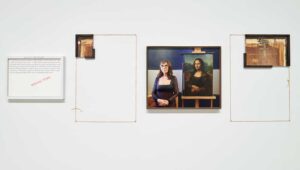
Kensmil’s installation of eight forceful portraits of black women and utopian feminists from Europe (mostly the UK), the US, and the Caribbean are hung against a modernist wall painting that refers to Kazimir Malevich, Piet Mondrian and others. She emblematically introduces female intellectuals and creators of colour into the foreground, inserting them into the primarily white male narratives of modernism.
Iris Kensmil, The New Utopia Begins Here #2, 2019. Ink and acrylic paint on wall, 580 x 390 cm. Installation view, Dutch Pavilion, Venice Biennale 2019. Photo: Altripiani Photography.
With a nod to the pavilion itself, built by Gerrit Rietveld in 1953, the installations – The New Utopia Begins Here #1 and #2 and Beyond the Burden of Representation – Kensmil offers their countervailing presence as antidote, resurrecting voices too often overlooked or misrepresented.
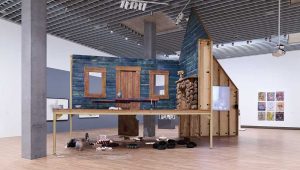
Remy Jungerman. Visiting Deities, 2018-19. Cotton textile, kaolin, dry river clay, water samples, painted wood, 58 table legs (meranti), yarn, mirror and nails, 384 x 138 x 102 in (975 x 350 x 260 cm). Photo: Aatjan Renders.
Jungerman also discusses, overtly and subtly, the complexity and inextricability of these issues. In his two elegant and monumental installations, Promise IV, vertically oriented, and Visiting Deities, horizontally directed, he muses on the routes taken by patterns and motifs, travels that reflect his personal history, the history of his ancestors and that of the Netherlands and its once far-flung dominions (Suriname was still a Dutch colony when Jungerman was born there), of global history and the countless ensuing connections and repercussions.
Remy Jungerman. Promise IV, 2018-19. Painted wood, cotton textile, kaolin, yarn and nails, 52.7 x 53.5 x 193 in (134 x 136 x 490 cm). Photo: Aatjan Renders.
Iris Kensmil and Remy Jungerman The Measurement of Presence Dutch Pavilion at the Venice Biennale, Giardini, Venice 11 May – 24 November 2019
Interview by LILLY WEI Filmed by MARTIN KENNEDY
Remy Jungerman speaking to Studio International at the opening of The Measurement of Presence, Dutch Pavilion, Venice Biennale 2019. Photo: Martin Kennedy.Remy Jungerman speaking to Studio International at the opening of The Measurement of Presence, Dutch Pavilion, Venice Biennale 2019. Photo: Martin Kennedy.Remy Jungerman. Visiting Deities, 2018-19. Cotton textile, kaolin, dry river clay, water samples, painted wood, 58 table legs (meranti), yarn, mirror and nails, 384 x 138 x 102 in (975 x 350 x 260 cm). Photo: Aatjan Renders.Remy Jungerman and Iris Kensmil: The Measurement of Presence, installation view, Dutch Pavilion, Venice Biennale 2019. Photo: Altripiani Photography.Remy Jungerman. Visiting Deities, 2018-19 (detail). Cotton textile, kaolin, dry river clay, water samples, painted wood, 58 table legs (meranti), yarn, mirror and nails, 384 x 138 x 102 in (975 x 350 x 260 cm). Photo: Aatjan Renders.Remy Jungerman. Promise IV, 2018-19 (detail). Painted wood, cotton textile, kaolin, yarn and nails, 52.7 x 53.5 x 193 in (134 x 136 x 490 cm). Photo: Aatjan Renders.Iris Kensmil, The New Utopia Begins Here #1, 2019 (detail). Acrylic paint on wall, oil on canvas, 500 x 1596 cm. Installation view, Dutch Pavilion, Venice Biennale 2019. Photo: Altripiani Photography.Dutch Pavilion, Giardini, Venice, built by Gerrit Rietveld in 1953. Photo: Altripiani Photography.
The 61st international art exhibition is a vast, volatile project that this year, more than most has faced personal loss, political conflict and protests
Recycled jute coffee bags, plastic pizza and a heap of wet wipes – for Iceland’s Pavilion at this year’s Venice Biennale, Birgisdóttir takes a wry look at our consumerist society and the mixed messages we absorb subliminally
His practice centres on journeys exploring the region where he was raised and lives as he attempts to capture the passage between present and past, between remembering and forgetting
Now on show at Turner Contemporary, Sonia Boyce’s immersive multimedia installation, which won the Golden Lion for best national participation at the 59th Venice Biennale, celebrates black female musicians and invites visitors on a journey of self-discovery, with the ultimate goal being freedom
The Barbadian-Scottish artist has used sculpture, film and tapestry for her Scotland in Venice presentation. Her aim, she says, is to show that, through self-compassion and collective care, we can battle racism and colonialism